
 10.1007/s40089-019-0280-8
The comparison of antibacterial activities of CsPbBr3 and ZnO nanoparticles
- Ali Akbari*
 1
1 - Masood Mehrabian2
- Zahra Salimi3
- Sina Dalir3
- Mohammadreza Akbarpour3
- Cellular and Molecular Research Center, Cellular and Molecular Medicine Institute, Urmia University of Medical Sciences, Urmia, IR
- Department of Physics, Faculty of Basic Science, University of Maragheh, Maragheh, IR
- Department of Materials Engineering, Faculty of Engineering, University of Maragheh, Maragheh, IR

Published in Issue 2019-07-25
How to Cite
Akbari, A., Mehrabian, M., Salimi, Z., Dalir, S., & Akbarpour, M. (2019). The comparison of antibacterial activities of CsPbBr3 and ZnO nanoparticles. International Nano Letters, 9(4 (December 2019). https://doi.org/10.1007/s40089-019-0280-8




HTML views: 19
PDF views: 98
Share:





Abstract
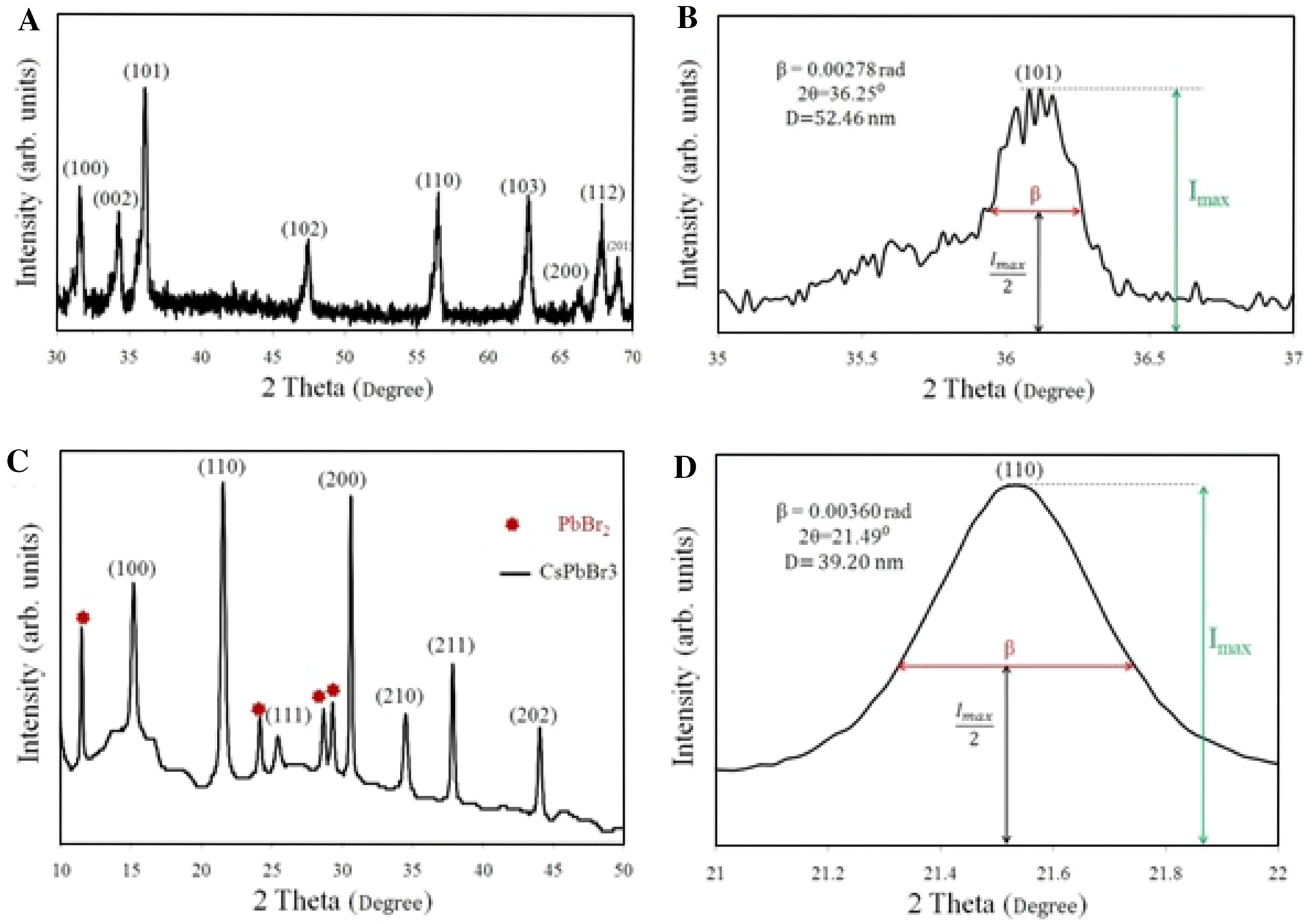
Abstract All-inorganic cesium lead bromide (CsPbBr 3 ) perovskite nanoparticles and ZnO nanoparticles were synthesized. The structure, optical properties and the morphology of synthesized nanoparticles were fully characterized using X-ray diffraction (XRD), UV/Vis spectroscopy and transition electron microscopy (TEM). A comparative study was carried out to investigate the antibacterial activity of ZnO and CsPbBr 3 perovskite nanoparticles toward Gram-negative, rod-shaped Escherichia coli O157:H7 bacteria cells. Experimental results showed that the antibacterial activity of CsPbBr 3 nanoparticles was better than that of ZnO nanoparticles.Keywords
- CsPbBr3 perovskite nanoparticles,
- ZnO nanoparticles,
- Antibacterial activity,
- E. coli
References
- Santhosh et al. (2016) Role of nanomaterials in water treatment applications: a review (pp. 1116-1137) https://doi.org/10.1016/j.cej.2016.08.053
- Sahoo, S.K., Misra, R., Parveen, S.: Nanoparticles: a boon to drug delivery, therapeutics, diagnostics and imaging. In: Nanomedicine in Cancer, pp. 73–124. Pan Stanford (2017)
- Peters et al. (2016) Nanomaterials for products and application in agriculture, feed and food (pp. 155-164) https://doi.org/10.1016/j.tifs.2016.06.008
- Sirelkhatim et al. (2015) Review on zinc oxide nanoparticles: antibacterial activity and toxicity mechanism (pp. 219-242) https://doi.org/10.1007/s40820-015-0040-x
- Ghasemi et al. (2017) CuO and Ag/CuO nanoparticles: Biosynthesis and antibacterial properties (pp. 78-82) https://doi.org/10.1016/j.matlet.2017.02.111
- Qi et al. (2017) Review on the improvement of the photocatalytic and antibacterial activities of ZnO (pp. 792-820) https://doi.org/10.1016/j.jallcom.2017.08.142
- Iqbal et al. (2018) Facile synthesis of ZnO nanosheets: Structural, antibacterial and photocatalytic studies (pp. 59-63) https://doi.org/10.1016/j.matlet.2018.04.078
- Noh et al. (2013) Chemical management for colorful, efficient, and stable inorganic–organic hybrid nanostructured solar cells (pp. 1764-1769) https://doi.org/10.1021/nl400349b
- Du et al. (2017) High-quality CsPbBr 3 perovskite nanocrystals for quantum dot light-emitting diodes (pp. 10391-10396) https://doi.org/10.1039/C6RA27665B
- Habibi and Karimi (2014) Preparation, characterization, and application of zinc oxide nanoparticles by sol-gel pyrrolysis method: Influence of annealing temperature on crystalline phases (pp. 1291-1298) https://doi.org/10.1080/15533174.2013.801856
- Dobrucka and Długaszewska (2016) Biosynthesis and antibacterial activity of ZnO nanoparticles using Trifolium pratense flower extract (pp. 517-523) https://doi.org/10.1016/j.sjbs.2015.05.016
- Akhtar et al. (2012) Zinc oxide nanoparticles selectively induce apoptosis in human cancer cells through reactive oxygen species
- Shekhirev et al. (2017) Synthesis of cesium lead halide perovskite quantum dots (pp. 1150-1156) https://doi.org/10.1021/acs.jchemed.7b00144
- Patterson (1939) The Scherrer formula for X-ray particle size determination https://doi.org/10.1103/PhysRev.56.978
- Bhuyan et al. (2015) A comparative study of pure and copper (Cu)-doped ZnO nanorods for antibacterial and photocatalytic applications with their mechanism of action https://doi.org/10.1007/s11051-015-3093-3
- Tumuluri et al. (2014) Band gap determination using Tauc’s plot for LiNbO3 thin films (pp. 3353-3356)
- Jing et al. (2017) Surface passivation of mixed-halide perovskite CsPb (Br x I 1− x) 3 nanocrystals by selective etching for improved stability (pp. 7391-7396) https://doi.org/10.1039/C7NR01287J