
 10.1007/s40089-016-0181-z
Phytotoxicity of Ag nanoparticles prepared by biogenic and chemical methods
- Rupasree Choudhury
 1
1 - Manna Majumder1
- Dijendra Nath Roy2
- Srijita Basumallick1
- Tarun Kumar Misra*1
- Department of Chemistry, National Institute of Technology, Agartala, Tripura, 799046, IN
- Department of Bioengineering, National Institute of Technology, Agartala, Tripura, 799046, IN

Published in Issue 2016-06-25
How to Cite
Choudhury, R., Majumder, M., Roy, D. N., Basumallick, S., & Misra, T. K. (2016). Phytotoxicity of Ag nanoparticles prepared by biogenic and chemical methods. International Nano Letters, 6(3 (September 2016). https://doi.org/10.1007/s40089-016-0181-z




HTML views: 40
PDF views: 134
Share:





Abstract
Abstract
Silver nanoparticles (Ag NPs) are now widely used as antibacterial and antifungal materials in different consumer products. We report here the preparation of Ag NPs by neem leaves extract (
Azadirachta
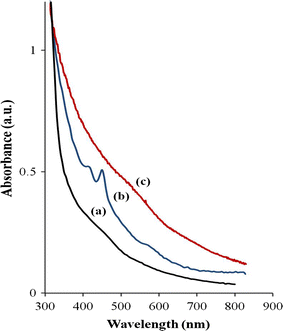
) reduction and trisodium citrate–sodium borohydride reduction methods, and study of their phytotoxicity. The nanoparticles were characterized by UV–Vis spectroscopy, FTIR, and atomic force microscopy (AFM) techniques. Both neem-coated and citrate-coated Ag NPs exhibit surface plasmon around 400 nm, and their average sizes measured by AFM are about 100 and 20 nm, respectively. Antibacterial and antifungal activities of these nanomaterials have been studied by simple pea seed germination and disk diffusion methods. It has been observed from the growth of root and shoot, citrate-coated Ag NPs significantly affect seedling growth, but neem-coated Ag NPs exhibit somehow mild toxicity toward germination process due to the nutrient supplements from neem. On the other hand, antifungal activity of neem-coated Ag NPs has been found much higher than that of citrate-coated Ag NPs due to the combined effects of antifungal activity of neem and Ag NPs. Present research primarily indicates a possible application of neem-coated Ag NPs as a potential fungicide.
Keywords
- Ag nanoparticles,
- Neem (Azadirachta indica),
- Seed germination,
- Antifungal effect
References
- Abboud et al. (2013) 3(84) (pp. 1-7)
- Tripathy et al. (2010) Process variables in biomimetic synthesis of silver nanoparticles by aqueous extract of Azadirachta indica (Neem) leaves (pp. 237-246) https://doi.org/10.1007/s11051-009-9602-5
- Mazumdar (2014) The impact of silver nanoparticles on plant biomass and chlorophyll content 4(7) (pp. 12-20)
- Dietz and Herth (2011) Plant nanotoxicology (pp. 582-589) https://doi.org/10.1016/j.tplants.2011.08.003
- Klein, DA: Disposition and environmental impact of silver iodide in the National Hail Research Experiment: final report submitted to the National Center for Atmospheric Research, Publisher, Colorado State University (1978)
- Farkhanda et al. (2012) Chemical analysis and comparison of antitermitic activity of essential oils of neem (Azadirachta indica), vetiver (Vetiveria zizanioides) and mint (Mentha arvensis) against Heterotermesindicola (Wasmann) from Pakistan 24(5) (pp. 2069-2072)
- Vinoth et al. (2012) Phytochemical analysis and antibacterial activity of azadirachta indica a juss 2(3) (pp. 50-55)
- James et al. (1974) The temporal organization of the endocrine events underlying pupation of the tobacco hornworm (pp. 371-382)
- Dai et al. (1999) Extraction and colorimetric determination of Azadirachtin-related limonoids in neem seed kernel 47(9) (pp. 3738-3742) https://doi.org/10.1021/jf990227h
- Sharma et al. (2003) An efficient method for the purification and characterization of nematicidal azadirachtins A, B, and H, using MPLC and ESIMS (pp. 3966-3972) https://doi.org/10.1021/jf0342167
- Khan et al. (2012) Shape-directing role of cetyltrimethylammonium bromide in the green synthesis of Ag-nanoparticles using neem (Azadirachta indica) leaf extract (pp. 229-234) https://doi.org/10.1016/j.colsurfb.2012.03.002
- Alves et al. (2009) Chromatographic evaluation and antimicrobial activity of Neem (Azadirachta indica A. Juss., Meliaceae) leaves hydroalcoholic extracts, Brazilian 19(2B) (pp. 510-515)
- Lokanadhan et al. (2012) Neem products and their agricultural applications (pp. 72-76)
- Pankaj et al. (2011) Review on neem (Azadirachta indica): thouasand problem one solution 2(12) (pp. 97-102)
- Xiu et al. (2011) Differential effect of common ligands and molecular oxygen on antimicrobial activity by silver nanoparticles versus silver ions (pp. 9003-9008) https://doi.org/10.1021/es201918f
- Ogbuewu et al. (2011) The growth importance of Neem (Azadirachta indica A. Juss) in agriculture, industry, medicine and environment: a review 5(3) (pp. 230-245) https://doi.org/10.3923/rjmp.2011.230.245
- Yin et al. (2012) Effects of silver nanoparticle exposure on germination and early growth of eleven wetland plants 7(10) (pp. e47674(1)-e47674(7)) https://doi.org/10.1371/journal.pone.0047674
- Lin and Xing (2007) Pytotoxicity of nanoparticles: inhibition of seed germination and root growth (pp. 243-250) https://doi.org/10.1016/j.envpol.2007.01.016
- Prabhu and Poulose (2012) Silver nanoparticles: mechanism of antimicrobial action, synthesis, medical applications and toxicity effects 2(32) (pp. 1-10)
- Namratha and Monica (2013) Synthesis of silver nanoparticles using Azadirachta indica (neem) extract and usage in water purification 3(4) (pp. 170-174)
- Gavhane et al. (2012) Synthesis of silver nanoparticles using extract of neem leaf and triphala and evaluation of their antimicrobial activities 3(3) (pp. 88-100)
- Tripathy et al. (2009) Anti bacterial application of silver nanoparticles synthesized by aqueous extract of Azadirachta Indica (neem) leaves (pp. 93-98) https://doi.org/10.1166/jbn.2009.038
- Lee et al. (2010) The citrate-mediated shape evolution of transforming photomorphic silver nanoparticles (pp. 7807-7809) https://doi.org/10.1039/c0cc02580a
- Ahmed et al. (2013) Phytotoxicity of silver nanoparticles on Vicia faba seedlings 6(12) (pp. 148-156)
- Wierzbicka and Obidzinska (1998) The effect of lead on seed inhibition and germination in different plant species (pp. 155-171) https://doi.org/10.1016/S0168-9452(98)00138-1
- Hans (1999) Bioaccumulation and toxicity of silver compounds: a review 18(1) (pp. 89-108) https://doi.org/10.1002/etc.5620180112
- Slade and Pegg (1993) The effect of silver and other metal ions on the in vitro growth of root-rotting Phytophthora and other fungal species 122(2) (pp. 233-251) https://doi.org/10.1111/j.1744-7348.1993.tb04030.x
- Yin et al. (2012) Effects of silver nanoparticle exposure on germination and early growth of eleven wetland plants 7(10) https://doi.org/10.1371/journal.pone.0047674
- Yin et al. (2011) More than the ions: the effects of silver nanoparticles on lolium multiflorum 45(6) (pp. 2360-2367) https://doi.org/10.1021/es103995x
- Cheng et al. (2011) Toxicity reduction of polymer-stabilized silver nanoparticles by sunlight 115(11) (pp. 4425-4432) https://doi.org/10.1021/jp109789j
- Sharma et al. (2012) Silver nanoparticle-mediated enhancement in growth and antioxidant status of Brassica juncea (pp. 2225-2233) https://doi.org/10.1007/s12010-012-9759-8
- Das et al. (2015) Effect of N-acetyl cysteine coated CdS:Mn/ZnS quantum dots on seed germination and seedling growth of snow pea (Pisumsativum L.): imaging and spectroscopic studies (pp. 203-212) https://doi.org/10.1039/C4EN00198B