
 10.1007/s40089-015-0139-6
Preparation and characterization of Mn-doped ZnS nanoparticles
- L. Bruno Chandrasekar*
 1
1 - R. Chandramohan2
- R. Vijayalakshmi3
- S. Chandrasekaran4

Published in Issue 2015-02-01




HTML views: 73
PDF views: 129





Abstract
Abstract
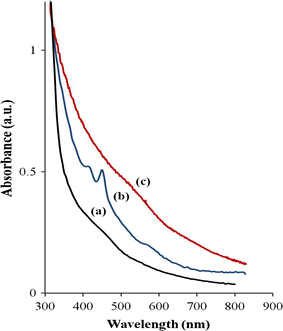
Mn-doped ZnS nanoparticles are synthesized by simple and cost effective chemical precipitation method. This diluted magnetic semiconductor is characterized by various techniques such as energy dispersive X-ray analysis, scanning electron microscopy, X-ray diffraction, photoluminescence and UV–Vis spectroscopy. High purity of the sample is confirmed by energy dispersive X-ray analysis. Sub-micrometer nanocrystals are observed using scanning electron microscope. Hexagonal phase of the material is confirmed by X-ray diffraction studies, and the micro-structural properties such as grain size, strain, dislocation density and texture coefficient are examined. High value of texture coefficient indicates the well-crystalline nature of the material. The band gap, Urbach energy and steepness parameter are calculated from the absorption spectrum. The band gap is also calculated from photoluminescence. The Stokes’s shift, Urbach energy and steepness parameter are reported in the case of Mn-doped ZnS for the first time.
Keywords
- Nanoparticles,
- Diluted magnetic semiconductor,
- Micro-structural,
- Urbach energy
References
- Sugunan et al. (2006) https://doi.org/10.1007/s10971-006-6969-y
- Yamamoto et al. (2002) https://doi.org/10.1002/1521-3951(200201)229:1<371::AID-PSSB371>3.0.CO;2-S
- Ragam M., Prem Ananth K., Parasakthi P., Thiribuvan M., Prema K., Karuppaian R., Sankar N., Ramachandran K., J. Nano. Electron. Phys.
- 3
- , 111 (2011)
- L. Juanjuan, X. Guangming, Progr. Chem.
- 22
- , 861 (2010)
- Chen et al. (2001) https://doi.org/10.1016/S0040-6090(01)00912-9
- Amaranatha Reddy D., Mural G., Vijayalakshmi R.P., Reddy B.K., Sreedhar B., Cryst. Res. Technol.
- 46
- , 731 (2011)
- Jeon and Kang (2001) https://doi.org/10.1142/S0219581X02000565
- Khosic et al. (1995) https://doi.org/10.1063/1.114298
- Soni et al. (2009) Electrical and optical characteristics of Ni doped ZnS clusters https://doi.org/10.1016/j.matlet.2008.12.052
- Bruno Chandrasekar et al. (2013) 8(4) https://doi.org/10.1166/jno.2013.1481
- Zinki and Verma (2008) https://doi.org/10.1007/s10853-008-2818-4
- Bruno Chandrasekar L., Chandramohan R., Vijayalakshmi R., J. Nanoeng. Nanomanu,
- 3
- (3), 253 (2013)
- Amirjani et al. (2014) https://doi.org/10.1016/j.colsurfa.2013.12.033
- Amirjani et al. (2014) https://doi.org/10.1007/s40089-014-0108-5
- Barreau N., Marsillac S., Bernede J.C., Ben Nasrallah T., Belgacem S., Phys. Stat. Sol. A
- 184
- , 179 (2001)
- Sahraei R., Daneshfar A., Goudarzi A., Abbasi S., Majles Ara M.H., Rahimi F., J. Mater. Sci Mater. Electron
- 24
- , 260 (2013)
- Yakuphanoglu et al. (2007) 9(7)
- Ilican et al. (2008) 10(10)