
 10.1007/s40089-014-0095-6
Investigations of CO2, CH4 and N2 physisorption in single-walled silicon carbon nanotubes using GCMC simulation
- Mohammad Ali Bagherinia*
 1
1 - Muhammad Shadman2
- Department of Chemistry, Faculty of Science, Lahijan Branch, Islamic Azad University, Lahijan, IR
- Department of Chemistry, Faculty of Science, University of Zanjan, Zanjan, IR

Published in Issue 2014-02-25
How to Cite
Bagherinia, M. A., & Shadman, M. (2014). Investigations of CO2, CH4 and N2 physisorption in single-walled silicon carbon nanotubes using GCMC simulation. International Nano Letters, 4(1 (March 2014). https://doi.org/10.1007/s40089-014-0095-6




HTML views: 25
PDF views: 132
Share:





Abstract
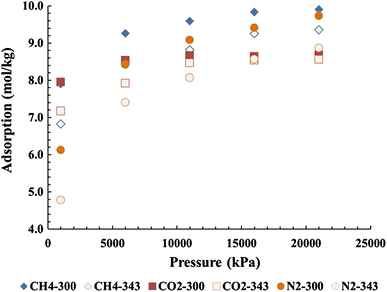
Abstract In this paper, we report N 2 , CH 4 and CO 2 adsorption in single-walled silicon carbon nanotubes (SiCNTs) using grand canonical Monte-Carlo and calculate the isosteric heat of gas adsorption. The results demonstrate that at ambient temperature and high pressure, gas adsorption in these nanotubes is in the order of CO 2 > CH 4 > N 2 and nanotubes’ order is (10,10) < (20,20) < (40,40), while this order of adsorptivity of nanotubes will be inverted for N 2 when the pressure is very low. Then, we fit our simulation results to Langmuir and Langmuir–Freundlich equations to illustrate the mechanism of gas adsorptivity. The fitting exhibits that the simulation data obtained are very close to Langmuir–Freundlich behavior, which emphasizes that the dominant adsorptivity has occurred in multi-layer adsorption. Moreover, the comparison between our simulation results and other reports, which studied these gases’ adsorption on different nanoporous materials, experimentally and theoretically, is presented to illustrate that SiCNTs still have the best gas adsorptivity ability at ambient temperature and low/high pressure.Keywords
- GCMC,
- Adsorption,
- SiC nanotube,
- Molecular simulation
References
- Iijima (1991) Helical microtubules of graphitic carbon (pp. 56-58) https://doi.org/10.1038/354056a0
- Pham-Huu et al. (2001) The first preparation of silicon carbide nanotubes by shape memory synthesis and their catalytic potential (pp. 400-410) https://doi.org/10.1006/jcat.2001.3216
- Sun et al. (2002) Formation of silicon carbide nanotubes and nanowires via reaction of silicon (from disproportionation of silicon monoxide) with carbon nanotubes (pp. 14464-14471) https://doi.org/10.1021/ja0273997
- Malek and Sahimi (2010) Molecular dynamics simulations of adsorption and diffusion of gases in silicon-carbide nanotubes https://doi.org/10.1063/1.3284542
- Huang et al. (2007) Simulations of binary mixture adsorption of carbon dioxide and methane in carbon nanotubes: temperature, pressure, and pore size effects (pp. 11912-11920) https://doi.org/10.1021/jp067226u
- Basu et al. (2011) MOF-containing mixed-matrix membranes for CO2/CH4 and CO2/N2 binary gas mixture separations (pp. 31-40) https://doi.org/10.1016/j.seppur.2011.06.037
- Peng et al. (2009) Grand canonical Monte Carlo simulation of methane–carbon dioxide mixtures on ordered mesoporous carbon CMK-1 (pp. 50-60) https://doi.org/10.1016/j.seppur.2009.04.005
- Zhang et al. (2012) Computational study of adsorption and separation of CO2, CH4 and N2 by an rht-type metal–organic framework (pp. 12122-12133) https://doi.org/10.1021/la302537d
- Mishra et al. (2012) Adsorption of CO2, CO, CH4 and N2 on a zinc based metal organic framework (pp. 124-130) https://doi.org/10.1016/j.seppur.2011.09.041
- Yi et al. (2013) Adsorption separation of CO2, CH4, and N2 on microwave activated carbon (pp. 635-642) https://doi.org/10.1016/j.cej.2012.11.050
- Karra and Walton (2010) Molecular simulations and experimental studies of CO2, CO, and N2 adsorption in metal-organic frameworks (pp. 15735-15740) https://doi.org/10.1021/jp105519h
- Billemont et al. (2013) Adsorption of carbon dioxide, methane, and their mixtures in porous carbons: effect of surface chemistry, water content, and pore disorder (pp. 3328-3338) https://doi.org/10.1021/la3048938
- Harris and Yung (1995) Carbon dioxide’s liquid–vapor coexistence curve and critical properties as predicted by a simple molecular model (pp. 12021-12024) https://doi.org/10.1021/j100031a034
- Shadman and Ahadi (2011) Argon and neon storages in single-wall boron nitride nanotubes: a Grand Canonical Monte-Carlo Study (pp. 1-13)
- Ahadi et al. (2012) Hydrogen adsorption capacities of multi-walled boron nitride nanotubes and nanotube arrays: a grand canonical Monte Carlo study (pp. 2981-2991) https://doi.org/10.1007/s00894-011-1316-9
- Menon et al. (2004) Structure and stability of SiC nanotubes (pp. 115322-115325) https://doi.org/10.1103/PhysRevB.69.115322
- Li et al. (2007) Fullerene coalescence into metallic hetero structures in boron nitride nanotubes: a molecular dynamics study (pp. 3709-3715) https://doi.org/10.1021/nl0720410
- Shadman et al. (2009) Ab initio interaction potential of methane and nitrogen (pp. 237-242) https://doi.org/10.1016/j.cplett.2008.11.045
- Binder and Heermann (2002) Springer https://doi.org/10.1007/978-3-662-04685-2
- Gupta et al. (2003) Object-oriented programming paradigms for molecular modeling (pp. 29-46) https://doi.org/10.1080/0892702031000065719
- Mani-Biswas and Cagin (2012) Insights from theoretical calculations on structure, dynamics, phase behavior and hydrogen sorption in nanoporous metal organic frameworks (pp. 42-56) https://doi.org/10.1016/j.comptc.2012.02.023