
 10.1007/s40089-014-0097-4


Published in Issue 2014-06-19
How to Cite
Abjameh, R., Moradi, O., & Amani, J. (2014). The study of synthesis and functionalized single-walled carbon nanotubes with amide group. International Nano Letters, 4(2 (June 2014). https://doi.org/10.1007/s40089-014-0097-4




HTML views: 58
PDF views: 104
Share:





Abstract
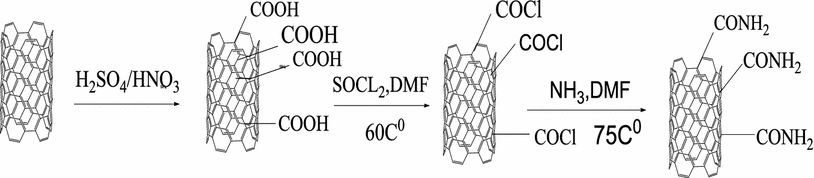
Abstract This study includes of syntheses and characteristics functionalized single-walled carbon nanotubes (SWCNTs) with amide group using thionyl chloride and NH 3 . First SWCNTs in H 2 SO 4 and HNO 3 , solved and the solution obtained ultrasound was to reach the equilibrium temperature to functionalization of carboxylate single-walled carbon nanotubes (SWCNT-COOH). Then using thionyl chloride with (SOCl 2 ) and DMF the mixture was refluxing. SWCNT-COCl was obtained from the previous step with ammonia (NH 3 ), and DMF as solvent, and the mixture was refluxing. The black solid obtained was placed overnight in the oven to dry. Carbon nanotubes were expected at this stage to have a functional group CONH 2 . All new chemical bonding products were identified by FT-IR and observations using scanning electron microscopy (SEM) were confirmed. SWCNT-COOH functionalized carbon nanotubes have a relatively smooth surface and thin Stowe and the SEM image of the SWCNT-NH 2 ; a thin layer of hope is clearly placed on the surface of SWCNT-COOH and its diameter is increased.Keywords
- Single-walled carbon nanotubes (SWCNTs),
- Amide,
- Chemical modified
References
- Yang et al. (2004) Synthesis and photoconductivity study of carbon nanotube bonded by tetrasubstituted amino manganese phthalocyanine (pp. 73-78) https://doi.org/10.1016/j.mseb.2003.09.001
- Singhal et al. (2012) Carbon nanotubes: amino functionalization and its application in the fabrication of Al-matrix composites (pp. 254-263) https://doi.org/10.1016/j.powtec.2011.10.013
- Iijima (1991) Helical microtubules of graphitic carbon (pp. 56-58) https://doi.org/10.1038/354056a0
- Li et al. (2010) Amino-functionalized carbon nanotubes as nucleophilic scavengers in solution phase combinatorial synthesis (pp. 1434-1436) https://doi.org/10.1016/j.tetlet.2010.01.022
- Vukovi´ et al. (2011) Removal of lead from water by amino modified multi-walled carbon nanotubes (pp. 855-865) https://doi.org/10.1016/j.cej.2011.08.036
- Chen and Gu (2012) Microwave assisted fast fabrication of Fe3O4-MWCNTs nanocomposites and their, application as MRI contrast agents (pp. 49-51) https://doi.org/10.1016/j.matlet.2011.09.042
- Zhang et al. (2009) Amino functionalization and characteristics of multi-walled carbon nanotube/poly(methyl methacrylate) nanocomposite (pp. 316-318) https://doi.org/10.1016/j.diamond.2008.08.005
- Chen et al. (2010) Amino group introduction onto multiwall carbon nanotubes by NH3/Ar plasma treatment (pp. 939-948) https://doi.org/10.1016/j.carbon.2009.10.033
- Qin et al. (2004) Polymer brushes on single-walled carbon nanotubes by atom transfer radical polymerization of n-butyl methacrylate (pp. 170-176) https://doi.org/10.1021/ja037937v
- Coleman et al. (2006) Small but strong: a review of the mechanical properties of carbon nanotube–polymer composites (pp. 1624-1652) https://doi.org/10.1016/j.carbon.2006.02.038
- Cadek et al. (2004) Reinforcement of polymers with carbon nanotubes: the role of nanotube surface area (pp. 353-356) https://doi.org/10.1021/nl035009o
- Tseng et al. (2007) Functionalizing carbon nanotubes by plasma modification for the preparation of covalent-integrated epoxy composites (pp. 308-315) https://doi.org/10.1021/cm062277p
- Eo et al. (2008) Poly(2,5 benzoxazole)/carbon nanotube composites via in situ polymerization of 3-amino-4-hydroxybenzoic acid hydrochloride in a mild poly(phosphoric acid) (pp. 1603-1612) https://doi.org/10.1016/j.eurpolymj.2008.03.024
- Nakamura et al. (2008) Photochemical modification of single-walled carbon nanotubes with amino functionalities and their metal nanoparticles attachment (pp. 559-562) https://doi.org/10.1016/j.diamond.2007.08.029
- Duan et al. (2012) Halloysite nanotube-Fe3O4 composite for removal of methyl violet from aqueous solutions (pp. 46-52) https://doi.org/10.1016/j.desal.2012.02.022
- Theodore et al. (2011) Influence of functionalization on properties of MWCNT–epoxy nanocomposites (pp. 1192-1200) https://doi.org/10.1016/j.msea.2010.09.095
- Datsyuk et al. (2008) Chemical oxidation of multi-walled carbon nanotubes (pp. 833-840) https://doi.org/10.1016/j.carbon.2008.02.012
- Murugesan et al. (2011) Amino-functionalized and acid treated multi-walled carbon nanotubes as supports for electrochemical oxidation of formic acid (pp. 266-274) https://doi.org/10.1016/j.apcatb.2010.07.038
- Dong et al. (2008) Electrochemical behaviors of amino acids at multiwall carbon nanotubes and Cu2O modified carbon paste electrode (pp. 199-204) https://doi.org/10.1016/j.ab.2008.05.011
- Zardini et al. (2012) Enhanced antibacterial activity of amino acids-functionalized multi walled carbon nanotubes by a simple method (pp. 196-202) https://doi.org/10.1016/j.colsurfb.2011.11.045
- Ganji and Bakhshandeh (2011) Functionalized single-walled carbon nanotubes interacting with glycine amino acid: DFT study (pp. 4453-4459) https://doi.org/10.1016/j.physb.2011.09.006
- Yen et al. (2011) The enhancement of neural growth by amino-functionalization on carbon nanotubes as a neural electrode (pp. 4124-4132) https://doi.org/10.1016/j.bios.2011.04.003
- Deng et al. (2012) Solvothermal in situ synthesis of Fe3O4-multi-walled carbon nanotubes with enhanced heterogeneous Fenton-like activity (pp. 3369-3376) https://doi.org/10.1016/j.materresbull.2012.07.021
- Li et al. (2014) Electrochemically enhanced adsorption of nonylphenol on carbon nanotubes: kinetics and isotherms study (pp. 159-164) https://doi.org/10.1016/j.jcis.2013.10.021
- Aguayo-Villarreal et al. (2013) Role of acid blue 25 dye as active site for the adsorption of Cd2+ and Zn2+ using activated carbons (pp. 459-466) https://doi.org/10.1016/j.dyepig.2012.08.027
- Bandaru et al. (2013) Enhanced adsorption of mercury ions on thiol derivatized single wall carbon nanotubes (pp. 534-541) https://doi.org/10.1016/j.jhazmat.2013.07.076
- Chen et al. (2008) Mechanical and thermal properties of epoxy nanocomposites reinforced with amino-functionalized multi-walled carbon nanotubes (pp. 236-242) https://doi.org/10.1016/j.msea.2008.04.044
- Liu et al. (2009) Preparation and properties of chitosan/carbon nanotube nanocomposites using poly(styrene sulfonic acid)-modified CNTs (pp. 232-238) https://doi.org/10.1016/j.carbpol.2008.10.021
- Wanga et al. (2011) Hybridization biosensor based on the covalent immobilization of probe DNA on chitosan-mutiwalled carbon nanotubes nanocomposite by using glutaraldehyde as an arm linker (pp. 599-605) https://doi.org/10.1016/j.snb.2011.02.004
- Mazov et al. (2014) Thermal conductivity of polypropylene-based composites with multiwall carbon nanotubes with different diameter and morphology (pp. S440-S442) https://doi.org/10.1016/j.jallcom.2012.10.167
- Huang and Rodrigue (2014) The effect of carbon nanotube orientation and content on the mechanical properties of polypropylene based composites (pp. 653-663) https://doi.org/10.1016/j.matdes.2013.10.039
- Hollerer (2014) Numerical validation of a concurrent atomistic-continuum multiscale method and its application to the buckling analysis of carbon nanotubes (pp. 220-246) https://doi.org/10.1016/j.cma.2013.11.014
- Mohammadi and Khoshnevisan (2014) Doping effects of Co on exo-hydrogenated narrow single-walled carbon nanotubes (pp. 2087-2092) https://doi.org/10.1016/j.ijhydene.2013.11.036
- Ling et al. (2014) Molecular dynamics simulations of thermal conductivity of carbon nanotubes: resolving the effects of computational parameters (pp. 954-964) https://doi.org/10.1016/j.ijheatmasstransfer.2013.11.065
- Ji et al. (2014) Azide functionalization of carbon nanotubes by electrochemical oxidation of N3−−− in situ (pp. 292-294) https://doi.org/10.1016/j.cclet.2013.11.023
- Das et al. (2014) Carbon nanotube membranes for water purification: a bright future in water desalination (pp. 97-109) https://doi.org/10.1016/j.desal.2013.12.026
- Khan et al. (2014) Dual nature, self oxidized poly(o-anisidine) functionalized multiwall carbon nanotubes composite: preparation, thermal and electrical studies (pp. 451-456) https://doi.org/10.1016/j.compositesb.2013.10.059
- Mukherjee et al. (2014) Improved properties of hydroxyapatite–carbon nanotube biocomposite: mechanical, in vitro bioactivity and biological studies (pp. 5635-5643) https://doi.org/10.1016/j.ceramint.2013.10.158
- Sheng et al. (2014) Determination of 5,7-dihydroxychromone and luteolin in peanut hulls by capillary electrophoresis with a multiwall carbon nanotube/poly (ethylene terephthalate) composite electrode (pp. 555-561) https://doi.org/10.1016/j.foodchem.2013.08.118
- Mahapatra et al. (2014) Tailored and strong electro-responsive shape memory actuation in carbon nanotube-reinforced hyperbranched polyurethane composites (pp. 384-390) https://doi.org/10.1016/j.snb.2013.12.006
- Mendoza et al. (2014) Effect of the reagglomeration process of multi-walled carbon nanotubes dispersions on the early activity of nanosilica in cement composites (pp. 550-557) https://doi.org/10.1016/j.conbuildmat.2013.12.084
- Kaur et al. (2014) Conjugation of chlorinated carbon nanotubes with quantum dots for electronic applications (pp. 165-167) https://doi.org/10.1016/j.matlet.2013.11.130
- Das and Satapathy (2014) Designing tough and fracture resistant polypropylene/multi wall carbon nanotubes nanocomposites by controlling stereo-complexity and dispersion morphology (pp. 712-726) https://doi.org/10.1016/j.matdes.2013.08.067
- DeValve and Pitchumani (2014) Analysis of vibration damping in a rotating composite beam with embedded carbon nanotubes (pp. 289-296) https://doi.org/10.1016/j.compstruct.2013.12.007
- Moaseri et al. (2014) Two-fold enhancement in tensile strength of carbon nanotube–carbon fiber hybrid epoxy composites through combination of electrophoretic deposition and alternating electric field (pp. 774-785) https://doi.org/10.1016/j.ijsolstr.2013.11.007
- Dong et al. (2014) Interaction between edge dislocations and amorphous interphase in carbon nanotubes reinforced metal matrix nanocomposites incorporating interface effect (pp. 1149-1163) https://doi.org/10.1016/j.ijsolstr.2013.12.011
- Shazed et al. (2014) Effect of fibre coating and geometry on the tensile properties of hybrid carbon nanotube coated carbon fibre reinforced composite (pp. 660-669) https://doi.org/10.1016/j.matdes.2013.08.063
- Ghaedi et al. (2014) Multiwalled Carbon nanotube impregnated with bis(5-bromosalicylidene)-1,3-propandiamine for enrichment of Pb2+ ion (pp. 638-643)
- Yang et al. (2014) The assembly of carbon nanotubes by dielectrophoresis: insights into the dielectrophoretic nanotube nanotube interactions (pp. 117-122) https://doi.org/10.1016/j.physe.2013.08.034
- Shah and Batra (2014) In-plane elastic moduli of covalently functionalized single-wall carbon nanotubes (pp. 349-361) https://doi.org/10.1016/j.commatsci.2013.11.018
- Olney et al. (2014) A greenhouse gas silicon microchip sensor using a conducting composite with single walled carbon nanotubes (pp. 545-552) https://doi.org/10.1016/j.snb.2013.10.039
- Huang et al. (2014) Optimization and evaluation of chelerythrine nanoparticles composed of magnetic multiwalled carbon nanotubes by response surface methodology (pp. 378-386) https://doi.org/10.1016/j.apsusc.2013.11.148
- Fan et al. (2014) The role of multiwalled carbon nanotubes (MWCNTs) in the catalytic ozonation of atrazine (pp. 66-76) https://doi.org/10.1016/j.cej.2013.12.023
- Machado et al. (2014) Photodynamic therapy in the cattle protozoan Tritrichomonas foetus cultivated on superhydrophilic carbon nanotube (pp. 180-186) https://doi.org/10.1016/j.msec.2013.12.004
- Siu et al. (2014) Non-covalently functionalized single-walled carbon nanotube for topical siRNA delivery into melanoma (pp. 3435-3442) https://doi.org/10.1016/j.biomaterials.2013.12.079
- Tasaltin and Basarir (2014) Preparation of flexible VOC sensor based on carbon nanotubes and gold nanoparticles (pp. 173-179) https://doi.org/10.1016/j.snb.2013.12.063
- Cabaniss (2011) Forward modeling of metal complexation by NOM. II. Prediction of binding site properties (pp. 3202-3209) https://doi.org/10.1021/es102408w
- Madrakian et al. (2014) Simultaneous determination of tyrosine, acetaminophen and ascorbic acid using gold nanoparticles/multiwalled carbon nanotube/glassy carbon electrode by differential pulse voltammetric method (pp. 451-460) https://doi.org/10.1016/j.snb.2013.11.117
- Derakhshan, M.S., Moradi, O.: The study of thermodynamics and kinetics methyl orange and malachite green by SWCNTs, SWCNT-COOH and SWCNT-NH
- 2
- as adsorbents from aqueous solution. J. Ind. Eng. Chem. (2013). doi:
- 10.1016/j.jiec.2013.11.064
- Veisi et al. (2014) Synthesis of biguanide-functionalized single-walled carbon nanotubes (SWCNTs) hybrid materials to immobilized palladium asnew recyclable heterogeneous nanocatalyst for Suzuki–Miyaura coupling reaction” (pp. 106-113) https://doi.org/10.1016/j.molcata.2013.10.028