
 10.1007/s40089-014-0121-8
Facile synthesis and characterization of magnetic MnFe2O4/CNT nanocomposites
- N. Dehghan-Niarostami
 1
1 - F. Taleshi*2
- A. Pahlavan3
- F. Zabihi3
- M. Ahmadi Taresi2
- Department of Physics, Science and Research Branch, Islamic Azad University, Mazandaran, IR
- Department of Applied Science, Qaemshahr Branch, Islamic Azad University, Qaemshahr, IR
- Department of Physics, Sari Branch, Islamic Azad University, Sari, IR

Published in Issue 2014-09-17
How to Cite
Dehghan-Niarostami, N., Taleshi, F., Pahlavan, A., Zabihi, F., & Ahmadi Taresi, M. (2014). Facile synthesis and characterization of magnetic MnFe2O4/CNT nanocomposites. International Nano Letters, 4(3 (September 2014). https://doi.org/10.1007/s40089-014-0121-8




HTML views: 35
PDF views: 121
Share:





Abstract
Abstract
In this paper, the effects of carbon nanotubes (CNTs) were studied as supports for the synthesis of MnFe
2
O4 nanocomposite. The synthesis of nanocomposite powder MnFe
2
O
4
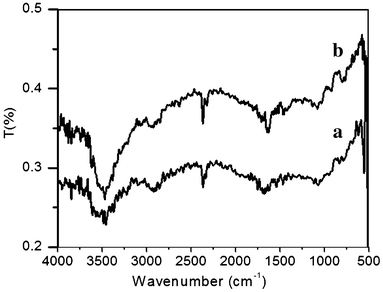
/CNTs was performed by direct precipitation method in aqueous solution. The prepared samples were analyzed by X-ray diffraction, scanning electron microscopy and Fourier transform infrared spectroscopy. The results represent the considerable change in the MnFe
2
O
4
nanoparticle size and also the morphology of MnFe
2
O
4
/CNT nanocomposite powder from agglomerative into nanorod in shape.
Keywords
- Carbon nanotube,
- Nanoparticles,
- Nanocomposite,
- Morphology,
- Direct precipitation
References
- Yuan and Zhang (2001) (pp. 1265-1268) https://doi.org/10.1039/b006994i
- Rana and Misra (2005) (pp. 65-69) https://doi.org/10.1007/s11837-005-0186-y
- Viswanathan, B., Murthy, V.R.K.: Ferrite Materials, Science and Technology, p. 198 (1990)
- Grancharov et al. (2005) (pp. 13030-13035) https://doi.org/10.1021/jp051098c
- Laurent et al. (2008) (pp. 2064-2110) https://doi.org/10.1021/cr068445e
- Li et al. (2011) (pp. 102-108) https://doi.org/10.1016/j.jcis.2011.02.052
- Li, S., Lin, Y., Zhang, B., Nan, C., Wang, Y.: J. Appl. Phys. 105, 056105/1–056105/3 (2009)
- Qiao et al. (2009) (pp. 6274-6293) https://doi.org/10.1039/b902394a
- Han et al. (2009) (pp. 055008-055012) https://doi.org/10.1088/0022-3727/42/5/055008
- Balaji et al. (2002) (pp. 617-620) https://doi.org/10.1016/S0304-8853(01)01043-5
- Lahiri and Sengupta (1995) (pp. 3489-3494) https://doi.org/10.1039/ft9959103489
- Simsa (1979) (pp. 581-587) https://doi.org/10.1002/pssb.2220960211
- Zhao et al. (2010) (pp. 704-709) https://doi.org/10.1016/j.jhazmat.2010.08.096
- Dom et al. (2011) (pp. 470-473) https://doi.org/10.1016/j.ssc.2010.12.034
- Liu et al. (2000) (pp. 1141-1145) https://doi.org/10.1021/jp993552g
- Yang et al. (2007) (pp. 154-156) https://doi.org/10.1016/j.matchemphys.2007.04.050
- Hatanaka et al. (2003) (pp. 7569-7570) https://doi.org/10.1063/1.1558677
- Silva et al. (2004) (pp. 201-204) https://doi.org/10.1016/j.jnoncrysol.2004.08.169
- Sreekumar and Sugunan (2002) (pp. 259-268) https://doi.org/10.1016/S1381-1169(02)00074-2
- Pardeshi and Pawar (2010) (pp. 609-615) https://doi.org/10.1016/j.materresbull.2010.01.011
- Tsoncheva et al. (2010) (pp. 105-109) https://doi.org/10.1016/j.catcom.2010.08.007
- Hou et al. (2010) (pp. 1-7) https://doi.org/10.1016/j.colsurfa.2010.03.016
- Bujoreanu et al. (2000) (pp. 169-174) https://doi.org/10.1016/S0167-577X(00)00162-2
- Chen et al. (2010) (pp. 168-172) https://doi.org/10.1016/j.jallcom.2010.04.072
- Taleshi and Hosseini (2012) https://doi.org/10.1186/2193-8865-3-4
- Ramin, M., Taleshi, F.: Inter. Nano. Letter. 3 doi:
- 10.1186/2228-5326-3-32
- (2013)
- Venkateswarlu, K., Chandra Bose, A., Rameshbabu, N.: Phys. B. 405, 4256–4261 (2010)
- Taleshi and Pahlavan (2014) (pp. 2450-2455) https://doi.org/10.1007/s10854-014-1894-2