
 10.57647/j.ijnd.2025.1603.24
Effect of reinforcements, temperature and defect on mechanical properties of aluminum nanocomposites reinforced with carbon nanotube and graphene: A molecular dynamics study
- Wijdan Qahtan Farhan Al-Humairi

 1
1 - Samrand Rash-Ahmadi*1
- Mortaza Khalilian1

Received: 2024-11-13
Revised: 2024-12-08
Accepted: 2025-01-29
Published in Issue 2025-06-01

This work is licensed under a Creative Commons Attribution 4.0 International License.




PDF views: 279





Abstract
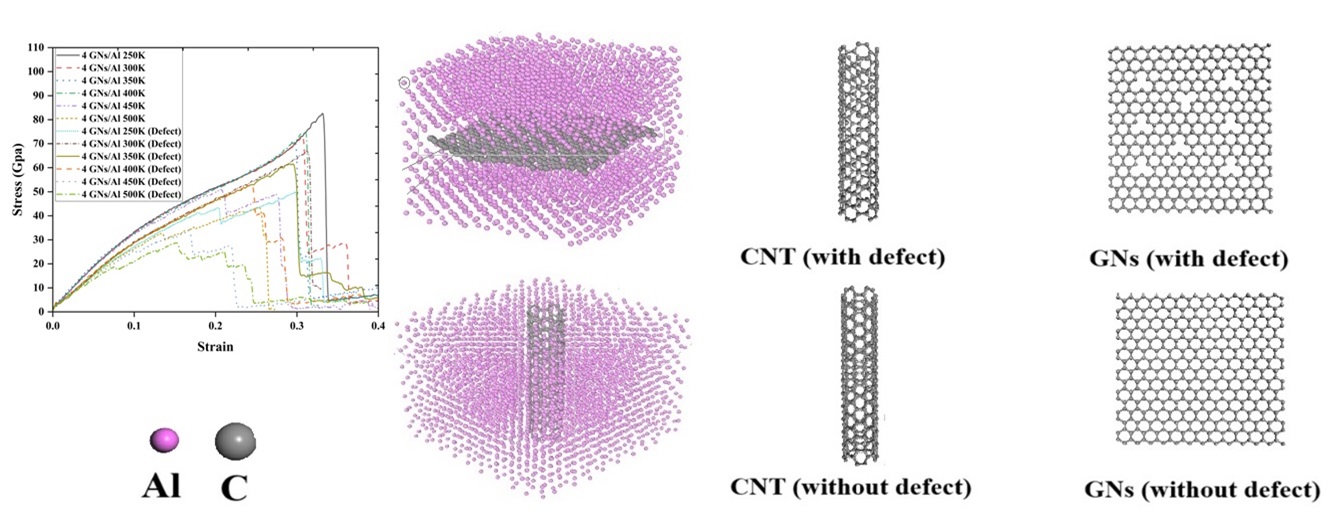
Numerous industries widely utilize aluminum metal because of its excellent properties. Therefore, enhancing the strength and tensile strength of aluminum holds significant importance. In this study, molecular dynamics simulation was used to investigate the effect of increasing the number of graphene nanosheets and carbon nanotubes with defects and without defects in the aluminum matrix under different temperatures. The simulation results show that by adding the number of reinforcements (1 to 4) to the aluminum matrix, the Young's modulus of the nanocomposites improved for graphene nanosheets (88 to 252 GPa) and carbon nanotubes (79 to 138 GPa). Also, the presence of defects in graphene nanosheets and carbon nanotubes reduces Young's modulus and tensile strength of aluminum nanocomposites. In addition, as the temperature of nanocomposites increased (250 to 500 ͦ K), the tensile strength and Young's modulus decreased. The results of this study provide a more comprehensive understanding of the mechanical properties and behavior of aluminum nanocomposites reinforced with several graphene nanoplates and carbon nanotubes.
Keywords
- Aluminum nanocomposites,
- Carbon nanotubes,
- Defects,
- Graphene,
- Mechanical properties,
- Nanocomposites
References
- Ashkenazi D., (2019), How aluminum changed the world: A metallurgical revolution through technological and cultural perspectives. Technol Forecast Soc Change. 143: 101-13. https://doi.org/10.1016/j.techfore.2019.03.011
- Cole G., Sherman A., (1995), Light weight materials for automotive applications. Mater Charact. 35: 3-9. https://doi.org/10.1016/1044-5803(95)00063-1
- Lee HM., Choi SY., Jung A., Ko SH., (2013), Highly conductive aluminum textile and paper for flexible and wearable electronics. Angew Chem. 125: 7872 –7. http://dx.doi.org/10.1002/anie.201301941
- Mancin S., Zilio C., Rossetto L., Cavallini A., (2011), Heat transfer performance of aluminum foams. J Heat Mass Transf. 133: 060904. https://doi.org/10.1115/1.4003451
- de Morais WA., Lima LCR., Junior HDS., de Morais Tavares M., (2020), Improvement of Safety in the use of Aluminum Platforms for Civil Construction. Unisanta Science and Technology. 8: 75-84. http://periodicos.unisanta.br/index.php/sat
- Dordevic D., Buchtova H., Jancikova S., Macharackova B., Jarosova M., Vitez T, et al., (2019), Aluminum contamination of food during culinary preparation: Case study with aluminum foil and consumers’ preferences. Food Sci Nutr. 7: 3349-60. https://doi.org/10.1002/fsn3.1204
- Wang B., Xie G., Wu L., Xue P., Ni D., Xiao B., et al., (2021), Grain size effect on tensile deformation behaviors of pure aluminum. Mater Sci amp; Eng A: Struct Mater: Prop Microstruct Process. 820: 141504. https://doi.org/10.1016/j.msea.2021.141504
- Sadjadi M., Meskinfam M., Sadeghi B., Jazdarreh H., Zare K., (2011), In situ biomimetic synthesis and characterization of nano hydroxyapatite in gelatin matrix. J Biomed Nanotechnol. 7: 450-4. https://doi.org/10.1166/jbn.2011.1305
- Sadjadi MS., Sadeghi B., Zare K., (2007), Natural bond orbital (NBO) population analysis of cyclic thionylphosphazenes,[NSOX (NPCl2) 2]; X= F (1), X= Cl (2). J Mol Struct THEOCHEM. 817: 27-33. https://doi.org/10.1016/j.theochem.2007.04.015
- Sadeghy B., Ghammami S., (2005), Oxidation of alcohols with tetramethylammonium fluorochromate in aceticoi acid. Russ J Gen Chem. 75: 1886-8. https://doi.org/10.1007/s11176-006-0008-0
- Amininia A., Pourshamsian K., Sadeghi B., (2020), Nano-ZnO Impregnated on Starch—A Highly Efficient Heterogeneous Bio-Based Catalyst for One-Pot Synthesis of Pyranopyrimidinone and Xanthene Derivatives as Potential Antibacterial Agents. Russ J Org Chem. 56: 1279-88. https://doi.org/10.1134/S1070428020070234
- Sadeghi B., Ghammamy S., Gholipour Z., Ghorchibeigy M., Nia AA., (2011), Gold/hydroxypropyl cellulose hybrid nanocomposite constructed with more complete coverage of gold nano-shell. Micro & Nano Letters. 6: 209-13. https://doi.org/10.1049/mnl.2011.0036
- Salehi A., Rash-Ahmadi S., (2023), Effect of temperature and oxygen functional groups on interaction between epoxy resins and graphene surface. Proc Inst Mech Eng C: J Mech Eng Sci. 237: 941-51. https://doi.org/10.1177/09544062221126626
- Kumar A., Sharma K., Dixit AR., (2021), A review on the mechanical properties of polymer composites reinforced by carbon nanotubes and graphene. Carbon Lett. 31: 149-65. https://doi.org/10.1007/s42823-020-00161-x
- Kumar A., Sharma K., Dixit AR., (2020), A review on the mechanical and thermal properties of graphene and graphene-based polymer nanocomposites: understanding of modelling and MD simulation. https://doiorg/101080/0892702220191680844. 46: 136-54.
- Yadav A., Kumar A., Sharma K., Pandey A., (2022), Influence of various functional groups in graphene on the mechanical and interfacial properties of epoxy nanocomposites: A review on molecular modeling and MD simulations. Int J Comput Mater Sci Eng. 11: 2250005. https://doi.org/10.1142/S2047684122500051
- Kumar A., Sharma K., Singh PK., Dwivedi VK., (2017), Mechanical characterization of vacancy defective single-walled carbon nanotube/epoxy composites. Mater Today: Proc. 4: 4013-21. https://doi.org/10.1016/j.matpr.2017.02.303
- Moghadam AD., Omrani E., Menezes PL., Rohatgi PK., (2015), Mechanical and tribological properties of self-lubricating metal matrix nanocomposites reinforced by carbon nanotubes (CNTs) and graphene–a review. Compos B: Eng. 77: 402-20. https://doi.org/10.1016/j.compositesb.2015.03.014
- Sadeghzadeh S., Hamzavi M., Hasheminia F., Khashei H., (2024), Improving the thermal shock response of aluminum by graphene composition. Mater Today Commun. 40: 110093. https://doi.org/10.1016/j.mtcomm.2024.110093
- Sadeghzadeh S., Hamzavi M., Hasheminia F., (2024), Improving the mechanical shock response of aluminum by graphene composition: molecular dynamic simulation study. Appl Phys A: Mater Sci Process. 130: 1-14. https://doi.org/10.1007/s00339-024-07503-w
- Roshan M., Akbarzadeh AR., Sadeghzadeh S., Maleki A., (2022), Tailoring the hardness of aluminum surface reinforced with graphene and C3N nanosheets. Diam Relat Mater. 127: 109139. https://doi.org/10.1016/j.diamond.2022.109139
- Eshkalak KE., Sadeghzadeh S., Molaei F., (2020), Aluminum nanocomposites reinforced with monolayer polyaniline (C 3 N): assessing the mechanical and ballistic properties. RSC Adv. 10: 19134-48. https://doi.org/10.1039/D0RA03204B
- Ahmad I., Yazdani B., Zhu Y., (2015), Recent advances on carbon nanotubes and graphene reinforced ceramics nanocomposites. Nanomaterials. 5: 90-114. https://doi.org/10.3390/nano5010090
- Ovid’Ko I., (2013), Mechanical properties of graphene. Rev Adv Mater Sci. 34: 1-11.
- Salehi A., Ghaderiazar N., Rash-Ahmadi S., (2024), Investigation of thermal conductivity and mechanical properties in multi-layer of graphene and graphene oxide: a molecular dynamics study. Mol Simul. 50: 954-68. https://doi.org/10.1080/08927022.2024.2369710
- Singh PK., Sharma K., Kumar A., Shukla M., (2017), Effects of functionalization on the mechanical properties of multiwalled carbon nanotubes: A molecular dynamics approach. J Compos Mater. 51: 671-80. https://doi.org/10.1177/0021998316649781
- Novoselov KS., Geim AK., Morozov SV., Jiang D-e., Zhang Y., Dubonos SV., et al., (2004), Electric field effect in atomically thin carbon films. science. 306: 666-9. https://doi.org/10.1126/science.1102896
- Salehi A., Rash-Ahmadi S., (2024), Influence of oxygen functional groups on the crack growth behavior of graphene with edge and middle crack: A molecular dynamics study. Proc Inst Mech Eng N: J Nanomater Nanoeng Nanosyst. 23977914231217920. https://doi.org/10.1177/23977914231217920
- Jiang Y., Xu R., Tan Z., Ji G., Fan G., Li Z., et al., (2019), Interface-induced strain hardening of graphene nanosheet/aluminum composites. Carbon. 146: 17-27. https://doi.org/10.1016/j.carbon.2019.01.094
- Morovvati M., Mollaei-Dariani B., Angili SN., Toghraie D., (2023), The effects of single-walled carbon nanotubes dispersion and agglomeration in aluminum matrix: Fabrication and finite element simulation. Measurement. 218: 113144. https://doi.org/10.1016/j.measurement.2023.113144
- Li M., Lei X-W., (2022), Molecular dynamics studies on mechanical properties and deformation mechanism of graphene/aluminum composites. Comput Mater Sci. 211: 111487. https://doi.org/10.1016/j.commatsci.2022.111487
- Azizi Z., Rahmani K., Taheri-Behrooz F., (2023), Fatigue life prediction of aluminum-graphene nanocomposites: Application to high-capacity conductors. Int J Fatigue. 175: 107749. https://doi.org/10.1016/j.ijfatigue.2023.107749
- Zhang S., Chen G., Wei J., Liu Y., Xie R., Liu Q., et al., (2019), Effects of energy input during friction stir processing on microstructures and mechanical properties of aluminum/carbon nanotubes nanocomposites. J Alloys Compd. 798: 523-30. https://doi.org/10.1016/j.jallcom.2019.05.269
- Choi BK., Yoon GH., Lee S., (2016), Molecular dynamics studies of CNT-reinforced aluminum composites under uniaxial tensile loading. Compos B: Eng. 91: 119-25. https://doi.org/10.1016/j.compositesb.2015.12.031
- Khanna V., Kumar V., Bansal SA., (2022), Effect of reinforcing graphene nanoplatelets (GNP) on the strength of aluminium (Al) metal matrix nanocomposites. Mater Today: Proc. 61: 280-5. https://doi.org/10.1016/j.matpr.2021.09.227
- Motamedi M., Naghdi A., Jalali S., (2020), Effect of temperature on properties of aluminum/single-walled carbon nanotube nanocomposite by molecular dynamics simulation. Proc Inst Mech Eng C: J Mech Eng Sci. 234: 635-42. https://doi.org/10.1177/0954406219878760
- Dixit S., Mahata A., Mahapatra DR., Kailas SV., Chattopadhyay K., (2018), Multi-layer graphene reinforced aluminum–manufacturing of high strength composite by friction stir alloying. Compos B: Eng. 136: 63-71. https://doi.org/10.1016/j.compositesb.2017.10.028
- Huang J., Li M., Chen J., Cheng Y., Lai Z., Hu J., et al., (2023), Effect of Temperatures and Graphene on the Mechanical Properties of the Aluminum Matrix: A Molecular Dynamics Study. Materials. 16: 2722. https://doi.org/10.3390/ma16072722
- Wang X., Xiao W., Wang L., Shi J., Sun L., Cui J., et al., (2020), Investigation on mechanical behavior of multilayer graphene reinforced aluminum composites. Phys E: Low-Dimens Syst Nanostructures. 123: 114172. https://doi.org/10.1016/j.physe.2020.114172
- Tersoff J., (1988), New empirical approach for the structure and energy of covalent systems. Phys Rev B. 37: 6991. https://doi.org/10.1103/PhysRevB.37.6991
- Daw MS., Baskes MI., (1984), Embedded-atom method: Derivation and application to impurities, surfaces, and other defects in metals. Phys Rev B. 29: 6443. https://doi.org/10.1103/PhysRevB.29.6443
- Plimpton S., (1995), Fast parallel algorithms for short-range molecular dynamics. J Comput Phys. 117: 1-19. https://doi.org/10.1006/jcph.1995.1039
- Rong Y., He H., Zhang L., Li N., Zhu Y., (2018), Molecular dynamics studies on the strengthening mechanism of Al matrix composites reinforced by grapnene nanoplatelets. Comput Mater Sci. 153: 48-56. https://doi.org/10.1016/j.commatsci.2018.06.023
- Mortazavi B., Silani M., Podryabinkin EV., Rabczuk T., Zhuang X., Shapeev AV., (2021), First‐principles multiscale modeling of mechanical properties in graphene/borophene heterostructures empowered by machine‐learning interatomic potentials. Adv Mater. 33: 2102807. https://doi.org/10.1002/adma.202102807
- Li D., Song S., Zuo D., Wu W., (2020), Effect of pore defects on mechanical properties of graphene reinforced aluminum nanocomposites. Metals. 10: 468. https://doi.org/10.3390/met10040468
- Salehi A., Rash-Ahmadi S., (2022), Effect of adsorption, hardener, and temperature on mechanical properties of epoxy nanocomposites with functionalized graphene: A molecular dynamics study. J Mol Graph Model. 117: 108311. https://doi.org/10.1016/j.jmgm.2022.108311
- Talebi H., Silani M., Bordas SP., Kerfriden P., Rabczuk T., (2014), A computational library for multiscale modeling of material failure. Comput Mech. 53: 1047-71. https://doi.org/10.1007/s00466-013-0948-2
- Yolshina L., Muradymov R., Vichuzhanin D., Smirnova E., editors., (2016), Enhancement of the mechanical properties of aluminum-graphene composites. AIP Conf Proc: AIP Publishing. https://doi.org/10.1063/1.4967150