
 10.57647/j.ijnd.2025.1601.06
Bio Synthesis and Characterization of Ni Doped CuO Nanocomposite using Centratherum Punctatum leaf extract
- Subramanian Subha*

 1
1 - Muthukurumban Nagarajan1
- Selvaraj Saseetha1
- Subbiah Chelladurai Vella Durai2

Received: 2024-08-19
Revised: 2024-09-15
Accepted: 2024-09-26
Published in Issue 2025-01-10
Copyright (c) 2024 Subramanian Subha, Muthukurumban Nagarajan, Selvaraj Saseetha, Subbiah Chelladurai Vella Durai (Author)

This work is licensed under a Creative Commons Attribution 4.0 International License.




PDF views: 526





Abstract
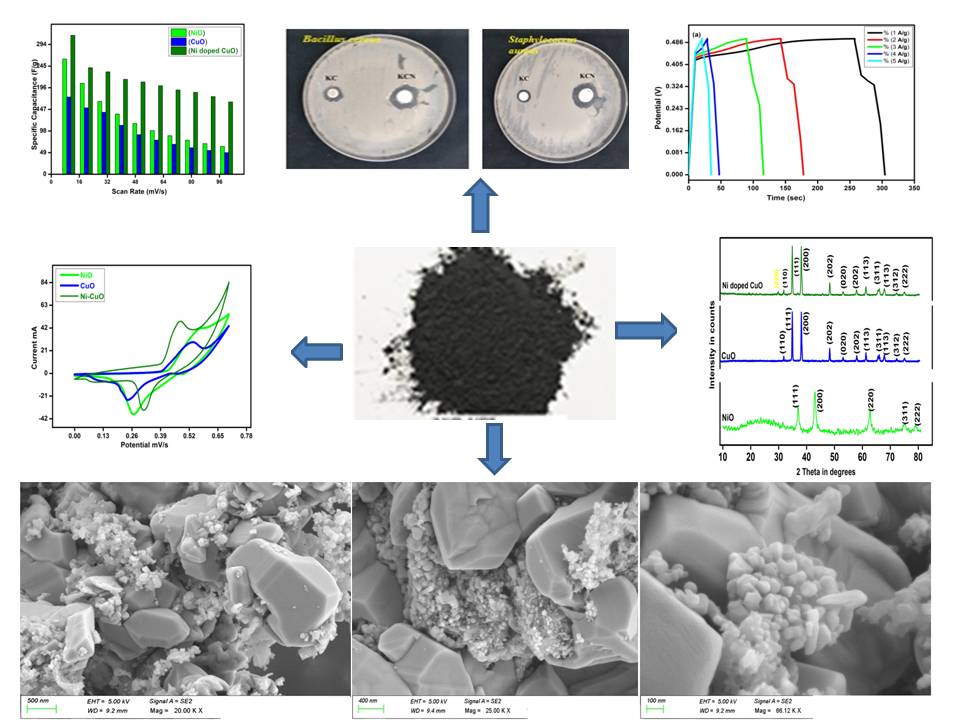
Pristine and Nickel doped Copper Oxide (CuO) Nanocomposite were synthesized using Centratherum Punctatum leaf extract. The structural characterization is performed employing XRD, SEM, and EDAX. Pure Copper Oxide nanoparticles (CuO Nps) exhibit leaf-like morphology, but Nickel-doped Copper Oxide nanocomposites exhibit a mixture of rod, spherical and hexagonal morphology. Owing to the XRD data, the resulting particles for NiO NPs, CuO NPs, and Ni-doped CuO nanocomposite comprised crystallite sizes of 35 nm, 41 nm, and 37 nm, respectively. The optical properties and functional group of the materials are analyzed utilizing UV-Vis and FTIR. The rise in the measured optical band gap values was seen by the blue shift noted in the UV-vis study subsequent to nickel doping. The existence of different functional groups in samples is verified by FT-IR characterization. The electrochemical analysis is studied by cyclic voltammetry. It exhibits an elevated specific capacitance value of 314 ????????−1 for Ni doped copper oxide nanocomposite. The antibacterial activity studies reveal that the Ni-doped nanocomposite is active against gram-negative bacteria over and above the gram-positive bacteria species.
Keywords
- Antibacterial,
- Centratherum Punctatum leaves,
- Cyclic voltammetry,
- Electrochemical,
- Morphology,
- Nanocomposites
References
- Ghane M., Sadeghi B., Jafari A. R., Paknejhad A. R., (2010), Synthesis and characterization of a Bi-Oxide nanoparticle ZnO/CuO by thermal decomposition of oxalate precursor method. Int. J. Nano Dim. 1: 33-40. https://doi.org/10.7508/IJND.2010.0X.003.
- Vishveshvar K., Aravind Krishnan M., Haribabu K., Vishnuprasad S., (2018), Green Synthesis of Copper Oxide Nanoparticles Using Ixiro coccinea Plant Leaves and its Characterization. BioNanoSci. 8: 554–558. https://doi.org/10.1007/s12668-018-0508-5.
- Stark W. J., Stoessel P. R., Wohlleben W., Hafner A., (2015), Industrial applications of nanoparticles, Chem. Soc. Rev. 44: 5793–5805. https://doi.org/10.1039/C4CS00362D.
- Arun L., Karthikeyan C., Philip, D., Dhayanithi D., Giridharan N. V., Unni C., (2018), Influence of transition metal ion Ni 2+ on optical, electrical, magnetic and antibacterial properties of phyto-synthesized CuO nanostructure. Opt. Quantum Electron. 50: 1-19. https://doi.org/10.1007/s11082-018-1684-9.
- Iqbal M., Ali A., Ahmad K. S., Rana F. M., Khan J., Thebo K. H., (2019), Synthesis and characterization of transition metals doped CuO nanostructure and their application in hybrid bulk heterojunction solar cells. SN Appl. Sci. 1: 1-8. https://doi.org/10.1007/s42452-019-0663-5.
- Vomacka P., Stengl V., Henych J., Kormunda M., (2016), Shape-controlled synthesis of Sn-doped CuO nanoparticles for catalytic degradation of Rhodamine B. J. Colloid Interface Sci. 481: 28-38. https://doi.org/10.1016/j.jcis.2016.07.026.
- Balakrishnan K., Thangavel G., Murugesan N., (2023), Structural, morphological, optical and electrochemical aspects of novel synthesized Nickel Oxide and Cobalt doped Nickel Oxide nanoparticles–An alternate electrode material for energy storage devices. Int. J. Nano Dim. 14: 191-202. https://doi.org/10.22034/IJND.2023.1981971.2209.
- Jahromi S. P., Huang N. M., Muhamad M. R., Lim H. N., (2013), Green gelatine-assisted sol–gel synthesis of ultrasmall nickel oxide nanoparticles. Ceram. Int. 39: 3909-3914. https://doi.org/10.1016/j.ceramint.2012.10.237.
- Edison T. N. J. I., Atchudan R., Lee Y. R., (2018), Binder-free electro-synthesis of highly ordered nickel oxide nanoparticles and its electrochemical performance, Electrochim. Acta. 283: 1609-1617. https://doi.org/10.1016/j.electacta.2018.07.101.
- Nasseri M. A., Kamali F., Zakerinasab B., (2015), Catalytic activity of reusable nickel oxide nanoparticles in the synthesis of spirooxindoles. RSC Adv. 5: 26517-26520. https://doi.org/10.1039/C5RA02825F.
- Kannan K., Radhika D., Vijayalakshmi S., Sadasivuni K. K. A., Ojiaku A., Verma, U. (2022), Facile fabrication of CuO nanoparticles via microwave-assisted method: photocatalytic, antimicrobial and anticancer enhancing performance. Int. J. Environ. Anal. Chem. 102: 1095-1108. https://doi.org/10.1080/03067319.2020.1733543.
- Rather G. A., Nanda A., Pandit M. A., Yahya S., Barabadi H., Saravanan M., (2021), Biosynthesis of Zinc oxide nanoparticles using Bergenia ciliate aqueous extract and evaluation of their photocatalytic and antioxidant potential. Inorg. Chem. Commun. 134: 109020. https://doi.org/10.1016/j.inoche.2021.109020.
- Ghomi A. R. G., Mohammadi-Khanaposhti M., Vahidi H., Kobarfard F., Reza M. A. S., Barabadi H., (2019), Fungus-mediated extracellular biosynthesis and characterization of zirconium nanoparticles using standard penicillium species and their preliminary bactericidal potential: a novel biological approach to nanoparticle synthesis. Iran. J. Pharm. Res. 18: 2101-2110. https://doi.org/10.22037/ijpr.2019.112382.13722.
- Vahidi H., Kobarfard F., Alizadeh A., Saravanan M., Barabadi H., (2021), Green nanotechnology-based tellurium nanoparticles: Exploration of their antioxidant, antibacterial, antifungal and cytotoxic potentials against cancerous and normal cells compared to potassium tellurite. Inorg. Chem. Commun. 124: 108385. https://doi.org/10.1016/j.inoche.2020.108385.
- Rayapa Reddy K., (2017), Green synthesis, morphological and optical studies of CuO nanoparticles. J. Mol. Struct. 1150: 553-557. https://doi.org/10.1016/j.molstruc.2017.09.005.
- Ijaz F, Shahid S, Khan S. A., Ahmad W., Zaman S., (2017), Green synthesis of copper oxide nanoparticles using Abutilon indicum leaf extract: Antimicrobial, antioxidant and photocatalytic dye degradation activities, Trop. J. Pharm. Res. 16: 743-753. https://doi.org/10.4314/tjpr.v16i4.2.
- Vijay Kumar P. P. N., Shameem U, Kollu P, Kalyani R. L., Pammi S. V, N., (2015), Green Synthesis of Copper Oxide Nanoparticles Using Aloe vera Leaf Extract and Its Antibacterial Activity against Fish Bacterial Pathogens. BioNanoSci. 5: 135-139. https://doi.org/10.1007/s12668-015-0171-z.
- Padil V. V. T., Černík M., 2013, Green synthesis of copper oxide nanoparticles using gum karaya as a biotemplate and their antibacterial application. Int. J. Nanomed. 8: 889–898. https://doi.org/10.2147/IJN.S40599.
- Pawar N. K., Arumugam N., (2011), Leaf extract of Centratherum punctatum exhibits antimicrobial, antioxidant and anti proliferative properties. Asian J. Pharm. Clin. Res. 4: 71-76.
- Chitra B., Brindha P., (2014), Studies On Preliminary Phytochemical Screening Of Different Extracts Of Centratherum Punctatum Cass. - A Traditional Wound Healer. Int. J. Pharm. Pharm. Sci. 6: 19-22.
- Sivasubramanian R., Brindha P., (2013), In-vitro cytotoxic, antioxidant and GC-MS studies on Centratherum punctatum Cass. Int. J. Pharm. Pharm. Sci. 5: 364-367.
- Satyal P., Ho V., Hieu., Do T., Lai., Thi N., Ngoc B., Huy N. C., Nang D., Setzer W. N., (2018), The essential oil compositions of Centratherum punctatum growing wild in Vietnam. Am. J. Essent. Oil Nat. Prod. 6: 15-18.
- Shankaran K. S., Ganai S. A., Arun K. P., Brindha B., Vijalakshmi M., (2017), In silico and In vitro evaluation of the anti-inflammatory potential of Centratherum punctatum Cass-A. J. Biomol. Struct. Dyn. 35: 765-780. https://doi.org/10.1080/07391102.2016.1160840.
- Chitra B., Brindha P., (2015), Antimicrobial activity of ethanol and aqueous extracts of Centratherum punctatum Cass. World J. Pharm. Pharm. Sci. 4: 1126-1131.
- Chukwujekwu J. C., Ndhlala A. R., De Kock C. A., Smith P. J., Van Staden J., (2014), Antiplasmodial, HIV-1 reverse transcriptase inhibitory and cytotoxicity properties of Centratherum punctatum Cass and its fractions. S. Afr. J. Bot. 90: 17-19. https://doi.org/10.1016/j.sajb.2013.10.001.
- Chitra B., Brindha P, Vijayakumar A. B., (2016), Protease activity of floral extracts of Centratherum punctatum Cass. a wound healing herb. World J. Pharm. Res. 5: 1079-1083. https://doi.org/10.1016/j.sajb.2013.10.001.
- Fardood S. T., Ramazani A., Moradi S., (2017), A Novel Green Synthesis Of Nickel Oxide Nanoparticles Using Arabic Gum. Chemistry Journal of Moldova. General, Industrial and Ecological Chemistry. 12: 115-118. https://doi.org/10.19261/cjm.2017.383.
- Ghazal S., Alireza A., Hosseini H. A., Sabouri Z., Forouzanfar F., Khatami M., Darroudo M., (2020), Sol gel Biosynthesis Of Nickel Oxide Nanoparticlesusing Cydoniaoblonga Extract And Evaluation Of Their Cytoxicity And Photocatalytic Activities. J. Mol. Struct. 1217: 128378.
- https://doi.org/10.1016/j.molstruc.2020.128378.
- Yousaf S., Zulfiqar S., Shahi M. N., Warsi M. F., Al-Khalli N. F., Aboud M. F. A., Shakir I., (2020), Tuning the structural, optical and electrical properties of NiO nanoparticles prepared by wet chemical route. Ceram. Int. 46: 3750-3758. https://doi.org/10.1016/j.ceramint.2019.10.097.
- Hassanien A. S., Akl A. A., (2016), Effect of Se addition on optical and electrical properties of chalcogenide CdSSe thin films. Superlattice Microstruct. 89: 153–169. https://doi.org/10.1016/j.spmi.2015.10.044.
- Udayabhanu P. C., Nethravathi M. A., Pavan Kumar D., Suresh K., Lingaraju H., Rajanaika H., Nagabhushana S. C. S., (2015), Tinospora cordifolia mediated facile green synthesis of cupric oxide Nanoparticles and their photocatalytic, antioxidant and antibacterial properties. Mater. Sci. Semicond. Process. 33: 81-88. https://doi.org/10.1016/j.mssp.2015.01.034.
- Pramothkumar A., Senthilkumar N., Mercy Gnana Malar, K.C. Meena M., Pothekar I. V., (2019). A comparative analysis on the dye degradation efficiency of pure, Co, Ni and Mn-doped CuO nanoparticles. J. Mater. Sci.: Mater. Electron. 30: 19043–19059. https://doi.org/10.1007/s10854-019-02262-4.
- Siddique M. N., Ahmed A., Ali T., Tripathi P., (2018), Investigation of optical properties of nickel oxide nanostructures using photoluminescence and diffuse reflectance spectroscopy. AIP Conf. Proc. 1953: 030027. https://doi.org/10.1063/1.5032362.
- Sabouri Z., Rangrazi A., Amiri M. S., Khatami M., Darroudi M., (2021), Green synthesis of nickel oxide Nanoparticles using Salvia hispanica L. (chia) seeds extract and studies of their photocatalytic activity and cytotoxicity effects. Bioprocess Biosyst. Eng. 44: 2407-2415. https://doi.org/10.1007/s00449-021-02613-8.
- Alam M. W., Aamir M., Farhan M., Albuhulayqah M., Ahmad M. M., Ravikumar C. R., Dileep Kumar V. G., Ananda Murthy H. C., (2021), Green Synthesis of Ni-Cu-Zn Based Nanosized Metal Oxides for Photocatalytic and Sensor Applications. Crystals. 11: 1467. https://doi.org/10.3390/cryst11121467.
- Lingarajua K., Raja Naika H., Nagabhushana H., Jayanna K., Devaraja S., Nagaraju G., (2019), Biosynthesis of Nickel oxide Nanoparticles from Euphorbia heterophylla (L.) and their biological application. Arabian J. Chem. 13: 4712-4719. https://doi.org/10.1016/j.arabjc.2019.11.003.
- Oh J., Ryu H., Lee W. J, Bae J. S., (2018), Improved photostability of a CuO photoelectrode with Ni-doped seed layer. Ceram. Int. 44: 89-95. https://doi.org/10.1016/j.ceramint.2017.09.129.
- Aydın J. R., Akkaya A., Sahin B., (2022), Light-weight and flexible Ni-doped CuO (Ni:CuO) thin films grown using the cost-effective SILAR method for future technological requests. Mater. Sci: Mater. Electron. 33: 23806–23820. https://doi.org/10.1007/s10854-022-09139-z.
- Dwivedi L. M., Shukla N., BaranwalnK., Gupta S., Siidique S., Singh V., (2021), Gum Acacia Modified Ni Doped CuO Nanoparticles: An Excellent Antibacterial Material. J. Clust. Sci. 32: 209-219. https://doi.org/10.1007/s10876-020-01779-7.
- Ansari M. A., Jahan N., (2023), A Novel Co-Precipitation Route for the Synthesis of Pure and Ni-Doped CuO Nanoparticles: Effect of Doping on Structural, Optical, and Electrical Properties. Int. J. Nanosci. Nanotechnol. 19: 65-76. https://doi.org/10.22034/IJNN.2023.555186.2219.
- Amri S. A., Ansari M. S., Rafique S., Aldhahri M., Rahimuddin S., Azam A., Memic A., (2015), Ni doped CuO nanoparticles: structural and optical characterizations. Curr. Nanosci. 11: 191-197. https://doi.org/10.2174/1573413710666141024212856.
- Sukumar S., Rudrasenan A., Nambiar D. P., (2020), Green-Synthesized Rice-Shaped Copper Oxide Nanoparticles Using Caesalpinia bonducella Seed Extract and Their Applications. ACS Omega. 5: 1040–1051. https://doi.org/10.1021/acsomega.9b02857.
- Siddiqui V. U., Ansari A., Chauhan R., Siddiqi W. A., (2021), Green synthesis of copper oxide (CuO) Nanoparticles by Punica granatum peel extract. Mater. Today Proc. 36: 751-755. https://doi.org/10.1016/j.matpr.2020.05.504.
- Vishveshvar K., Aravind Krishnan M. V., Haribabu K., Vishnuprasad S., (2018), Green Synthesis of Copper Oxide Nanoparticles Using Ixiro coccinea Plant Leaves and its Characterization. BioNanoSci. 8: 554–558. https://doi.org/10.1007/s12668-018-0508-5.
- Dwivedi L. M., Shukla N., Baranwal K., Gupta S., Siddique S., Singh V., (2021), Gum Acacia Modified Ni Doped CuO Nanoparticles: An Excellent Antibacterial Material. J. Cluster Sci. 32: 209–219. https://doi.org/10.1007/s10876-020-01779-7.
- Maheo A. R., Scholastica M. V. B., Augustine A. P. T., (2022), Biosynthesis and characterization of Eupatorium adenophorum and chitosan mediated Copper oxide Nanoparticles and their antibacterial activity. Results Surf. Interfaces. 6: 100048. https://doi.org/10.1016/j.rsurfi.2022.100048.
- Geetha P., Ponsindhuja K., Sankaralingam S., Sivasankara N. S., Sugapriya M. P., (2019), Green synthesis of copper Nanoparticles obtained from Pedalium Murex. L (Yanai Nerunjil) and their antimicrobial activity. Int. J. Res. Advent. Technol. 7: 2321-9637.
- Suresh K. C., Balamurugan A., (2020), Evaluation of structural, optical, and morphological properties of nickel oxide Nanoparticles for multi-functional applications. Inorg. Nano-Metal Chem. 51: 296-301. https://doi.org/10.1080/24701556.2020.1770793.
- Arun L., Karthikeyan C., Philip D., Sasikumar M., Elaiyappillai E., Merlin J. P., Unni C., (2018), Effect of Ni2+doping on chemocatalytic and supercapacitor performance of biosynthesized nanostructured CuO. J. Mater. Sci.: Mater. Electron. 29: 21180–21193. https://doi.org/10.1007/s10854-018-0268-6.
- Fuku X., Kaviyarasu K., Matinise N., Maaza M., (2016), Punicalagin Green Functionalized Cu/Cu2O/ZnO/CuO Nanocomposite for Potential Electrochemical Transducer and Catalyst. Nanoscale Res. Lett. 11: 386. https://doi.org/10.1186/s11671-016-1581-8.
- Uma B., Anantharaju K. S., Suredra B. S., Gurusantha K., More S. S., Meena S., Hemavathi B., Murthy H. C. A., (2023), Influence of Ag on the Structural, Electrochemical, Antibacterial, and Photocatalytic Performance of the (CuO–Cu2O) Cu Nanocomposite. ACS omega. 8: 9947-9961. https://doi.org/10.1021/acsomega.2c07124.
- Manibalan G. Murugadoss G., Thangamuthu R., Ragupathy P., Mohan Kumar R., Jayavel R., (2018), Enhanced electrochemical supercapacitor and excellent amperometric sensor performance of heterostructure CeO2-CuO nanocomposites via chemical route. Appl. Surf. Sci. 456: 104-113. https://doi.org/10.1016/j.apsusc.2018.06.071.
- Senthilkumar V., Kim Y. S., Chandrasekaran S., Rajagopalan B., Kim E. J.; Chung, J. S., (2015), Comparative supercapacitance performance of CuO nanostructures for energy storage device applications. RSC Adv. 5: 20545−20553. https://doi.org/10.1039/C5RA00035A.
- Mohamed Racik K., Manikandan A., Mahendiran M., Prabakaran P., Madhavan J., Victor Antony Raj M., (2020), Fabrication of manganese oxide decorated copper oxide (MnO2/CuO) nanocomposite electrodes for energy storage supercapacitor devices. Physica E. 119: 114033. https://doi.org/10.1016/j.physe.2020.114033.
- Paul D., Sudarsan N., (2019), Synthesis, characterization and a comparative antibacterial study of CuO, NiO and CuO-NiO mixed metal oxide. Mater. Res. Express. 6: 055004. https://doi.org/10.1088/2053-1591/ab003c.
- Azam A., Ahmed A. S., Oves M., Khan M. S., Habib S. S., Memic A., (2012), Antimicrobial activity of metal oxide nanoparticles against gram-positive and gram-negative bacteria: a comparative study. Int. J. Nanomed. 7: 6003-6009. https://doi.org/10.2147/IJN.S35347.
- Kumar K., Kumar R., Jasrotia R., Kalia S., Arya V., Kumar A., Khargotra R., Singh T., Thakur N., (2024), In-vitro bactericidal and anti-oxidant efficacy of biosynthesized CuO/Cu2O-NiO nanocomposites against the pathogenic bacteria and DPPH free radical. Discov. Appl. Sci. 6: 87. https://doi.org/10.1007/s42452-024-05679-7.
- Hassanpour M., Safardoust H., Ghanbari D., Niasari M. S., (2016), Microwave synthesis of CuO/NiO magnetic nanocomposites and its application in photo-degradation of methyl orange. J. Mater. Sci.: Mater. Electron. 27: 2718–2727. https://doi.org/10.1007/s10854-015-4082-0.
- Sedighi F., Esmaeili-Zare M., Sobhani-Nasab A., Behpour M., (2018), Synthesis and characterization of CuWO4 nanoparticle and CuWO4/NiO nanocomposite using co-precipitation method; application in photodegradation of organic dye in water. J. Mater. Sci.: Mater. Electron. 29: 13737–13745. https://doi.org/10.1007/s10854-018-9504-3.
- Jana T. K., Maji S. K., Pal A., Maiti R. P.,. Dolai T.K, Chatterjee K., (2016), Photocatalytic and antibacterial activity of cadmium sulphide/zinc oxide nanocomposite with varied morphology. J. Colloid Interface Sci. 480: 9-16. https://doi.org/10.1016/j.jcis.2016.06.073.
- Hoseinpour V., Nasser G., (2018), Novel ZnO–MnO2–Cu2O triple nanocomposite: Facial synthesis, characterization, antibacterial activity and visible light photocatalytic performance for dyes degradation-A comparative study. Mater. Res. Express. 5: 085012. https://doi.org/10.1088/2053-1591/aad2c6.
- Karthik K., Dhanuskodi S., Gobinath C. Prabukumar S., Sivaramakrishnan S., (2018), Multifunctional properties of microwave assisted CdO–NiO–ZnO mixed metal oxide nanocomposite: enhanced photocatalytic and antibacterial activities. J. Mater. Sci.: Mater. Electron. 29: 5459–5471. https://doi.org/10.1007/s10854-017-8513-y.
- Lefatshe K., Muiva C. M., Kebaabetswe L. P., (2017), Extraction of nanocellulose and in-situ casting of ZnO/cellulose nanocomposite with enhanced photocatalytic and antibacterial activity. Carbohydr. Polym. 15: 301-308. https://doi.org/10.1016/j.carbpol.2017.02.020.
- Kumar D., Shukla H., Sharma N., (2022), Antibacterial and morphological studies of plant-mediated synthesized CuO nanoparticles using Azadirachta indica (neem) leaf extract. Int. J. Nano Dim. 13: 197-204. https://doi.org/10.22034/IJND.2022.686826.
- Nagore P. B., Ghoti A. J., Salve A. P., Mane K., (2020), Green Synthesis of Luminescent Copper Oxide Nanoparticles Using Ginger Lily Leaves Extract. J. Inorg. Organomet. Polym. Mater. 30: 4229. https://doi.org/10.1007/s10904-020-01614-6.
- Tawale J. S., Dey K. K., Pasricha R., Sood K. N., Srivastava A. K., (2010), Synthesis and characterization of ZnO tetrapods for optical and antibacterial applications. Thin Solid Films. 519: 1244-1247. https://doi.org/10.1016/j.tsf.2010.08.077.
- Almontasser A., Parveen A., (2022), Probing the effect of Ni, Co and Fe doping concentrations on the antibacterial behaviors of MgO nanoparticles. Sci. Rep. 12:7922. https://doi.org/10.1038/s41598-022-12081-z.
- Majeed S., Saravanan M., Danish M., Zakariya N. A., Ibrahim M. N. M., Rizvi E. H., Andrabi S. N., Barabadi H., Mohanta Y. K., Mostafavi E., (2023), Bioengineering of green-synthesized TAT peptide-functionalized silver nanoparticles for apoptotic cell-death mediated therapy of breast adenocarcinoma. Talanta. 253: 124026. https://doi.org/10.1016/j.talanta.2022.124026.
- Kumar P. S. M., Kyaw H. H., Myint M. T. Z., Al-Haj L., Al-Muhtaseb A. H., Al-Abri M., Thanigaivel V., Ponnusamy V. K., (2020), Green route synthesis of nanoporous copper oxide for efficient supercapacitor and capacitive deionization performances. Int. J. Energy Res. 44: 10682-10694. https://doi.org/10.1002/er.5712.