
 10.22034/ijnd.2023.1988055.2225
Fused nanogranular polyaniline-sawdust (Cocos nucifera) composite for Lead adsorption application
- Shalaine Sana Tatu-Qassim

 1
1 - Marvin Ali Maulion2
- Rey Ralph Herrera Virtucio2
- Joel Gonzales Fernando*2

Published in Issue 2024-03-03




PDF views: 216
HTML views: 48





Abstract
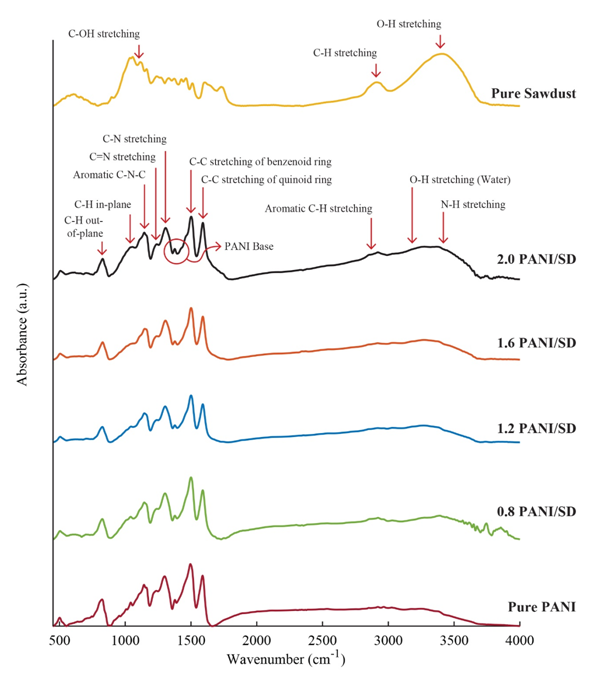
The problem of heavy metal contamination in industrial effluents requires new and environment-friendly agents for wastewater treatment. In this study, we developed fused nanogranular polyaniline-sawdust (PANI/SD) composites for lead ion removal through the adsorption process. To prevent the aggregation of polyaniline (PANI), coconut (Cocos nucifera) sawdust (SD), an agricultural waste, was used as a substrate via in situ chemical polymerization in varied sawdust-to-aniline ratios. The scanning electron micrographs (SEM) of the obtained PANI/SD composites revealed a nanogranular structure that indicated the complete coating of polyaniline on sawdust. Furthermore, the PANI/SD composites were verified to be in the emeraldine oxidation state through Fourier-Transform Infrared (FT-IR) spectroscopy. Among the formulations studied, the PANI/SD composite with a sawdust-to-aniline ratio of 1.2 g/mL was found to have the highest adsorption capacity of 738.9 mg/g. This study presents the promising potential of PANI/SD as a novel and cost-effective adsorbent material to remove lead from contaminated water.
Keywords
- Adsorption,
- Lead,
- Polyaniline,
- sawdust,
- wastewater.