
 10.57647/ijnd.2026.1704.05
Increased sensitivity in planar waveguide plasmonic nanobiosensores based on two-dimensional graphene-MoS2 multilayers
- Shabnam Andalibi Miandoab
 1
1 - Nazlar Ghasemzadeh *2
- Pedram Asmand Debaglou 2
- Department of Electrical Engineering, Ta.C., Islamic Azad University, Tabriz, Iran
- Department of Biomedical Engineering, Ta.C., Islamic Azad University, Tabriz, Iran

Received: 2026-02-16
Revised: 2026-05-18
Accepted: 2026-06-13
Published in Issue 2026-06-22
Published Online: 2026-06-15
Copyright (c) 2025 Shabnam Andalibi Miandoab, Nazlar Ghasemzadeh , Pedram Asmand Debaglou (Author)

This work is licensed under a Creative Commons Attribution 4.0 International License.
How to Cite




PDF views: 19





Abstract
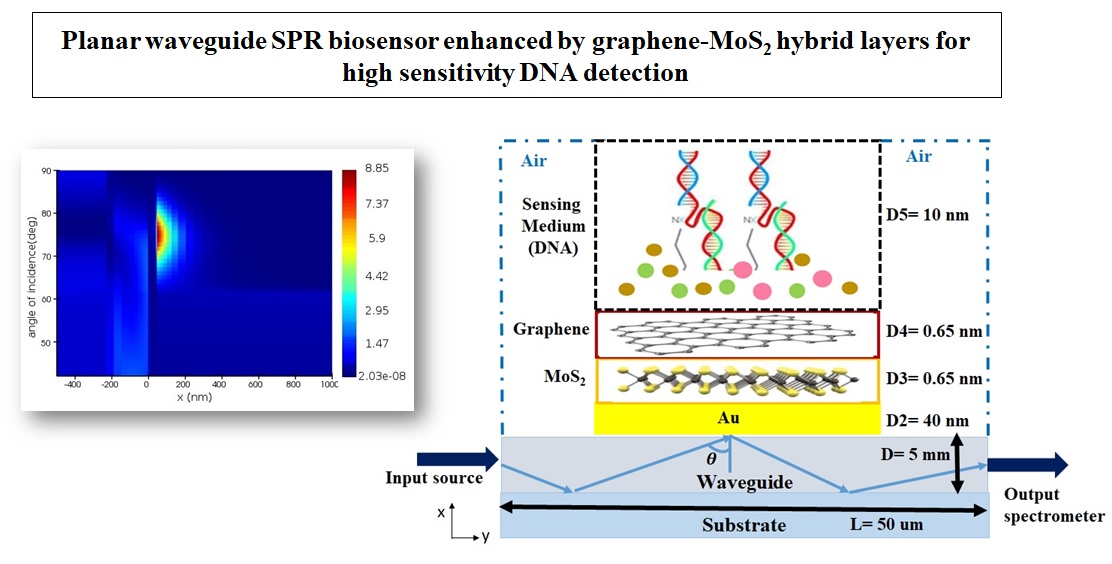
This paper investigates biosensors based on plasmonic nanostructures. A plasmonic sensor using planar optical waveguide consisting of graphene and metal oxide layers has been designed and simulated for detecting biomolecules such as DNA. Plasmonics, branch of photonics, underpins many biophotonic applications, especially biosensing. Proposed biosensor relies on surface plasmon resonance in hybrid graphene/MoS2 structure, enabling high-sensitivity detection. Sensing mechanism analyzes transmission spectrum of an electromagnetic wave launched into waveguide, which varies with refractive index changes of biomolecules near surface. Performance has been evaluated at 633 nm and for different light incidence angles. Effects of number and arrangement of graphene and MoS2 layers on resonance angle, sensitivity, full width at half maximum (FWHM), and figure of merit (FOM) have been studied. Results show that a single graphene layer with a single MoS2 layer yields optimal performance, with sensitivity of 193 deg/RIU and FOM of 16.6 RIU-¹. Minimum FWHM of 11.62° and transmission intensity Tmin of 0.02 have been obtained. Increasing layer numbers due to optical absorption and plasmonic damping leads to higher optical losses, broader resonance curve, and reduced FOM. Electromagnetic field distribution and sensor characteristics have been analyzed via resonance angle shifts, identifying optimal structure with highest sensitivity and FOM.
Keywords
- Angle,
- FDTD,
- Graphene,
- Nanobiosensores,
- Surface Plasmon Resonance Sensitivity
References
- Alwan, A.M., A.A. Yousif, and L.A. Wali, The growth of the silver nanoparticles on the mesoporous silicon and macroporous silicon: a comparative study. Indian Journal of Pure & Applied Physics, 2017. 55(11): p. 813–820. Available at: https://nopr.niscpr.res.in/handle/123456789/43261 .
- Choi, S.H., Y.L. Kim, and K.M. Byun, Graphene-on-silver substrates for sensitive surface plasmon resonance imaging biosensors. Optics express, 2011. 19(2): p. 458466.https://doi.org/10.1364/oe.19.000458
- Halterman, K. and M. Alidoust, Waveguide modes in Weyl semimetals with tilted dirac cones. Optics Express, 2019. 27(25): p. 3616436182.https://doi.org/10.1364/oe.27.036164.
- Ghasemzadeh N, Rahatabad FN, Haghipour S, Miandoab SA, Maghooli K. Controlling pathological activity of Parkinson basal ganglia based on excitation and inhibition optogenetic models and monophasic and biphasic electrical stimulations. J Biosci. 2023; 48:40. PMID: 37846022.http://dx.doi.org/10.1007/s12038-023-00359-x.
- Miandoab SA, Ghasemzadeh N. Modeling the neurodegenerative Parkinson’s disease treatment with high effectiveness of beta-band neural activity using the optogenetic-electrical hybrid stimulation. Biomedical Signal Processing and Control. 2025 Dec 1;110:107999.https://doi.org/10.1016/j.bspc.2025.107999.
- Faraji, H., S. Haji-Nasiri, and S.A. Miandoab, Correction: Engineered Graphene-Integrated 3D curved hyperbolic metamaterial nanolenses for advanced multiselective nanophotonic biosensing. Optical and Quantum Electronics, 2025. 57(11): p. 608.https://doi.org/10.1007/s11082-025-08533-1.
- Faraji H, Haji-Nasiri S, Andalibi Miandoab S. Plasmonic Mid-infrared Biosensor with High Sensitivity Using Multilayer Graphene/Al2O3 Cylindrical Hyperbolic Metamaterials. Sensing and Imaging. 2026 Feb 19;27(1):34. https://doi.org/10.1007/s11220-026-00730-w.
- Parcham, E. and S.A. Miandoab, Introducing nanostructure patterns for performance enhancement in PbS colloidal quantum dot solar cells. International Journal of Nano Dimension, 2020. 11(1). Available at: https://oiccpress.com/ijnd/article/view/4254.
- Bozhevolnyi, S.I., et al., Channel plasmon subwavelength waveguide components including interferometers and ring resonators. Nature, 2006. 440(7083): p. 508–511.https://doi.org/10.1038/nature04594.
- Ouyang, Q., et al., Sensitivity enhancement of transition metal dichalcogenides/silicon nanostructure-based surface plasmon resonance biosensor. Scientific reports, 2016. 6(1): p. 28190.https://doi.org/10.1038/srep28190.
- Wali, L.A., et al., Excellent fabrication of Pd-Ag NPs/PSi photocatalyst based on bimetallic nanoparticles for improving methylene blue photocatalytic degradation. Optik, 2019. 179: p. 708–717. https://doi.org/10.1016/j.ijleo.2018.11.011.
- Xiao, S., et al., Tunable anisotropic absorption in hyperbolic metamaterials based on black phosphorous/dielectric multilayer structures. Journal of Lightwave Technology, 2019. 37(13): p. 3290–3297.https://doi.org/10.1109/jlt.2019.2914183 .
- Zhang, S., et al., Chiral surface plasmon polaritons on metallic nanowires. Physical Review Letters, 2011. 107(9): p. 096801. DOI: 10.1103/PhysRevLett.107.096801.
- Cen, C., et al., A tunable plasmonic refractive index sensor with nanoring-strip graphene arrays. Sensors, 2018. 18(12): p. 4489.https://doi.org/10.3390/s18124489 .
- Liang, C., et al., Dual-band infrared perfect absorber based on a Ag-dielectric-Ag multilayer films with nanoring grooves arrays. Plasmonics, 2020. 15(1): p. 93–100.https://doi.org/10.1007/s11468-019-01018-4.
- Wang, X., et al., Tunable terahertz/infrared coherent perfect absorption in a monolayer black phosphorus. Optics Express, 2018. 26(5): p. 5488–5496. DOI: 10.1364/OE.26.005488.
- Ma, Y., et al., A terahertz polarization insensitive dual band metamaterial absorber. Optics letters, 2011. 36(6): p. 945–947.https://doi.org/10.1364/ol.36.000945 .
- Yao, G., et al., Dual-band tunable perfect metamaterial absorber in the THz range. Optics express, 2016. 24(2): p. 1518–1527.https://doi.org/10.1364/oe.24.001518 .
- Ji, S., et al., Design of a polarization-insensitive triple-band metamaterial absorber. Optics Communications, 2019. 432: p. 65–70.https://doi.org/10.1016/j.optcom.2018.09.040.
- Zhang, Y., et al., A graphene based tunable terahertz sensor with double Fano resonances. Nanoscale, 2015. 7(29): p. 12682–12688.https://doi.org/10.1039/c5nr03044g .
- Andryieuski, A. and A.V. Lavrinenko, Graphene metamaterials based tunable terahertz absorber: effective surface conductivity approach. Optics express, 2013. 21(7): p. 9144–9155.https://doi.org/10.1364/oe.21.009144 .
- Bibikova, O., Haas, J., López-Lorente, A. I., Popov, A., Kinnunen, M., Meglinski, I., & Mizaikoff, B. (2017). Towards enhanced optical sensor performance: SEIRA and SERS with plasmonic nanostars. Analyst, 142(6), 951–958. https://doi.org/10.1039/C6AN02596J.
- Mejia-Salazar, J.R., et al., New trends in plasmonic (bio) sensing. Anais da Academia Brasileira de Ciências, 2018. 90: p. 779–801.https://doi.org/10.1590/00013765201820170571.
- Lai, W., K. Wen, J. Lin, Z. Guo, Q. Hu, and Y. Fang, Plasmonic filter and sensor based on a subwavelength end-coupled hexagonal resonator. Applied Optics, 2018. 57(22): p. 6369–6374. DOI: 10.1364/AO.57.006369.
- Li, H., J. Niu, and G. Wang, Dual-band, polarization-insensitive metamaterial perfect absorber based on monolayer graphene in the mid-infrared range. Results in Physics, 2019. 13: p. 102313. https://doi.org/10.1016/j.rinp.2019.102313
- Tsuchikawa, K., et al., Characterization of a Weyl semimetal using a unique feature of surface plasmon polaritons. Physical Review B, 2020. 102(3): p. 035443.https://doi.org/10.1103/physrevb.102.035443.
- Ebadi SM, Örtegren J, Bayati MS, Ram SB. A multipurpose and highly-compact plasmonic filter based on metal-insulator-metal waveguides. IEEE Photonics Journal. 2020 Feb 19;12(3):1-9. https://doi.org/10.1109/jphot.2020.2974959.
- Wen, C., et al., Enhanced molecular infrared spectroscopy employing bilayer graphene acoustic plasmon resonator. Biosensors, 2021. 11(11): p. 431.https://doi.org/10.3390/bios11110431
- Patel, S.K., et al., Tunable infrared metamaterial-based biosensor for detection of hemoglobin and urine using phase change material. Scientific Reports, 2021. 11(1): p. 7101. DOI: 10.1038/s41598-021-86583-5.
- Bensalah, H., Hocini, A., Bahri, H. et al. A plasmonic refractive index sensor with high sensitivity and its application for temperature and detection of biomolecules. J Opt 52, 1035–1046 (2023). https://doi.org/10.1007/s12596-022-00922-z.
- Miandoab, S.A. and S.S. Hars, Design and simulation of concentrator plasmonic nanostructure optical antenna to improve the performance of Li-Fi communication technology. International Journal of Nano Dimension, 2025. 16(3 (July 2025)). https://dx.doi.org/10.57647/j.ijnd.2025.1603.21.
- Shakya AK, Ramola A, Balal N, Bergman A. Evolution of Photonic Crystal Fiber Based Smart Sensors with Emphasis on Biomedical Applications: A Review. IEEE Sensors Journal. 2026 Jan 12. DOI:10.1109/JSEN.2026.3650816.
- Ramola A., Shakya A.K., Balal N., Bergman A. Theoretical Investigation of Early Cancer Biomarker Sensing Using a PMMA–Gold Hybrid Quasi-D-Shaped Photonic-Crystal-Fiber-Based Surface Plasmon Resonance Biosensor. Micromachines, 2026, 17(1), 68. https://doi.org/10.3390/mi17010068.
- Ramola A., Shakya A.K., Droby A., Bergman A. Numerical Study of a Novel Kagome-Inspired Photonic Crystal Fiber-Based Surface Plasmon Resonance Biosensor for Detection of Blood Components and Analytical Targets. Biosensors, 2025, 15(8), 539. https://doi.org/10.3390/bios15080539
- Ramola A., Shakya A.K., Kumar V., Bergman A. Recent Advances in Photonic Crystal Fiber-Based SPR Biosensors: Design Strategies, Plasmonic Materials, and Applications. Micromachines, 2025, 16(7), 747. https://doi.org/10.3390/mi16070747
- Ramola A., Shakya A.K., Bergman A. Finite Element Method-Based Modeling of a Novel Square Photonic Crystal Fiber Surface Plasmon Resonance Sensor with a Au–TiO₂ Interface and the Relevance of Artificial Intelligence Techniques in Sensor Optimization. Photonics, 2025, 12(6), 565. https://doi.org/10.3390/photonics12060565.
- Ramola A, Shakya AK, Bergman A. Comprehensive analysis of advancement in optical biosensing techniques for early detection of cancerous cells. Biosensors. 2025 May5;15(5):292..https://doi.org/10.3390/bios15050292.
- Shakya A.K., Singh S. Development of a Generalized Fourier Transform Model for Distinct Household Oil Samples by Performing Spectroscopy Analysis. Results in Optics, 2023, 10, 100355. https://doi.org/10.1016/j.rio.2023.100355.
- Nematpour A, Nikoufard M. Plasmonic thin film InP/graphene-based Schottky-junction solar cell using nanorods. Journal of advanced research. 2018 Mar 1;10:15-20. 10.1016/j.jare.2018.01.008.https://doi.org/10.1016/j.jare.2018.01.008
- Mahdian MA, Nikoufard M, Soleimannezhad F. Effect of etching depth on the performance of InP-based hybrid plasmonic waveguides. AEU-International Journal of Electronics and Communications. 2020 Nov 1;126:153403.10.1016/j.aeue.2020.153403.https://doi.org/10.1016/j.aeue.2020.153403.
- Soleimannezhad F, Nikoufard M, Mahdian MA. Low‐loss indium phosphide‐based hybrid plasmonic waveguide. Microwave and Optical Technology Letters. 2021 Sep;63(9):2242-51.10.1002/mop.32488.https://doi.org/10.1002/mop.32488.
- Nikoufard M, Kazemi Alamouti M, Adel A. Ultra-compact photonic crystal based water temperature sensor. PhotonicSensors.2016Sep;6(3):274-8.10.1007/s13320-016-0321-0. https://doi.org/10.1007/s13320-016-0321-0 .
- Nematpour A, Nikoufard M, Mehragha R. Design and optimization of the plasmonic graphene/InP thin-film solar-cell structure. Laser Physics. 2018 Jun 1;28(6):066202.10.1088/15556611/aab462.https://doi.org/10.1088/1555-6611/aab462.
- Dalvand H, Nikoufard M, Zangeneh HR. Graphene-based modulator using GST-phase change material on semi-ellipsoid slot waveguide configuration: H Dalvand et al. Indian Journal of Physics. 2025 Feb;99(2):357 66.10.1007/s12648-024-03308-y. https://doi.org/10.1007/s12648-024-03308-y.
- Nikoufard M, Alamouti MK, Pourgholi S. Multimode interference power-splitter using InP-based deeply etched hybrid plasmonic waveguide. IEEE Transactions on Nanotechnology. 2017 Mar 28;16(3):477 83.10.1109/TNANO.2017.2688397. https://doi.org/10.1109/tnano.2017.2688397.
- Nikoufard M, Nourmohammadi A, Esmaeili S. Hybrid plasmonic nanoantenna with the capability of monolithic integration with laser and photodetector on InP substrate. IEEE Transactions on Antennas and Propagation. 2017 Oct 30;66(1):3-8.10.1109/TAP.2017.2767623.https://doi.org/10.1109/tap.2017.2767623
- Yu, P., et al., Metamaterial perfect absorber with unabated size-independent absorption. Optics Express, 2018. 26(16): p. 20471–20480.https://doi.org/10.1364/oe.26.020471
- Pan, W., et al., A broadband terahertz metamaterial absorber based on two circular split rings. IEEE Journal of Quantum Electronics, 2016. 53(1): p. 1–6.https://doi.org/10.1109/jqe.2016.2643279.
- Khodadad H, Hatamjafari F, Pourshamsian K, Sadeghi B. Microwave-assisted synthesis of novel pyrazole derivatives and their biological evaluation as anti-bacterial agents. Combinatorial Chemistry & High Throughput Screening. 2021 Jun 1;24(5):695-700.https://doi.org/10.2174/1386207323666201019152206.
- Pourjafari M, Ghane M, Kaboosi H, Sadeghi B, Rezaei A. Antibacterial properties of Ag–Cu alloy nanoparticles against multidrug-resistant Pseudomonas aeruginosa through inhibition of quorum sensing pathway and virulence-related genes. Journal of Biomedical Nanotechnology. 2022 Apr 1;18(4):1196-204.https://doi.org/10.1166/jbn.2022.3331.
- Azari B, Pourahmad A, Sadeghi B, Mokhtary M. Green synthesis of SiO2 from Equisetnm arvense plant for synthesis of SiO2/ZIF-8 MOF nanocomposite as photocatalyst. Journal of Coordination Chemistry. 2023 Jan 17;76(2):219-31.https://doi.org/10.1080/00958972.2023.2166408
- Sadeghi B, Vahdati RA. Comparison and SEM-characterization of novel solvents of DNA/carbon nanotube. Applied surface science. 2012 Jan 15;258(7):3086-8.https://doi.org/10.1016/j.apsusc.2011.11.042.
- Sohrabnezhad S, Pourahmad A, Sadjadi MS, Sadeghi B. Nickel cobalt sulfide nanoparticles grown on AlMCM-41 molecular sieve. Physica E: Low-dimensional Systems and Nanostructures. 2008 Jan1;40(3):684-8.https://doi.org/10.1016/j.physe.2007.09.081.
- Wang, L. et al., Recent progress in the assembly of nanodevices and van der Waals heterostructures by deterministic placement of 2D materials, Chemical Society Reviews, 2017. https://pubs.rsc.org/en/content/articlehtml/2017/cs/c7cs00556c
- Kinoshita, K. et al., Dry release transfer of graphene and few-layer h-BN using polypropylene carbonate, arXiv, 2019. https://arxiv.org/abs/1904.12170
- Castellanos-Gomez, A. et al., Van der Waals heterostructures and their assembly techniques, Nature Reviews Methods Primers, 2022.https://www.nature.com/articles/s43586-022-00139-1.pdf
- Wang, L. et al., Advances in deterministic transfer methods for 2D materials and van der Waals heterostructures, Nano-Micro Letters, 2019.https://link.springer.com/article/10.1007/s40820-019-0245-5
- Rahman, M.S., K.A. Rikta, and M. Anower, Numerical Analysis of MoS2-Graphene Hybrid Structure Based Planar Waveguide Surface Plasmon Resonance Biosensor for Sensing DNA Hybridization. Sensor Letters, 2017. 15(10): p. 868–875.https://doi.org/10.1166/sl.2017.3886
- Chen S, Lin C. Figure of merit analysis of graphene based surface plasmon resonance biosensor for visible and near infrared. Optics Communications. 2019 Mar 15;435:102-7. https://doi.org/10.1016/j.optcom.2018.11.031 .
- Bahmani E, Kaatuzian H, Shafagh SG. High-performance Au– MoS2–graphene multilayer SPR biosensor with superior sensitivity and precision. Scientific Reports. 2026 Feb 12. https://doi.org/10.1038/s41598-026-39993-4.
- Runthala R, Venkatesh VK, Gupta D, Arora P. Simulation-Driven Design of a Multilayer Plasmonic Sensor Using Cu-Ni and BaTiO2 for Waterborne Pathogen Detection. In2025 IEEE 20th Nanotechnology Materials and Devices Conference (NMDC) 2025 Oct 9 (pp. 259-264). IEEE. https://doi.org/10.1109nmdc64551.2025.11233969.
- Hocini A, Ben Salah H, Temmar MN. Ultra-high-sensitive sensor based on a metal–insulator–metal waveguide coupled with cross cavity. Journal of Computational Electronics. 2021 Jun;20(3):1354-62. https://doi.org/10.1007/s10825-021-01706-7.