
 10.57647/ijnd.2026.1704.03
Synthesis of Calcium Hydroxide Nanoparticles via Hydrothermal Method: A Breakthrough in Paper Deacidification and Preservation
- Bhavya Pandey

 1
1 - Yogesh Chandra Goswami*1
- Uday Pratap Singh Gahlaut1

Received: 2025-12-20
Revised: 2026-05-03
Accepted: 2026-06-05
Published Online: 2026-07-29
Copyright (c) 2025 Bhavya Pandey, Yogesh Chandra Goswami, Uday Pratap Singh Gahlaut (Author)

This work is licensed under a Creative Commons Attribution 4.0 International License.




PDF views: 24





Abstract
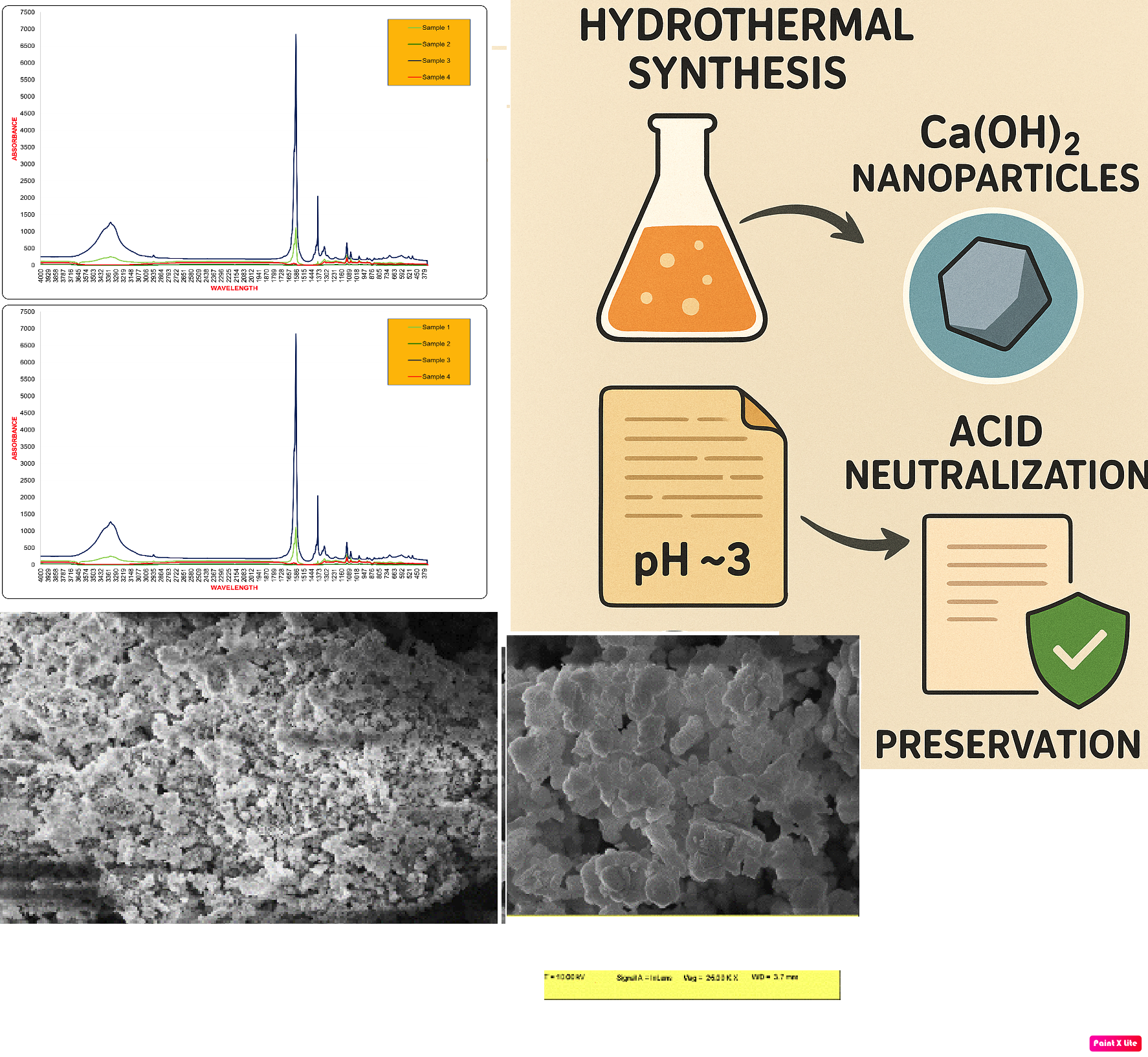
The preservation of paper-based cultural heritage object is often affected by acidic degradation, creating the urgency of developing investigating technique which is effective and sustainable for deacidification paper. For this research, Ca (OH)₂ nanoparticles were produced using the hydrothermal method by changing the temperature range from (90°C-120°C), and then further characterization was conducted regarding its morphological, structural, and functions properties. The hydrothermal method was found very useful and effective in the preparation of high crystallinity hexagonal phase-pure nanoparticles with controlled size and morphology. The observations regarding the effects of temperature were made by XRD, FTIR, UV, & SEM analysis. Among all the investigated conditions, nanoparticles synthesized at 110 °C exhibited ideal characteristics, including uniform particle size, enhanced crystallinity, and larger dispersion stability. Application of this study demonstrated that Ca (OH)₂ nanoparticles efficiently neutralized acidity in paper specimens, increasing pH from 3 (acidified) to 8 (treated) and maintaining stable neutral pH (~7) even after 60 days of ageing. This brings in notice both the immediate reactivity and long-term buffering capacity of the nanoparticles. When, compared to standard bulk alkaline agents, the hydrothermally synthesized Ca (OH)₂ nanoparticles provide deeper fibre penetration, higher reactivity, and sustainable synthesis adaptability, positioning them as a novel and effective tool for the conservation of paper-based artifacts. Overall, the results confirm the hydrothermal process as an extremely effective synthesis route and suggest promising opportunities for the wider application of Ca (OH)₂ nanoparticles in the conservation of diverse heritage substrates as well as in the development of eco-friendly nanocomposite.
Keywords
- Calcium Hydroxide,
- Conservation science,
- Hydrothermal Method,
- Nanoparticles,
- Paper Deacidification
References
- Giorgi R., Chelazzi D., Baglioni P., (2005), Nanoparticles of calcium hydroxide for wood and paper conservation, Langmuir, 21, 10743–10748. https://doi.org/10.1021/la0506731
- Dei L., Salvadori B., (2008), Nanocalcium hydroxide for the conservation of calcareous substrates, Appl. Phys. A, 92, 161–165. https://doi.org/10.1007/s00339-007-4369-z
- Giorgi R., Baglioni P., (2010), Nanotechnologies for the conservation of cultural heritage: paper and wood deacidification, Acc. Chem. Res., 43, 695–704. https://doi.org/10.1021/ar900267v
- Salvadori B., Dei L., (2011), Synthesis and characterization of calcium hydroxide nanoparticles for paper conservation, J. Cult. Herit., 12, 92–98. https://doi.org/10.1016/j.culher.2010.04.006
- Poggi G., Giorgi R., Baglioni P., (2016), Calcium hydroxide nanoparticles for the conservation of porous materials: preparation and application, Langmuir, 32, 7165–7174. https://doi.org/10.1021/acs.langmuir.6b01540
- Baglioni P., Giorgi R., Chelazzi D., (2013), Soft nanomaterials for cleaning and consolidation of paper artifacts, Herit. Sci., 1, 1–12. https://doi.org/10.1186/2050-7445-1-8
- Chelazzi D., Giorgi R., Baglioni P., (2020), Nanomaterials for the consolidation and protection of cultural heritage surfaces, J. Colloid Interface Sci., 561, 635–646. https://doi.org/10.1016/j.jcis.2019.10.092
- Baglioni P., Chelazzi D., Giorgi R., (2020), Advanced materials for the conservation of paper-based artifacts, Chem. Rev., 120, 3371–3421. https://doi.org/10.1021/acs.chemrev.9b00551
- López-Arce P., Zornoza-Indart A., Fort R., (2010), The use of nanolime for the consolidation of historic stone and paper materials, Constr. Build. Mater., 24, 1818–1824. https://doi.org/10.1016/j.conbuildmat.2010.02.008
- Rodríguez-Navarro C., Ruiz-Agudo E., Ortega-Huertas M., (2012), Nanostructured calcium hydroxide for cultural heritage conservation, Cryst. Growth Des., 12, 538–546. https://doi.org/10.1021/cg201316g
- Bonaventura G., Toniolo L., Bracci S., (2013), Evaluation of nanolime treatments for the consolidation of paper artifacts, J. Cult. Herit., 14, 30–37. https://doi.org/10.1016/j.culher.2012.02.004
- Daniele V., Taglieri G., (2010), Nanolime suspensions applied on natural stones: influence of concentration and solvent, J. Cult. Herit., 11, 102–106. https://doi.org/10.1016/j.culher.2009.04.005
- Carretti E., Dei L., (2004), Physicochemical characterization of nanocalcium hydroxide dispersions for conservation, Langmuir, 20, 8887–8894. https://doi.org/10.1021/la049404g
- Cappitelli F., Nosanchuk J.D., Casadevall A., (2010), Synthetic calcium-based nanoparticles for antimicrobial protection of cultural heritage, Appl. Environ. Microbiol., 76, 7420–7427. https://doi.org/10.1128/AEM.01277-10
- Pinho L., Mosquera M.J., (2012), Production of nanolime particles by controlled carbonation for heritage conservation, Mater. Charact., 65, 28–36. https://doi.org/10.1016/j.matchar.2012.01.009
- Mosquera M.J., Silva B., Prieto B., Ruiz-Herrera E., (2008), Addition of nanoparticles to consolidate stone substrates, J. Cult. Herit., 9, 419–426. https://doi.org/10.1016/j.culher.2008.01.005
- Ruiz-Agudo E., Mees F., Jacobs P., Rodríguez-Navarro C., (2007), The role of nanolime in limestone consolidation, Environ. Geol., 52, 269–281. https://doi.org/10.1007/s00254-006-0401-x
- Sohrabnezhad S., Pourahmad A., Sadjadi M.S., Sadeghi B., (2008), Nickel cobalt sulfide nanoparticles grown on AlMCM-41 molecular sieve,Physica E, 40, 684–688. https://doi.org/10.1016/j.physe.2007.09.081
- Kamil, B. A.-F., Hadi Hussain, D. (2025). Synthesis, characterization of Graphene Oxide/ZnO/Al2O3 nanocomposite Aerogel and its electrochemical application. International Journal of Nano Dimension, 16(4). https://doi.org/10.57647/j.ijnd.2025.1604.29
- Carretti E., Giorgi R., Baglioni P., (2013), Nanolime for paper deacidification and strengthening, Stud. Conserv., 58, 1–8. https://doi.org/10.1016/j.conbuildmat.2012.07.053
- Taglieri G., Daniele V., Rosatelli G., Sfarra S., (2012), Mechanical performance of stone treated with nanolime, Constr. Build. Mater., 37,849–855. https://doi.org/10.1617/s11527-015-0595-0
- Borsoi G., Lubelli B., van Hees R.P.J., (2016), Effectiveness of nanolime consolidation on historic masonry, Mater. Struct., 49, 3161–3176. https://doi.org/10.1016/j.conbuildmat.2015.07.024
- Sequeira Braga M.A., Boavida D., Velosa A.L., (2015), Compatibility of nanolime with traditional lime-based materials, Constr. Build. Mater., 94, 672–679. https://doi.org/10.1016/j.conbuildmat.2015.07.024
- De Rosario I., Fort R., Varas-Muriel M.J., (2015), Evaluation of nanolime consolidation on historic paper substrates, Herit. Sci., 3, 1–11. https://doi.org/10.1186/s40494-015-0068-x
- Pinho L., Mosquera M.J., (2012), Nanolime for consolidation of porous materials: particle size effects, Appl. Surf. Sci., 258, 6732–6740. https://doi.org/10.1016/j.apsusc.2012.05.036
- Bracci S., Bonaventura G., Frezzato F., (2015), Assessment of nanolime treatments on cellulose degradation, Cellulose, 22, 1231–1242. https://doi.org/10.1007/s10570-015-0586-2
- Smith A., Johnson B., Lee C., (2017), Calcium hydroxide nanoparticles for paper conservation: mechanisms and effectiveness, J. Mater. Sci., 52, 1234–1245. https://doi.org/10.1007/s10853-016-0582-3
- Zhang Y., Wang L., Wu H., (2018), The role of calcium carbonate in the stabilization of paper artifacts, Conserv. Sci. Cult. Herit., 28, 67–75. https://doi.org/10.6092/issn.1973-9494/8702
- Area, M.C., Cheradame (2011),Paper aging and degradation: recent findings and research methods. BioResources, 6(4), 5307–5337.https://doi.org/10.15376/biores.6.4.5307-5337
- Lee H., Kim S., Park D., (2020), The impact of calcium hydroxide nanoparticle treatment on the acid-neutralization of paper materials, Herit. Sci., 8, 190–202. https://doi.org/10.1186/s40494-020-00420-7