
 10.57647/j.ijc.2024.1402.13
Efficient photodegradation of paracetamol by TiO2/ZnO photocatalyst and prediction via Fuzzy Inference System
- Zul Adlan Mohd Hir*

 1
1 - Hamizah Mokhtar2
- Hartini Ahmad Rafaie3
- Shaari Daud4
- Norshahidatul Akmar Mohd Shohaimi4
- Nik Muhammad Farhan Hakim Nik Badrul Alam5
- Catalysis for Sustainable Water and Energy Nexus Research Group, School of Chemical Engineering, College of Engineering, Universiti Teknologi MARA, Shah Alam, Selangor, Malaysia
- Civil Engineering Studies, College of Engineering, Universiti Teknologi MARA Pahang Branch, Jengka, Pahang, Malaysia.
- Centre of Foundation Studies, Universiti Teknologi MARA, Selangor Branch, Dengkil Campus, Dengkil, Selangor, Malaysia.
- Faculty of Applied Sciences, Universiti Teknologi MARA Pahang, Bandar Tun Abdul Razak Jengka, Pahang, Malaysia.
- College of Computing, Informatics and Mathematics, Universiti Teknologi MARA Pahang, Bandar Tun Abdul Razak Jengka, Pahang, Malaysia.

Published in Issue 2024-05-25
How to Cite




PDF views: 236
HTML views: 14





Abstract
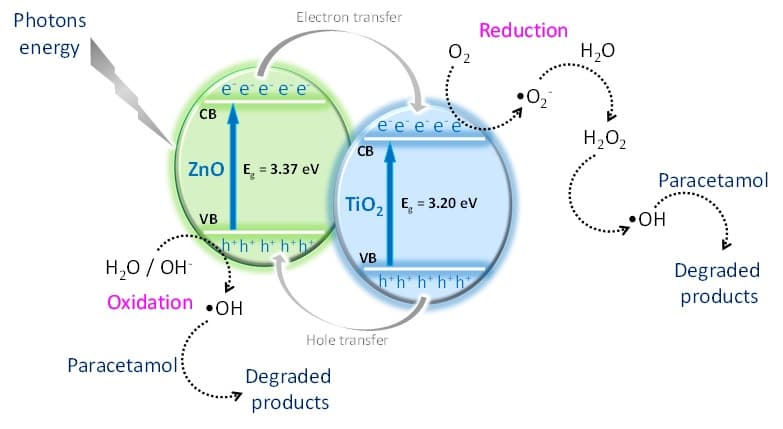
A facile chemical mixing approach was used to prepare TiO2/ZnO photocatalystswith different mass ratios. The photodegradation activity was tested against paracetamol in an aqueous phase assisted by low UVC-light intensity (9 W). TiO2/ZnO particles mainly exhibited irregular shapes with uniform distributions and high crystallinity degree, the primary oxidation state in the structure is titanium Ti4+ of anatase TiO2 (459.2 and 464.9 eV), and the presence of standard chemical state of Zn2+ (1021.9 and 1044.9 eV). The composite with a 1:5 mass ratio displayed a rapid and outstanding degradation percentage of 95% and a rate of 1.83 Ã 10-2 min-1. The best photocatalyst can be recycled up to five times towards paracetamol degradation without any regeneration step or severe deactivation. A Fuzzy inference system (FIS) was computed for the first time to investigate the relationship between the TiO2/ZnO ratio, degradation percentage, and rate constant. The optimal concentration of 9 mg/L was obtained, whereby the degradation percentage and rate were sufficiently maintained above 90% and 0.19 mg/L.min, respectively. Using a fuzzy logic controller (FLC) in this work enables future guidance and prediction for developing the best TiO2/ZnO photocatalysts for real-world water remediation processes.
Highlights1. Facile preparation of TiO2/ZnO composite photocatalyst via simple mixing for degradation of paracetamol under low UVC light intensity (9 W).
2. TiO2/ZnO particles are mostly exhibited irregular shapes with uniform distributions and high crystallinity degree, the main oxidation state in the structure is titanium Ti4+ of anatase TiO2 (459.2 and 464.9 eV), and the presence of standard chemical state of Zn2+ (1021.9 and 1044.9 eV).
3. TiO2/ZnO (1:5) displayed a rapid and outstanding degradation percentage of 95% and rate of 1.83 Ã 10-2 min-1, in accordance with pseudo first-order kinetics.
4. The optimal concentration of 9 mg/L was computed by the prediction using fuzzy inference system (FIS) for the first time, whereby the degradation percentage and rate were sufficiently maintained above 90% and 0.19 mg/L.min, respectively.
5. The stability of TiO2/ZnO composite photocatalyst towards paracetamol degradation was retained up to 5 cycles, without undergo any regeneration procedure.
Keywords
- Fuzzy inference system,
- Paracetamol,
- Photodegradation,
- Titanium dioxide,
- Water remediation,
- Zinc oxide