
 10.57647/ijc.2026.1602.15
Vanadium-Doped Zirconia as an Efficient Visible-Light Photocatalyst for Advanced Treatment of Dye-Loaded Wastewater
- Samra Tahir*

 1
1 - Fatima Waheed1
- Momal Akram2
- School of Chemistry, University of the Punjab, Lahore 54590, Pakistan
- Department of Basic & Applied Chemistry, Faculty of Science & Technology, University of Central Punjab, Lahore 54000, Pakistan

Received: 2025-10-22
Revised: 2025-11-30
Accepted: 2026-02-07
Published in Issue 2026-06-23
Published Online: 2026-05-08

This work is licensed under a Creative Commons Attribution 4.0 International License.
How to Cite




PDF views: 83





Abstract
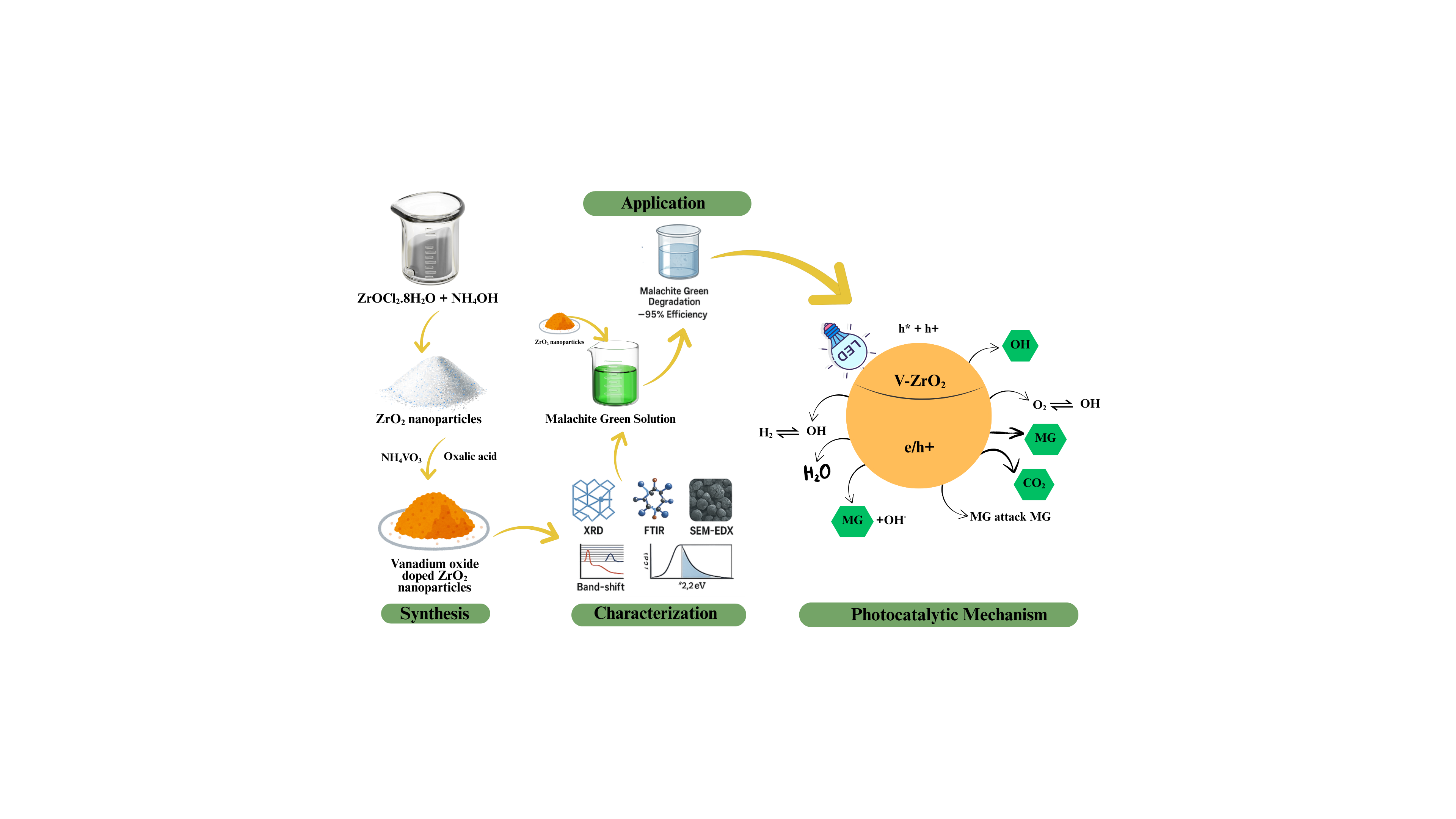
The Vanadium oxide doped zirconia (V–ZrO₂) nanoparticles were synthesized via a wet-impregnation route and evaluated as visible-light photocatalysts for the degradation of malachite green (MG). Structural and surface analyses (XRD, FTIR, SEM–EDX, pHpzc) confirmed the formation of mixed-phase ZrO₂ with dispersed surface vanadium species that enhance light absorption and reduce band gap to ~2.2 eV. The photocatalytic performance was optimized by varying key operational parameters. The maximum degradation efficiency was obtained at pH 12, 0.3 g catalyst dose, 10 ppm initial dye concentration, 45 min irradiation, and 60 °C, achieving 95–97% MG removal. Kinetic analysis showed that the degradation followed the pseudo-second-order model (R² = 0.9645) more closely than the pseudo-first-order model (R² = 0.8521), supported by the Langmuir–Hinshelwood fit (R² = 0.99), indicating a surface-controlled, adsorption-dependent pathway. Temperature dependent kinetics yielded activation energies of 12.9 kJ·mol⁻¹ (PFO) and 30.6 kJ·mol⁻¹ (PSO), confirming efficient, low-energy degradation. Mechanistic evaluation revealed that the process is dominated by an indirect pathway involving reactive oxygen species (•OH and O₂•⁻). These results demonstrate that V–ZrO₂ is a promising visible-light photocatalyst for efficient treatment of dye-contaminated wastewater.
Highlights1. Synthesis of vanadium oxide doped zirconia (V–ZrO₂) as an efficient photocatalyst.
2. Vanadium doping of ZrO₂ successfully extends its photocatalytic activity into the visible light region by narrowing the bandgap.
3. Structural modifications, crystallinity, and enhanced optical absorption due to vanadium integration were confirmed by pHpzc, XRD, FTIR, SEM-EDX, and UV-Vis analyses.
4. High degradation efficiency of Malachite Green dye achieved under visible light
5. Kinetic modeling indicates strong alignment with pseudo-second-order and Langmuir–Hinshelwood models, revealing surface-controlled reaction pathways.
6. V-ZrO₂ proves to be effective and eco-friendly for treating dye-contaminated wastewater.
Keywords
- Advanced oxidation process; Dye degradation; Emerging contaminants; Visible-light photocatalysis; Vanadium-doped zirconia; Wastewater treatment;
References
- M. Jain, S.A. Khan, K. Sharma, M.A. Blaskovich et al., Bioresour. Technol. 344 (2022) 126305. https://doi.org/10.1016/j.biortech.2021.126305.
- P.O. Oladoye, T.O. Ajiboye, E.O. Omotola, O.J. Oyewola, Results Eng. 16 (2022) 100678. https://doi.org/10.1016/j.rineng.2022.100678.
- J. Abdi, M. Vossoughi, N.M. Mahmoodi, I. Alemzadeh, Chem. Eng. J. 326 (2017) 1145–1158. https://doi.org/10.1016/j.cej.2017.06.054.
- V. Katheresan, J. Kansedo, S.Y. Lau, J. Environ. Chem. Eng. 6 (2018) 4676–4697. https://doi.org/10.1016/j.jece.2018.06.060.
- S.I. Sinar Mashuri, M.L. Ibrahim, M.F. Kasim, M.S. Mastuli, U. Rashid, et al. Catalysts 10 (2020) 1260. https://doi.org/10.3390/catal10111260.
- D. Chen, Y. Cheng, N. Zhou, P. Chen, P. Peng, R. Zhang, J. Clean. Prod. 268 (2020) 121725. https://doi.org/10.1016/j.jclepro.2020.121725.
- S. Mehra, M. Singh, P. Chadha, Toxicol. Int. 28 (2021) 165–176. https://doi.org/10.18311/ti/2021/v28i2/26798.
- J. Yadav, O. Sahu, Ceram. Int. 49 (2023) 24831–24851. https://doi.org/10.1016/j.ceramint.2023.05.010.
- J. Yadav, K. Qanungo, AIP Conf. Proc. 2535 (2023) 030020. https://doi.org/10.1063/5.0111400.
- J. Sharma, S. Sharma, V. Soni, Reg. Stud. Mar. Sci. 62 (2023) 102911. https://doi.org/10.1016/j.rsma.2023.102911.
- R. Hasan, M.M. Hasan, M.A. Reza, M.S. Biswas, Toxicol. Lett. 409 (2025) 61–73. https://doi.org/10.1016/j.toxlet.2025.05.003.
- Y. Zheng, G. Luo, G. Chen, R. Jiang, G. Ouyang, J. Clean. Prod. 501 (2025) 145335. https://doi.org/10.1016/j.jclepro.2025.145335.
- M.A. Hoque, M.I. Guzman, Materials 11 (2018) 1990. https://doi.org/10.3390/ma11101990.
- K. Mhalshekar, S. Selvam, A. Sahoo, M.P. Illa, M. Gaydhane, ACS Omega 10 (2025) 45965–45981. https://doi.org/10.1021/acsomega.5c06750.
- S.S. Batool, R. Saleem, R.R.M. Khan, Mater. Sci. Semicond. Process. 178 (2024) 108419. https://doi.org/10.1016/j.mssp.2024.108419.
- M.A. Wahba, S.M. Yakout, J. Sol-Gel Sci. Technol. 92 (2019) 628–640. https://doi.org/10.1007/s10971-019-05103-2.
- P. Čičmanec, Y. Ganjkhanlou, J. Kotera, J.M. Hidalgo, Appl. Catal. A Gen. 564 (2018) 208–217. https://doi.org/10.1016/j.apcata.2018.07.040.
- I. Apostolova, A. Apostolov, J. Wesselinowa, Nanomaterials 13 (2022) 145. https://doi.org/10.3390/nano13010145.
- M. Rezaei, E. Heydari-Bafrooei, A.A. Ensafi, J. Alloys Compd. (2025) 181214. https://doi.org/10.1016/j.jallcom.2025.181214.
- E. Heydari-Bafrooei, M. Rezaei, M. Ahmadi et al. Mater. Chem. Phys. 332 (2025) 130254. https://doi.org/10.1016/j.matchemphys.2024.130254.
- M. Rezaei, A. Nezamzadeh-Ejhieh, A.R. Massah, Energy Fuels 38 (2024) 7637–7664. https://doi.org/10.1021/acs.energyfuels.4c00325.
- M. Rezaei, A.A. Ensafi, et al. Colloids Surf. A Physicochem. Eng. Aspects 708 (2025) 135993. https://doi.org/10.1016/j.colsurfa.2024.135993.
- S. Samantaray, B. Mishra, D. Pradhan, G. Hota, Ceram. Int. 37 (2011) 3101–3108. https://doi.org/10.1016/j.ceramint.2011.05.047.
- A. Adamski, Z. Sojka, K. Dyrek, M. Che, Solid State Ion. 117 (1999) 113–122. https://doi.org/10.1016/S0167-2738(98)00254-9.
- S. Tibebu, M.A. Gnaro, A.M. Kebede, A.A. Ammona, et al. M. Jabli, Results Eng. (2025) 108143. https://doi.org/10.1016/j.rineng.2025.108143.
- I.A. Amar, A.A. Nouh, A.M. Aljarani, A. Hosseini-Bandegharaei, Chem. Afr. (2025) 1–34. https://doi.org/10.1007/s42250-025-01472-0.
- M. Kosmulski, Adv. Colloid Interface Sci. 319 (2023) 102973. https://doi.org/10.1016/j.cis.2023.102973.
- F. Azeez, E. Al-Hetlani, M. Arafa, Y. Abdelmonem, A.A. Nazeer, M.O. Amin, Sci. Rep. 8 (2018) 1–9. https://doi.org/10.1038/s41598-018-25673-5.
- I.G. Alhindawy, K. Mahmoud, Adv. Compos. Hybrid Mater. 8 (2025) 1–25. https://doi.org/10.1007/s42114-025-01379-x.
- S. Ojala, T. Laitinen, S. Leneuf de Neufville, M. Honkanen, R.L. Keiski, Materials 14 (2021) 5265. https://doi.org/10.3390/ma14185265.
- A. Moshfegh, A. Ignatiev, Thin Solid Films 198 (1991) 251–268. https://doi.org/10.1016/0040-6090(91)90344-W.
- S. Chen, F. Ma, A. Xu, L. Wang, F. Chen, W. Lu, Appl. Surf. Sci. 289 (2014) 316–325. https://doi.org/10.1016/j.apsusc.2013.10.158.
- D. Gazzoli, S. De Rossi, G. Ferraris, G. Mattei, J. Mol. Catal. A Chem. 310 (2009) 17–23. https://doi.org/10.1016/j.molcata.2009.05.014.
- N. Horti, M. Kamatagi, S. Nataraj, M. Wari, S. Inamdar, Nano Express 1 (2020) 010022. https://doi.org/10.1088/2632-959X/ab8684.
- F. Ren, S. Ishida, N. Takeuchi, J. Am. Ceram. Soc. 76 (1993) 1825–1831. https://doi.org/10.1111/j.1151-2916.1993.tb06654.x.
- J.R. Sohn, S.G. Cho, Y.I. Pae, S. Hayashi, J. Catal. 159 (1996) 170–177. https://doi.org/10.1006/jcat.1996.0076.
- Y. Luo, Y. Wu, Nanomaterials 13 (2023) 1116. https://doi.org/10.3390/nano13061116.
- B.D. Cullity, R. Smoluchowski, Phys. Today 10 (1957) 50. https://doi.org/10.1021/ja01564a077.
- A. Bumajdad, A.A. Nazeer, F. Al Sagheer, S. Nahar, M.I. Zaki, Sci. Rep. 8 (2018) 3695. https://doi.org/10.1038/s41598-018-22088-0.
- M. Petriceanu, F.G. Ioniță, I.A. Tudor, Ș. Caramarin, C.F. Ciobota, Inorganics 12 (2024) 290. https://doi.org/10.3390/inorganics12110290.
- Y. Kera, S. Teratani, K. Hirota, Bull. Chem. Soc. Jpn. 40 (1967) 2458. https://doi.org/10.1246/bcsj.40.2458.
- A. Teimouri, B. Najari, A.N. Chermahini, H. Salavati, RSC Adv. 4 (2014) 37679–37686. https://doi.org/10.1039/C4RA07435A.
- M. Patel, S. Mishra, R. Verma, D. Shikha, Discov. Mater. 2 (2022) 1. https://doi.org/10.1007/s43939-022-00022-6.
- D. Gazzoli, S. De Rossi, G. Ferraris, M. Valigi, Appl. Surf. Sci. 255 (2008) 2012–2019. https://doi.org/10.1016/j.apsusc.2008.06.139.
- S.R. Teeparthi, E.W. Awin, R. Kumar, Sci. Rep. 8 (2018) 5541. https://doi.org/10.1038/s41598-018-23648-0.
- M. Kantcheva, Solid State Ion. 141 (2001) 487–492. https://doi.org/10.1016/S0167-2738(01)00793-7.
- M. Rezaei, A. Nezamzadeh-Ejhieh, Int. J. Hydrogen Energy 45 (2020) 24749–24764. https://doi.org/10.1016/j.ijhydene.2020.06.258.
- A.Z. Johannes, R.K. Pingak, M. Bukit, IOP Conf. Ser. Mater. Sci. Eng., IOP Publishing, 2020, pp. 012030.
- Z. Xu, N. Zada, F. Habib, H. Ullah, K. Hussain, H. Ghani, S. Khan, Molecules 28 (2023) 6241. https://doi.org/10.3390/molecules28176241.
- Y. Chen, M. Cai, J. Li, W. Zhang, Water 17 (2025) 1452. https://doi.org/10.3390/w17101452.
- M.F. Elkady, H.S. Hassan, Polymers 13 (2021) 2033. https://doi.org/10.3390/polym13132033.
- P. Bansal, N. Bhullar, D. Sud, Desalin. Water Treat. 12 (2009) 108–113. https://doi.org/10.5004/dwt.2009.944.
- K. Saeed, M. Sadiq, I. Khan, S. Ullah, N. Ali, A. Khan, Appl. Water Sci. 8 (2018) 60. https://doi.org/10.1007/s13201-018-0709-7.
- F. Boran, M. Okutan, Turk. J. Chem. 47 (2023) 448–464. https://doi.org/10.55730/1300-0527.3551.
- C. Mita, N. Cornei, M. Frenti, G. Bulai, M. Dobromir, D. Mardare, Materials 16 (2023) 5901. https://doi.org/10.3390/ma16175901.
- M.H. Zare, A. Mehrabani-Zeinabad, Sci. Rep. 12 (2022) 10388. https://doi.org/10.1038/s41598-022-14674-0.
- S. Jabeen, M. Sufaid Khan, R. Khattak, A. Kallistova, N. Pimenov, M. Zahoor, Water 13 (2021) 1522. https://doi.org/10.3390/w13111522.
- F. Alresheedi, Results Phys. 79 (2025) 108521. https://doi.org/10.1016/j.rinp.2025.108521.
- A. Ajmal, I. Majeed, R.N. Malik, H. Idriss, M.A. Nadeem, RSC Adv. 4 (2014) 37003–37026. https://doi.org/10.1039/C4RA06658H.
- Y. Khan, H. Sadia, S.Z. Ali Shah, M.N. Khan, A.A. Shah, N. Ullah, N.B. Khedher, Catalysts 12 (2022) 1386. https://doi.org/10.3390/catal12111386.
- M.K.H.M. Nazri, N. Sapawe, Mater. Today Proc. 31 (2020) A42–A47. https://doi.org/10.1016/j.matpr.2020.10.967.
- V. Selvaraj, T.S. Karthika, C. Mansiya, M. Alagar, J. Mol. Struct. 1224 (2021) 129195. https://doi.org/10.1016/j.molstruc.2020.129195.
- W. Fang, J. Yan, Z. Wei, J. Liu, W. Guo, Z. Jiang, W. Shangguan, Chin. J. Catal. 60 (2024) 1–24. https://doi.org/10.1016/S1872-2067(23)64637-6.