
 10.71877/ijamad.2025.8437
Semantic Reconstruction of Inverse Immigration by Grounded Theory: Case of Divandarreh District, Iran
- Hossein Ghodrati*
 1
1 - Kaveh Salimi2
- Shafieh Ghodrati1

Received: 06-06-2024
Revised: 28-10-2024
Accepted: 07-12-2024
Published in Issue 27-03-2025
Copyright (c) 2025 Hossein Ghodrati, Kaveh Salimi, Shafieh Ghodrati (Author)

This work is licensed under a Creative Commons Attribution 4.0 International License.




PDF views: 575





Abstract
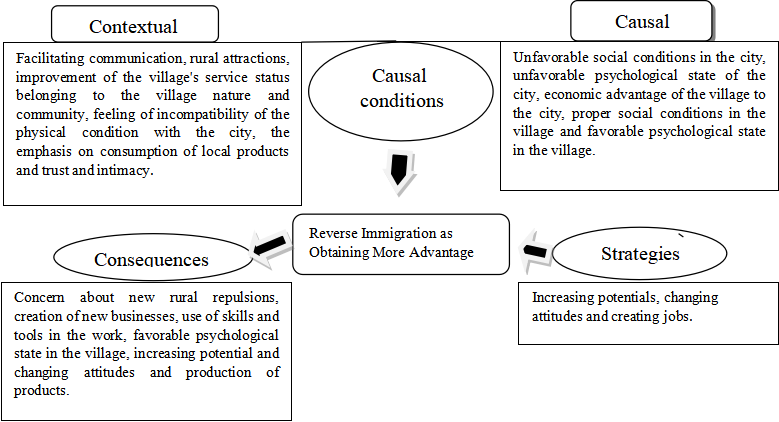
Migration, as an integral component of both regional and international processes, significantly impacts the contemporary world and the spatial mobility of societies, influencing family, social bonds, economy, politics, culture, and communication. This research aimed to examine the social reconstruction of reverse migration based on the interpretations and mental meanings of those who have experienced it. Grounded theory and semi-structured interviews were used for this purpose. The participants included 16 individuals who had returned as migrants from the city of Saqez to the village of Abbareh in Iran. These individuals were selected through theoretical sampling and the criterion of theoretical saturation. The data were coded into 145 concepts, 15 major categories, and 1 core category encompassing the axial category. The categories include: economic advantages of the village over the city, unfavorable social conditions in the city, favorable social conditions in the village, unfavorable psychological states in the city, favorable psychological states in the village, facilitated communication, rural attractions, improved village services, attachment to village nature and community, physical incompatibility with the city, emphasis on consuming local products, increased potential and changing attitudes, new rural repulsions, trust and intimacy, and the factor of migration to the city. These categories are presented in a paradigmatic model based on three dimensions: causation, strategies, and outcomes. Ultimately, the core category identified was "perceived relative advantage of the village." The findings indicate that reverse migration resulted from the perceived social, economic, and leisure benefits of village life compared to the city. The return of migrants was driven by dissatisfaction with urban living and the presence of job opportunities, leisure attractions, intimacy, and trust among friends, relatives, and village residents.
Keywords
- Grounded theory,
- reverse Immigration,
- Iran,
- relative advantage of the village
References
- Abrahizadeh Asmin, H., Ashtri Mehrjardi, A., & Eslami, I. (2020). Rural reverse migration with urban lifestyle change. Scientific and Research Quarterly of New Approaches in Human Geography, 12(1), 169-186.
- Afraqat, H., Manafi Azar, R., & Valai, M. (2016). Spatial-spatial effects of recurrent migration in the city of Miandoab. Journal of Research and Rural Planning, 5(1), 1-15.
- Ali Babaei, M., & Juma Pour, M. (2016). Rural reverse immigration process and the factors affecting it (Case Study: Hajiloo Village - Kabudarahang). Journal of Research and Rural Planning, 5(4), 45-60.
- Aslani, M. (2006). The study of the immigration process in the Islamic Republic of Iran over the past three decades and its effect on national security (with an emphasis on internal migration to Tehran). Population Magazine, (55), 23-40.
- Azkia, M., & Firouzabadi, S. A. (2006). Social capital and its role in manufacturing formations (Case Study of Azad Karkheh Basin). Iranian Sociological Association, 5(4), 112-130.
- Baniasidi, M., Zare Mehrjerdi, M. R., & Vermesyari, H. (2013). The study of economic factors affecting the immigration of villagers in Iran. Journal of Agricultural Economics Research, 5(1), 183-196.
- Bilecen, T. (2022). To stay or to return? A review on return migration literature. Migration Letters, 19(4), 367-385.
- Camarero, L., Sampedro, R., & Oliva, J. (2014). Foreigners, neighbours, immigrants: Translocal mobilities in rural areas in Spain. In C. Hedberg & R. M. do Carmo (Eds.), Translocal ruralism: Mobility and connectivity in European rural spaces (pp. 143–162). Dordrecht: Springer.
- Cassarino, J. P. (2004). Theorising return migration: The conceptual approach to return migrants revisited. International Journal on Multicultural Societies, 6(2). 253-279.
- de Lima, P. (2012). Boundary crossings: Migration, belonging/‘un‐belonging’ in rural Scotland. In C. Hedberg & R. M. do Carmo (Eds.), Translocal ruralism: Mobility and connectivity in European rural spaces (pp. 203–217). Springer.
- Farrell, M., Mahon, M., & McDonagh, J. (2012). The rural as a return migration destination. European Countryside, 4(1), 31–44.
- Flick, E. (2015). Income on qualitative research (H. Jalili, Trans., 2nd ed.). Tehran: Naie Publishing.
- Gafari, F., Niko Maram, H., & Kanaani Moghaddam, S. (2012). Identifying and assessing economic variables affecting reverse immigration: Case study Tehran metropolis. Journal of Urban Management Studies, 4(9). 58-69.
- Ghasemi Ardahani, A., & Hosseini Rad, A. (2008). Iranian immigration currents during the decade of 1996–2006. Population Magazine, 15(65), 1-26.
- Ghasemi Ardehayi, A., & Nobakht, R. (2016). The causes and determinants of reverse immigration currents in Iran. Journal of Population Association of Iran, 11(21), 42-71.
- Ghasemi, M., Jafan, J., & Saberi, Z. (2014). An analysis of the reasons for the formation of reverse immigration in rural areas of Binalud County. Journal of Arid Regions Geographical Studies, 4(16). 15-37.
- Iran Statistical Center. (2011). Statistical information. https://www.amar.org.ir
- Iran Statistical Center. (2016). Statistical information. https://www.amar.org.ir
- Kordel, S., Weidinger, T., & Rustja, D. (2018). Processes of immigration in rural Europe. Cambridge Scholars Publishing.
- Layder, D. (1997). Modern social theory. Taylor & Francis Ltd.
- Lucas, D., & Mir, P. (2002). An introduction to demographic studies (H. Mahmoudian, Trans.). Tehran University Press.
- Ma, L., Hi, Q., Long, H., Zhang, Y., & Liao, L. (2024). Rural return migration in the post-COVID-19 China: Incentives and barriers. Journal of Rural Studies, 107, 103258.
- Ma, Z. (2001). Urban labour-force experience as a determinant of rural occupation change: Evidence from recent urban–rural return migration in China. Environment and Planning A, 33(2), 237–255.
- McAreavey, R., & Argent, N. (2018). New immigration destinations (NID): Unravelling the challenges and opportunities for migrants and for host communities. Journal of Rural Studies, 64, 148–152.
- Mohajeri, A. A. (1992). Investigating the internal immigration in Iran. Journal of Social Science Education, 13, 17-23.
- Mohmmadpur, A. (2013). Qualitative research methodology: Logic and design in qualitative methodology (2nd ed., Vol. 1, pp. 313–314). Sociologists Publishing.
- Moshfeq, M., & Eidi Terkameh, H. (2012). Measurement of the relation between state incentives and the reversal of immigration in Iran (Case study of staff officers of the Tehran Ministry of Jihad-e-Agriculture). Population Quarterly, 19(81–82), 5-18.
- Mostafa, A. M. (2012). Quality of life indicators in value urban areas: Kasr Elnile Street in Cairo. Procedia - Social and Behavioral Sciences, 50, 254–270.
- Motiai Langroodi, S. H., Ghadiri, M., Mojtaba, R., Mohammad Reza, N., & Abdolhamid, S. B. (2011). The impact of refugees' return to villages on improving livelihoods of the residents (Case study: Aq Qala Township). Human Geography Research, 43(4), 67-84.
- Norouzi, A., & Mahdian, F. (2022). Causes and consequences of reverse migration to the rural areas of Buin and Miandasht County. Spatial Planning, 12(4), 1–22.
- Okali, D., Okpara, E., & Olawoye, J. (2001). The case of Aba and its region, southeastern Nigeria (Working Paper No. 4). Rural–Urban Interactions and Livelihood Strategies Series. Human Settlements Programme, IIED.
- Ottoit, W., & Batamour, T. (2013). Social culture of the twentieth century (H. Chavashian, Trans.). Tehran: Nay Noye.
- Rabbani, R., & Taheri, Z. (2011). A study of the reasons of reverse immigration motives and its impact on socioeconomic development (Case study of residential immigrants in Tonekabon and Ramsar cities). Journal of Management System, 2(5), 83-108.
- Razm Ara, H. A. (1952). Geography of Iran-Abadi. Army Staff Press.
- Ritzer, G. (2004). Modern sociological theory. McGraw-Hill College Publishers.
- Rye, J. F., & O’Reilly, K. (2021). New perspectives on international labour migration to Europe’s rural regions. In J. F. Rye & K. O’Reilly (Eds.), International labour migration to Europe’s rural regions (pp. 3–21). Routledge.
- Shams, M., Ghomari, M., Aboodi, I., & Mohammadi, K. (2011). Investigating the ruralrural immigration and its impact on the city's morphology. Journal of Management System, 1(3), 57-68.
- Sharifzadeh, M. S., Abdollahzadeh, Gh. H., Azhdipour, A., & Sharifi, M. (2016). Phenomenology of the villagers' perception of the place's place of residence in Zabol. Journal of Community Development (Rural–Urban Community), 8(1), 113-138.
- Sheikhi, M. T. (1990). Third world sociology. Tehran: Eshraghi Publishing House.
- Shokouhi, M., Vareshi, H. R., Ghanbari, M., & Samadi, R. (2017). The impact of village integration and reverse immigration in the development of the new Binaloud town. Journal of Geography and Regional Development (Peer-reviewed), 15(28), 25-50.
- Skaptadóttir, U., Innes, P., & Wojtyńska, A. (2024). Migrants’ inclusion in rural communities. Social Inclusion, 12, 1-5.
- Sood, S., & Bala, R. (2022). Assessment of challenges of reverse migration in India in the post-COVID economy. International Journal of Health Sciences, 6(S2), 7949–7953.
- Strauss, A., & Corbin, J. (2015). The basics of qualitative research: The techniques and stages of theory of the earth (E. Afshar, Trans., 4th ed.). Tehran: Nayer Rey.
- Taheri, M. (2011). An analysis of the spatial interaction effects of Tabriz metropolis and residential dwelling areas with emphasis on reverse immigration and its influential factors. Geographical Researches Quarterly Journal, 26(23), 169-188.
- Taherkhani, M. (2001). Recognition of factors affecting urban-migratory migrations with emphasis on migration of rural youth in Qazvin province. Journal of Modares, 6(2), 41-60.
- Turner, J. (2003). Structure of sociological theory. Wadsworth Publishing.
- von Reichert, C., Cromartie, J. B., & Arthun, R. (2013). Impacts of return migration on rural U.S. communities. Rural Sociology, 79, 200–226.
- Wang, W. W. (2004). Urban–rural return labor migration in China: A case study of Sichuan and Anhui provinces. Department of Geography, UCLA.
- Yeonjae Lee, J., Friesen, W., & Kearns, R. A. (2015). Return migration of 1.5 generation Korean New Zealanders: Short-term and long-term motives. New Zealand Geographer, 71, 34–44.
- Zanjani, H. (2001). Immigration. Tehran: Samt.