Background
Research in graphene has attracted significant interest in recent years due to itsremarkable mechanical [ 1 ] and physical properties [ 2 , 3 ]. A single-layer graphene sheet has the thickness of only one carbon atomwhich makes it the thinnest material [ 4 ] with a large specific surface area [ 5 ]. This feature of graphene makes it an ideal candidate fornanoelectromechanical systems (NEMS) [ 6 ] and nanofluidic devices. These future applications require a criticalunderstanding of the exceptional mechanical properties of graphene for itsapplication in NEMS and nanolevel biological devices. Theoretical studies ongraphene are a popular mode of research, employing ab initio calculationsor molecular dynamics (MD) simulation technique.
Application of soft computing methods such as artificial neural networks (ANN),genetic programming, and fuzzy logic can be used as an alternative method formodeling complex behavior of materials such as graphene. These methods require inputtraining data which can be obtained from the analytical tools such as MD that isbased on a specific geometry and temperature. Based on the input, the proposedcomputing method can then be able to generate meaningful solutions for complicatedproblems [ 7 – 11 ]. Additionally, among the various soft computing methods described above,ANN offers the advantage of a fast and cost-effective formulation of a mathematicalmodel based on multiple variables with no existing analytical models [ 12 , 13 ]. It is to the best of author's knowledge that limited or no work existson the application of soft computing models on the tensile properties of graphenesheets.
Hence, in the present work, we have proposed ANN method to model the elasticcharacteristics of hydrogen functionalized graphene (HFG). The values of tensilestrength of HFG generated by MD simulations are further fed into the paradigm ofANN.
Nanoscale material modeling by MD simulation
The classical MD method is deployed to carry out the numerical simulation. Inthis capacity, Newton's equations of motion are computed by means of Brenner'ssecond-generation bond order (REBO) function [
14
] for the set of atoms which are covalently bonded. The REBO potentialis able to accurately describe the properties of solid-state and molecularcarbon nanostructures [
15
,
16
] while maintaining the accuracies of the
ab initio
andsemi-empirical methods in simulating large systems [
15
–
21
]. The mathematical form of the potential equations is defined as
where V R ( r ij ) and V A ( r ij ) are the repulsive and attractive pair terms and b ij term is used to include the reactive empirical bond order between theatoms.
The MD simulation procedure described here is similar to our previous work as canbe seen in [
15
]. The tensile loading procedure of HFG sheet is shown inFigure
1
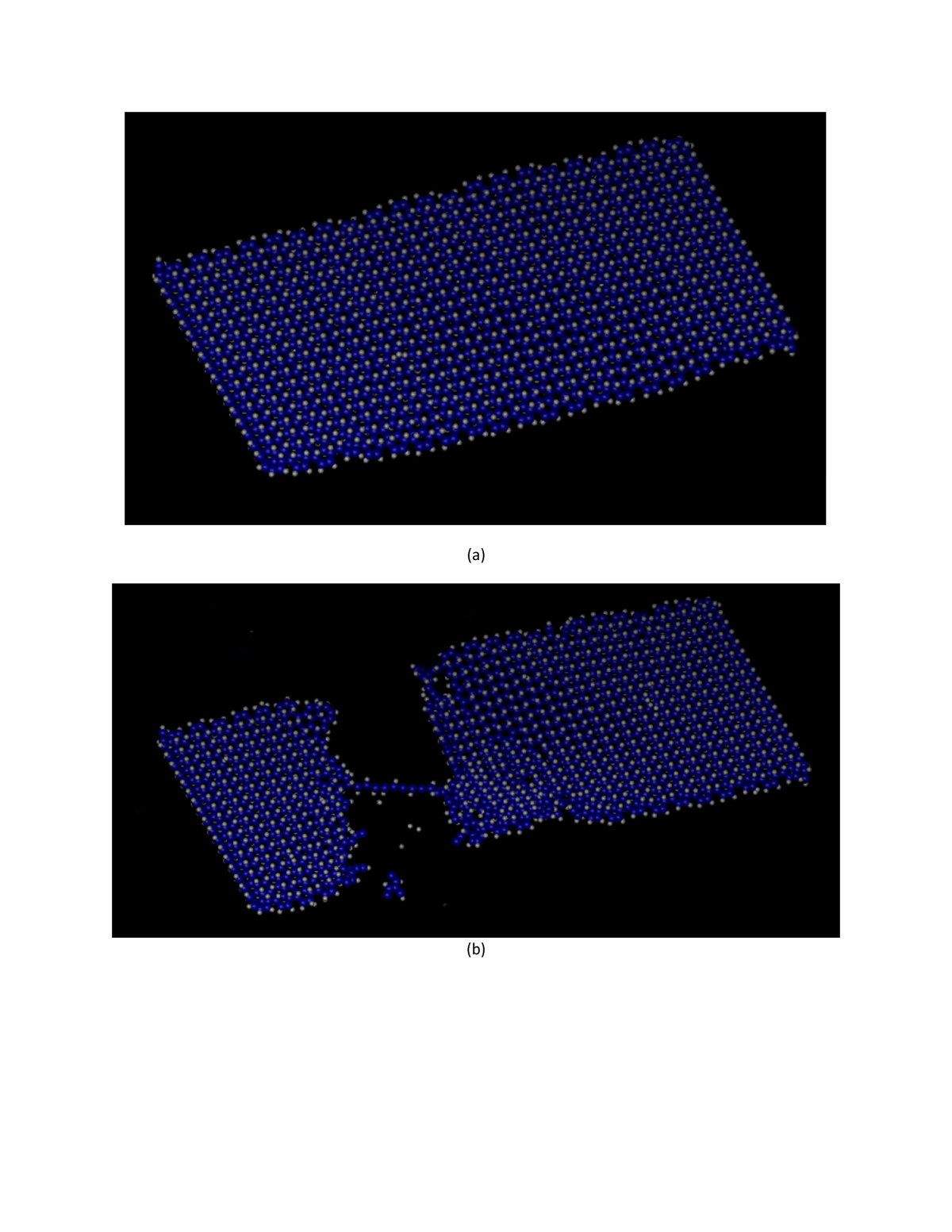
. As an illustration, the morphologicalcharacteristics of the HFG sheet of length 100 Å under tension isdepicted in Figure
2
. The data hence generated by ourMD simulation agrees very well with the literature [
15
,
20
], and hence, we can validate the reliability of our MD simulation.
Mechanism of tensile loading in an HFG sheet by MD simulation
[
15
]
.
Atoms inside the red rectangle are subjected tooutward displacement to affect tensile loading. Tensile loading applied on an HFG sheet
[
15
]
.
The graphene sheet maintains its stable shape
(a)
when no load is applied, further application of tensileload results in breaking and fragmentation as shown in
(b)
.Figure 1
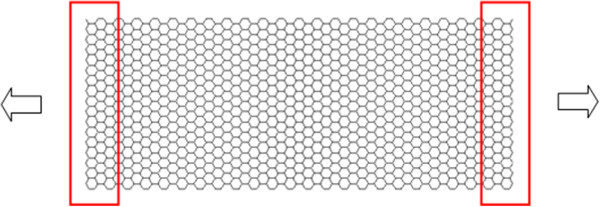
Figure 2
Methods
The data obtained by the MD simulation are shown in Tables
1
and
2
which represent the data for trainingand testing samples, respectively. The main inputs considered in our study arethe percentage of hydrogen functionalization and simulation temperature. Theoutput of our study is the tensile strength of HFG. In order to explicitly testthe extrapolation capability of method, 20 samples are used for training and 11are used for testing. Training samples consist of values of tensile strength attemperatures of 0 and 300 K, whereas testing samples consist of values oftemperature at 600 K.
Data for training obtained by MD simulation Temperature (K) Percentage of hydrogen functionalization Tensile strength (GPa) 0 0 157 0 0.1 135 0 0.2 123 0 0.3 109 0 0.4 92 0 0.5 85 0 0.6 82 0 0.7 83 0 0.8 85 0 0.9 81 0 1 87 300 0 101 300 0.1 72 300 0.2 63 300 0.3 52 300 0.4 43 300 0.5 39 300 0.6 34 300 0.7 35 300 0.8 35 300 0.9 41 300 1 43 Data for testing obtained by MD simulation Temperature (K) Percentage of hydrogen functionalization Tensile strength (GPa) 600 0 51 600 0.1 35 600 0.2 32 600 0.3 25 600 0.4 20 600 0.5 19 600 0.6 15 600 0.7 18 600 0.8 18 600 0.9 21 600 1 22Table 1
Table 2
Nanoscale material modeling by ANN approach
In this paper, we proposed ANN approach. In this approach, data obtained from MDis fed into the paradigm of ANN for training of network. ANN network consist ofthree layers: input, hidden, and output layers. Input layer consist of twoneurons since there are two inputs [ 22 – 31 ]. The number of neurons in the hidden layer is chosen based ontrial-and-error method. The output layer comprise of single neuron, i.e., outputof the system. The neurons of one layer to the neurons of pre-and-after layerare connected through weighted links.
Weights are initialized and are multiplied by input values specified by eachneuron. The neuron estimate summation of weighted inputs and passes it to thetransfer function (
A
) which produces an output
Y
p
.
where
w
i
is weight,
x
i
is the
i
th input variable, and
δ
is the thresholdor offset of the neuron. The activation function used is sigmoid logisticfunction given by
The difference between the output value of network and actual value for a sample
i
is given by
where
Ac
i
and
M
i
are actual and predicted values for
i
th sample, respectively,and
M
is the number of neurons in the output of network. The averageerror for the whole network is given by
where
N
is the total number of samples. The Levenberg-Marquardtalgorithm [
32
] that works on the principle of the second derivative is used tooptimize the Error
p
. The simpler form of Hessian matrix is used and the algorithm iteratesweights using formulae
where j is the Jacobian matrix that consists of the first derivatives ofthe network errors, e is a vector of network errors, μ isthe learning rate, and I is the identity matrix. The weights areupdated by LMA until the threshold error is achieved. The computation of weightsis iterative and it consumes time.
In the present work, feed-forward network of three layers is implemented inMATLAB R2010b. The number of neurons in hidden layer is determined based on theminimum value of root-mean-square error (RMSE) of the model on the training dataset. A trial-and-error approach is adopted to select the number of neurons inthe hidden layers. It was found that for number of neurons six, the RMSE isminimum, and therefore, the ANN model with single hidden layer of six neurons isselected. The performance of the selected ANN model is discussed in the‘Performance comparison of proposed approach’ section.
Results and discussion
The predictions obtained from the proposed approach is compared to thosegenerated using MD simulations based on square of correlation coefficient(
R
2
) given by
where
M
i
and
A
i
are predicted and actual values, respectively,
The results obtained from the simulation studies and predicted by using proposedapproach on training and testing data is shown in Figures
3
and
4
, respectively. The graph shown inFigure
3
indicates that the proposed approach hasimpressively well learned the non-linear relationship between the input andoutput process parameters with high correlation values. The result of testingphase shown in Figure
4
indicates that the valuespredicted by MD-ANN approach are well in agreement with the simulatedvalues.
Comparison between predicted values and simulated values on trainingdata. Comparison between predicted values and simulated values on testingdata.Figure 3
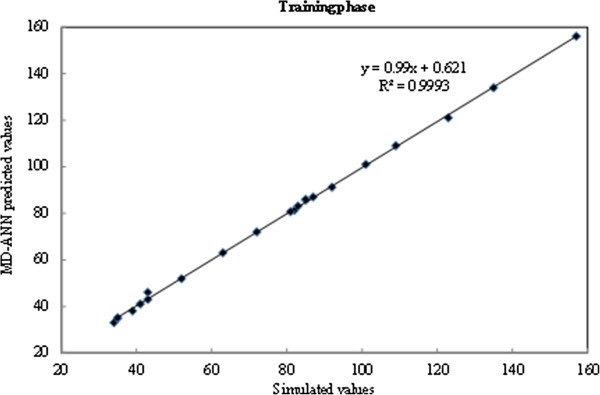
Figure 4
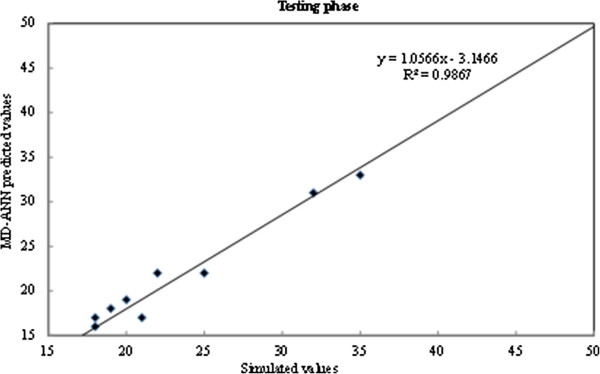
Conclusion
The performance of the proposed MD-ANN approach is evaluated in the‘Performance comparison of proposed approach’ section. The resultsconclude that the MD-ANN model have shown excellent generalization ability withhigh statistical values of R 2 on testing data. The high generalization ability of the MD-ANNmodel is beneficial for MD experts who are currently looking for high fidelitymodels that predict the tensile strength of graphene under uncertain inputprocess conditions, and therefore, the cost of having to run additional MDsimulations can be avoided. The model can be used offline for prediction and canbe further optimized to determine the optimum input process parameters thatmaximize the tensile strength of nanomaterials.