Department of Chemistry, Shahre-Qods Branch, Islamic Azad University, Tehran, IR
Abstract
The method used in this paper is
in situ
process for the synthesis of polyaniline (PANI)/manganese dioxide. Polymerization of aniline was carried out in a one-pot reaction vessel, and MnO
2
particles were influenced by the PANI pores to yield a PANI/MnO
2
nanocomposite. Morphology analysis showed soft and flat surfaces of the PANI/MnO
2
nanocomposite by scanning electron microscopy, and Fourier transform infrared spectroscopy revealed polyaniline being intercalated between manganese oxide layers. Findings showed that the MnO
2
particles should be doped on the network of polyaniline; therefore, the morphology of the product is in the same line with the results.
Background
Between metal oxides, MnO
2
shows a great potential as an alternative material because it is cheap. It is available in abundance and environmentally friendly. Manganese oxides have long been known as materials of technological importance for catalytic and electrochemical applications. However, in comparison with another oxidation, MnO
2
exhibits a much lower electrochemical capacitance [
1
–
5
]. In order to improve the performance of MnO
2
, we can prepare nanocomposites of MnO
2
with conducting polymers [
6
,
7
]. Among these polymers, polyaniline (PANI)/MnO
2
nanocomposites have more applications because the capacitance of these nanocomposites was greatly improved compared with that of pure MnO
2
due to the high conductivity of PANI and the correlation effect between PANI and MnO
2
[
8
,
9
]. Synthesis and studies of nanocomposites of PANI and MnO
2
have attracted much attention due to low cost and environment friendliness of the active materials and also due to a good coating layer to restrain MnO
2
from dissolution in acidic environment [
10
]. It is reported that the nanocomposite obtained through intercalation of PANI into layers of MnO
2
showed an enhanced specific capacitance due to synergistic effects [
11
]. Polyaniline is one of the most promising conducting polymers due to its ease of preparation and good environmental stability; it is soluble in various solvents and exhibits a number of interesting properties such as chemical sensitivity and electrochromism [
12
–
14
]. The chemistry of PANI allows for several routes of synthesis and processing. It is easy to synthesize via simple chemical or electrochemical oxidation methods of aniline. PANI has a wide range of applications such as anticorrosion coating, batteries, and sensor [
15
,
16
].
In situ
chemical polymerization techniques of PANI followed by dipping the partially oxidized PANI in a suspension of the metal oxide is reported for the synthesis of nanocomposites. It is known that MnO
2
can initiate the polymerization of aniline and simultaneously is reduced into soluble Mn
2+
ions [
17
,
18
].
Results and discussion
SEM measurements
Figure
1
shows the scanning electron microscopy (SEM) image of pure polyaniline. As can be seen from this picture, the pores of PANI are formed and the smooth surface is determined. It shows that the blank PANI is constructed with rodlike aggregates. PANI chains are prepared in acidic media and exist in the form of polycations. The strong interactions between charged PANI chains [
19
] facilitate the formation of nanorods.
Figure 1
SEM image of pure PANI.
Findings showed that PANI/MnO
2
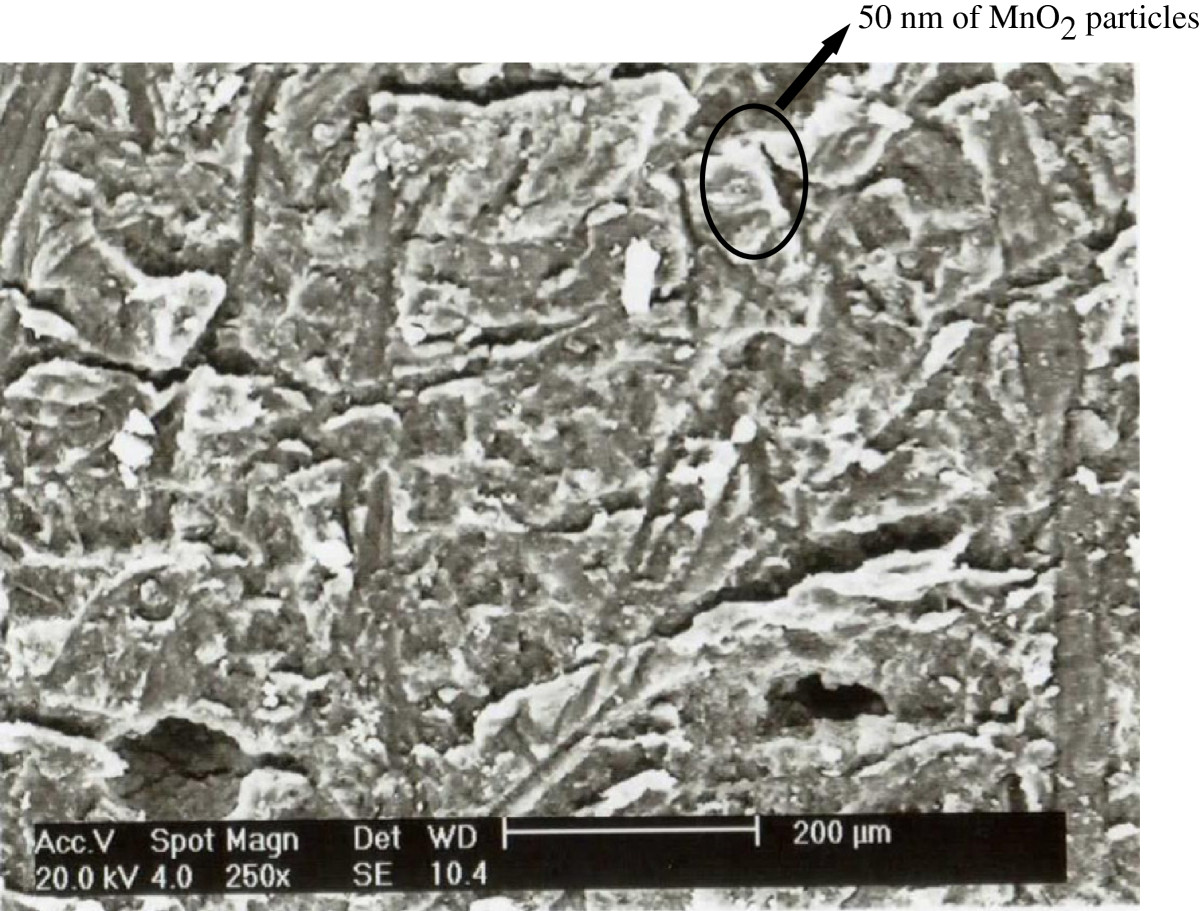
nanocomposite comprises platelike particles, which are about 50 nm in thickness (Figure
2
). The morphology of the product after polyaniline being intercalated between manganese oxide layers is maintained. In addition, the incorporation of MnO
2
nanoparticles would effectively avoid the entanglement of PANI chains due to repulsion between charged MnO
2
nanoparticles in an acidic media. The SEM image of PANI/MnO
2
nanocomposite reveals that the nanocomposite is composed of many nanoparticles which are connected to each other resulting in a porous structure.
Figure 2
SEM image of PANI/MnO2nanocomposite.
FT-IR characterization
Structural information of the synthesized PANI/MnO
2
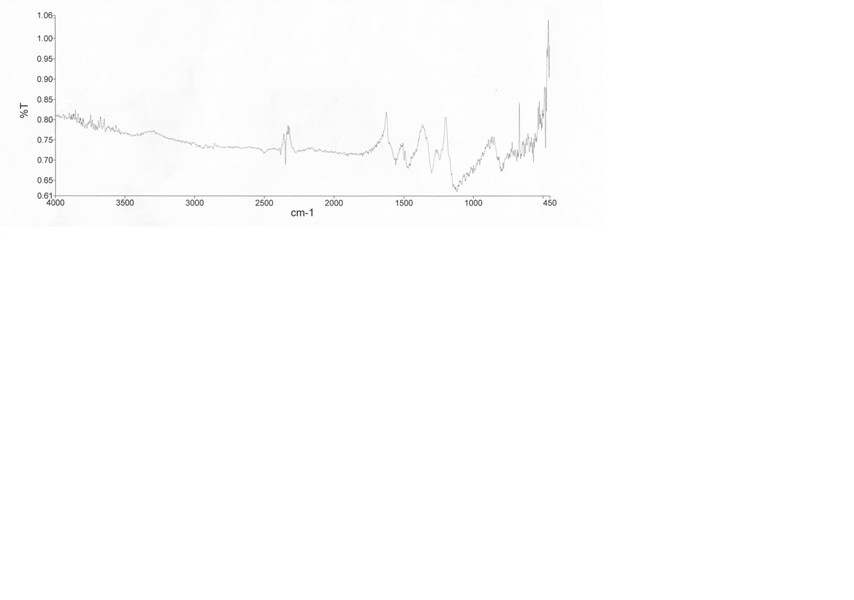
nanocomposite was identified by Fourier transform infrared (FT-IR) spectroscopy. Figure
3
shows the FT-IR spectra of PANI. It can be seen in the spectra the range of 1,600 to 1,000 cm
−1
which comes from the vibrational and rotational bands of the functional groups in PANI. The bands at 1,568 and 1,495 cm
−1
can be assigned to C=C stretching of quinoid and benzenoid rings; the C-N stretchings for the benzenoid unit appear at 1,297 and 1,239 cm
−1
, respectively; the peak at 1,144 cm
−1
can be attributed to the in-plane bending vibration of aromatic C-H. The weak band at 3,320 cm
−1
is attributed to N-H stretching.
Figure 3
FT-IR spectra of pure PANI.
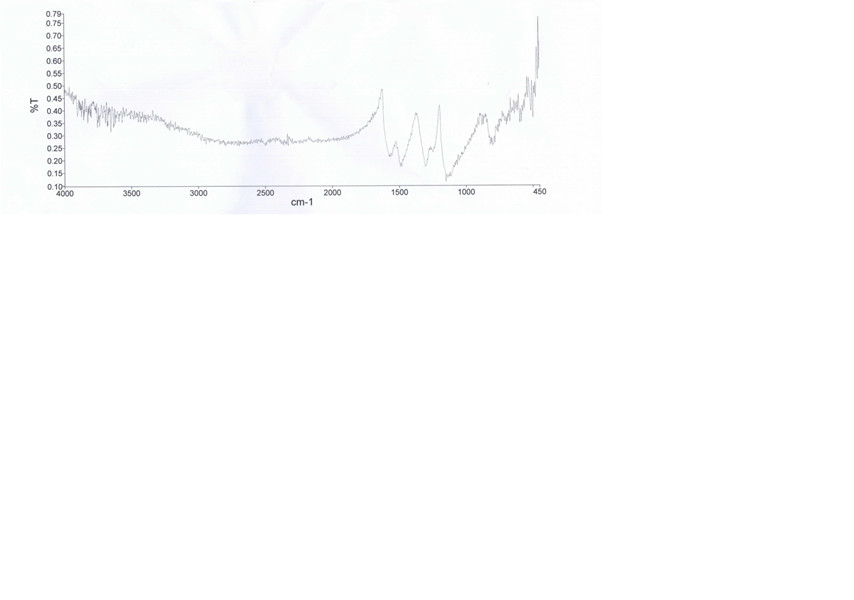
The FT-IR spectra obtained from PANI/MnO
2
nanocomposite showed characteristic peaks of PANI (Figure
4
). For example, vibrational peaks centered at 1,565 and 1,468 cm
−1
are attributed to the stretching peaks of quinoid and benzenoid deformations of PANI. We also observed C-N stretching peaks at 1,238 and 1,300 cm
−1
and C-H bending of protonated PANI at 1,124 cm
−1
. The band in the regions over 400 cm
−1
can be assigned to Mn-O stretching vibrations [
20
]. FT-IR spectra of the PANI/MnO
2
nanocomposite are similar to those of PANI, but the bands' characteristic of polymer backbone at 1,500 and 1,600 cm
−1
are shifted to higher values after annealing, indicating deprotonation. The peak at 1,195 cm
−1
is suppressed after annealing to a greater extent for PANI compared to that for the nanocomposites, indicating a higher extent of deprotonation in pure PANI compared to nanocomposites. The results of FT-IR spectra confirm the presence of both components in the nanocomposite.
Figure 4
FT-IR spectra of PANI/MnO2nanocomposite.
Conclusions
In this work,
in situ
polymerization of aniline in the presence of MnO
2
has been studied. Polyaniline intercalated layered manganese oxide nanocomposite shows great enhancement of morphology than the pristine PANI, which indicates that intercalation of PANI into the layered MnO
2
. From the SEM and FT-IR results, we obtained that the nanocomposite is synthesized and that the information are in the same line with each other. We expect that this method can be used to produce other polymer/metal oxide nanocomposites.
Methods
Materials
Aniline was purified by distillation; hydrochloric acid solution (1 M) and manganese oxide were all purchased from the Merck (Darmstadt, Germany) and used as received.
Instrumentation
The morphology of the samples was studied using a scanning electron microscope XI-300 model Philips (Amsterdam, The Netherlands). Also, FT-IR spectra were recorded by PerkinElmer Spectrum 100 (Branford, CT, USA). KBr pellets were used to prepare samples, with a sweeping range of 400 to 4,000 cm
−1
at a 4-cm
−1
resolution.
Synthesis of PANI/MnO2 nanocomposite
First, 30 ml of 1 M HCl solution was prepared, and 0.5 g MnO
2
and 0.46-ml monomer of aniline were added to the solution simultaneously. As soon as they were added, it obtained a dark color. After 30 min of sonication in an ice bath, the temperature of the solution decreased to 0°C until polymerization was stopped. After filtering, the precipitates were washed with deionized water and ethanol (96%). The product was then dried at 60°C in an oven for 1 h.
Acknowledgments
The authors thank Islamic Azad University, Shahre-Qods Branch for their support. References.
Competing interests
Both authors declare that they have no competing interests.