Results and discussions
X-ray diffraction studies
X-ray diffraction (XRD) was performed on the as-synthesized powders as well as on the powders calcined at 500°C, and the XRD patterns of all the samples were shown in Figure
1
a,b. Obtained XRD patterns and crystalline phases were identified by comparison with reference data from the ICSD card no. 22–1086 for cobalt ferrites (CoFe
2
O
4
) and have been indexed. It confirms the formation of a homogeneous well-defined single-phase cubic spinel structure without any impurity peak belonging to the space group Fd3m (ICSD reference). The strongest reflection comes from the (311) plane that indicates the spinel phase.
XRD patterns of the Co-Cr ferrites. (a)
XRD patterns of the as-synthesized Co-Cr ferrites.
(b)
XRD patterns of the Co-Cr ferrites calcined at 500°C.Figure 1

From the XRD patterns of the as-synthesized powders, it is clear that the as-burnt powder is also in single phase with a spinel structure which indicates that the ferrite can be directly formed after the autocombustion of the gel without heat treatment. The broad peaks in the XRD patterns indicate a fine particle nature of the particles.
Figure
1
a,b clearly shows that the positions of the reflection peaks for as-burnt powders are almost identical to the corresponding peaks for the calcined material. This implies that the basic structure of the nanoparticles is essentially same as that of the bulk material. The average particle sizes of the as-synthesized Co-Cr ferrites and calcined Co-Cr ferrites for different compositions were calculated from Scherrer formula [
14
] using the maximum intensity peak (311) and were shown in Table
1
.
Crystallite size of as-synthesized and heat-treated CoCr
x
Fe
2 −
x
O
4
nanoferrites Composition Crystallite size of as-synthesized samples (nm) Crystallite size of heat-treated samples (nm) CoFe2O4 16.5 6.5 CoCr0.1Fe1.9o4 9.95 12.14 CoCr0.3Fe1.7o4 9.29 12.79 CoCr0.5Fe1.5o4 9.39 11.86 CoCr0.7Fe1.3o4 9.06 10.55 CoCr0.9Fe1.1o4 10.01 10.69 CoCrFeO4 10.98 12.32Table 1
From the table, it is clear that nano-sized Co-Cr ferrite powders can be directly synthesized by Citrate-gel auto combustion method. After calcination at 500°C for 4 h, the reflection peaks of the samples become sharper and narrower, indicating the improvement of crystallinity. Comparing Figure 1 a,b it was found that there were no differences between the same compositional samples, except for the relative intensity. Similar behavior was reported in by Toksha et al. [ 15 ].
Magnetic susceptibility using faradays balance
The magnetic susceptibility is a dimensionless proportionality constant that indicates the degree of magnetization of a material in response to an applied magnetic field. Magnetic susceptibility of heat-treated Co-Cr nanoferrites at room temperature is measured using very sensitive instrument known as a Faraday magnetic susceptibility millibalance. In the Faraday balance, the sample is placed in between the magnetic poles, and the force depends only on the total mass of the material present. The force is measured as a weight change, using a magnetic balance. Working of the Faraday balance is clearly described by Carlin [ 16 ]. To calibrate the field gradient (the force experienced by a standard sample), mercury tetra thiocyanato cobaltate was measured which is known to have a gram susceptibility of 16.44 × 10 −6 cgs units at 20°C [ 17 ]. The diamagnetic materials are weakly repelled by an external magnetic field, resulting in a negative reading. Paramagnetic materials are attracted to an external magnetic field and give a positive reading.
The gram magnetic susceptibility (χ
g
) of synthesized samples may be calculated from the following equation.
where χ g is the gram susceptibility of compound,
( χ g ) s is gram susceptibility of 16.44 × 10 −6 cgs units at 20°C, and
W s is the weight of the standard sample in the absence of magnetic field,
W c denotes the weight of the compound in the absence of magnetic field,
Δ w s the change in weight of the standard sample after the applied magnetic field, and
Δ w c the change in weight of the compound after the applied magnetic field.
The molar magnetic susceptibility (
χ
m
) values were then calculated from the gram magnetic susceptibility values using the following equation and were tabulated in Table
2
.
Molar susceptibility (
χ
m
) and effective magnetic moment (
μ
eff
) of CoCr
x
Fe
2 −
x
O
4 Composition χm(cgs units) CoFe2O4 1576368.35 × 10−6 62.053 CoCr0.1Fe1.9o4 718362.59 × 10−6 41.889 CoCr0.3Fe1.7o4 647697.77 × 10−6 39.775 CoCr0.5Fe1.5o4 606994.92 × 10−6 38.505 CoCr0.7Fe1.3o4 625344.65 × 10−6 39.082 CoCr0.9Fe1.1o4 592982.68 × 10−6 38.058 CoCrFeO4 675140.33 × 10−6 40.607Table 2
The effective magnetic moment of the samples can be calculated from the gram magnetic susceptibility using the following equation and were tabulated in Table
2
.
where μ eff stands for effective magnetic moment in Bohr magnetons (BM),
χ m is the molar magnetic susceptibility, and
T is the absolute temperature.
It is reported that the χ m value ranges between 10 −5 and 10 −6 for the paramagnetic substances and between −10 −5 and −10 −6 for the diamagnetic substances.
From the Table 2 it is clear that the molar susceptibility values of Co-Cr ferrites of various compositions are of the order of 10 −6 , indicating the paramagnetic nature of Co-Cr ferrite system. Further, the effective magnetic moment calculated for various samples shows that μ eff decreases with the increase in the concentration of dopant Cr 3+ . This indicates that CoFe 2 O 4 is super paramagnetic in nature. Its behavior has changed to paramagnetic by Cr substitution (due to antiferromagnetic nature of Cr). This behavior was confirmed by studying hysteresis loops from VSM measurements.
Magnetic properties using VSM
The magnetic measurements of various compositions of heat-treated Co-Cr nanoferrites were made using vibrating sample magnetometer at room temperature in 15 kOe. Figure
2
shows the magnetic hysteresis loops for all Co-Cr ferrite samples (calcined at 500°C) obtained from VSM measurements. Hysteresis loop gives the relation between the magnetization (
M
) and the applied field (
H
).
Magnetic hysteresis loops for all Co-Cr ferrite samples.Figure 2
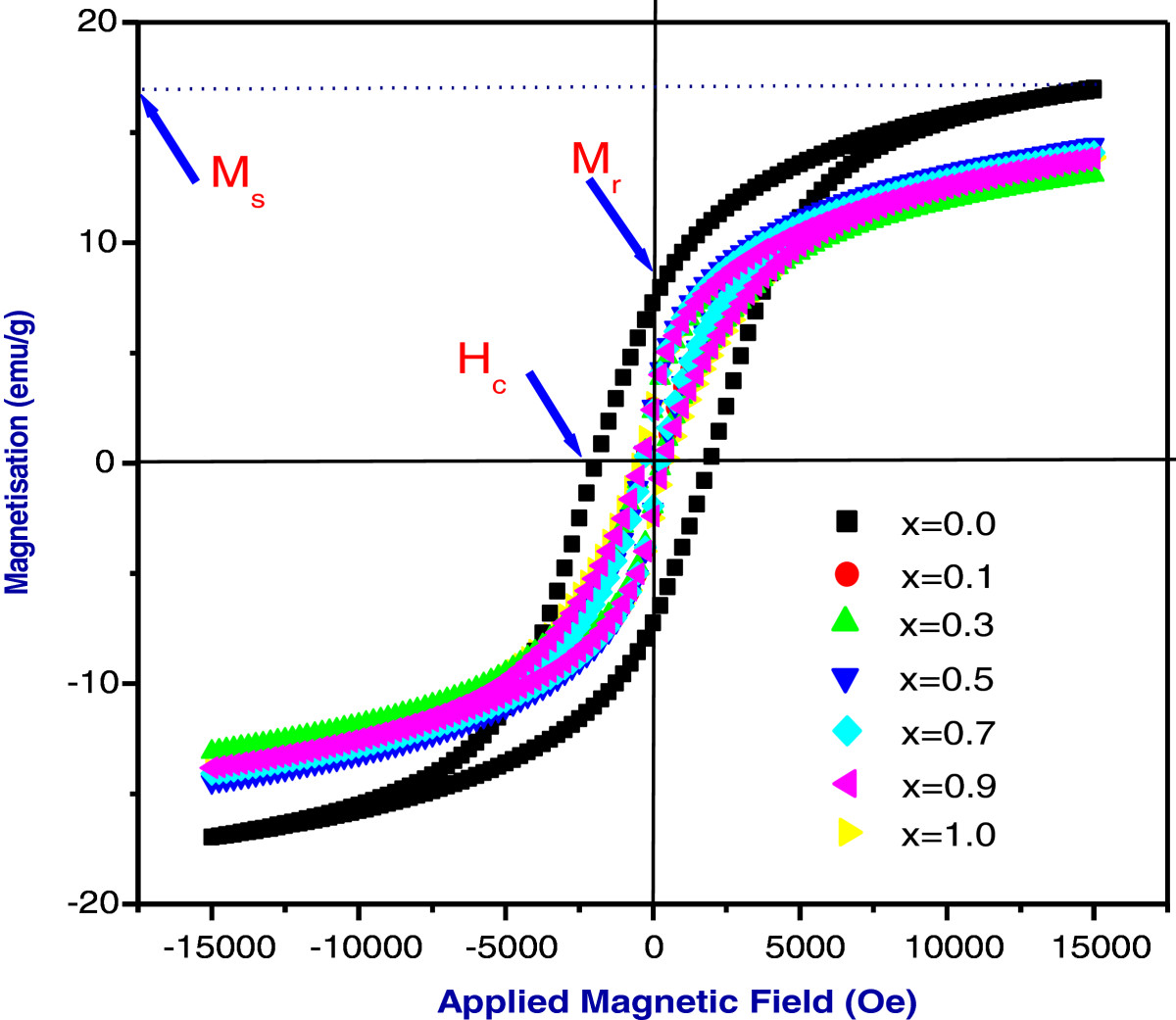
Magnetic parameters extracted from the hysteresis loops are saturation magnetization ( M s ; maximum value of magnetization), remanent magnetization ( M r ; magnetization at zero field), and coercivity ( H c ; magnetic field required to reduce the magnetization of that material to zero after the magnetization of the sample has been driven to saturation). These magnetic parameters are used to characterize the magnetic properties of materials.
The magnetic parameters of all the samples of Co-Cr ferrites were calculated from the individual
M
-
H
loops and were tabulated in Table
3
. The
M
-
H
loops of CoFe
2
O
4
and CoCrFeO
4
were shown in Figure
3
.
M-H curves for CoCr
x
Fe
2-x
O
4
(x = 0.0 and 1.0) nano particles synthesized by Citrate-gel technique.Figure 3

Table 3
Magnetic parameters from Hysteresis loops
Composition | Saturation magnetization (emu/g) | Remanent magnetization (emu/g) | Coercivity (kOe) | Remanence ratio ( |
|---|---|---|---|---|
CoFe2O4 | 33.8448 | 14.540 | 1,954.66 | 0.4296 |
CoCr0.1Fe1.9o4 | 15.3200 | 2.912 | 381.03 | 0.1900 |
CoCr0.3Fe1.7o4 | 14.9600 | 2.805 | 355.04 | 0.1875 |
CoCr0.5Fe1.5o4 | 14.4232 | 2.617 | 319.25 | 0.1814 |
CoCr0.7Fe1.3o4 | 14.0734 | 2.391 | 298.57 | 0.1698 |
CoCr0.9Fe1.1o4 | 13.8651 | 2.423 | 389.73 | 0.1747 |
CoCrFeO4 | 13.8347 | 2.784 | 500.22 | 0.2012 |
From Table 3 , it is clear that M s at room temperature decreased from 33.8448 to 13.8347 emu/g with the increase in Cr 3+ ion concentration in the Co-Cr ferrites. This decrease in M s value may be due to the fact that the Fe 3+ (magnetic moment 5 μB) are replaced by lesser magnetic Cr 3+ ions (magnetic moment 3 μB) in the octahedral (B) sites of the ferrite sublattice. As the concentration of the Cr 3+ ion increases, it decreases the Fe 3+ (B)/Fe 2+ (A) ratio, that is, A-B super exchange interaction decreases [ 18 ].
H c which is a measure of the magnetic field strength required for overcoming anisotropy to flip the magnetic moments is clearly affected by the chromium substitution. It can be seen from Table 3 that the value of H c decreased from 1,954.66 Oe to 298.57 kOe up to the ferrite sample with Cr composition x = 0.7 and then increased for x = 0.9 and 1.0. The decrease in coercivity with increase in Cr 3+ concentrations may be due to the decrease in anisotropy field which in turn decreases the domain wall energy [ 19 ]. The increase in coercivity for ferrites with composition x = 0.9 and 1.0 might be due to the increase in magnetic crystalline anisotropy. The coercivity of the nanoferrites has a contribution from their finite size namely surface anisotropy [ 20 ]. Normally, for a given composition of ferrite, when the crystal size is less, the coercivity will be more as the surface becomes much more dominant [ 21 ]. Higher Coercivity of CoFe 2 O 4 in the present case may also be related to the particle size effect.
From the values of
H
c
and
M
s
, anisotropy constant (
K
) can be calculated [
22
] and tabulated in Table
4
. It is seen that the value of
K
decreases with increase of Cr
3+
concentrations.
Anisotropy constant and Magnetic moment values for various Co-Cr ferrites Composition Anisotropy constant Magnetic moment (BM) (erg/Oe) CoFe2O4 67,505.2 1.4339 CoCr0.1Fe1.9o4 5,956.97 0.6425 CoCr0.3Fe1.7o4 5,419.79 0.6253 CoCr0.5Fe1.5o4 4,698.58 0.6009 CoCr0.7Fe1.3o4 4,287.65 0.5844 CoCr0.9Fe1.1o4 5,513.89 0.5738 CoCrFeO4 7,061.63 0.5716Table 4
The magnetic moment per formula unit in Bohr magneton ( μ B ) was calculated [ 23 ] and tabulated in Table 4 . Magnetic moment values were found to decrease with increase in Cr 3+ concentration which is attributed to greater occupancy of Cr 3+ at B sites.
From all these results, it is clear that the increase of Cr concentration decreases the magnetization, and the material is being converted into a soft magnetic material. Hysteresis curves also show that CoFe 2 O 4 has large area inside the hysteresis loop, where as CoCrFeO 4 has a smaller area inside the hysteresis loop . This indicates the fact that the increase in Cr substitution has made the material magnetically soft.
The present study confirms that soft magnetic Co-Cr nanoferrite materials that were synthesized can be easily magnetized and demagnetized. Such materials are desirable for transformer and motor cores to minimize the energy dissipation with the alternating fields associated with AC electrical applications.