Faculty of Pharmacy, Tabriz University of Medical Science, Tabriz, IR
Student Research Committee, Tabriz University of Medical Science, Tabriz, IR
Abstract
The oral route is the main route of drug delivery in many diseases. A major problem in oral oil-soluble drug administration is poor aqueous solubility. One way to deliver oil-soluble drugs is to incorporate the drug into an inert vehicle, such as microemulsions. The purpose of this research was to develop the oil-in-water (o/w) microemulsion areas of pseudo-ternary phase diagrams for a drug delivery system. Our systems consist of sunflower oil + surfactant (Tween 80) + vitamin A palmitate + different co-surfactants + water. Vitamin A palmitate is an oil-soluble drug with poor aqueous solubility. Our goal is to increase its aqueous solubility. The effects of different co-surfactants on the o/w microemulsion region were investigated. The co-surfactants studied were anhydrous glycerol, sucrose, ethanol, and 1-propranol. A titration technique was employed for the preparation of the samples. The phases were identified by visual inspection and polarized microscopy. Samples of the microemulsion area were separated, and pseudo-ternary phase diagram was plotted for them. The system sunflower oil + Tween 80 + sucrose + water+ model drug showed the largest o/w microemulsion region. Consequently, sucrose was selected as the best co-surfactant. Finally, some samples of this system were selected for particle size measurement and stability testing. Results showed that more than 90% of the samples in different temperatures (4°C, 45°C, and room temperature) are stable.
Background
Water-soluble drugs can diffuse easily in the body, but oil-based drugs have poor aqueous solubility and a low bioavailability [
1
]. Microemulsions are suitable systems for the delivery of oil-soluble drugs. Microemulsions are thermodynamically stable systems, having unique properties. They have a small particle size (nano size), high stability, large interfacial area, and low interfacial tension and form spontaneously. This spontaneous formation in the gastrointestinal tract presents the drug in a solubilized form, and the small size of the formed droplet provides a large interfacial surface area for drug absorption [
2
]. When the droplet size of a microemulsion is decreased, the emulsion stability against sedimentation is being increased [
3
]. In microemulsion systems, solubilization may be defined as the phenomenon whereby substances that are otherwise insoluble in a given medium are brought into solution by incorporating them into, or upon, aggregates of colloidal dimensions, termed micelles [
4
].
The dispersed phase of microemulsion can act as a potential drug reservoir, and the drug is partitioned between the dispersed phase and dispersion medium and can get transported through the membrane, e.g., skin, mucous membrane, etc. Another important point about using microemulsion is that the same medium could be used both for hydrophilic and lipophilic drugs [
5
].
There are three types of microemulsion: bicontinuous, oil-in-water, and water-in-oil. Oil-in-water (o/w) microemulsions are more important in delivering oil-soluble drugs. Generally, a microemulsion contains oil, surfactant, cosolvent/co-surfactant, and other components. For a drug delivery system, formulations are isotropic mixtures of an oil, a surfactant, a co-surfactant (or solubilizer), and a drug. The basic principle of this system is its ability to form fine o/w microemulsions under gentle agitation following dilution by aqueous phases [
2
].
The hydrophilic-lipophilic balance of a surfactant system is a good guide for mixing water and oil into a microemulsion [
6
]. Nonionic surfactants with high hydrophilic-lipophilic balance (HLB) values are used in the formulation of drug delivery systems [
7
]. On the other hand, from the pharmacological point of view, surfactants with low critical micelle concentration (cmc) value have more stable micelles. Examples of nonionic surfactants with high HLB and low cmc values are Span 80, Tween 80, and Tween 20. Surfactants with a high cmc value may dissociate into monomers, their content may precipitate in the blood [
8
], and they are not suitable for drug delivery.
Often the use of co-surfactants is required for the optimal formation of a microemulsion. The co-surfactant is often the second surfactant but may also refer to a low molecular weight amphiphile, such as an alcohol. Co-surfactants increase the flexibility of the surfactant film around the microemulsion droplet [
9
]. The role of the co-surfactant is to overcome the repulsive forces of similar phases and fluidity of the oil and water to increase the permeability of two phases to form a microemulsion [
10
]. Short- and medium-chain alcohols, such as butanol, pentanol, ethanol, isopropanol, or propylene glycol, are commonly added as co-surfactants [
9
].
The use of pseudo-ternary phase diagram is required to map the optimal composition range for three excipients. This technique is mainly used to map the microemulsion areas [
7
]. Pseudo-ternary phase diagrams can be used to show the influence of changes in the volume fractions of the different phases on the phase behavior of the system [
11
].
Microemulsions are characterized using dynamic light scattering, polarized light microscopy, electrical conductivity, and rheology [
9
]. Dynamic light scattering is used to measure nanoscale particles of liquid mediums such as microemulsions. Polarized light microscopy can distinguish between isotropic and anisotropic materials. Microemulsion is an isotropic system, and birefringence is not found in it. A black background under polarized light is a key distinctive property of microemulsion. The conductometery method is used to detect boundary of different areas in the ternary phase diagram.
Results and discussion
Identification of microemulsions
The phases were identified by visual inspection and polarized microscopy. A microemulsion is optically clear and transparent. The samples with transparent appearance were separated for further investigations. Polarized light microscopy can distinguish between isotropic and anisotropic materials [
9
]. Microemulsion is an isotropic system, and birefringence is not found in it. The samples exhibited no birefringence, and a black background under polarized light is a microemulsion. Figure
1
shows our microemulsion picture under polarized light microscopy.
Figure 1
Black background of vitamin A palmitate microemulsion under polarized light microscopy.
Choosing the best system
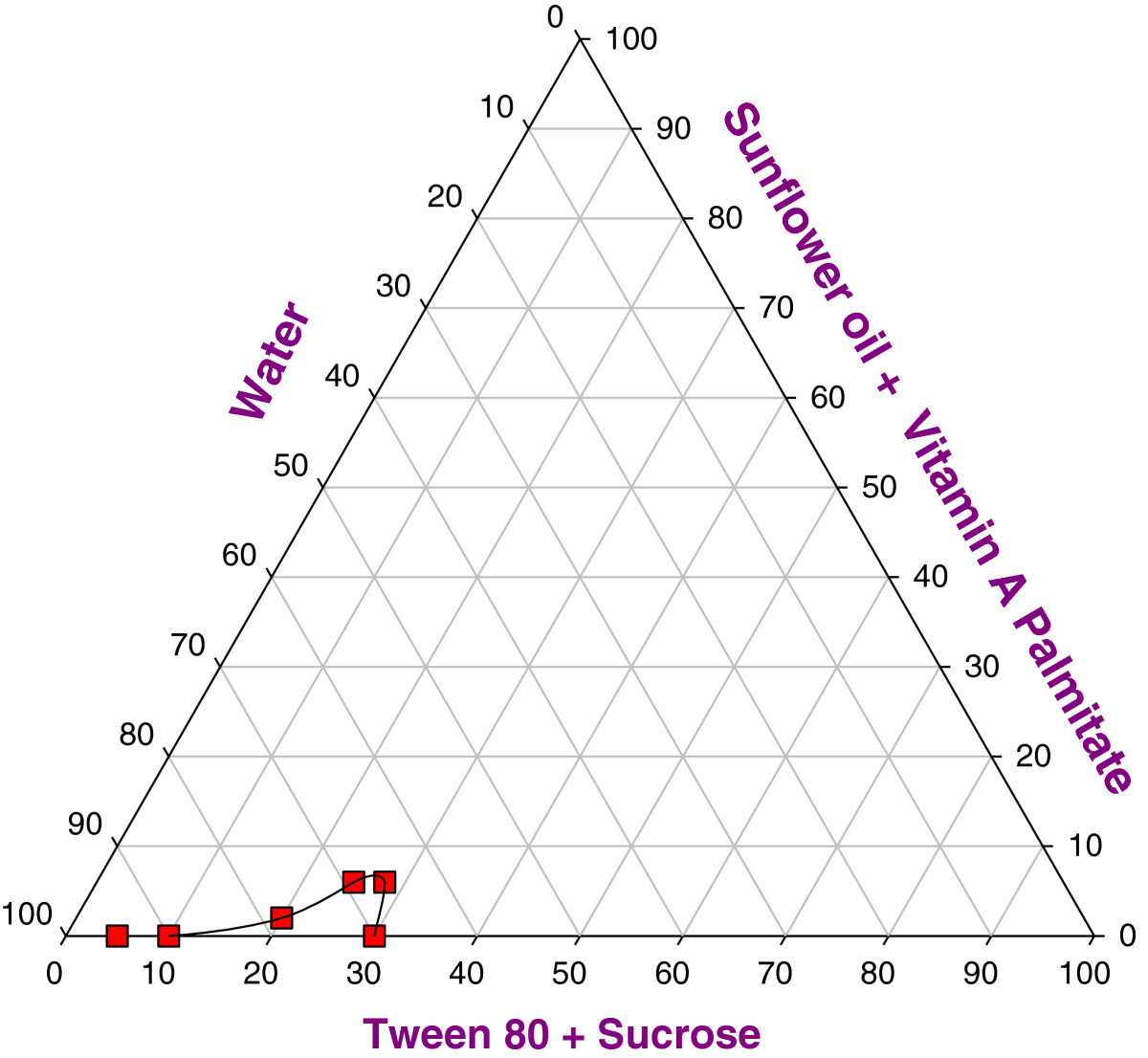
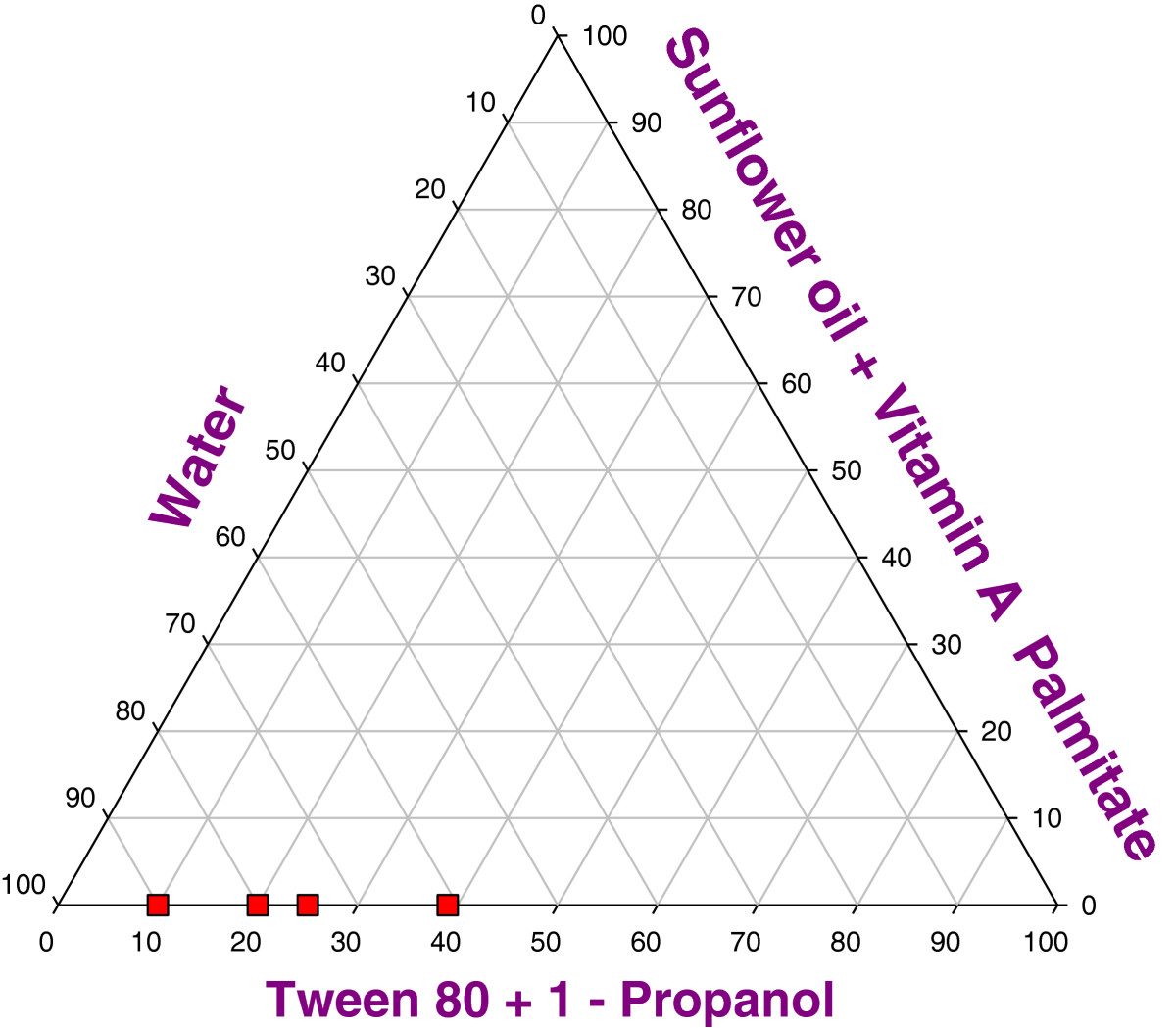
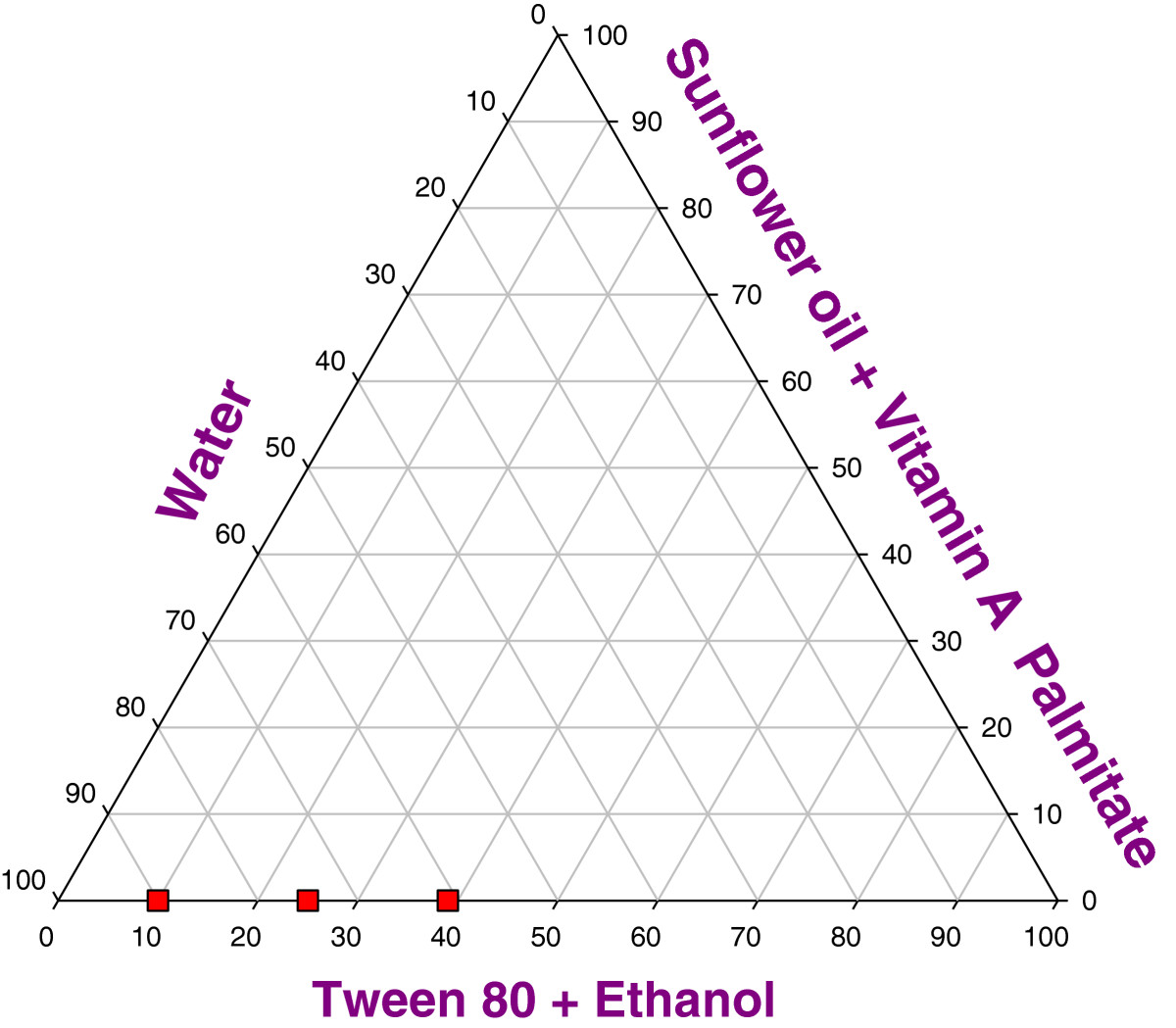
The o/w area of the pseudo-ternary phase diagrams for our different systems is shown in Figures
2
,
3
,
4
,
5
,
6
. Results show that with short-chain alcohols, such as ethanol and 1-propanol, microemulsions are very difficult to form even when the surfactant is in high concentration. Systems with anhydrous glycerol and sucrose form relatively good o/w microemulsion with Tween 80, but this region for sucrose is larger than for anhydrous glycerol. The system sunflower oil + Tween 80 + sucrose + water + vitamin A showed the largest microemulsion region. This system has higher solubility compared with the other systems, and our choice for drug formulation is increased in this system. Consequently, sucrose was selected as the best co-surfactant for this system, and the system was investigated for particle size measurement and stability studies.
Figure 2
Pseudo-ternary phase diagram of the vitamin A palmitate microemulsion region without co-surfactant.
Figure 3
Pseudo-ternary phase diagram of the vitamin A palmitate microemulsion region with anhydrous glycerol co-surfactant.
Figure 4
Pseudo-ternary phase diagram of the vitamin A palmitate microemulsion region with sucrose co-surfactant.
Figure 5
Pseudo-ternary phase diagram of the vitamin A palmitate microemulsion region with 1-propanol co-surfactant.
Figure 6
Pseudo-ternary phase diagram of the vitamin A palmitate microemulsion region with ethanol co-surfactant.
Particle size measurement
A key distinctive property of microemulsion is its nanoscale particle size [
2
]. For the selected system, particle size analysis was performed by dynamic light scattering. Dynamic light scattering method, sometimes called photon correlation spectroscopy, is used to measure particles in a liquid medium. Recently, particles with a diameter of less than 1 nm can also be measured with this method. Figure
7
shows the particle size distributions of our microemulsions.
Figure 7
Particle size distribution of vitamin A palmitate microemulsion with DLS.
Stability studies
Some samples were selected for stability testing. The samples were kept at different temperatures (4°C, 45°C, and room temperature) for 48 h and were evaluated periodically. In some cases, sugar crystallization or phase separation was observed. Of the samples which were kept at 4°C, 93% remained stable and 6% of them showed phase separation or sugar crystallization. The samples at room temperature showed the highest stability (96%). The stability percentage obtained for samples which were kept at 45°C was 94%.
Conclusions
We develop the o/w microemulsion areas of pseudo-ternary phase diagrams for a drug delivery system consisting of sunflower oil, surfactant (Tween 80), vitamin A palmitate, different co-surfactants, and water. The effects of different co-surfactants on the vitamin A palmitate microemulsion drug delivery system region were investigated. The co-surfactants studied were anhydrous glycerol, sucrose, ethanol, and 1-propranol. In conclusion, the system sunflower oil + Tween 80 + sucrose + water + vitamin A showed the largest microemulsion region. This system has higher solubility compared with the other systems, and our choice for drug formulation is increased in this system. Consequently, sucrose was selected as the best co-surfactant for this system.
Methods
Materials
The materials used were as follows: Tween 80 (polysorbate 80) surfactant (AppliChem, Darmstadt, Germany), sucrose (AppliChem), anhydrous glycerol, 1-propanol and ethanol (Merck, Darmstadt, Germany), sunflower oil (Faravardehaye Roghani Iran Co., Tehran, Iran), and vitamin A palmitate (USP30, Germany).
Methods
From the stability point of view, the ratio of surfactant to co-surfactant was fixed at 1:1 on the weight basis. In the oil phase, the ratio of sunflower oil to vitamin A was fixed at 9:1 in all of the samples. A titration technique was employed for the preparation of the samples of the five systems below:
Tween 80 + sunflower oil + water + vitamin A palmitate (without co-surfactant)
Tween 80 + sunflower oil + water + vitamin A palmitate + anhydrous glycerol as a co-surfactant
Tween 80 + sunflower oil + water + vitamin A palmitate + sucrose as a co-surfactant
Tween 80 + sunflower oil + water + vitamin A palmitate + 1-propanol as a co-surfactant
Tween 80 + sunflower oil + water + vitamin A palmitate + ethanol as a co-surfactant
Deionized water was added in different volumes to the mixture of sunflower oil, surfactant, co-surfactant, and model drug at room temperature. All of the samples were stirred for 24 h and 1,200 rpm using a magnetic stirring plate. After phase preparation, we identify the microemulsion area by visual inspection (a microemulsion is optically clear and transparent) and polarized microscopy (Olympus, BX51TRF Model, Tokyo, Japan). In each system, samples of the microemulsion area were separated, and the o/w area of the pseudo-ternary phase diagram using Sigma plot (12) software was plotted for them. The system sunflower oil + Tween 80 + sucrose + water + vitamin A showed the largest microemulsion region. Then sucrose was selected as the best co-surfactant, and further studies such as particle size analysis and stability studies were performed for it. Particle size analysis was performed by dynamic light scattering (NANOPHOX PCCS with WINDOX 5 software, Sympatec, Clausthal-Zellerfeld, Germany).
Acknowledgements
We would like to thank Urmia Payam Noor University and Dr Alireza Salehi Sadaghiani for his valuable guidance.
Competing interests
The author declares that has no competing interests.
References
Wang (2009) University of Waterloo
Taha et al. (2004) Preparation and in vitro characterization of self-nanoemulsified drug delivery system of all-trans-retionol acetate (pp. 109-119) 10.1016/j.ijpharm.2004.03.034
Najafi et al. (2010) Evaluation factors affecting the formation and properties of nanoemulsion stabilized with Tween 80 6(1) (pp. 9-16)