Department of Chemistry, Faculty of Science, Urmia University, Urmia, 57159-165, IR
Abstract
Magnetically nano Fe
3
O
4
efficiently catalyzes solvent-free conversion of various carbonyl compounds to the corresponding oximes with NH
2
OH·HCl. The reactions were carried out in oil bath (70°C to 80°C) at solvent-free conditions to afford oximes in high to excellent yields. This method offers some advantages in terms of clean reaction conditions, recyclable of catalyst, short reaction times, easy work-up procedure, and suppression of side products.
Background
Transformation of carbonyl compounds into oximes is one of the most important synthetic reactions in organic chemistry. Oximes are not only useful for protection, purification, and characterization of carbonyl compounds [
1
] but also they can serve as intermediates for conversion into nitro compounds [
2
], amides [
3
], nitriles [
4
], and amines [
5
]. In addition, all compounds that contain the oxime fragment, which represents a pharmacophore group, exhibit diverse biological activities. These derivatives are also recommended as insecticides, fungicides, pesticides, herbicides, protozoacides, and plant growth regulators [
6
]. A wide spectrum of biological activity was revealed for oximes of pyridine, indole, isatin, and pyrroleandquinoline series [
7
]. Oximes of α, β-unsaturated ketones are known as insecticides, vasorelaxants, and antimicrobial agents [
6
].
The literature review shows that many improvements have been carried out for the preparation of oximes. NH
2
OH·HCl/K
2
CO
3
[
8
], DOWEX(R)50WX4 [
9
], ethylenediamine/oxone [
10
], ultrasound/Na
2
SO
4
[
11
], Bi
2
O
3
[
12
], heterogeneous polyoxometalates [
13
], phase transfer catalysis [
14
], and TiO(acac)
2
[
15
] are some of the reagents or protocols which have been reported for transformation of carbonyl compounds to oximes. Generally low yields, long reaction times, and limitation to use acid- or base-sensitive functionality in carbonyl compounds are the major limitations of these methods.
On the other hand, nanoparticles exhibit high catalytic activity and chemical selectivity under mild conditions [
16
]. The extremely small-size particles maximize the surface area which, when exposed to the reactant, allow more reactions to occur at the same time and thus speed up the process [
17
]. Thus, in the line of the outlined strategies, herein, we wish to report a green and practical method for solvent-free conversion of various carbonyl compounds to the corresponding oximes by NH
2
OH·HCl catalyzed by magnetically nano Fe
3
O
4
(Scheme
1
).
Scheme 1
A green and practical method for solvent-free conversion of various carbonyl compounds.
Results and discussion
Magnetically nano Fe
3
O
4
due to highly active and specific centers of ultra-size coupled with high magnetic specification has been found some useful applications in organic synthesis [
18
]. Continuation of our research program directed to the oximes reactions under mild and green reaction conditions [
3
] and lack of information to use magnetically nano Fe
3
O
4
in preparation of oximes from carbonyl compounds by NH
2
OH·HCl encouraged us to investigate the titled transformation.
The promotion effect of nano Fe
3
O
4
in the formation of oximes was studied by the reaction of benzaldehyde with NH
2
OH·HCl under different reaction conditions. The effects of molar ratio of the reaction components and solvent were investigated in the typical experiment (Table
1
). As it is seen, the combination system of hydroxylamine hydrochloride with nano Fe
3
O
4
in a molar ratio of 2:1.5, respectively, in oil bath (70°C to 80°C) at solvent-free conditions showed a perfect efficiency for complete conversion of 1 mmol benzaldehyde to benzaldehydeoxime within 20 min(entry 6). This success encouraged us to further explore the capability of NH
2
OH·HCl/nano Fe
3
O
4
system for oximation of different carbonyl compounds at the optimized reaction conditions. The summarized results in Tables
2
and
3
show that all reactions were carried out successfully in oil bath (70°C to 80°C) at solvent-free conditions, and the corresponding aldoximes or ketoximes were obtained in high to excellent yields within 15 min to 3 h. In addition, due to inherent less reactivity of ketones versus aldehydes, the oximation reactions took excess amounts of NH
2
OH·HCl and nano Fe
3
O
4
in longer reaction times (Table
3
). α,β-Unsaturated aldehydes and ketones were successfully converted to the corresponding conjugated oximes with NH
2
OH·HCl/nano Fe
3
O
4
system in high yields and without any side reaction (Table
2
: entry 8 and Table
3
: entry 9). We also observed that oximation of carbonyl compounds with two carbonyl moieties was carried out selectively. By using the controlled amounts of NH
2
OH·HCl in an appropriate time, oximation of one or both of the carbonyl group took place efficiently (Table
3
: entries 7 and 8).
Table 1
Optimization experiment for oximation of benzaldehyde with NH2OH
·
HCl/nano Fe3O4system under different reaction conditions (all reactions were carried out with 1 mmol of benzaldehyde)
Entry
Molar ratioa
Conditionb
Time (min)
Convertion (%)
1
1:2:1.5
CH3CH/reflux
120
30
2
1:2:1.5
EtOH/reflux
100
30
3
1:2:1.5
H2O/reflux
120
60
4
1:2:1.5
THF/reflux
100
10
5
1:2:1
Solvent-free/oil bath
50
80
6
1:2:1.5
Solvent-free/oil bath
20
100
7
1:2:2
Solvent-free/oil bath
20
100
Table 2
Oximation of aldehydes with NH2OH·HCl/nano Fe3O4system (all reactions were carried out in oil bath (70°C to 80°C) under solvent-free conditions)
Entry
Substrate
Product
Molar ratioa
Time (min)
E:Z ratiob
Yield (%)c
1
1:2:1.5
15
98:2
96
2
1:2:1.5
30
98:2
95
3
1:2:1.5
25
96:4
95
4
1:2:1.5
30
98:2
96
5
1:2:1.5
20
98:2
98
6
1:2:1.5
15
97:3
93
7
1:3:1.5
45
98:2
90
8
1:2:1.5
50
98:2
92
9
1:2:2
15
100
74
Table 3
Oximation of ketones with NH2OH·HCl/nano Fe3O4system (all reactions were carried out oil bath (70°C to 80°C) under solvent-free conditions)
Entry
Substance
Product
Molar ratioa
Time (h)
E:Z(%)b
Yield (%)c
1
1:3:2
1
98:2
90
2
1:3:2
1.8
98:2
94
3
1:3:2
2
100:0
93
4
1:3:2
1.8
98:2
95
5
1:3:2
1.2
100:0
94
6
1:3:2
1
100:0
92
7
1:3:2
2.2
100:0
93
8
1:4:2
3
100:0
95
9
1:3:2
3
96:4
95
A plausible mechanism for the nanoFe
3
O
4
catalyzed was illustrated in Scheme
2
. The nano Fe
3
O
4
facilitates the oximation process through coordination of its Fe
3+
with O of carbonyl.
Scheme 2
A plausible mechanism for the nano Fe3O4catalyzed.
In the next attempt, we turned our attention to recyclable of catalyst; the catalyst was easily separated from the reaction system and reused (after washing with distilled water/acetone and dried under vacuum) for three consecutive runs, and no obvious diminishing activity was observed (the conversions and selectivities were 100% and 100% for first run; 99% and 100% for second run; 91% and 95% for third run; 91% and 90% for fourth run).
Conclusions
In this paper, we have shown that magnetically nano Fe
3
O
4
promoted oximation of various carbonyl compounds byhydroxylamine hydrochloride in oil bath (70°C to 80°C) under solvent-free conditions. Aldoximes and ketoximes were obtained in high yields within 15 min to 3 h. This method offers some advantages in term of clean reaction conditions, easy work-up procedure, short reaction times, and suppression of any side product. So we think that NH
2
OH·HCl/nano Fe
3
O
4
system could be considered a new and useful addition to the present methodologies in this area.
Methods
General
All solvents and reagents were purchased from commercial sources with the best quality and they were used without further purification. Nano Fe
3
O
4
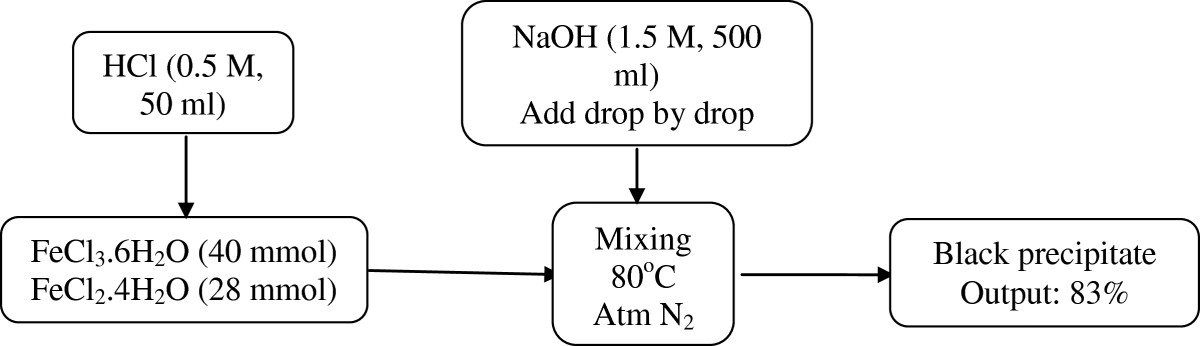
are prepared in high purity according to the reported procedures in literature [
19
] (Figures
1
,
2
, and
3
).
1
H,
13
C NMR, and IR spectra were recorded on 300 MHz Bruker Avance and Thermo Nicolet Nexus 670 FT-IR spectrometers (Bruker AXS, Inc., Madison, WI, USA). All products are known and were characterized by their spectral data. Yields refer to isolated pure products. Thin layer chromatography (TLC) was applied for monitoring of the reactions over silica gel 60 F
254
aluminum sheet.
Figure 1
XRD pattern of obtained samples and XRD pattern of
[
19
].
Figure 2
Infrared spectra of the samples (a) and (b)
[
19
].
A typical procedure for solvent-free oximation of acetophenone to acetophenone-oxime with NH2OH·HCl/nano Fe3O4 system
A mixture of Acetophenone (0.120 g, 1 mmol) and nano Fe
3
O
4
(0.462 g, 2 mmol) was ground in a mortar. NH
2
OH·HCl (0.2085 g, 3 mmol) was then added to the mortar, and the grinding of the reaction mixture was continued for a moment. The mixture was stirred magnetically in oil bath (70°C to 80°C) under solvent-free conditions for 60 min. TLC monitored the progress of the reaction (eluent;
n
-hexane/EtOAc: 5/3). After completion of the reaction, the mixture was washed with EtOAc (3 × 5 ml). Evaporation of the solvent affords the white solid Acetophenone Oxime in 90% yield (1215 g, Table
2
: entry 1).white solid, m.p. 58°C to 60°C. IR (KBr,
νmax
): 3,235, 3,084, 2,924, 1,496, 1,444, 1,370, 1,300, 1,079, 1,005, 924, 847, 773, 756, 688, and 651 cm
−1
.
1
H NMR (300 MHz, CDCl
3
, δ ppm): 8.86 (br s, 1H), 7.69 to 7.58 (m, 2H), 7.43-7.36 (m, 3H), 2.32 (s, 3H),
13
C NMR (75 MHz, CDCl
3
, δ ppm): 156.1, 136.6, 129.3, 128.6, 126.1, 12.3; MS (EI)
m
/
z
(% rel. intensity) 135 (M+, 86), 118 (14), 106 (22), 103 (26), 94 (32), 77 (100), 66 (16), and 51 (33).
Acknowledgments
The authors gratefully acknowledge the financial support of this work by the research council of Urmia University.
Competing interests
Both authors declare that they have no competing interests.
Authors' contributions
BZ participated in the design of the study and performed the statistical analysis. MK carried out the nanoparticle studies and participated in its design and coordination. Both authors read and approved the final manuscript.
Barnes (1976) An oxime to nitro conversion. a superior synthesis of secondary nitroparaffins (pp. 733-735) 10.1021/jo00866a044
Bagheri and Karimkoshteh (2013) Nano SiO2/H2SO4 as catalyst for the Beckmann rearrangement anddeoximation of aldoximes 3(1) (pp. 27-32)
Hegedüs et al. (2002) Microwave-assisted conversion of oximes into nitriles in the presence of a zeolite (pp. 618-620) 10.1039/b207273b
Zeynizadeh and Kouhkan (2011) A rapid and practical protocol for solvent-free reduction of oximes to amines with NaBH4/ZrCl4/Al2O3 system (pp. 3448-3452) 10.5012/bkcs.2011.32.9.3448
Abele and Lukevics (2000) Recent advances in the chemistry of oximes (pp. 235-264) 10.1080/00304940009355921
Abele and Lukevics (2000) Recent advances in the synthesis of heterocycles from oximes (pp. 2285-2336) 10.3987/REV-00-536
Bo et al. (2013) A development of rapid, practical and selective proces for preparation of Z-oximes (pp. 295-299) 10.5012/jkcs.2013.57.2.295
Davood et al. (2012) Synthesis of oximes with NH2OH·HCl/DOWEX(R) 50W-X4 system (pp. 1119-1124) 10.1002/jccs.201200011
Xia and Wang (2007) Efficient preparation of aldoximes from arylaldehydes, ethylenediamine and Oxone® in water (pp. 231-236) 10.3390/12020231
Lakhinath et al. (2011) A rapid, convenient, solventless green approach for the synthesis of oximes using grindstone chemistry10.1186/2191-2858-1-12
Shen et al. (2013) Highly selective and efficient Lewis acid–base catalysts based on lanthanide-containing polyoxometalates for oximation of aldehydes and ketones (pp. 1659-1663)
Tomilov and OsadchenkoI (2002) Phase-transfer catalysis in synthesis of oximes (pp. 511-512) 10.1023/A:1016140131717
Zeynizadeh and Amjadi (2009) Facile Oximation of carbonyl compounds with titanyl acetylacetonate/NH2OH system (pp. 3611-3616)
Nasir Baig and Rajender (2013) Magnetically retrievable catalysts for organic synthesis (pp. 752-770) 10.1039/C2CC35663E
Montazeri et al. (2013) Separation of the defect-free Fe3O4-Au core/shell fraction from magnetite-gold composite nanoparticles by an acid wash treatment10.1186/2193-8865-3-25
Polshettiwar et al. (2011) Magnetically recoverable nanocatalysts (pp. 3036-3075) 10.1021/cr100230z
Ch et al. (2012) The preparation of Fe3O4 magnetic nanometer particle by co-precipitation (pp. 271-272)