Department of Chemistry, Islamic Azad University (Rasht Branch), Rasht, IR
Abstract
In recent years, HIV-1 integrase (IN) has become an attractive target for designing antiretroviral agents. The development of raltegravir and other successful lead IN inhibitors has also influenced the IN inhibitor design strategy. This has led to the identification of several potent inhibitors in these last 2 years. The medicines which have the compound of C-centered and N-centered anti-HIV inhibitor with single-walled carbon nanotube are examined by density functional theory (DFT) method. In this paper, the end of the nanotubes, which was saturated with hydrogen atoms, was examined by DFT at the level of B3LYP and 6-31G(d) standard basis set. There are free Gibbs energy, free Helmholtz energy, enthalpy, bond length (Å), bond angle (in degrees), dihedral angle (in degrees), energy hyperconjugation, total energy (in Kcal mol
−1
), moment dipole (in Debye), occupancy between nanotube (6, 6), and chalcone derivative. These cases and medicines show that complex 2 is more stable than the other complexes.
Background
Since the discovery of carbon nanotubes by Iijima [
1
], extensive research has been devoted to their structural characterization [
2
]. Among the numerous delivery systems currently under investigations, carbon nanotubes (CNTs) seem to embody a promising option [
3
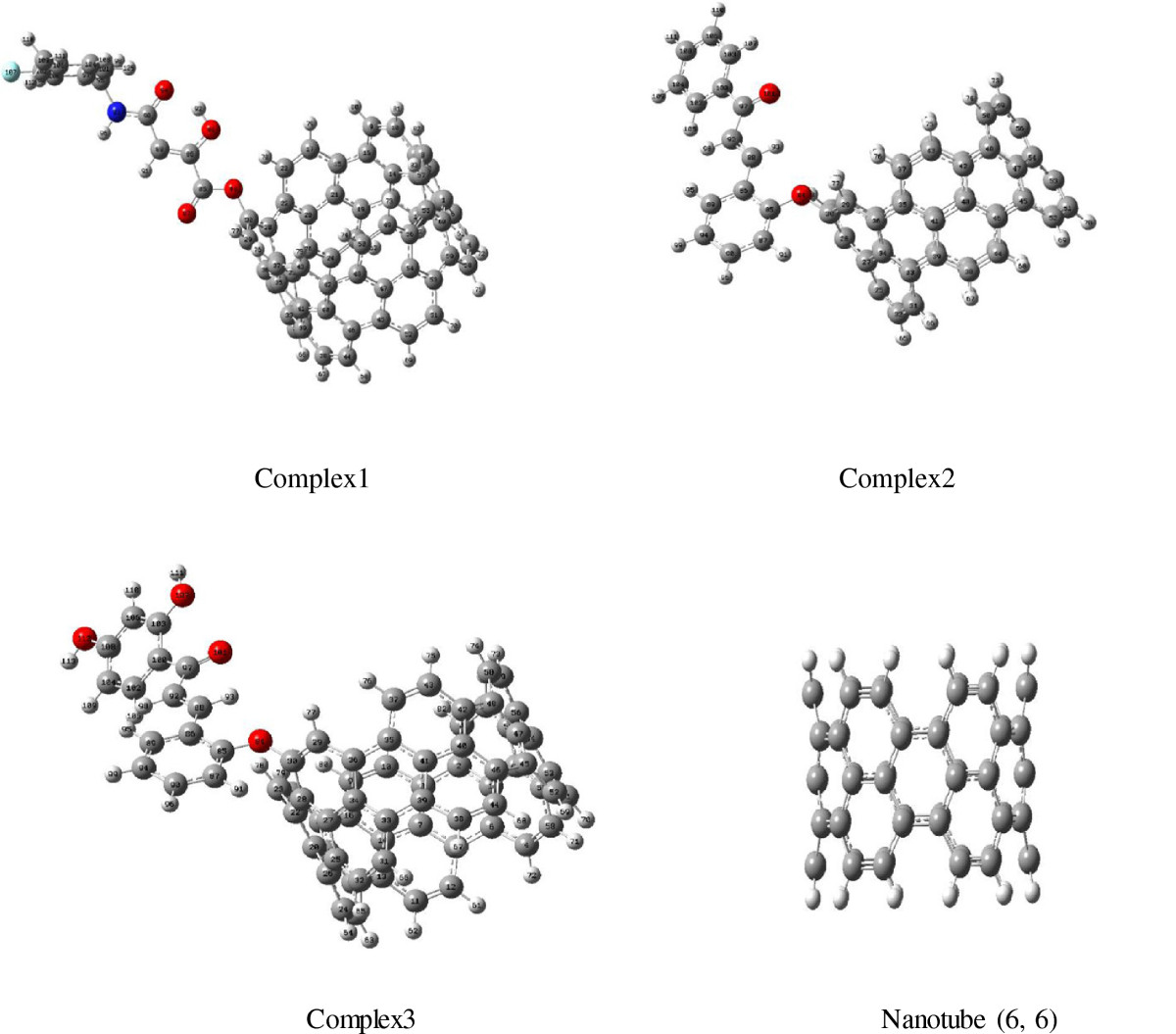
]. Pristine carbon nanotubes (pCNTs) are made up of carbon atoms arranged in a series of condensed benzene rings and wrapped into a tubular form (Figure
1
). Concerning their use in biological systems, lack of solubility (both in organic solvents and aqueous solutions), formation of thick and inhomogeneous bundles, circulation half-life of 3 to 3.5 h [
4
], and biocompatibility and immunogenicity limitations raise great concerns. However, these observations hold only for pCNTs and, therefore, just indicate the need for further modifications in order to explore the feasibility of functionalized CNTs (f-CNTs) as safe bio-nanomaterial [
5
,
6
]. In particular, the application of f-CNTs as new nanovectors for drug delivery became doable soon after the demonstration of cellular uptake of this new material [
7
,
8
]. It is worth to mention that apart from a few cases of phagocytic incorporation inside macrophages [
9
,
10
] (which are known to be large cleaning cells able to remove foreign material including less soluble nanotubes), no uncoated pCNTs were reported to penetrate inside the cells without displaying remarkable effect. This last point should reinforce the use of f-CNTs as improved, less harmful nanovehicles, especially after our recent discovery regarding the lack of a direct correlation between the kind of functionalization on the surface of carbon nanotubes and the extent of their internalization [
11
–
13
]: either electrostatically neutral or charged f-CNTs could be taken up by cells with comparable amount, hence indicating that numerous different chemical procedures could be adapted to introduce several groups and functionalities. Further, an increased understanding of IN structural biology has opened up novel approaches to inhibit IN, such as targeting its multimerization or interaction with cellular cofactors [
14
]. In the paper, complex between chalcone and nanotube (6, 6) is investigated, and chalcone is used as anti-HIV drug. The chemistry of chalcones has generated intensive scientific studies throughout the world. Special interest has been focused on the synthesis and biodynamic activities of chalcones. The term ‘chalcones’ was given by Kostanecki and Tambor [
15
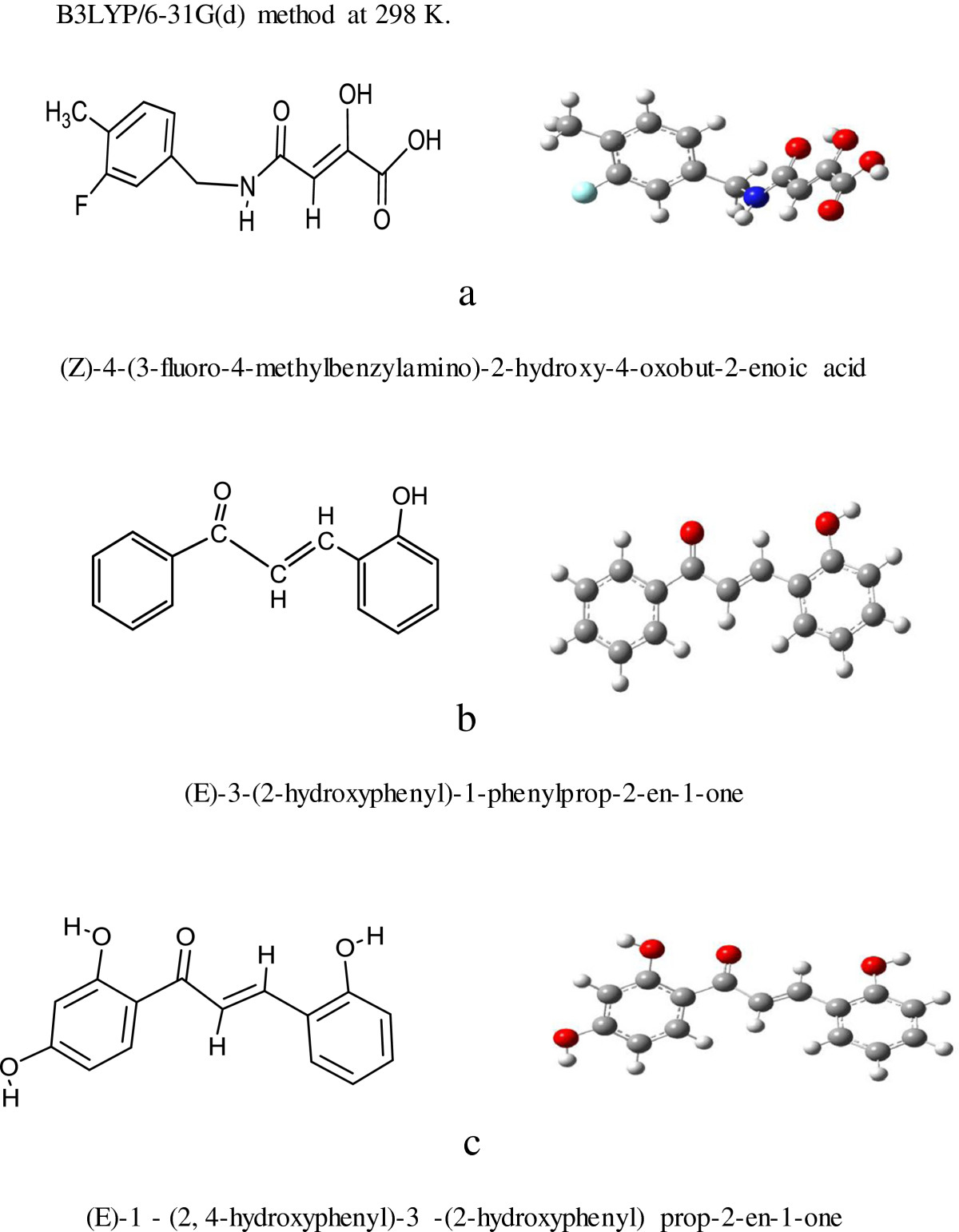
]. These compounds are also known as benzalacetophenone or benzylidene acetophenone. In chalcones, two aromatic rings are linked by an aliphatic three carbon chain. Chalcone bears a very good synthon, so a variety of novel heterocycles with good pharmaceutical profile can be designed. Chalcones are α- and β-unsaturated ketones containing the reactive ketoethylenic group CO-CH=CH-. These are colored compounds because of the presence of the chromospheres -CO-CH=CH-, which depend in the presence of other auxochromes. Chalcones resemble the diketo acid functionality and are potential leads in designing potent IN inhibitors. Potent chalcones were identified through an NCI drug screening program [
16
]. The structures of chalcone are shown in Figure
2
.
Figure 1
The optimized complex of chalcone derivative - SWCNT (6, 6) in B3LYP/6-31G(d) method at 298.15K.
Figure 2
The structures of chalcone derivative.
Optimizations were performed by B3LYP/6-31G(d) method at 298 K.
(a)
(Z)-4-(3-fluoro-4-methylbenzylamino)-2-hydroxy-4-oxobut-2-enoic acid.
(b)
(E)-3-(2-hydroxyphenyl)-1-phenylprop-2-en-1-one.
(c)
(E)-1-(2, 4-hydroxyphenyl)-3-(2-hydroxyphenyl)prop-2-en-1-one.
Results and discussion
We measured the parameters such as bond length (Å), natural bond orbital (NBO), and bond angle, dihedral angle, distances of analyzed models of the SWCNT (6, 6). The end of the nanotubes, which was saturated with hydrogen atoms, was examined by DFT at the level of B3LYP and 631G(d) standard basis set and is shown in Tables
1
,
2
, and
3
. The electron that is given by the complexes in a reaction should make it as HOMO, while that which captured the complexes must be placed on its LUMO [
17
], so the atom on which the HOMO mainly scattered should be able to separate the electrons, while the atom, by holding the LUMO, should achieve electrons on this basis. HOMO-LUMO gap is usually associated with chemical stability against electronic excitation with a larger distance like greater stability [
18
]. The energy (kcal mol
−1
) and dipole moments (Debye) indicate the consistency among the three complex calculations in the DFT method. The optimized configurations are shown in Figures
1
and
2
. In Table
1
, it becomes obvious that the complexes 2 and 3 have higher hyperconjugation energy than complex 1. The results also show that as the P increases through the sharing of hybrid atoms, the occupancy decreases. The hybrid
s
orbital shared in the oxygen atom in complex 3 is more than the hybrid
s
orbital shared in complexes 1 and 2. Most of the combined energy hyperconjugations are stable. Occupancy coefficient is smaller. Complex 2 is more stable than complexes 1 and 3. The energy hyperconjugation of complex 2 (21.25) is lesser than that of complex3. Reduced coupling energy is due to the resonance interference.
Table 1
The parameters of NBO complexes 1, 2, and 3 by B3LYP/631G(d) method at 298.15 K
Agent
Acceptor
Occupancy
Donor
Occupancy
Hybrid
Σ E2
Complex 1
σ* C28-30
LP(1)O84
0.03683
21.27
π* C29-30
1.93552
LP(1)O84
0.23326
sp 1.84
σ* C28-30
1.84587
LP(2)O84
0.03683
sp 99.99
σ* C29-30
LP(2)O84
0.02234
π* C29-30
LP(2)O84
0.23326
Complex 2
σ* C28-30
LP(1)O84
0.03694
21.25
π* C29-30
1.93477
LP(1)O84
0.23167
sp 1.99
σ* C28-30
1.84823
LP(2)O84
0.03694
sp 12.91
σ* C29-30
LP(2)O84
0.02252
π* C29-30
LP(2)O84
0.23167
Complex 3
σ* C28-30
LP(1)O84
0.03705
25.67
π* C29-30
1.93368
LP(1)O84
0.24195
sp 1.87
σ* C28-30
1.84353
LP(2)O84
0.03705
sp 1.00
σ* C29-30
LP(2)O84
0.02139
π* C29-30
LP(2)O84
0.24195
Table 2
The parameter of bond distances, bond angles, and torsional angles in B3LYP/631G(d) method optimized complexes 1, 2, and 3 at 298.15 K
Agent
Complex1
Complex 2
Complex3
C30O84
1.38360
1.38918
1.38844
O84C85
1.36355
1.37733
1.37905
C85… C87/86
1.50671
1.41639
1.41556
C85=C86 or C85… C87
1.34399
-
1.39631
C88… N92
1.37423
-
-
C88=C92
-
1.35015
1.34867
C88=O93/92
1.22636
1.33211
-
C95/92-C97
1.51805
1.48257
1.49038
C97=O101
-
1.23025
1.22693
C89/88H93
-
1.08671
1.08697
C97C101/100
1.40144
1.50356
1.49705
C102F107
1.35539
-
-
C108O112
-
-
1.3632
N92C95
1.46093
-
-
C30O84C85
119.49672
119.98567
119.72205
O84C85/95…C86
122.94446
115.99633
116.00968
C85… C86… H89/C89
115.63440
117.35796
117.31516
C86C89=N92/C92
112.89707
127.05408
126.82625
C92C97=C101/O101
120.54112
121.23147
121.14706
C100… C103F/O/H1071
118.48520
117.99263
118.85317
C30O84C85… C872
65.15798
10.06339
10.44740
C85=C86C89N92/H953
−171.74691
178.34956
178.08447
C28… C30O84C854
−160.04093
74.54557
75.32017
C106 .… C108O112H1135
-
-
179.82075
C88… N92C95F1076
179.93485
-
1.32961
Table 3
The parameter of Mulliken charge, energy HOMO/LUMO and gap energy in B3LYP/631G(d) method at 298.15 K
Agent
C30Mulliken charge
Energy of HOMO (Kcal mol−1)
O84Mulican charge
Energy of LUMO (Kcal mol−1)
Gap of energy
Complex 1
0.282424
−0.1579
−0.586927
−0.0889
0.06906
Complex 2
0.282510
−0.1567
−0.586736
−0.0876
0.06911
Complex 3
0.291184
−0.1538
−0.581214
−0.0855
0.06837
Based on the drug resonance structure, a phenolic ring is observed. In complex 2, the negative charge is located in orthoposition. However, in complex 3, the negative charge is in the oxygen group (OH). Thus, complex 2 is stable. The hybrid orbital S of a compound is lower. The occupancy factor is larger. In complex 2, the hybrid and occupancy are
sp1.88
and 1.9355, respectively.
The calculations of the total energies and energy hyperconjugation (E
2
) of the optimized structures, dipole moments (μ), occupancy, and hybrid orbital at B3LYP/631G(d) levels are presented in Tables
2
and
3
. The DFT calculated geometric parameters for complexes 1, 2, and 3 are compared in Table
2
. The bond lengths of C
30
-O
84
calculated for complexes 1, 2, and 3 at the DFT level are 1.383, 1.389, and 1.388 Å, respectively at the B3LYP/631G(d) level. The bond length of C
85
…C
87
for complex 1 is 1.50671 Å; for complexes 2 and 3, 1.41639 and 1.41556 Å, respectively. The bond length of C
88
… N
92
(1.37423 Å) in complex 1 is lower than the bond length of C
88
=C
92
in complexes 2 (1.35015 Å) and 3 (1.34867 Å). This is because the electronegative nitrogen is bigger than carbon. The bond length of C
88
=O
93/92
in complexes 1 and 2 are 1.22636 and 1.33211 Å respectively lower than those of C=C, C…N in complexes 2, 3, and 1. The dihedral angles of C
100
…C
103
F/O/H
1071
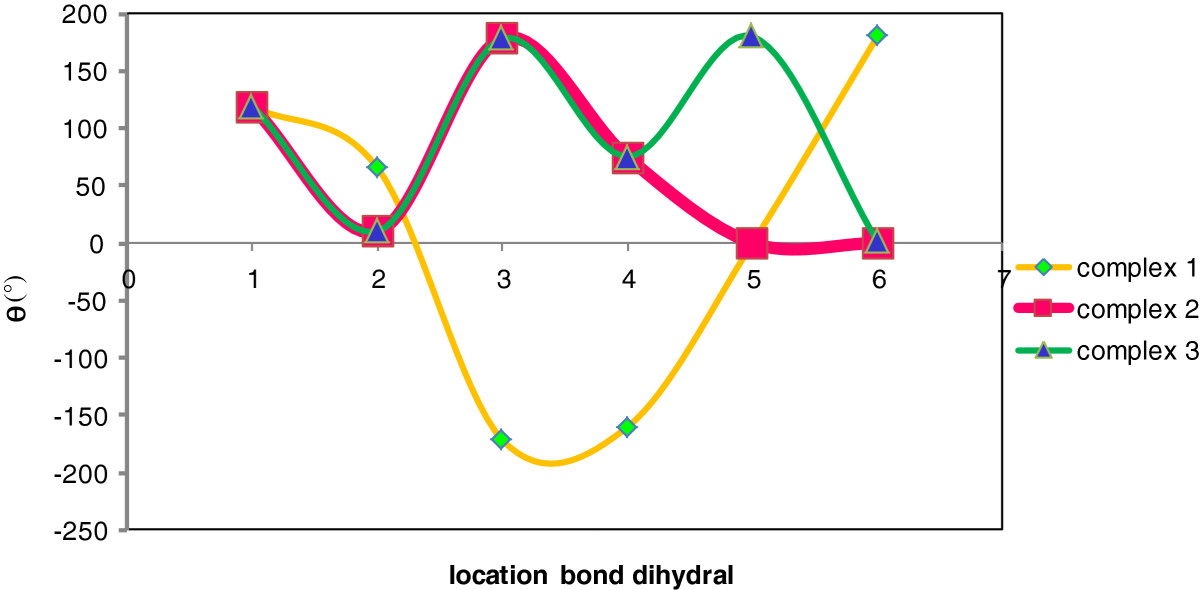
for complexes 1, 2, and 3 are 118.48520°, 117.99263°, and 118.85317° (in F, O, and H atoms). In locations 1, 2, 3, 4, 5, and 6, the hydra angle differences are observed in Table
1
and Figure
3
. In Table
3
, the Mulliken charges in donor electronegative atom O
84
and acceptor C
30
are negative and positive, respectively. The gap of energy of complex 2 is larger than that of complexes 1 and 3. Therefore, complex 2 is stable (Table
4
).
Figure 3
Parameter of dihedral angle change to locations 1, 2, 3, 4, 5, and 6 of complexes 1, 2, and 3 formed in B3LYP/631g(d) method at 298.15 K.
Table 4
Comparison between stability energy and moment dipole of complexes 1, 2, and 3 formed in B3LYP/631g(d) method at 298.15 K
Agent
Stability energy (Kcal mol−1)
Dipole moment (Debye)
Complex 1
−1,900,685.711
−0.2357
Complex 2
−1,995,192.983
1.09133
Complex 3
−1,972,541.490
0.5679
Conclusions
Based on the above discussion, the following conclusions were made:
● The Mulliken charges of the donor atoms are negative.
● The formed bond between oxygen and carbon is stronger and has more hybrid S orbital sharing, so the bond length becomes shorter.
● There is no reaction between the nanotube and drugs in the normal body temperature.
● NBO analysis shows high hyperconjugations in all compounds.
● By increasing the hybrid
P
orbital sharing, the occupancy decreases.
Methods
A computer was used to account all calculations, which has Intel® Core™ 2 quad CPU 8400 with 4 GB RAM Gaussian 98 plan package [
19
] Gauss view, and nanotube model [
20
] maker at DFT of theory, the B3LYP useful hybrid [
21
] with the standard of 631G(d) basis set [
22
,
23
]. Schemes were used to display the geometric optimization of the nanotube (6, 6) with 84 atoms and compound chalcones (HIV-1 inhibitors). Separately (Figures
1
,
2
, and
3
) then, complexes 1,2, and 3 were formed. The reaction of the nanotube and chalcone is shown in Equation
1
.
Chalcone+Nanotube6,6Chalcone−Nanotube6,6+H2
Acknowledgments
The authors would like to thank the financial support by Islamic Azad University, Rasht, Iran.
Competing interests
The authors declare that they have no competing interests.
Authors’ contributions
SG and MG participated in writing the manuscript. Both authors read and approved the final manuscript.
References
Iijima (1991) Helical microtubules of graphitic carbon10.1038/354056a0
Colomer et al. (2001) Electron diffraction study of small bundles of single-wall carbon nanotubes with unique helicity10.1103/PhysRevB.64.125425
Singh et al. (2006) Tissue biodistribution and blood clearance rates of intravenously administered carbon nanotube radiotracers (pp. 3357-3362) 10.1073/pnas.0509009103
Wong Shi Kam et al. (2004) Nanotube molecular transporters: internalization of carbon nanotube-protein conjugates into mammalian cells (pp. 6850-6851) 10.1021/ja0486059
Pastorin (2009) Crucial functionalizations of carbon nanotubes for improved drug delivery: a valuable option? (pp. 746-769) 10.1007/s11095-008-9811-0
Taft et al. (2004) Site-specific assembly of DNA and appended cargo on arrayed carbon nanotubes (pp. 12750-12751) 10.1021/ja045543d
Pantarotto et al. (2004) Functionalized carbon nanotubes for plasmid DNA gene delivery (pp. 5242-5236) 10.1002/anie.200460437
Cato et al. (2008) Cell-type specific and cytoplasmic targeting of PEGylated carbon nanotube-based nanoassemblies (pp. 2259-2269) 10.1166/jnn.2008.501
Gannon and Cherukuri (2007) Carbon nanotube-enhanced thermal destruction of cancer cells in a noninvasive radiofrequency field (pp. 2654-2665) 10.1002/cncr.23155
Cherukuri et al. (2004) Near-infrared fluorescence microscopy of single-walled carbon nanotubes in phagocytic cells (pp. 15638-15639) 10.1021/ja0466311
Dumortier et al. (2006) Functionalized carbon nanotubes are non-cytoxic and preserve the functionality of primary immune cells (pp. 1522-1528) 10.1021/nl061160x
Kostarelos et al. (2007) Cellular uptake of functionalized carbon nanotubes is independent of functional group and cell type (pp. 108-113) 10.1038/nnano.2006.209
Kostanecki and Tambor (1899) Ueber die sechs isomeren monooxybenzalacetophenone (monooxychalkone) (pp. 1921-1926) 10.1002/cber.18990320293
Moyle et al. (2008) Potential for new antiretrovirals to address unmet needs in the management of HIV-1 infection (pp. 459-471) 10.1089/apc.2007.0136
Wrodnigg and Eder (2001) Springer
Stephens et al. (1994) Ab initio calculation of vibrational absorption and circular dichroism spectra using density functional force fields (pp. 11623-11624) 10.1021/j100096a001
Frisch et al. (1998) Gaussian Inc.
J Crystal Soft:
JCrystal
. (2013). Accessed 28 Feb 2013
http://www.jcrystal.com
(2013). Accessed 28 Feb 2013
Becke (1993) A new mixing of Hartree–Fock and local density‒functional theories (pp. 1372-1377) 10.1063/1.464304