Nanocrystalline titania-based sulfonic acid (TiO2-Pr-SO3H) as a new, highly efficient, and recyclable solid acid catalyst for preparation of quinoxaline derivatives
Young Researchers Club, Rasht Branch, Islamic Azad University, Rasht, IR
Abstract
Nanocrystalline titania-based sulfonic acid (TiO
2
-Pr-SO
3
H) was used as an efficient and reusable catalyst for the synthesis of quinoxalines. The clean and mild acidity condition, quantitative yields of products, short reaction time, and low reaction temperature are attractive features of this method, making it suitable for heat- or acid-sensitive substrates, particularly in drug synthesis. In practice, this method affords an advantageous combination of satisfactory yields, easy product isolation, and purification.
Background
Among various classes of nitrogen-containing heterocyclic compounds, quinoxaline derivatives are important components of several pharmacologically active compounds[
1
,
2
]. These compounds are widely used as anticancer and anthelmintic agents[
3
], antiviral, and antibacterial[
4
]. Also, quinoxalines have been reported for their applications as dyes[
5
] and building blocks in the synthesis of organic semiconductors[
6
], and they also serve as useful rigid subunits in macrocyclic receptors or molecular recognition[
7
] and chemically controllable switches[
8
]. Therefore, the preparation of these compounds has gained considerable attention in recent years.
Improved methods have been reported for the synthesis of quinoxalines; some of the newly used reagents include alumina[
9
], montmorillonite K-10[
10
], sulfated TiO
2
[
11
–
13
], clayzic[
14
], zirconium (IV)-modified silica gel[
15
], PEG-400[
16
], heteropoly acid[
17
], ZrO
2
/M
x
O
y
/MCM-41[
18
], cellulose sulfuric acid[
19
], and Ga(OTf)
3
[
20
]. These procedures, although effective, have various drawbacks such as requirement of long reaction times (24 h[
14
]), potential hazards, difficulty in catalyst preparation (e.g., preparation of ZrO
2
/M
x
O
y
/MCM-41 involves a complex procedure and calcination at 500°C) and low yields. Hence, introduction of new methods to circumvent these problems is still in demand.
In recent years, there has been considerable growth of interest in the catalysis of organic reactions by solid acid catalysts. Solid acid catalysts provide numerous opportunities for recovering and recycling the catalysts from reaction mixtures. These features can lead to improved processing steps, better process economics, and environmentally friendly industrial manufacturing.
In the present study, the synthesis of chemically bound adsorbed sulfonic acid on TiO
2
(TiO
2
-Pr-SO
3
H) by the reaction of (3-mercaptopropyl) trimethoxysilane and TiO
2
and oxidation of the thiol groups with H
2
O
2
is reported. The characterization of TiO
2
-Pr-SO
3
H was performed by means of various techniques such as Fourier transform infrared spectroscopy (FT-IR), X-ray diffraction (XRD), scanning electron microscopy (SEM), transmission electron microscopy (TEM), and thermogravimetric analysis (TGA). The acidic property of the synthesized catalyst was evaluated by the calculation of Hammett acidity function. The assessment of the catalyst was carried out in the preparation of quinoxalines under mild conditions at room temperature (Scheme
1
).
Scheme 1
Preparation of quinoxalines in the presence of TiO2-Pr-SO3H.
Results and discussion
In an initial study, in order to examine the catalytic activity of catalyst, we examined the reaction of 1,2-phenylenediamine (1 mmol) with benzil (1 mmol) in various solvents (EtOH, THF, MeCN, EtOAc, and toluene) and also under solvent-free classical heating conditions in the presence of different amounts of the catalyst. The best result was achieved by carrying out the reaction in the presence of 10 mg of TiO
2
-Pr-SO
3
H in EtOH (Table
1
, entry 9). The feasibility of the reaction was successfully tested by producing good yields of the products using various 1,2-dicarbonyl compounds and O-phenylenediamines (Table
2
). The present protocol also works well for condensation of aliphatic 1,2-diamines and 1,2-dicarbonyl compounds to give the corresponding quinoxaline derivatives in moderate yields.
Table 1
Optimization of the reaction conditions
Entry
Amount of catalyst (mg)
Solvent
Time (min)
Yield (%)
1
20
-
60
60a
2
20
THF
60
70
3
20
MeCN
60
81
4
20
EtOH
60
93
5
20
EtOAc
60
75
6
20
Toluene
60
85
7
18
EtOH
30
94
8
15
EtOH
10
95
9
10
EtOH
10
95
10
5
EtOH
20
90
Table 2
Synthesis of quinoxalines in the presence of TiO2-Pr-SO3H
Entry
Amine
Carbonyl compound
Time (min)
Yielda(%)
Product
1
10 (10, 14)b
95 (94, 90)b
2
5
91
3
4
96
4
10
90
5
25
85
6c
30
80
Another advantage of the present methodology is the reusability of the catalyst. After completion of the reaction, the catalyst was removed by simple filtration, then washed with acetone, dried at 100°C for 2 h, and reused for three consecutive reactions without any appreciable change in its catalytic activity (Table
2
, entry 1). The infrared (IR) spectra and TGA of the recovered catalyst after the third run showed the same spectra of the unused catalyst, which show that the catalyst remained unchanged after three usages.
The possible mechanism for the preparation of quinoxalines in the presence of TiO
2
-Pr-SO
3
H as a promoter is shown in Scheme
2
. On the basis of this mechanism, TiO
2
-Pr-SO
3
H catalyzes the reaction by the electrophilic activation of 1,2-dicarbonyls,making these compounds susceptible to nucleophilic attack by the diamine. Successive elimination of H
2
O results in the formation of quinoxaline derivatives and regenerates TiO
2
-Pr-SO
3
H in the reaction mixture. A similar mechanism has been proposed for this reaction with the sulfated TiO
2
catalyst[
10
].
Scheme 2
Proposed mechanism.
In order to show the efficiency of this method, Table
3
compares the results from the preparation of 2,3-diphenylquinoxaline in the presence of TiO
2
-Pr-SO
3
H and some of the other catalysts. In comparison with previously reported methods, our catalyst promotes the reaction very effectively and gives the desired product in a very short time at high yield, and very low amount of the catalyst is needed. Also, our synthesized catalyst can be recovered simply by filtration and can be reused in the next runs without a significant yield decrease of the products. Moreover, our procedure is environmentally friendly as it does not use any toxic auxiliary or solvent.
Table 3
Comparison of the efficiency of TiO2-Pr-SO3H in the synthesis of 2,3-diphenylquinoxaline with other reported methods
Entry
Reagent
Solvent
Amount of catalyst (mg)
Time (min)
Yield (%)a
1
TiO2-Pr-SO3H (this work)
EtOH
10
10
95
2
Montmorillonite K-10 [10]
H2O
21
150
100
3
Clayzic [14]
H2O-EtOH
100
24
89
5
Heteropoly acid [17]
Acetic acid
30
5
98
6
ZrO2/MxOy/MCM-41 [18]
MeCN
40
120
97
7
Cellulose sulfuric acid [19]
EtOH
10
60
93
8
Cellulose sulfuric acid [19]
H2O
10
150
80
Conclusions
In conclusion, we have described a novel and efficient method for the preparation of quinoxalines catalyzed by TiO
2
-Pr-SO
3
H, as a new and efficient reagent, under mild conditions. High yields of the products, short reaction times, ease of the preparation and recyclability of the reagent, solvent-free nature of the reaction, and easy work-up are among the other advantages of this method which make this procedure an alternative to the useful available methods.
Methods
General
Chemicals were purchased from Merck (Darmstadt, Germany) and Sigma-Aldrich (St. Louis, MO, USA) chemical companies. All of the yields refer to the isolated products. Identification of the products was confirmed by comparison of their physical constants with those of authentic samples. The purity determination of the substrate and reaction monitoring were accompanied by thin-layer chromatography (TLC) on silica gel POLYGRAM SILG-UV
254
(Carl Roth GmbH, Karlsruhe, Germany) plates.
Instrumentation
Thermogravimetric analyses were conducted using a TGA PYRIS 1 (PerkinElmer Instruments, Waltham, MA, USA) thermoanalyzer instrument. Samples were heated from 25°C to 600°C at ramp 10°C/min under N
2
atmosphere. Wide-angle XRD measurements were performed at room temperature on a Siemens D-500 X-ray diffractometer (Munich, Germany), using Ni-filtered Cu-Kα radiation (
λ
= 0.15418 nm). IR and FT-IR spectra were obtained in KBr wafers on Shimadzu IR-470 (Kyoto, Japan) and PerkinElmer RX1 (Waltham, MA, USA) spectrophotometers respectively. TEM analysis was performed on a Philips model CM 10 (FEI Co., Hillsboro, OR, USA) instrument. Sample was prepared by sonicating a small amount of powder in methanol and then placing a drop of the mixture on a 3-mm TEM Cu grid having a lacey carbon support film. Scanning election microphotographs were obtained on a LEO 1430VP instrument. The absorption spectra in the UV-visible regions were recorded by a PerkinElmer LAMBDA 25 recording spectrophotometer.
1
H and
13
C NMR spectra were measured in CDCl
3
with a Brucker DRX-400AVANCE (Karlsruhe, Germany) spectrometer at 400 and 100 MHz, respectively.
Catalyst preparation
Synthesis of 3-mercaptopropyltitania
To 20 g of TiO
2
(anatase, from Sigma-Aldrich) in dry toluene, 25 mL of (3-mercaptopropyl) trimethoxysilane was added, and the reaction mixture was refluxed for 24 h. After this period, the mixture was filtered to obtain 3-mercaptopropyltitania (MPT), which was washed with acetone and dried.
Oxidation of 3-mercaptopropyltitania
MPT was oxidized with 10 wt.% H
2
O
2
in methanol (20 mL) for 24 h at room temperature. The prepared sample was then treated with 1 N H
2
SO
4
at ambient temperature for complete protonation, and then the mixture was filtered and washed with H
2
O and acetone to obtain TiO
2
-Pr-SO
3
H catalyst (Scheme
3
).
Scheme 3
Preparation of nanoporous titania-based sulfonic acid (TiO2-Pr-SO3H).
Catalyst characterization
FT-IR analysis
FT-IR spectra for the pure TiO
2
and TiO
2
-Pr-SO
3
H samples are shown in Figure
1
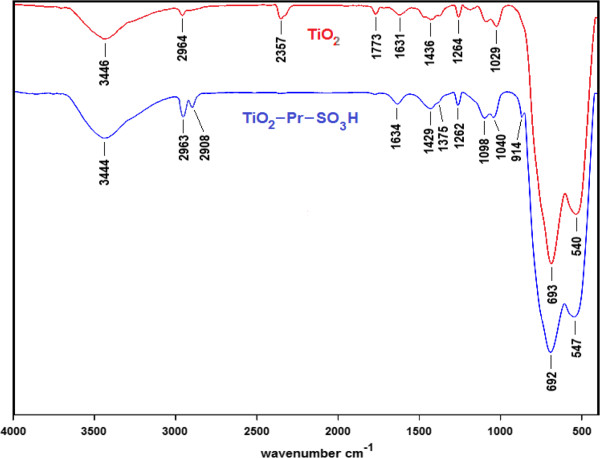
. In the case of TiO
2
, the peaks at 3,446 and 1,773 cm
−1
correspond to the -OH stretching and bending vibrations of the adsorbed water, respectively. The spectrum of functionalized TiO
2
by sulfonic acid displays almost the same pattern as that of pristine TiO
2
, but the band at 3,000 to 3,600 cm
−1
that centered at 3,444 cm
−1
is flattened in sulfonated TiO
2
which can be attributed to the modification of TiO
2
. Also, CH stretching vibrations of silylating agent was observed at 2,963 and 2,908 cm
−1
, and the bands at 1,040 and 914 cm
−1
can be collectively attributed to Si-O stretching vibrations. Furthermore, the band at 1,375 cm
−1
corresponds to the stretching frequency of S = O in SO
3
H.
Figure 1
FT-IR spectra of TiO2and TiO2-Pr-SO3H.
Wide-angle X-ray diffraction
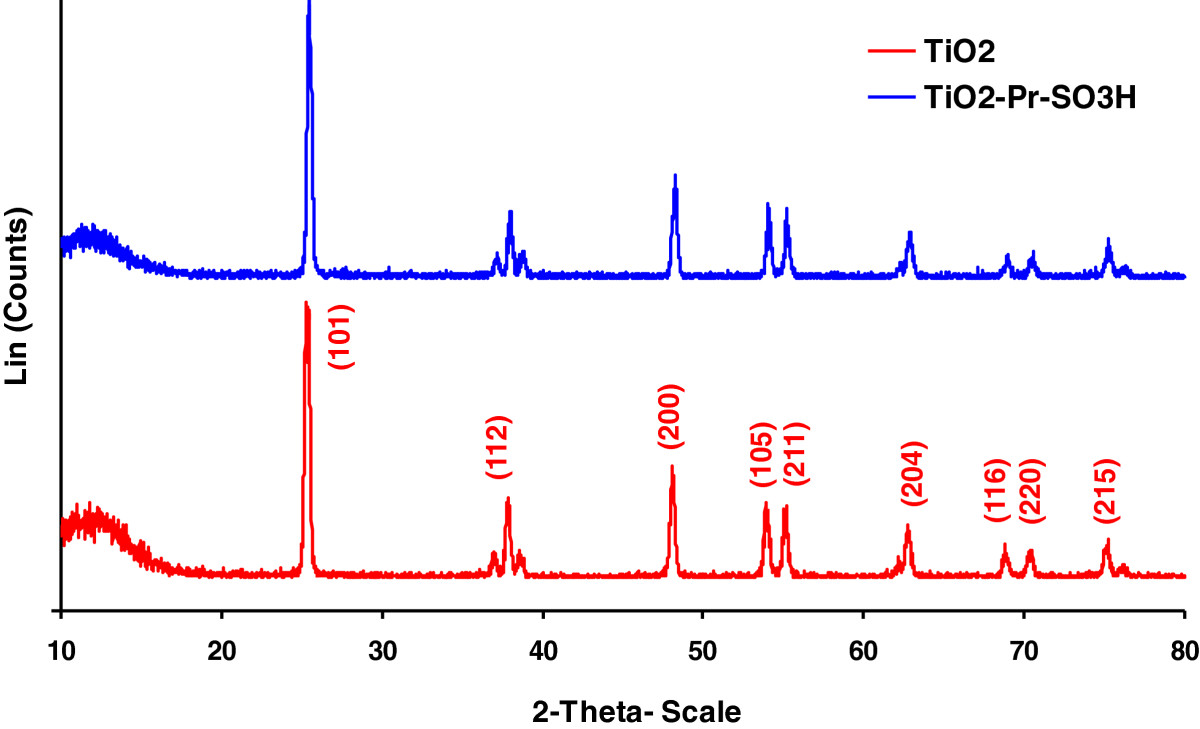
XRD patterns of TiO
2
and TiO
2
-Pr-SO
3
H are given in Figure
2
. XRD patterns clearly show anatase lines. It seems that the peak intensities of TiO
2
-Pr-SO
3
H are almost the same as those of TiO
2
, and the sulfate modification does not change the phase of TiO
2
. The average crystallite sizes of TiO
2
and TiO
2
-Pr-SO
3
H, determined using Debye-Scherrer equation, are 15.3 and 20 nm, respectively, which demonstrated that sulfate modification increases the size of TiO
2
.
Figure 2
XRD patterns of TiO2and TiO2-Pr-SO3H.
SEM analysis
The representative SEM images of TiO
2
and TiO
2
-Pr-SO
3
H are shown in Figure
3
a,b,c,d with ×30,000 and ×50,000 magnifications. All of the SEM images exhibit a cloud-like structure and small spherical-shaped particles. In TiO
2
-Pr-SO
3
H, aggregation of TiO
2
nanoparticles was clearly seen. However, the SEM micrographs of the catalyst show some modifications with respect to TiO
2
such that the primary surface structure of TiO
2
has changed.
Figure 3
SEM images of TiO2and TiO2-Pr-SO3H.
TiO
2
(
a
) ×30,000 and (
b
) ×50,000 magnifications and TiO
2
-Pr-SO
3
H (
c
) ×30,000 and (
d
) ×50,000 magnifications.
TEM analysis
TEM images of TiO
2
-Pr-SO
3
H are shown in Figure
4
. TiO
2
-Pr-SO
3
H particles are seen in different sizes ranging from 20 to 100 nm, and the average crystallite size of TiO
2
-Pr-SO
3
H, determined using XRD, was 20 nm. As can be seen in Figure
4
, the particles are slightly corroded in the modification path. This is indicated in the figure by the arrow.
Figure 4
TEM images of TiO2-Pr-SO3H.
Red arrow, corroded.
Thermal analysis
TGA was performed for the characterization of TiO
2
-Pr-SO
3
H in comparison with TiO
2
(Figure
5
). The TGA curve of TiO
2
displays a weight loss (4 wt.%) below 100°C which corresponds to the loss of the physically adsorbed water. Also, there is a slight weight loss (3 wt.%) in the range of 100°C to 600°C, which possibly corresponds to the dehydroxylation of TiO
2
.
Figure 5
TGA curves of TiO2and TiO2-Pr-SO3H.
TGA of the catalyst shows an initial weight loss (4 wt.%) due to the desorption of water below 100°C. This is followed by a second weight loss that started at 245°C, corresponding to the loss of the covalently bound organic group. From this weight loss, it is calculated that the loading of the organic group bound to the titania surface was 2.52 mmol g
−1
. Also, from the TGA, we understood that TiO
2
-Pr-SO
3
H has a greater thermal stability (until 245°C) relative to TiO
2
.
Surface acidity studies
The Hammett acidity function (H
0
) can effectively express the acidity strength of an acid in organic solvents. It can be calculated using the following equation:
H0=pKIaq+logIs/IH+s,
Here, ‘I’ represents the indicator base (mainly substituted dinitroanilines), and [IH
+
]
s
and [I]
s
are respectively the molar concentrations of the protonated and unprotonated forms of the indicator. The pK(I)
aq
values are already known (for example the pK(I)
aq
value of 4-nitroaniline is 0.99) and can be obtained from many references. According to the Lambert-Beerlaw, the value of [I]
s
/[IH
+
]
s
can be determined and calculated using the UV-visible spectrum.
In our experiment, 4-nitroaniline was chosen as the basic indicator, and CCl
4
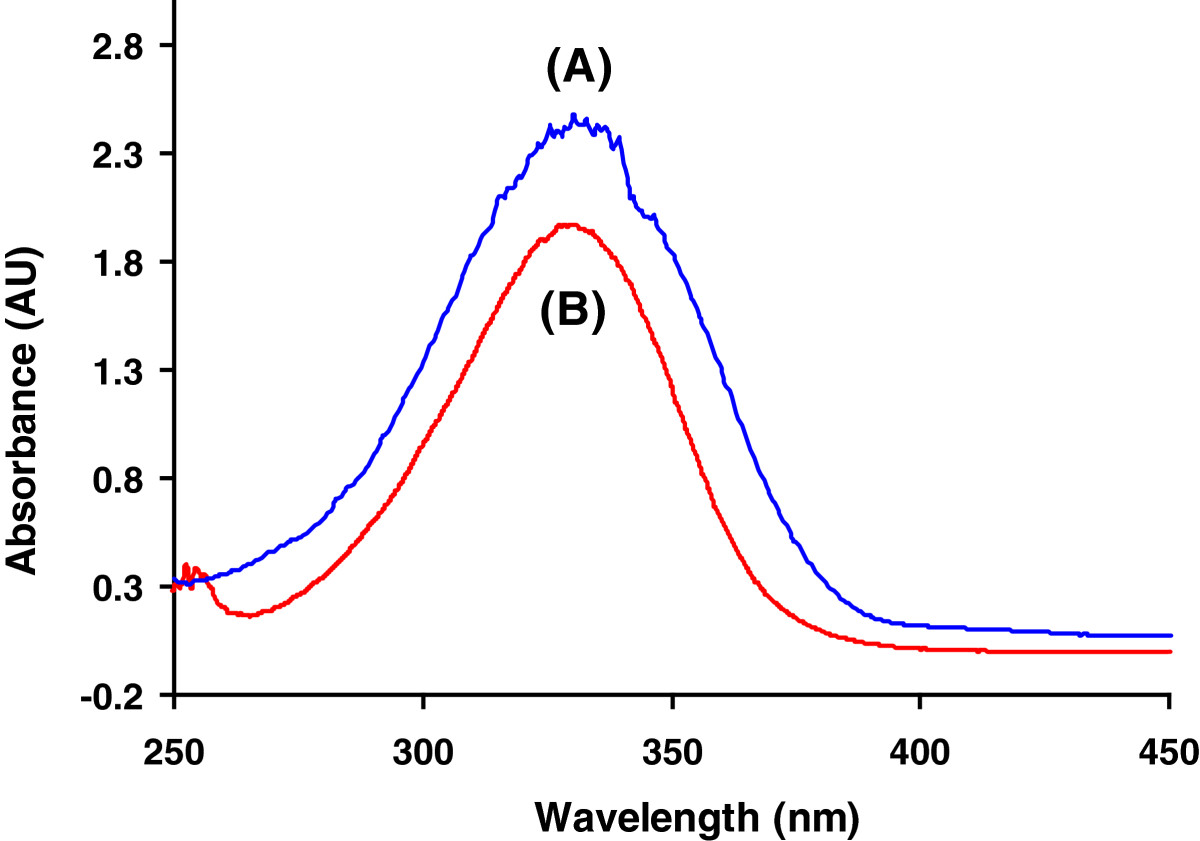
was chosen as the solvent because it is aprotic. The maximal absorbance of the unprotonated form of 4-nitroaniline was observed at 329 nm in CCl
4
. As Figure
6
shows, the absorbance of the unprotonated form of the indicator in TiO
2
-Pr-SO
3
H was weak as compared to the sample of the indicator in CCl
4
, which indicated that the indicator was partially in the form of [IH
+
]. The results obtained are listed in Table
4
, which shows the acidity strength of TiO
2
-Pr-SO
3
H.
Figure 6
Absorption spectra of 4-nitroaniline (indicator; curve A) and TiO2-Pr-SO3H (catalyst; curve B) in CCl4.
Table 4
Calculation of Hammett acidity function (H0) of TiO2-Pr-SO3H
Entry
Catalyst
Amax
[I]s(%)
[IH+]s(%)
H0
1
-
2.4113
100
0
-
2
TiO2-Pr-SO3H
1.1862
49.19
50.80
0.98
General procedure
To a mixture of a substituted 1,2-diketone (1 mmol) and 1,2-diamine (1 mmol) in ethanol (5 mL), TiO
2
-Pr-SO
3
H (10 mg) was added. The mixture was stirred at room temperature and the reaction was monitored by TLC. After completion, the reaction mixture was heated for a few minutes. The catalyst was removed by filtration, the filtrate was concentrated, and the solid residue was recrystallized from ethanol to give the pure product.
Acknowledgments
The authors acknowledge the editor who made the significant revision and contribution towards improving the standard of our article.
Competing interests
The authors declare that they have no competing interests.
Authors’ contributions
Both authors - SVA and SSB - contributed equally in this article. Both authors read and approved the final manuscript.
References
Sarges et al. (1990) 4-Amino[1,2,4]triazolo[4,3-a]quinoxalines. A novel class of potent adenosine receptor antagonists and potential rapid-onset antidepressants (pp. 2240-2254) 10.1021/jm00170a031
Brown (2005) Chemistry and enzymology of vitamin B12 (pp. 2075-2150) 10.1021/cr030720z
Sakata et al. (1998) Recent progress in the quinoline chemistry: synthesis and biological activity (pp. 2481-2515)
Ali et al. (2000) Synthesis and antimicrobial activities of some novel quinoxalinone derivatives (pp. 864-873) 10.3390/50600864
Sonawane and Rangnekar (2002) Synthesis and application of 2-styryl-6,7-dichlorothiazolo[4,5-b]-quinoxaline based fluorescent dyes: part 3 (pp. 303-308) 10.1002/jhet.5570390210
Dailey et al. (2001) Synthesis and device characterisation of side-chain polymer electron transport materials for organic semiconductor applications (pp. 2238-2243) 10.1039/b104674h
Elwahy (2000) Synthesis of new benzo-substituted macrocyclic ligands containing quinoxaline subunits (pp. 897-907) 10.1016/S0040-4020(99)01072-8
Crossley and Johnston (2002) Laterally-extended porphyrin systems incorporating a switchable unit
Jafarpour et al. (2011) Easy access to quinoxaline derivatives using alumina as an effective and reusable catalyst under solvent-free conditions (pp. 48-51) 10.1016/j.apcata.2010.12.022
Huang et al. (2008) Montmorillonite K-10: an efficient and reusable catalyst for the synthesis of quinoxaline derivatives in water (pp. 1143-1147) 10.1016/j.catcom.2007.10.024
Krishnakumar and Swaminathan (2011) Solvent free synthesis of quinoxalines, dipyridophenazines and chalcones under microwave irradiation with sulfated Degussa titania as a novel solid acid catalyst (pp. 16-25) 10.1016/j.molcata.2011.08.026
Krishnakumar and Swaminathan (2010) A recyclable and highly effective sulfated TiO2-P25 for the synthesis of quinoxaline and dipyridophenazine derivatives at room temperature (pp. 2572-2577) 10.1016/j.jorganchem.2010.08.055
Krishnakumar et al. (2010) An efficient protocol for the green synthesis of quinoxaline and dipyridophenazine derivatives at room temperature using sulfated titania (pp. 997-1002) 10.1016/j.catcom.2010.04.021
Dhakshinamoorthy et al. (2011) Zn2+-K10-clay (clayzic) as an efficient water-tolerant, solid acid catalyst for the synthesis of benzimidazoles and quinoxalines at room temperature (pp. 69-73) 10.1016/j.tetlet.2010.10.146
Sharma and Sharma (2011) Zirconium(IV)-modified silica gel: preparation, characterization and catalytic activity in the synthesis of some biologically important molecules (pp. 327-331) 10.1016/j.catcom.2010.10.011
Zhang et al. (2010) Synthesis of quinoxaline derivatives catalyzed by PEG-400 (pp. 395-398) 10.1016/j.cclet.2009.12.015
Heravi et al. (2007) Wells-Dawson type heteropolyacid catalyzed synthesis of quinoxaline derivatives at room temperature (pp. 465-467) 10.1007/s00706-007-0594-5
Ajaikumar and Pandurangan (2009) Efficient synthesis of quinoxaline derivatives over ZrO2/MxOy (M = Al, Ga, In and La) mixed metal oxides supported on MCM-41 mesoporous molecular sieves (pp. 184-192) 10.1016/j.apcata.2009.01.021
Shaabani et al. (2009) Green chemistry approaches for the synthesis of quinoxaline derivatives: comparison of ethanol and water in the presence of the reusable catalyst cellulose sulfuric acid (pp. 1249-1252) 10.1016/j.crci.2009.01.006
Cai et al. (2008) Gallium(III) triflate-catalyzed synthesis of quinoxaline derivatives (pp. 7386-7390) 10.1016/j.tetlet.2008.10.058