Department of Electrical Engineering, Indian Institute of Technology Kanpur, Kanpur, 208016, IN
Microelectronics Research Center, University of Texas at Austin, Austin, TX, 78758, US
Abstract
Semiclassical Monte Carlo simulation is used to determine the effect of microscopic ripples on spin relaxation length in freely suspended single-layer graphene. Spin relaxation lengths are simulated using D’yakonov–Perel mechanisms, with comparisons made by including ripple scattering mechanisms along with phonon scattering. The results are simulated with varying temperatures and concentration.
Introduction
Ever since its experimental discovery in 2004 by Novoselov et al. [
1
], there has been an ever growing interest in graphene-based devices due to the many outstanding properties that the two-dimensional sheet of carbon atoms displays. Single-layer graphene is the two-dimensional (2D) form of carbon characterized by a honeycomb lattice with two inequivalent lattice sites [
2
]. It is touted as the material of the future due to its extreme importance to superconductivity [
3
]. The extraordinary physical, chemical and optical properties exhibited by graphene have resulted in ultra-sensitive high-performance pH membranes, graphene-supported Pd catalysts, mechanical reinforcement fibers, etc. [
4
–
6
]. Graphene has drawn plenty of attention for spintronic and nano-electronics applications due to its unique electronic properties. Long spin relaxation length, high electron mobility and gate-tunable spin transport as demonstrated by Tombros et al. [
7
] have made graphene a suitable candidate for spintronics applications. As demonstrated by Neumann et al. [
8
], large spin accumulation in graphene can be obtained by interfacial layers at the graphene–ferromagnet interface. Graphene is shown to possess a mobility of
which is higher than other superconducting materials [
3
]. It is unusual in many aspects, one of them being the linear dispersion relation that causes the electrons to obey the relativistic Dirac equation instead of the Schrödinger equation [
9
]. The
π
orbitals between neighboring carbon atoms in the graphene sheet overlap and can be described by a tight-binding Hamiltonian [
10
]. Unlike other 2D electronic materials, the low-energy electronic band structure of graphene [
11
–
13
] is described by a massless Dirac equation with Fermi velocity
Various experiments using transmission electron microscopy (TEM) confirm that graphene behaves more like a membrane than a 2D sheet
[14
,
15
]. The presence of intrinsic ripples is both experimentally studied [
14
] and confirmed by Monte Carlo simulations [
15
]. The experiments as well as numerical simulations have confirmed the typical ripple length to be 50–100 Å, with peaks around 70 Å [
14
].
Considerable attention has been thus given to study the effect of such microscopic corrugations on electronic transport and resistivity of single-layer graphene on both SiO
2
and free-suspended graphene [
16
–
18
]. Recently, Bao et al. [
19
] reported that ripple properties like their orientation, wavelength and amplitude can be controlled using boundary conditions and making use of graphene’s negative thermal expansion coefficient. It has been shown that ripples cause the change in bond length, local resistivity and local charge inhomogeneity [
21
]. It has also been shown theoretically [
22
] that the density of states near the Dirac point is not affected by uncorrelated ripples (thermal agitation) thus enabling us to use graphene linear E–K relationship in our model. We aim to focus our attention to the importance of these intrinsic ripples on spin-based devices. Experimental and theoretical studies of spin relaxation length in single- and bilayer graphene concluded high potential for Spintronics devices [
12
,
20
].
Scattering through ripples
Ripples act as an additional source of scattering hence it becomes an important theoretical question to address the nature of electronic scattering of such ripples while considering spin relaxation lengths. In accordance with Mermin–Wagner theorem free-standing, 2D sheet of graphene would be disrupted by thermodynamic forces [
15
]. Rippling provides the thermodynamic stability to free-standing graphene sheets [
15
]. The approach followed by Katsnelson and Geim [
23
] is to consider a ‘‘single ripple’’ and, assuming that the rest of the sample is flat, calculate its scattering cross section. The ripples are then treated as random uncorrelated impurities with the cross section of single ripple.
The ripple scattering rate (1/
τ
) can be written as [
23
]
where
Vq
is the scattering potential caused by a single ripple.
where
h
is the displacement normal to the graphene plane and
a
is the lattice spacing.
Ripple height-correlation is given by [
24
]
where the exponent
H
characterizes the fractal dimensions of ripple. It also provides information about the origins of ripples. An exponent 2
H
= 1 indicates that height fluctuation domains have short-range correlations, implying that graphene conforms to the morphology of the underlying substrate, while 2
H
= 2 suggests a thermally excitable membrane only loosely bound by Van-der Waals forces to the substrate [
25
]. Hence, for a freely suspended graphene resistivity
and scattering mimics long range coulomb scattering. The given formulae rely on the assumption that scattering is elastic in the classical sense through thermally induced (dynamic) as well as quenching-induced (static) ripples.
The factor
for
and unity for
.
is the bending stiffness of graphene and is experimentally determined as ≈1 eV [
16
].
Spin relaxation in a single-layer graphene is caused by D’yakonov–Perel relaxation [
32
] due to structural inversion asymmetry (Rashba spin–orbit coupling). The spin dephasing occurs because electrons feel an effective magnetic field due to the spin–orbit interaction that changes randomly every time when an electron undergoes a scattering event. Temporal evolution of spin is given by following equation [
27
]
where
is the precession vector. The temporal evolution of the spin in a random time interval Δ
t
is determined by
.
To begin with the simulation, for the initialized distribution of electrons we solve the Poisson Equation [
12
,
26
] after dividing the device into uniformly spaced grids along its transport direction. From the position of the particles the charge distribution at each grid point is calculated and the local electric field at each grid is determined. Finally, from the energies of the particles the individual scattering rates for each of the particles are calculated. The electrons crossing over into the drain are reinjected at the source with initial polarization along
z
-axis which is perpendicular to the plane of graphene.
Monte Carlo method has been applied to model the spin transport [
26
] in graphene. In this method, we determined the free-flight time after calculating the various scattering rates. During the free-flight period, the carriers evolve according to the classical transport equations and then undergo scattering. After the scattering, we determine the carrier velocities from their scattering rates and by generation of random numbers. New scattering rates for the carriers are calculated from the new velocities and energies and new free-flight times are determined. The process continues for a fixed number of steps. During the free-flight period, the spin of an individual electron precess around an effective magnetic field is obtained from the spin–orbit Hamiltonian. The magnitude of the ensemble averaged spin vector |〈S〉| is computed from the expression given by [
27
]
The spin relaxation length (SRL) is the distance from the source where spin polarized electrons are injected with 100 % polarization in the
z
direction to the point where the magnitude of the average spin vector drops to 1/e times its initial value at the time of injection.
Simulation model for single-layer graphene
The Monte Carlo method has been discussed in detail in [
26
]. Single-layer graphene cannot be modeled with an effective mass owing to its linear energy momentum dispersion relation near the Dirac point given by
where
k
denotes the momentum and
denotes the Fermi velocity in graphene [
28
]. The simulations are done taking into account acoustic phonon, optical phonon and ripple scattering. The ripple resistivity calculated using the classical elastic scattering method is 150 Ω, which is in broad agreement with the experiments conducted on single-layer graphene [
29
]. This resistivity owes to the electron scattering rates of ~10
13
per second at room temperature. At room temperature, ripple scattering dominates other scattering mechanisms and is most influential in determining the spin relaxation length. For the simulation, the length of the device considered is 5,000 nm and the width is 10 nm. The carrier density is assumed to be 10
18
/m
2
(10
14
/cm
2
).
Results and discussion
Table
1
summarizes the findings of this work. Figure
1
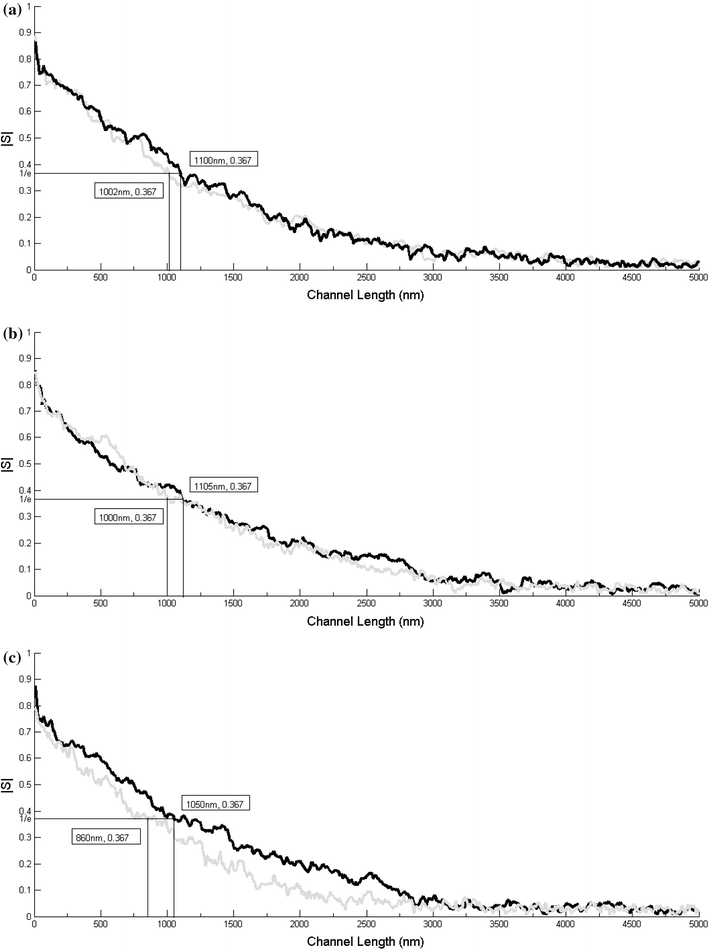
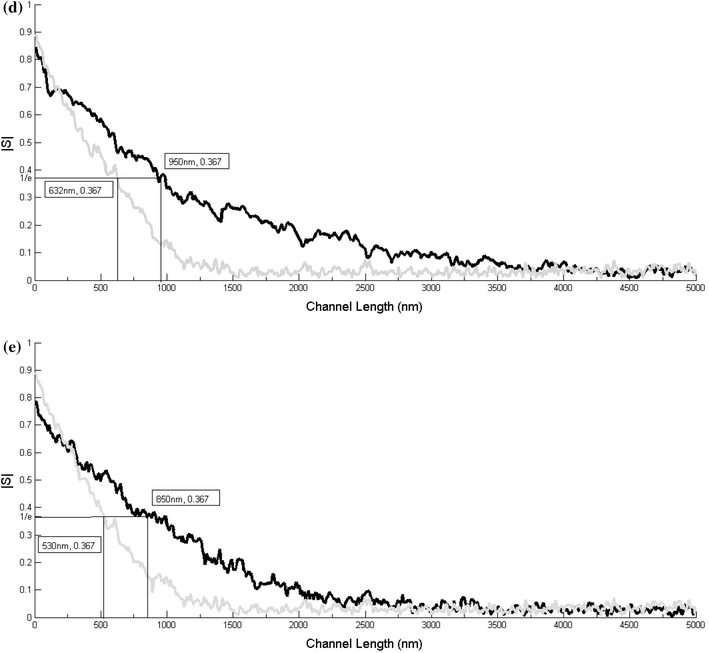
a–e shows the decay of magnitude of ensemble averaged spin at different temperatures with and without ripple scattering. Figure
2
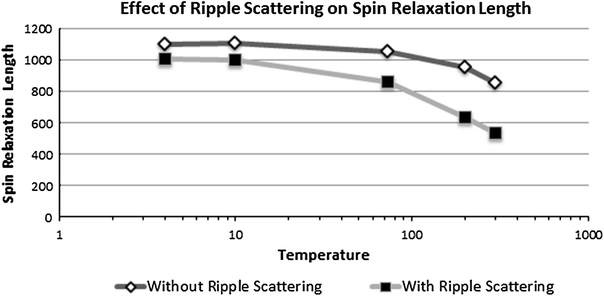
compares the variation of spin relaxation length with temperature for the cases when only phonon scattering is taken into consideration and when ripple scattering along with phonon scattering is taken into consideration.
Table 1
Effect of ripple scattering on spin relaxation length and % change with comparison to reference
Temperature (K)
Spin relaxation length (nm)
% change
Without ripple scattering
With ripple scattering
4
1,095
1,002
8
10
1,105
1,000
10
77
1,050
860
18
200
950
632
33
300
850
530
38
Fig. 1
Spin relaxation length comparison with (
grey color
) and without ripple (
black color
) scattering at
a
4 K,
b
10 K,
c
77 K,
d
200 K,
e
300 K respectively
Fig. 2
Spin relaxation length comparison with and without ripple scattering along different temperatures
From the figures we note that the spin relaxation length is lower if the effect of ripples is taken into consideration. The ripples act as additional scattering centers resulting in reduced mobility. The precession vector undergoes frequent randomization in the presence of ripples resulting in reduced spin relaxation length. It should also be noted that the effects of ripples and other corrugations increase as temperature increases. It is evident from the fact that the percent change in spin relaxation length from reference increases as temperature increases and is as high as 37 % at 300 K. Though it seems to saturate to value around 40 % at increasing temperature.
The qualitative outcome is that freely suspended graphene can be a choice for Spintronics at room temperature along with graphene exfoliated on SiO
2
[
31
]. In suspended graphene in the absence of the substrate, one can achieve high-quality device with low contamination and reduced surface roughness resulting in long spin relaxation length [
31
]. Quantitatively, since the ripple resistivity, as well as ripple scattering rate, is
T2
, the simulations predict a spin relaxation length of 0.53 μm at 300 K which is roughly half of what experiments conclude for graphene exfoliated on SiO
2
[
30
]. The thermally induced ripples (and other corrugations) are responsible for such low spin relaxation length. But as refs [
16
,
29
] point out, ripples can be controlled by applying strain on graphene by clamping it mechanically by electrodes. This can also be achieved by depositing graphene on substrate, where the attraction forces between the substrate molecules and graphene layer helps it to conform to the substrate’s morphology. Low temperatures show less ripple effect, as expected.
The spin relaxation length is found to be 1 μm at 4 K and 0.5 μm at 300 K. Hence this can be understood as the upper bound of length that can be achieved with freely suspended single-layer graphene. Hence, further experiments need to be conducted to determine the exact contribution of ripples to spin relaxation length.
Conclusion
Like mobility (and conductivity), spin relaxation length too is dependent on morphology of graphene. It is restricted by the ripples and other microscopic corrugations (clusters, puddles, etc.) which are a result of manufacture defects or thermal agitation. Keeping this in mind in this work, we studied the effect of microscopic ripples on SRL in Single-Layer Graphene. We found that the SRL decreases when the microscopic ripples are taken into consideration and the reduction in SRL is as high as 37 % at 300 K. However, it seems to saturate to value around 40 % decrease at higher temperatures. We conclude that the manufacturing defects cannot be minimized after a certain extent but thermal agitations and formation of thermally induced ripples can be controlled by subjecting graphene under strain. Further experiments need to be carried out so as to determine the optimum strain level at certain temperature which can provide us excellent spin lengths.
References
Novoselov et al. (2005) Two-dimensional gas of massless Dirac fermions in grapheme (pp. 197-200) 10.1038/nature04233
Geim and MacDonald (2007) Graphene: exploring carbon flatland10.1063/1.2774096
Chen et al. (2008) Intrinsic and extrinsic performance limits of graphene devices on SiO210.1038/nnano.2008.58
Li et al. (2012) CO oxidation over graphene supported palladium catalyst 125(21) (pp. 189-196) 10.1016/j.apcatb.2012.05.023
Jiang et al. (2013) Facilitating the mechanical properties of a high-performance pH-sensitive membrane by cross-linking graphene oxide and polyacrylic acid 24(33) 10.1088/0957-4484/24/33/335704
Jiang et al. (2013) Mechanical reinforcement fibers produced by gel-spinning of poly-acrylic acid (PAA) and graphene oxide (GO) composites (pp. 6265-6269) 10.1039/c3nr00288h
Tombros et al. (2007) Electronic spin transport and spin precession in single graphene layers at room temperature10.1038/nature06037
Neumann et al. (2013) Electrical Detection of Spin Precession in Freely Suspended Graphene Spin Valves on Cross-Linked Poly(methyl methacrylate) (pp. 156-160) 10.1002/smll.201201194
Du et al. (2008) Approaching ballistic transport in suspended graphene (pp. 491-495) 10.1038/nnano.2008.199
Deshpande et al. (2009) Spatially resolved spectroscopy of monolayer graphene on SiO210.1103/PhysRevB.79.205411
Bao et al. (2009) Controlled ripple texturing of suspended graphene and ultrathin graphite membrane (pp. 562-566) 10.1038/nnano.2009.191
Yang et al. (2011) Observation of long spin-relaxation times in bilayer graphene at room temperature10.1103/PhysRevLett.107.047206
de Juan et al. (2007) Charge inhomogeneities due to smooth ripples in graphene sheets10.1103/PhysRevB.76.165409
Brey and Palacios (2008) Exchange-induced charge inhomogeneities in rippled neutral graphene10.1103/PhysRevB.77.041403
Katsnelson and Geim (2008) Electron scattering on microscopic corrugations in graphene (pp. 195-204) 10.1098/rsta.2007.2157
Ishigami et al. (2007) Atomic structure of graphene on SiO210.1021/nl070613a
Stolyarova et al. (2007) High-resolution scanning tunneling microscopy imaging of mesoscopic graphene sheets on an insulating surface10.1073/pnas.0703337104
Jacoboni and Reggiani (1983) The Monte Carlo method for the solution of charge transport in semiconductors with applications to covalent materials10.1103/RevModPhys.55.645
Bournel et al. (1997) Modelling of gate-induced spin precession in a striped channel high electron mobility transistor10.1016/S0038-1098(97)00278-0