Sulfonic acid-functionalized ordered nanoporous Na+-montmorillonite (SANM) as an efficient and recyclable catalyst for the tetrahydropyranylation and detetrahydropyranylation of alcohols and phenols

Abstract

Sulfonic acid-functionalized ordered nanoporous Na + -montmorillonite, as a newly reported solid acid nanocatalyst, was efficiently used for the tetrahydropyranylation and detetrahydropyranylation of alcohols and phenols. All reactions were performed at room temperature in high to excellent yields. Ease of preparation and handling of the catalyst, heterogeneous reaction conditions, easy work-up of the products, high reaction rates and reusability of the catalyst are the main advantages of this method.


Background

Because of the presence of the hydroxyl group in a large number of biological and synthetic compounds, protection of this group during multi-step synthesis as an important process has attracted the considerable attention of organic chemists [ 1 ].

Between the several methods available for the protection of this group, tetrahydropyranylation has attracted the attention because tetrahydropyranyl ethers are very stable in various conditions.

The formation of tetrahydropyranyl ethers is carried out by the reaction of alcohols or phenols with excess amounts of dihydropyran (DHP) in the presence of a catalyst.

A wide variety of catalysts such as Sn IV (TPP)(OTf) 2 [ 2 ], polystyrene-supported GaCl 3 [ 3 ], silica sulfuric acid [ 4 ], solid silica based sulfuric acid [ 5 ], melamine trisulfonic acid [ 6 ], CuSO 4 ·5H 2 O [ 7 ], acetic acid assisted copper o -toluenesulfonate [ 8 ], Fe(ClO 4 ) 3 [ 9 ], Al(OTf) 3 [ 10 ], Sn IV (TNH 2 PP)(OTf) 2 @CMP [ 11 ], Al/AT-silica [ 12 ], {[K.18-crown-6]Br 3 } n [ 13 ], NbCl 5 [ 14 ], La(NO 3 ) 3 ·6H 2 O [ 15 ], Fe(CH 3 SO 3 ) 2 ·4H 2 O [ 16 ], preyssler heteropolyacid [ 17 ], AlCl 3 /SiO 2 [ 18 ], [V(TPP)(OTf) 2 ] [ 19 ] and pyridinium chloride [ 20 ] have been applied for tetrahydropyranylation of alcohols and phenols. However, many of these methods suffer from disadvantages such as long reaction times [ 9 , 10 ], unsatisfactory yields, harsh reaction conditions [ 8 ], expensive reagents [ 11 , 13 , 19 ], hazardous and toxic solvents or catalysts [ 17 , 18 ], tedious work-up, formation of polymeric by-products of the dihydropyran (DHP) and isomerization. Therefore, introduction of efficient and economical catalysts that solves these drawbacks is desirable.

In recent years, clays as nanostructured materials have been widely used in organic transformations as solid acid catalysts [ 2123 ]. These compounds have some advantages such as accessibility, cheapness, easy modification, non-toxicity and recyclability. The montmorillonite minerals are one of the most widely used clays which have very small micron-sized particles and are extremely fine-grained and thin-layered [ 24 ].

Methods

General

Chemicals were purchased from Southern Clay Products, Fluka, Merck, and Aldrich chemical companies. All yields refer to the isolated products. All the products were characterized by their physical constants and comparison with authentic samples. The purity determination of the substrate and reaction monitoring were accompanied by TLC on silicagel polygram SILG/UV 254 plates or gas chromatography (GC). Thermogravimetric analyses (TGA) were conducted using a TGA PYRIS 1 thermoanalyzer instrument. Samples were heated at 25–600 °C at ramp 10 °C/min under N 2 atmosphere. Wide-angle X-ray diffraction (XRD) measurements were performed at room temperature on a Simence D-500 X-ray diffractometer (Germany), using Ni-filtered Co-Kα radiation ( λ  = 0.15418 nm).

General procedure

Tetrahydropyranylation of alcohols and phenols

A mixture of the substrate (1 mmol), 3,4-dihydro-2 H -pyran (1.4 mmol, 0.12 g) and SANM (3.06 mol %, 8 mg) in CH 2 Cl 2 (3 mL) was stirred at room temperature. The progress of the reaction was monitored by TLC ( n -hexane: EtOAc = 10:1) and/or GC. After completion of the reaction, the mixture was filtered to separate the solid catalyst. Then, the solution was filtered through a silica gel pad and washed with CH 2 Cl 2 (2 × 5 mL). Evaporation of the solvent gave the desired products in high purity.

Deprotection of tetrahydropyranyl ethers

A mixture of the substrate (1 mmol) and SANM (3.06 mol %, 8 mg) in MeOH (3 mL) was stirred at room temperature. The progress of the reaction was monitored by TLC ( n -hexane: EtOAc = 10:1) and/or GC. After completion of the reaction, the mixture was filtered to separate the solid catalyst. The combined filtrates were concentrated on a rotary evaporator to remove MeOH, the crude residue was purified through a short silica gel column and the desired products were obtained in high yields.

Results and discussion

In recent years, introduction of new catalysts for the promotion of organic transformations became an important part of our ongoing research program [ 2529 ].

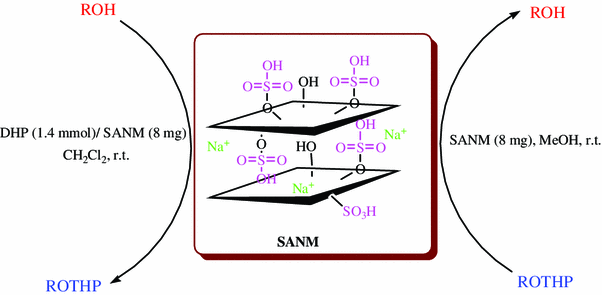
Herein, and in continuation of these studies, we wish to report the applicability of sulfonic acid-functionalized ordered nanoporous sodium montmorillonite (SANM) [ 3032 ], as a newly reported solid acid nanocatalyst in the promotion of the acceleration of the tetrahydropyranylation and detetrahydropyranylation of alcohols and phenols under mild conditions.

To optimize the reaction conditions, the reaction of 4-chlorobenzyl alcohol with DHP was studied in the presence of SANM as a model reaction. The reaction was performed in different solvents and also under solvent-free conditions, using different amounts of the catalyst and DHP at room temperature. The results are shown in Table  1 .

Table 1

Reaction of 4-chlorobenzyl alcohol with DHP in different conditions

Entry

Catalyst (mg)

DHP (mmol)

Solvent

Time (min)

Isolated yield (%)

1

4

1.4

CH2Cl2

7

50

2

8

1.4

CH2Cl2

3

98

3

12

1.4

CH2Cl2

3

98

4

8

1.2

CH2Cl2

3

80

5

8

1

CH2Cl2

3

50

6

8

1.4

CH3CN

5

90

7

8

1.4

n-Hexane

15

0

8

8

1.4

CCl4

10

0

9

8

1.4

CHCl3

10

0

10

8

1.4

Solvent-free

5

70

The obtained results showed that the reaction using 8 mg of the catalyst and 1.4 mmol of DHP in CH 2 Cl 2 at room temperature proceeded in highest yield during very short time (Table  1 , entry 2).

The selected condition is shown in Scheme  1 .

Scheme 1

Tetrahydropyranylation/detetrahydropyranylation of alcohols and phenols catalyzed by SANM

After optimization of the reaction conditions and to show the general applicability of this method, different types of alcohols were subjected to the same reaction under the determined conditions. The results are summarized in Table  2 .

Table 2

Tetrahydropyranylation and detetrahydropyranylation of alcohols and phenols catalyzed by SANM

Entry

Substrate

Product

Protection

Deprotection

Time (min)

Yield (%)

Time (min)

Yield (%)

1

C6H5CH2OH

C6H5CH2OTHP

5

98

5

98

2

2-ClC6H4CH2OH

2-ClC6H4CH2OTHP

3

95

5

98

3

4-ClC6H4CH2OH

4-ClC6H4CH2OTHP

3

98

5

98

4

2-BrC6H4CH2OH

2-BrC6H4CH2OTHP

4

98

6

98

5

4-BrC6H4CH2OH

4-BrC6H4CH2OTHP

4

98

6

98

6

3,4-Cl2C6H3CH2OH

3,4-Cl2C6H3CH2OTHP

5

98

6

98

7

2-MeC6H4CH2OH

2-MeC6H4CH2OTHP

4

98

6

98

8

3-MeOC6H4CH2OH

3-MeOC6H4CH2OTHP

5

98

12

98

9

4-MeOC6H4CH2OH

4-MeOC6H4CH2OTHP

5

98

10

98

10

3-NO2C6H4CH2OH

3-NO2C6H4CH2OTHP

8

90

12

98

11

4-NO2C6H4CH2OH

4-NO2C6H4CH2OTHP

7

98

10

98

12

4-Me3CC6H4CH2OH

4-Me3CC6H4CH2OTHP

4

98

25

98

13

4-Me2CHC6H4CH2OH

4-Me2CHC6H4CH2OTHP

5

98

25

98

14

Ph2CHOH

Ph2CHOTHP

5

98

18

98

15

PhCH(OH)Me

PhCH(OTHP)Me

5

98

15

98

16

C6H5CH=CHCH2OH

C6H5CH=CHCH2OTHP

30

90

15

90b

17

C6H5CH2CH2OH

C6H5CH2CH2OTHP

4

98

45

90

18

5

90

25

98

19

25

90

60

98

20

4

98

50

97

21

8

98

15

96

22

5

98

10

90b

23

C6H5OH

C6H5OTHP

6

98

45

90

24

2-MeC6H4OH

2-MeC6H4OTHP

12

95

35

95

25

3-MeC6H4OH

3-MeC6H4OTHP

5

98

35

98

26

4-EtC6H4OH

4-EtC6H4OTHP

3

98

45

80

27

4-Me2CHC6H4OH

4-Me2CHC6H4OTHP

8

95

40

90

28

6

98

10

90a

Isolated yield (%)

a 70 °C

Different types of benzylic alcohols (including electron-donating or electron-withdrawing groups) were tetrahydropyranylated with DHP in the presence of catalytic amounts of SANM in high to excellent yields (Table  2 , entries 1–16).

Primary and secondary aliphatic alcohols were also efficiently converted to their corresponding products under the same reaction conditions (Table  2 , entries 17–20). This method was found to be useful for the protection of hindered secondary and tertiary alcohols, and isomerization and dehydration of these compounds were not observed (Table  2 , entries 19–21).

Under the selected conditions, 2-(thiophen-2-yl) ethanol was also transformed smoothly to the corresponding ether in high yields (Table  2 , entry 22).

The reaction conditions are mild enough not to induce any damage to moieties like methoxy benzyl alcohol or cinnamyl alcohol (Table  2 , entries 8, 9, 16).

Our investigations also showed that under the same reaction conditions SANM is able to catalyze the tetrahydropyranylation of phenols in high to excellent yields (Table  2 , entries 23–28).

We have also found that the conversion of tetrahydropyranyl ethers to their corresponding alcohols or phenols can be easily catalyzed in the presence of SANM in methanol. All reactions were performed at room temperature in good to high yields (Scheme  1 ; Table  2 ).

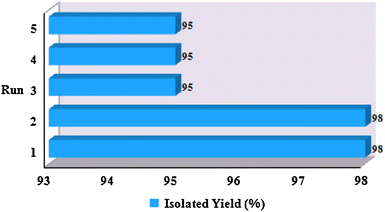
In continuation, we decided to study the catalytic activity of the recycled catalyst for the synthesis of tetrahydropyranyl ethers. We have found that SANM is a very stable catalyst and can be recycled by filtration, washing with acetone and drying at 100 °C. For the reaction of 4-chlorobenzyl alcohol with DHP, even after five cycles, the catalyst still has excellent yields (Fig.  1 ). It implied that SANM can be reused without appreciable loss of its activity.

Fig. 1

Reusability of SANM in the synthesis of 4-chlorobenzyl tetrahydropyranyl ether

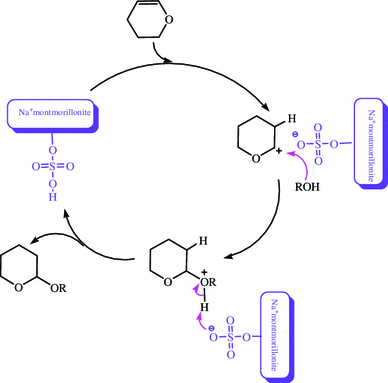
A plausible mechanism for this reaction is shown in Scheme  2 .

Scheme 2

Proposed mechanism of SANM-catalyzed synthesis of tetrahydropyranyl ethers

To show the efficiency of the present method, we have compared our results obtained from the tetrahydropyranylation of alcohol catalyzed by SANM with other results reported in the literature (Table  3 ).

Table 3

Comparison of the results of the tetrahydropyranylation of PhCH 2 OH catalyzed by SANM with those obtained by reported catalysts at room temperature

Entry

Catalyst [Ref.]

Catalyst load (mol %)

Solvent

Time (h)

Yield (%)

TOF (h−1)

1

Polystyrene-supported GaCl3 [3]

10

CH2Cl2

0.42

98

23.3

2

Silica sulfuric acid [4]

3.9

CH2Cl2

0.5

91

46.7

3

Solid silica based sulfuric acid [5]

0.5

CHCl3

0.25

92

736

4

Melamine trisulfonic acid [6]

3

CH2Cl2

0.58

95

54.6

5

CuSO4·5H2O [7]

20

CH3CN

0.67

91

6.8

6

Fe(ClO4)3 [9]

3.08

Et2O

1.5

98

21.2

7

Al(OTf)3 [10]

0.1

CH2Cl2

8

87

109

8

SnIV(TNH2PP)(OTf)2@CMP [11]

1

THF

0.07

97

1,386

9

Al/AT-silica [12]

9.8

CH2Cl2a

0.75

95

13

10

{[K.18-crown-6]Br3]n [13]

0.1

CH3CN

0.33

93

2,818

11

NbCl5 [14]

10

CH2Cl2

2.5

90

3.6

12

La(NO3)3·6H2O [15]

10

Solvent-free

2.5

93

3.7

13

Fe(CH3SO3)2·4H2O [16]

2

Solvent-free

1

97

48.5

14

SANM [this work]

3.06

CH2Cl2

0.083

98

386

a 40 °C

The results indicated that SANM is a very efficient catalyst for this reaction in terms of yield and reaction rate.

It is interesting to note that, to compare the applicability and efficiency of SANM with the other catalysts, we have tabulated the TOF (turnover frequency) of these catalysts in this reaction. As it is clear, SANM is superior in terms of TOF to the compared catalysts.

In addition, although some of these catalysts have high TOF (e.g., solid silica based sulfuric acid [ 5 ] or Sn IV (TNH 2 PP)(OTf) 2 @CMP [ 11 ]), its preparation is difficult when compared with SANM.

Conclusion

In conclusion, we have introduced sulfonic acid-functionalized ordered nanoporous Na + -montmorillonite (SANM) as a novel heterogeneous catalyst for the promotion of the tetrahydropyranylation/detetrahydropyranylation of alcohols and phenols under mild conditions. Ease of the preparation and handling of the catalyst, simple procedure and easy work-up, high reaction rates, excellent yields of the products and reusability of the catalyst are among the other advantages of this method, which make this procedure a useful and attractive addition to the available methods.


Acknowledgments

We are thankful to the University of Guilan Research and Payame Noor Ramsar Council for the partial support of this work.


References

  1. Fieser and Fieser (1999) Wiley
  2. Moghadam et al. (2010) High-valent tin(IV) porphyrin: an efficient and reusable catalyst for tetrahydropyranylation of alcohols and phenols under mild conditions (pp. 1523-1528) 10.1016/j.ica.2010.01.017
  3. Rahmatpour (2012) Polystyrene-supported GaCl3: a new, highly efficient and recyclable heterogeneous Lewis acid catalyst for tetrahydropyranylation of alcohols and phenols (pp. 66-71) 10.1016/j.poly.2012.06.063
  4. Pore et al. (2004) Chemoselective tetrahydropyranylation of alcohols and their detetrahydropyranylation using silicasulphuric acid as a reusable catalyst (pp. 2135-2142) 10.1081/SCC-120038489
  5. Karimi and Khalkhali (2005) Solid silica based sulfonic acid as an efficient and recoverable interphase catalyst for selective tetrahydropyranylation of alcohols and phenols (pp. 113-117) 10.1016/j.molcata.2005.01.028
  6. Shirini et al. (2011) Melamine trisulfonic acid: a new, efficient and reusable catalyst for the protection of alcohols, phenols, aldehydes and amines (pp. 11-17)
  7. Khan et al. (2004) Cupric sulfate pentahydrate (CuSO4·5H2O): a mild and efficient catalyst for tetrahydropyranylation/depyranylation of alcohols and phenols (pp. 7891-7894) 10.1016/j.tetlet.2004.08.141
  8. Min et al. (2008) Chemoselective tetrahydropyranylation of alcohols and phenols catalyzed by acetic acid assisted copper o-toluenesulfonate (pp. 1629-1632)
  9. Heravi et al. (2005) Mild and efficient tetrahydropyranylation of alcohols and dehydropyranylation of THP ethers catalyzed by ferric perchlorate (pp. 2543-2545) 10.1016/j.tetlet.2005.02.094
  10. Williams et al. (2010) Efficient tetrahydropyranyl and tetrahydrofuranyl protection/deprotection of alcohols and phenols with Al(OTf)3 as catalyst (pp. 4573-4576) 10.1016/j.tet.2010.04.053
  11. Moghadam et al. (2011) Tetrahydropyranylation of alcohols and phenols catalyzed by a new polystyrene-bound tin(IV) porphyrin (pp. 95-101) 10.1016/j.molcata.2011.01.023
  12. Kolahdoozan, M., Hossaini, M.: Development of a new heterogeneous Lewis acid catalyst for chemoselective tetrahydropyranylation of different hydroxyl compounds. J Chem. (2013). doi: 10.1155/2013/486562
  13. Chehardoli et al. (2013) {[K.18-Crown-6]Br3}n: a tribromide catalyst for the catalytic protection of amines and alcohols (pp. 1730-1733) 10.1016/S1872-2067(12)60644-5
  14. Nagaiah, K., Reddy, B.V.S., Sreenu, D., Venkat Narsaiah, A.: Niobium(V) chloride: an active Lewis acid catalyst for tetrahydropyranylation of alcohols and phenols. ARKIVOC. iii , 192–199 (2005)
  15. Srikanth et al. (2006) A mild and efficient chemoselective tetrahydropyranylation of primary alcohols using La(NO3)3·6H2O as a catalyst under solvent-free conditions (pp. 2341-2344) 10.1016/j.tetlet.2006.02.011
  16. Wang et al. (2011) Ferrous methanesulfonate as an efficient and recyclable catalyst for the tetrahydropyranylation of alcohols and phenols under solvent-free conditions (pp. 1690-1701)
  17. Romanelli et al. (2010) Preyssler heteropolyacid H14[NaP5W29MoO110]: a heterogeneous, green and recyclable catalyst used for the protection of functional groups in organic synthesis (pp. 355-362) 10.1016/j.cej.2009.12.029
  18. Cámera et al. (2008) Silica-supported aluminum chloride as catalyst for the tetrahydropyranylation of thymol (pp. 822-827) 10.1016/j.cattod.2007.12.121
  19. Taghavi et al. (2011) Highly efficient tetrahydropyranylation of alcohols and phenols catalyzed by a new and reusable high-valent vanadium(IV) porphyrin (pp. 1095-1102) 10.1016/j.crci.2011.09.009
  20. Hajipour et al. (2009) Tetrahydropyranylation of alcohols under solvent-free conditions (pp. 1084-1091) 10.1080/00397910802499518
  21. Bergaya and Lagaly (2001) Surface modification of clay minerals (pp. 1-3) 10.1016/S0169-1317(01)00063-1
  22. Vaccari (1998) Preparation and catalytic properties of cationic and anionic clays (pp. 53-71) 10.1016/S0920-5861(98)00038-8
  23. Laszlo (1987) Chemical reactions on clays (pp. 1473-1477) 10.1126/science.235.4795.1473
  24. Giannelis et al. (1999) Polymer-silicate nanocomposites: model systems for confined polymers and polymer brushes (pp. 107-147) 10.1007/3-540-69711-X_3
  25. Shirini et al. (2003) Silica sulfuric acid as an efficient reagent for the synthesis of symmetrical ethers under mild and heterogeneous conditions (pp. 2357-2361) 10.1080/714040949
  26. Shirini et al. (2004) Silica sulfuric acid as a mild and efficient reagent for the acetylation of alcohols in solution and under solvent free conditions (pp. 325-327) 10.5012/bkcs.2004.25.2.325
  27. Salehi et al. (2006) Silica sulfuric acid and silica chloride as efficient reagents for organic reactions (pp. 2171-2189) 10.2174/138527206778742650
  28. Shirini et al. (2009) Silica sulfuric acid: a versatile reagent for oxathioacetalyzation of carbonyl compounds and deprotection of 1,3-oxathiolanes (pp. 1457-1460) 10.1016/j.cclet.2009.07.006
  29. Shirini et al. (2013) Sulfunated rice husk ash (RHA-SO3H): a highly powerful and efficient solid acid catalyst for the chemoselective preparation and deprotection of 1,1-diacetates (pp. 31-37) 10.1016/j.catcom.2013.02.022
  30. Shirini et al. (2011) Sulfonic acid-functionalized ordered nanoporous Na+-montmorillonite (SANM): a novel, efficient and recyclable catalyst for the chemoselective N-Boc protection of amines in solventless media (pp. 1088-1094) 10.1016/j.catcom.2011.03.030
  31. Shirini et al. (2012) A mild and efficient method for the chemoselective trimethylsilylation of alcohols and phenols and deprotection of silyl ethers using sulfonic acid-functionalized ordered nanoporous Na+-montmorillonite (pp. 67-72) 10.1016/j.clay.2012.01.014
  32. Shirini et al. (2012) Sulfonic acid functionalized ordered nanoporous Na+ montmorillonite as an efficient and recyclable catalyst for the chemoselective methoxymethylation of alcohols (pp. 1-5) 10.1186/2193-8865-3-1