Synthesis of PPy–silver nanocomposites via in situ oxidative polymerization

Abstract

Silver nanoparticles were synthesized by chemical reduction method. The surface of silver nanoparticles (SNPs) was modified using polyvinylpyrrolidone to make them more compatible with pyrrole. Surface-modified SNPs were dispersed in pyrrole and polymerized via in situ oxidative polymerization technique. The molar ratio of monomer unit to initiator and dopant was 1:1:1 and the weight percent of SNPs in polymer matrix was varied from 1 to 10. The properties of polypyrrole–silver nanocomposites have been characterized using Fourier transform infrared spectroscopy, X-ray diffraction, scanning electron microscope, transmission electron microscope, thermo-gravimetric analysis and four-probe resistivity meter. All these characterizations indicate that the polypyrrole–silver nanocomposite is successfully synthesized via in situ oxidative polymerization and electrical extent shows suitable conductivity.


Introduction

In recent years, the attention in the improvement of inorganic/organic nanocomposites has increased significantly because of a wide range of potential application of these materials [ 1 , 2 ]. Among various types of organic compounds, conducting polymers found different applications due to their unique properties. Polypyrrole (PPy) is one of the most promising conducting polymers and received full interests due to its special properties such as high conductivity, simple methods of preparation, stability and good mechanical properties [ 3 , 4 ]. The mentioned advantages of PPy lead to wide potential applications in various fields, such as rechargeable and lightweight batteries, drug delivery, membrane separation, supercapacitors, sensors, corrosion protection and electronic and electrochromic devices. The unique properties of metal nanoparticles and conducting polymers result in an increasing motivation in the synthesis of nanocomposite materials containing from finely and homogenously dispersed nanoparticles in conducting polymer matrices [ 57 ]. On the other hand, the metal nanoparticles, such as silver and gold, have attracted much attention currently due to their high conductivity, therefore potential applications in technological fields. Particularly, SNPs have applications in catalysis, conductive inks, thick film pastes and adhesives for various electronic components, in photonics and in photography. Therefore, the preparation of composite of PPy and silver can be a fresh contest for investigators. However, one major problem in the synthesis of nanocomposite materials derived from the dispersion of nanoparticles in polymer matrices is the aggregation of nanoparticles. Oxidative polymerization exemplifies a new route to access conducting polymers and nanocomposites with conducting polymers matrices [ 1 , 5 , 8 ]. It is one of the important green chemistry processes to prepare multifunctional polymers. This method has been widely used to prepare different types of conducting polymers and their different derivatives [ 1 , 5 , 917 ]. The preparation of nanocomposite of PPy and organic nanoparticles becomes a novel challenge for investigators. For examples, Jing et al. [ 1 ] reported effects of hydrogen and electrostatic interaction between SNPs and PPy. Moreover, Lu et al. [ 18 ] informed the synthesis of nanocomposites of inorganic particles and polymer via introducing hydrogen and electrostatic interaction by an in situ polymerization method.

In this work, we look forward to synthesizing SNPs via reduction of AgNO 3 and PPy–silver nanocomposites were prepared by in situ chemical oxidative polymerization. Considering excellent electrical properties of PPy and silver it is expected to obtain excellent final electrical properties for their nanocomposites. The impact of different content of SNPs on the structures and properties of the PPy–silver nanocomposites were deeply discussed by means of their characterization with Fourier transform infrared spectroscopy (FT-IR), X-ray diffraction (XRD), thermo-gravimetric analysis (TGA), scanning electron microscope (SEM) and transmission electron microscope (TEM).

Experimental

Materials

Pyrrole monomer obtained from Merck and was purified in low pressure before using. Ammonium peroxydisulfate (APS), p -toluenesulfonic acid ( p -TSA), silver nitrate (AgNO 3 ), tributyl phosphate (TBP) and polyvinylpyrrolidone (PVP) were purchased from Merck and were used as received. All other chemicals and solvents were from analytical grade and were used without any further purification.

Synthesis of hydrophobic silver nanoparticles

SNPs were synthesised according to the following procedure: 1.9 g of PVP was introduced into the container, then 25 ml TBP added and disturbed at room temperature. Then, 0.015 g of silver nitrate was led into the solution. After PVP was dissolved into the TBP. The color of the solution extended within the reaction procedure, from colorless, light yellow, yellow, to orange. The reaction continued for 3 h before a stable solution with nano-silver colloids were attained. The equipped nano-silver/TBP/PVP colloid solution was varied and stirred strongly with 30 ml of deionized water for 45 min before the mixture was divided into two phases: the highest sheet was colorless oil phase, whereas the lowest layer was orange water phase, and hydrophobic nano-silver particles were transferred from TBP into water.

Synthesis of PPy–silver nanocomposites

The nanocomposites of PPy–silver were synthesized via in situ chemical oxidation polymerization. APS and PTSA were used as initiator and pyrrole surfactant dopant, respectively, during polymerization. In a typical process, 6.4 g (0.03 mol) of APS was solved in the 150 ml distilled water and agitated for 15 min. A solution of PTSA in water [5.3 g (0.03 mol) of PTSA in 50 ml water] was introduced into the aqueous solution of APS and mixed for 10 min. Two milliliter (0.03 mol) of pyrrole was added to the 50 ml water and then 0.02 g of SNPs added to the pyrrole solution and ultrasonicated to mark pyrrole to be adsorbed on the outward of SNPs for 15 min. Then pyrrole and SNPs solution was added slowly to the streak covering to APS/PTSA solution. The blend was stirred for about 5 h at room temperature. The black deposit was washed with ethanol and distilled water several times until the filtrate was pale. Then the samples were withered under vacuum at 50 °C for 72 h. Several PPy–silver nanocomposites were prepared with different wt% of SNPs respect to the pyrrole. For assessment, PPy was also synthesized in a similar procedure and used as reference.

Results and discussion

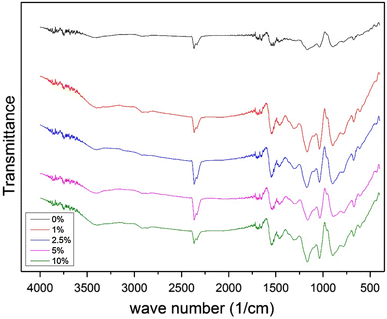
The molecular structures of PPy and PPy–silver nanocomposite were characterized by FT-IR spectroscopy. Figure  1 indicates the FT-IR spectra of samples. As can be seen this figure shows peaks located around 1,451 and 1,463 cm −1 , which correspond to the C–C and C–N stretching vibration in the pyrrole ring, respectively [ 5 , 19 ]. The peaks around 1,189 cm −1 correspond to the breathing vibration of the pyrrole ring and the peaks near 1,303, 1,024 and 922 cm −1 can be assigned to the C–H in and out-of-plane deformation vibration, respectively [ 1 ]. Indeed, the characteristic absorption bands at 1,451, 1,463, 1,189, 1,303, 1,024 and 922 and 765 cm −1 are assigned to the vibration of the typical PPy aromatic rings [ 20 ]. When the peaks were compared to the pure PPy, it can be found that the peaks position of the PPy–silver nanocomposites have a little shift to high wavenumber. It was due to the compound between PPy and silver. Also, it could be recognized to the amplified influence of the charge-transfer effect between the polymer chains of PPy and SNPs [ 1 ].

Fig. 1

FT-IR spectra of pure PPy and PPy–silver nanocomposites

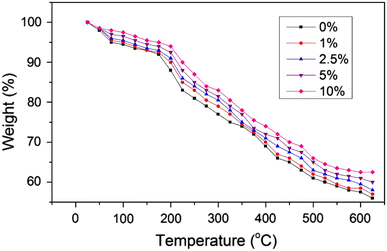
TGA of PPy and PPy–silver nanocomposites was carried out in the temperature range 25–625 °C. Figure  2 illustrates the TGA diagrams as can be seen, three steps of weight loss occurs during the TGA of samples. The first step of weight loss is occurred at 50–180 °C, which may be due to humidity loss, it is about 10 % weight loss. A slight weight loss happens before 190 °C due to the decomposition of oligomers molecules [ 7 , 13 , 21 ]. The second step of weight loss that occurs between 200 and 400 °C attributed to the loss of surfactant dopant. The third step of weight loss over the temperature range 400–625 °C is due to the thermal decomposition of PPy into a number of chemical forms. About 40 % weight loss occurs at 625 °C for pure PPy. Thermal permanency of nanocomposites grows somewhat with growing SNPs weight percent. Though, improvement of thermal stability is not momentous, owing to low weight percent of SNPs [ 13 ].

Fig. 2

TGA thermograms of PPy and different PPy–silver nanocomposites

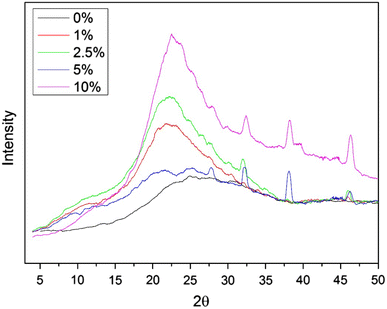
XRD patterns of PPy–silver nanocomposites confirmed the combination of SNPs in the PPy matrix as shown in Fig.  3 . The general peak with 2 θ around 23.3° is related to the diffraction of amorphous PPy [ 1 , 19 , 22 ]. Another sharp diffraction peaks at 2 θ values of 32.4◦, 38.2◦ and 45.6 corresponded to Bragg’s reflections from the (1 1 1), (2 0 0), (2 2 0) planes of silver and were in good treaty with the reported data [ 1 , 2224 ]. This result recommends that the silver cores in the PPy–silver nanocomposites are in FCC phase. From the XRD patterns, existence of SNPs in PPy matrix was established, which is consistent with the result of the TEM. As a result, all of the above experimental clarifications strongly established that the PPy–silver nanocomposites are successfully formed.

Fig. 3

XRD patterns of PPy and PPy–silver nanocomposites

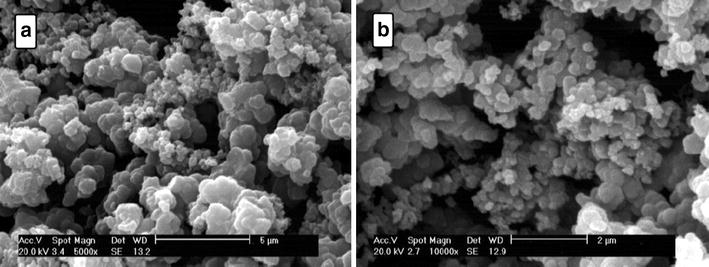
Figure  4 shows the FESEM micrograph of PPy–silver nanocomposite with pure PPy (a) and PPy–10 % silver (b). As shown by the images, PPy exhibits a routinely cauliflower-like (a) [ 15 ]. The particle size of PPy was around 140–320 nm by way of orbicular morphology. This value size is stable reported by other researchers [ 1 , 2 , 25 , 26 ]. While, as mention above, XRD configurations specify the existence of silver in the nanocomposite with the size of about 50 nm, the silver are also obscure by means of FESEM images. As can be seen from Fig.  4 b, the particle size of PPy are smaller than that of pure PPy, it seems that SPNs improve stability of PPy particles, this may affect the morphology of PPy particles. Also, it indicates both almost spherical group particles and some bulk morphology [ 22 ]. Therefore, the FESEM results clarify the existence of silver in PPy particles.

Fig. 4

FESEM images of a PPy and b PPy–silver (10 %)

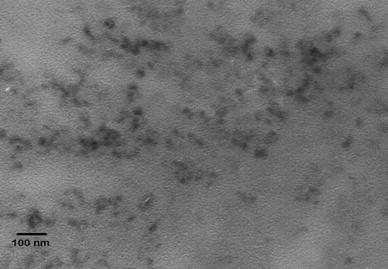
TEM micrograph of the PPy–silver (10 %) nanocomposite shown in Fig.  5 . In this figure the black spots presents SNPs and the grey background seems to be PPy. It is clear that SNPs are not ideally spherical, and their mean diameter is in the range of 40–70 nm. Considering both TEM micrographs and corresponding XRD patterns one can say that SNPs is dispersed in the polypyrrole matrix with a little aggregation. However, the extent of dispersion is not homogeneous in the matrix this phenomenon has reported for other nanoparticles in PPy such as Au [ 18 ].

Fig. 5

TEM micrograph of PPy–silver (10 %) nanocomposite

Electrical conductivity

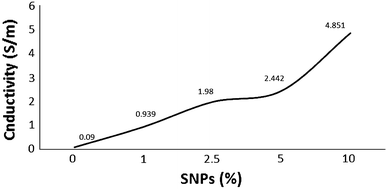
For measuring electrical conductivity, PPy and PPy–silver nanocomposites were pushed into cylinder pellet form under 15 MPa. Then, the conductivity at room temperature was measured by a DC voltage/current indicator with four-probe standard method [ 17 ]. The data are shown at Fig.  6 . These data are the average value of four measurements. The conductivity of the PPy–silver nanocomposites was increased by growing the percentage of SNPs compared to that of pure PPy. The structure of the PPy–silver nanocomposites is likely to contribute to its improved electrical conductivity in the following ways [ 27 ]. First, SNPs may use as conducting bridge connecting PPy conducting spheres and increasing the active saturation. Second, in accordance with the FT-IR observations, conductivity results suggested that the interaction between PPy and silver could be responsible for higher conducting than the preliminary constituents. However, the electrical conductivity of PPy–silver nanocomposites (4.9 S m −1 for silver:PPy = 1:10) was slightly decreased with the increase of the feeding mass ratio of pyrrole to silver [ 24 , 27 ].

Fig. 6

Conductivity plots of PPy and PPy–silver nanocomposites

Conclusion

In this work, PPy–silver nanocomposites have been synthesized successfully using a facile route of in situ chemical oxidative polymerization. Structural, morphological, thermal stability and conductivity studies have been performed. PPy and the combination of silver in the polymer matrix was established by FT-IR, XRD, TGA, FESEM and TEM studies. FT-IR results showed that the produced product was PPy and also indicated that some interaction between PPy and silver occurred in the nanocomposites. The electrical conductivity of the considered samples that has been measured with four-probe method was increased by growing the percentage of SNPs compared to that of pure PPy. FESEM and TEM results confirmed that semispherical SNPs with mean diameter in the range of 40–70 nm were dispersed into the PPy with a little aggregation. More significantly, the oxidative synthesis method might be superficial but effective and could be readily used for a large-scale preparation of the PPy–silver nanocomposites, representing a potential application in constructing the nanocomposites of metallic nanoparticles with conducting polymers.


Acknowledgments

The authors are thankful to Faculty of Engineering, Hakim Sabzevari University, for providing the necessary facilities for the preparation of the paper. In addition, Mr. E. Ghanei’s technical assistance is appreciated.


References

  1. Jing (2007) Synthesis and characterization of Ag/polypyrrole nanocomposites based on silver nanoparticles colloid 61(23–24) (pp. 4528-4530) 10.1016/j.matlet.2007.02.045
  2. Chen and Zhitomirsky (2013) Influence of dopants and carbon nanotubes on polypyrrole electropolymerization and capacitive behavior (pp. 67-70) 10.1016/j.matlet.2013.01.123
  3. Liu et al. (2006) Adjusting the inner-structure of polypyrrole nanoparticles through microemulsion polymerization 98(2–3) (pp. 304-308) 10.1016/j.matchemphys.2005.09.025
  4. Lu (2012) Functionalized ionic liquid-assisted mechanochemical synthesis of graphene nanosheet/polypyrrole nanocomposites (pp. 57-59) 10.1016/j.matlet.2011.12.037
  5. Peng (2012) Facile preparation of water dispersible polypyrrole nanotube-supported silver nanoparticles for hydrogen peroxide reduction and surface-enhanced Raman scattering (pp. 399-405) 10.1016/j.electacta.2012.05.034
  6. Liu et al. (2006) Strategy for the syntheses of isolated fine silver nanoparticles and polypyrrole/silver nanocomposites on gold substrates 51(17) (pp. 3441-3445) 10.1016/j.electacta.2005.09.040
  7. Attia (2013) One-step UV-induced modification of cellulose fabrics by polypyrrole/silver nanocomposite films (pp. 130-137) 10.1016/j.jcis.2012.11.008
  8. Pal et al. (2012) Oxidative polymerization of para-substituted styrene derivatives: synthesis, characterization and kinetics study 53(17) (pp. 3687-3694) 10.1016/j.polymer.2012.06.005
  9. Higashimura, H.: 5.07—oxidative coupling polymerization, in polymer science: a comprehensive reference. In: Krzysztof, M., Martin, M. (eds.) pp. 141–173. Elsevier, Amsterdam (2012)
  10. Xu (2009) Controlled fabrication of gold and polypyrrole nanowires with straight and branched morphologies via porous alumina template-assisted approach 63(16) (pp. 1431-1434) 10.1016/j.matlet.2009.03.026
  11. Dallas (2007) Interfacial polymerization of pyrrole and in situ synthesis of polypyrrole/silver nanocomposites 48(7) (pp. 2007-2013) 10.1016/j.polymer.2007.01.058
  12. Stejskal et al. (2010) Polyaniline nanostructures and the role of aniline oligomers in their formation 35(12) (pp. 1420-1481) 10.1016/j.progpolymsci.2010.07.006
  13. Omastová (2013) Polypyrrole/silver composites prepared by single-step synthesis (pp. 57-62) 10.1016/j.synthmet.2013.01.015
  14. Wang and Zhang (2009) Silver–polypyrrole composites: facile preparation and application in surface-enhanced Raman spectroscopy 159(13) (pp. 1332-1335) 10.1016/j.synthmet.2009.03.002
  15. Wu et al. (2009) Synthesis and characterization of conductive polypyrrole/multi-walled carbon nanotubes composites with improved solubility and conductivity 69(5) (pp. 639-644) 10.1016/j.compscitech.2008.12.010
  16. Chakraborty (2012) Synthesis, electrical and magnetotransport properties of polypyrrole–MWCNT nanocomposite 152(1) (pp. 13-18) 10.1016/j.ssc.2011.10.018
  17. Imani et al. (2013) Facile synthesis and characterization of polypyrrole–multiwalled carbon nanotubes by in situ oxidative polymerization 3(1) 10.1186/2228-5326-3-52
  18. Lu (2006) Preparation and characterization of inorganic/organic hybrid nanocomposites based on Au nanoparticles and polypyrrole 60(23) (pp. 2851-2854) 10.1016/j.matlet.2006.02.002
  19. Yang et al. (2010) Polypyrrole/silver composite nanotubes for gas sensors 145(1) (pp. 495-500) 10.1016/j.snb.2009.12.065
  20. Chatterjee et al. (2011) Mechanism of polypyrrole and silver nanorod formation in lauric acid–cetyl trimethyl ammonium bromide coacervate gel template: physical and conductivity properties 161(1–2) (pp. 62-71) 10.1016/j.synthmet.2010.10.035
  21. Amarnath (2013) Polypyrrole/lanthanum strontium manganite oxide nanocomposites: elaboration and characterization (pp. 18-24) 10.1016/j.synthmet.2013.02.003
  22. Wang and Shi (2007) Uniform silver/polypyrrole core-shell nanoparticles synthesized by hydrothermal reaction 102(2–3) (pp. 255-259) 10.1016/j.matchemphys.2006.12.014
  23. Chen (2008) Fabrication of the silver/polypyrrole/polyacrylonitrile composite nanofibrous mats 62(24) (pp. 4031-4034) 10.1016/j.matlet.2008.05.054
  24. Alqudami (2007) The incorporation of silver nanoparticles into polypyrrole: conductivity changes 157(1) (pp. 53-59) 10.1016/j.synthmet.2006.12.006
  25. Shi (2010) Room temperature synthesis of Ag/polypyrrole core–shell nanoparticles and hollow composite capsules 160(19–20) (pp. 2121-2127) 10.1016/j.synthmet.2010.07.042
  26. Shi (2012) Facile fabrication and characterization of poly(tetrafluoroethylene)@polypyrrole/nano-silver composite membranes with conducting and antibacterial property 258(17) (pp. 6359-6365) 10.1016/j.apsusc.2012.03.040
  27. Sahoo (2007) Polypyrrole coated carbon nanotubes: synthesis, characterization, and enhanced electrical properties 157(8–9) (pp. 374-379) 10.1016/j.synthmet.2007.04.006