Department of Chemistry, College of Science, University of Guilan, Rasht, 41335, IR
Abstract
BiVO
4
-NPs can be used as a new and efficient nano-catalyst for the promotion of the synthesis of 1,8-dioxo-octahydro xanthenes derivatives. The structures of the products were characterized by their physical properties, comparison with authentic samples and IR,
1
H NMR and
13
C NMR spectroscopy. Easy preparation of the catalyst, mild reaction conditions, easy work-up procedure, excellent yields and short reaction times are some of the advantages of this work.
Background
Xanthenes and their derivatives have received special attention due to their diverse array of biological activities such as anti-inflammatory, antibacterial and antiviral activities [
1
–
3
]. Furthermore, these compounds can be used as leuco dyes [
4
], in laser technology [
5
] and pH-sensitive fluorescent materials for the visualization of biomolecular assemblies [
6
]. Because of their wide range of synthetic, industrial and pharmacological applications, there are several reports in the literature for the synthesis of xanthene derivatives.
1,8-Dioxo-octahydro xanthene derivatives are among the most important types of xanthenes and for this reason several methods are reported for the synthesis of 1,8-dioxo-octahydro xanthenes using a variety of catalysts and reagents [
7
–
17
].
However, these methods suffer from one or more disadvantages such as: long reaction times, low yields, the use of toxic solvents, requirement of excess of reagents/catalysts and harsh reaction conditions. Therefore, it is important to find more efficient catalysts and methods for the synthesis of these types of compounds.
In recent years and because of the unique properties of nano-particles, synthetic chemists focused on the synthesis and characterization of these types of catalysts with lower dimensions named as nano-catalysts [
18
].
Results and discussion
In recent years, a considerable amount of our research program is focused on the development of new methods and use of new reagents for the synthesis of xanthenes derivatives [
19
–
25
]. In continuation of these studies, we have found that BiVO
4
-NPs as a newly reported reagent [
26
] is efficiently able to catalyze the synthesis of 1,8-dioxo-octahydro xanthenes. All reactions are performed under mild reaction conditions in good to high yields.
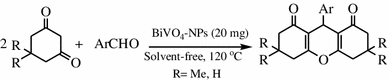
At the first step and to optimize the reaction conditions, the prepared catalyst was used for the promotion of the condensation of benzaldehyde with dimedone, as a model reaction, and compared the effect of different solvents and solvent-free conditions and also the effect of the catalyst load on the reaction yield and time at thermal conditions (Table
1
). On the basis of these studies, we concluded that the best result can be obtained under the conditions showed in Scheme
1
.
Table 1
The effect of different conditions on the model reaction
Entry
Conditions
BiVO4-NPs (mg)
Time (min)
Conversion (%)a
1
EtOH (reflux)
20
60
100
2
H2O (reflux)
20
60
0
3
Solvent-free (60 °C)
20
60
70
4
Solvent-free (100 °C)
20
45
90
5
Solvent-free (120 °C)
20
30 s
100
6
Solvent-free (120 °C)
10
15
80
Scheme 1
Synthesis of 1,8-dioxo-octahydro xanthenes
After optimization of the reaction conditions and to show the general applicability of the method, different types of aromatic aldehydes were subjected to the same reaction under the determined conditions. The obtained results showed that these conversions also were occurred with excellent yields during very short times (Table
2
).
Table 2
Preparation of 1,8-dioxo-octahydro xanthenes in the presence of BiVO
4
-NPs
Entry
Aldehydes
R
Time (min)
Yield (%)a
M.p. (°C)
Found
Reported
1
C6H5CHO
Me
30 s
99
197–198
199–201 [15]
2
4-ClC6H4CHO
Me
30 s
99
227–229
229–231 [15]
3
3-ClC6H4CHO
Me
30 s
98
186–187
186–187 [15]
4
2-ClC6H4CHO
Me
30 s
98
224–225
225–227 [27]
5
4-BrC6H4CHO
Me
30 s
97
239–240
240–242 [28]
6
3-BrC6H4CHO
Me
30 s
95
281–282
281–283 [21]
7
4-FC6H4CHO
Me
30 s
98
259–260
259–262 [21]
8
4-NO2C6H4CHO
Me
4
94
223–224
224–226 [15]
9
3-NO2C6H4CHO
Me
30 s
96
164–165
164–166 [15]
10
2-NO2C6H4CHO
Me
4
93
251–252
251–252 [27]
11
3-MeOC6H4CHO
Me
4
95
190–191
192–194 [21]
12
3-MeC6H4CHO
Me
5
98
205–206
206–208 [9]
13
Cinnamaldehyde
Me
3
90
170–172
172–174 [15]
14
4-Me2NC6H4CHO
Me
3
96
220–221
221–223 [29]
15
C6H5CHO
H
30 s
99
203–204
203–205 [27]
16
4-ClC6H4CHO
H
30 s
99
228–229
229–232 [27]
17
4-BrC6H4CHO
H
30 s
97
227–228
229–231 [27]
18
3-BrC6H4CHO
H
30 s
95
280–281
281–283 [21]
19
4-NO2C6H4CHO
H
30 s
94
263–264
263–265 [23]
20
3-NO2C6H4CHO
H
30 s
96
280–281
281–282 [19]
21
2-NO2C6H4CHO
H
30 s
96
238–240
238–240 [19]
22
4-OHC6H4CHO
H
30 s
98
245–246
245–247 [30]
23
4-MeOC6H4CHO
H
6
95
200–201
200–201 [19]
It seems that the electronic nature of the functional group on the ring of the aldehyde exerted a slight influence on the reaction time.
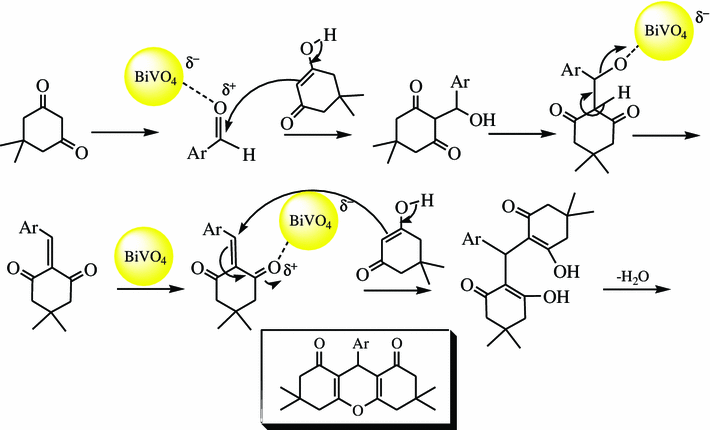
A plausible mechanism for the synthesis of 1,8-dioxo-octahydro xanthenes catalyzed by BiVO
4
-NPs is shown in Scheme
2
[
34
,
35
].
Scheme 2
Proposed mechanism for the synthesis of 1,8-dioxo-octahydro xanthenes catalyzed by BiVO
4
-NPs
To illustrate the efficiency of the present method, Table
3
compares some of our results obtained from the synthesis of xanthene derivatives with the same results reported by the other groups. This Table clearly shows the applicability and efficiency of the present method. Table
3
also compares the TOF (turnover frequency) of these catalysts in this reaction. As it is clear BiVO
4
-NPs is superior in terms of TOF to the compared catalysts.
Table 3
Comparison of the results of the reaction of dimedone with 4-ClC
6
H
4
CHO using BiVO
4
-NPs with some of those reported in the literature
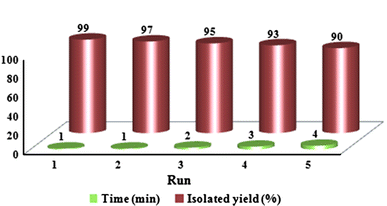
In addition, we decided to study the catalytic activity of the recycled catalyst for the synthesis of xanthenes derivatives. After the separation of the product, the catalyst was washed with acetone and derived at 70 °C. As shown in Fig.
1
, BiVO
4
-NPs can be recycled at least six times without significant decrease in its catalytic activity (Table
2
, entry 2).
Fig. 1
Reusability of BiVO
4
-NPs in the reaction of 4-chlorobenzaldehyde with dimedone
Conclusion
In conclusion, we have introduced an efficient and convenient approach for the synthesis of 1,8-dioxo-octahydro xanthenes using BiVO
4
-NPs as a novel nano-catalyst.
This method has several advantages such as: ease of preparation and handling of the catalyst, simplicity and easy work-up, high reaction rates, excellent yields and effective reusability of the catalyst for several times without considerable decrease in yields.
Methods
General
All chemicals were purchased from Merck or Fluka Chemical Companies. All yields refer to the isolated products. Products were characterized by their physical constants and comparison with authentic samples. The purity determination of the substrates and reaction monitoring were accompanied by TLC using silica gel SIL G/UV 254 plates. The FT-IR spectra were run on a VERTEX 70 Brucker company (Germany). The
1
H NMR (300, 400 and 500 MHz) and
13
C NMR (100 MHz) were run on a Bruker Avance DPX-400 FT-NMR spectrometer (δ in ppm).
General procedure
Synthesis of 1,8-dioxo-octahydro xanthene derivatives
A mixture of dimedone or cyclohexadione (2 mmol), aldehyde (1 mmol) and BiVO
4
-NPs (20 mg) was stirred at 120 °C under solvent-free conditions for the appropriate time. After completion of the reaction [monitored by TLC: EtOAc:
n
-hexane (2:8)], the reaction was cooled to room temperature, ethanol (5 mL) was added and the mixture was filtered. Evaporation of the solvent, followed by recrystallization of the residue from EtOH:H
2
O (95:5) afforded the pure products in good to high yields. The physical and spectral data of the known compounds were in agreement with those reported in the literature.
Acknowledgments
The authors are thankful to the Guilan University Research Council for the partial support of this work.
References
Chatterjee et al. (1996) Xanthene derived potent nonpeptidic inhibitors of recombinant human calpain I (pp. 1619-1622) 10.1016/S0960-894X(96)00286-7
Vieira et al. (2005) Synthesis 12-aryl or 12-alkyl-8,9,10,12-tetrahydrobenzo[a]xanthen-11-one derivatives catalyzed by dodecatungstophosphoric acid (pp. 4628-4631) 10.1016/j.bmcl.2005.05.135
Hafez et al. (2008) A facile regioselective synthesis of novel spiro-thioxanthene and spiro-xanthene-9′,2-[1, 3, 4]thiadiazole derivatives as potential analgesic and anti-inflammatory agents (pp. 4538-4543) 10.1016/j.bmcl.2008.07.042
Kitahara, Y., Tanaka, K.: Synthesis, crystal structure and properties of thiaheterohelicenes containing phenolic hydroxy functions. Chem. Commun. 932–933 (2002)
Ahmad et al. (2002) Performance and photostability of xanthene and pyrromethene laser dyes in sol–gel phases (pp. 1473-1476) 10.1088/0022-3727/35/13/303
Knight and Stephens (1989) Xanthene-dye-labelled phosphatidylethanolamines as probes of interfacial pH (pp. 683-687) 10.1042/bj2580683
Dadhania et al. (2012) Catalyst-free sonochemical synthesis of 1,8-dioxo-octahydroxanthene derivatives in carboxy functionalized ionic liquid 15(5) (pp. 378-383) 10.1016/j.crci.2012.01.006
Mulakayala et al. (2012) A greener synthesis of 1,8-dioxo-octahydroxanthene derivatives under ultrasound 53(51) (pp. 6923-6926) 10.1016/j.tetlet.2012.10.024
Lu et al. (2009) ZrOCl2·8H2O: a highly efficient catalyst for the synthesis of 1,8-dioxo-octahydro xanthene derivatives under solvent-free conditions (pp. 165-169) 10.1002/aoc.1488
Oskooie et al. (2010) Cellulose sulfonic acid: an efficient heterogeneous catalyst for the synthesis of 1,8-dioxo-octahydro xanthenes (pp. 717-720)
Bigdeli (2010) Clean synthesis of 1,8-dioxo-octahydro xanthenes promoted by DABCO-bromine in aqueous media (pp. 1180-1182) 10.1016/j.cclet.2010.05.018
Rostamizadeh et al. (2010) Ultrasound promoted rapid and green synthesis of 1,8-dioxo-octahydro xanthenes derivatives using nanosized MCM-41-SO3H as a nanoreactor, nanocatalyst in aqueous media (pp. 306-309) 10.1016/j.ultsonch.2009.10.004
Javid et al. (2011) One-pot synthesis of 1,8-dioxo-octahydro xanthenes utilizing silica-supported preyssler nano particles as novel and efficient reusable heterogeneous acidic catalyst (pp. 910-916) 10.1155/2011/980242
Mosaddegh et al. (2012) ZrOCl2·8H2O as an efficient and recyclable catalyst for the clean synthesis of xanthenedione derivatives under solvent-free conditions (pp. 77-80) 10.1016/j.arabjc.2010.07.027
Zolfigol et al. (2012) Preparation of various xanthene derivatives over sulfonic acid functionalized imidazolium salts (SAFIS) as novel, highly efficient and reusable catalysts (pp. 719-736) 10.1016/j.crci.2012.05.003
Khaksar and Behzadi (2012) Mild and highly efficient method for synthesis of 14-aryl(alkyl)-14H-dibenzo[a, j]xanthenes and 1,8-dioxo-octahydro xanthene derivatives using pentafluorophenyl ammonium triflate as a novel organocatalyst (pp. 982-985) 10.1016/S1872-2067(11)60393-8
Venkatesan et al. (2008) An efficient synthesis of 1,8-dioxo-octahydro-xanthene derivatives promoted by a room temperature ionic liquid at ambient conditions under ultrasound irradiation (pp. 548-553) 10.1016/j.ultsonch.2007.06.001
Shirini and Abedini (2013) Application of nanocatalysts in multi-component reactions (pp. 4838-4860) 10.1166/jnn.2013.7571
Shirini et al. (2012) Introduction of two efficient catalysts for the synthesis of 1,8-dioxo-octahydro xanthene derivatives in the absence of solvent (pp. 115-119)
Shirini et al. (2012) 1,3-Dibromo-5,5-dimethylhydantoin (DBH)/kaolin: an efficient reagent system for the synthesis of 14-aryl-14H-dibenzo[a, j]xanthenes under solvent-free conditions (pp. 1145-1148) 10.1016/j.cclet.2012.08.008
Shirini and Khaligh (2012) Succinimide-N-sulfonic acid: an efficient catalyst for the synthesis of xanthenes derivatives under solvent-free conditions (pp. 789-794) 10.1016/j.dyepig.2012.06.022
Shirini et al. (2013) 1,3-Dibromo-5,5-dimethylhydantoin (DBH) as a cheap and efficient catalyst for the synthesis of polyhydroquinolines and 12-aryl-8,9,10,12-tetrahydro [a] xanthene-11-ones (pp. 57-65)
Shirini et al. (2013) N-sulfonic acid poly(4-vinylpyridinium) chloride: a novel polymeric and reusable catalyst for the preparation of xanthenes derivative (pp. 250-255) 10.1016/j.dyepig.2013.04.036
Shirini et al. (2013) Rice-husk-supported FeCl3 nano-particles: introduction of a mild, efficient and reusable catalyst for some of the multi-component reactions (pp. 945-955) 10.1016/j.crci.2013.02.019
Shirini, F., Abedini, M., Akbari-Dadamahaleh, S., Rahmaninia, A.: Iranian chemist’s efforts to provide various effective methods for the synthesis of xanthenes. J. Iran. Chem. Soc.
11
, 791–824 (2014)
Golmojdeh and Zanjanchi (2012) A facile approach for synthesis of BiVO4 nano particles possessing high surface area and various morphologies (pp. 1014-1025) 10.1002/crat.201200216
Maleki et al. (2012) A novel polymeric catalyst for the one-pot synthesis of xanthene derivatives under solvent-free conditions (pp. 757-765) 10.1007/s13738-012-0092-5
Niknam and Damya (2009) 1-Butyl-3-methylimidazolium hydrogen sulfate [bmim]HSO4: an efficient reusable acidic ionic liquid for the synthesis of 1,8-dioxo-octahydro xanthenes (pp. 659-665) 10.1002/jccs.200900098
Ilangovan et al. (2013) Simple and cost effective acid catalysts for efficient synthesis of 9-aryl-1,8-dioxo-octahydro xanthene (pp. 491-494) 10.1016/j.tetlet.2012.11.058
John et al. (2006) Clean synthesis of 1,8-dioxo-dodecahydroxanthene derivatives catalyzed by polyaniline-p-toluenesulfonate salt in aqueous media (pp. 121-125) 10.1016/j.molcata.2005.12.017
Seyyedhamzeh et al. (2008) Solvent-free synthesis of aryl-14H-dibenzo[a, j]xanthenes and 1,8-dioxo-octahydro xanthenes using silica sulfuric acid as catalyst (pp. 836-839) 10.1016/j.dyepig.2007.02.001
Mohammadpoor-Baltork et al. (2011) Highly efficient and green synthesis of 14-aryl(alkyl)-14H-dibenzo[a, j]xanthene and 1,8-dioxooctahydroxanthene derivatives catalyzed by reusable zirconyl triflate [ZrO(OTf)2] under solvent-free conditions (pp. 9-12) 10.1016/j.cclet.2010.09.003
Rashedian et al. (2010) Silica-bonded N-propyl sulfamic acid: a recyclable catalyst for the synthesis of 1,8-dioxo-decahydroacridines, 1,8-dioxo-octahydro xanthenes and uinoxalines (pp. 998-1006) 10.1002/jccs.201000139
Ghasemzadeh et al. (2013) Fe3O4 nanoparticles: a highly efficient and easily reusable catalyst for the one-pot synthesis of xanthene derivatives under solvent-free conditions (pp. 769-779) 10.2298/JSC120624156G
Safaei-Ghomi and Ghasemzadeh (2012) Zinc oxide nanoparticles: a highly efficient and readily recyclable catalyst for the synthesis of xanthenes (pp. 1225-1229) 10.1016/j.cclet.2012.09.016