Graphical abstract

In this work, a library of diverse chemically and medicinally important heterocyclic polyhydroquinoline derivatives was efficiently prepared via a one-pot multicomponent reaction starting from various raw materials including aromatic aldehydes, dimedone or 1,3-cyclohexandione, ethyl acetoacetate or methyl acetoacetate and ammonium acetate in the presence of Fe 3 O 4 /SiO 2 -OSO 3 H as a sulfonated silica-based magnetic nanocatalyst in high yields. Main advantages of the present practical approach are ready availability of starting materials, non-toxicity, inexpensiveness, ease of workup procedure, diversity orientation synthesis and an eco-friendly nature of the reaction. The nanocatalyst was characterized by Fourier transform infrared (FT-IR) spectra, scanning electron microscopy (SEM) images and energy-dispersive X-ray spectroscopy (EDX) spectra. The nanocatalyst was simply recovered using an external magnet and reused several times. Then, the pharmacological and biological activities of the products were theoretically examined by the prediction of activity spectra for substances (PASS) program.
Multicomponent reactions (MCRs) could provide facile, efficient and practical methods in modern medicinal and combinatorial chemistry for the construction of molecular complexity and structural diversity because they have significant features such as simple design, atom-economy, environmental benignity and the possibility to construct target compounds using several assorted elements through one-pot processes and simple chemical procedures [ 1 , 2 , 3 , 4 – 5 ].
Recently, design, synthesis and application of supported nanoparticles as heterogeneous nanostructured catalysts have attracted much attention in chemical reactions and especially to apply them in known important organic transformations. They can be isolated from the reaction mixture by simple filtration and reused several times in subsequent reactions. Additionally, core/shell, hybrid and composite nanoparticles are very useful nanostructure materials to provide new heterogeneous catalysts because of their high specific surface area that would promote enhanced activities. Additionally, metal-based nanocatalysts such as supported magnetic nanoparticles have been widely studied in various academic and industrial research groups. Readily availability and ease of separation have made them strong alternatives to classic bulk materials [ 6 , 7 ].
Due to diverse chemical, biological and medicinal properties, polyhydroquinolines are attractive and important heterocyclic compounds. Therefore, several synthetic methods have been reported in the literature for their synthesis [ 8 , 9 , 10 , 11 , 12 – 13 ]. Although these various methods have some advantages for the synthesis of polyhydroquinolines, they have some drawbacks such as harsh reaction conditions, use of expensive catalysts or reagents, tedious work-up procedures, sensitivity to water and toxicity. Therefore, design and development of new synthetic protocols are of prime importance. Besides these points, catalysis is an important principal of clean protocol in green chemistry, and one of the fundamental challenges chemists face now is design and development of eco-friendly catalysts. The cutting-edge research works in this field are focusing on stable and green catalysts that deserve high catalytic efficiency, ease of preparation, high selectivity, reusability and environmentally compatible properties.
The prediction of activity spectra for substances (PASS) software predicts the probability of biological properties of chemicals. The predictive accuracy percentage of thousands of chemical compounds by PASS could be about 85% [ 14 ]. The results of PASS prediction for a compound are demonstrated as a list of activity names and probability activity ( P a ) values. In this case, the P a values can be interpreted as P a >0.7, 0.5 < P a < 0.7 and P a <0.5. As a result, the possibility of finding this activity in the experiments will be high, less and least, respectively [ 15 ].
Our group previous works have been on preparation and application of nanostructure heterogeneous catalysts in chemical reactions, especially MCRs [ 16 , 17 , 18 , 19 , 20 , 21 , 22 – 23 ]; in this article, we want to describe the practical synthesis and theoretical prediction of the pharmacological and biological activities of polyhydroquinoline derivatives 4 – 37 . In this purpose, sulfonated silica-based magnetic nanocatalyst (Fe 3 O 4 /SiO 2 -OSO 3 H) was used as a green heterogeneous nanocatalyst in a one-pot MCR starting from diverse aromatic and heteroaromatic aldehyde 1 , dimedone/cyclohexandione 2 , ethyl- or methyl-acetoacetate 3 and NH 4 OAc.
The present MCR protocol includes various outcomes and advantages such as using green reaction media, mild reaction conditions, simple preparation and purification, high yields, simple workup procedure and reusability of the magnetic nanocatalyst. Furthermore, for the first time, the pharmacological and biological activities of the various polyhydroquinoline derivatives were computationally examined using the PASS program.
The chemicals, reagents and solvents were used as received, without further purification. Melting points were measured on an Electrothermal 9100 apparatus and are uncorrected. SEM images were taken with Zeiss-DSM 960A microscope with an attached camera. FT-IR spectra were recorded on PerkinElmer spectrometer using KBr pellets. 1 H NMR spectra were recorded on Bruker DRX-300 Avance spectrometer at 300.13 MHz. Elemental analysis was performed by an Elementar Analysensysteme GmbH VarioEL. EDX analysis was recorded on Numerix DXP–X10P. The magnetic property was measured on VSM-AGFM of Meghnatis Daghigh Kavir Co., Iran.
Fe 3 O 4 /SiO 2 -OSO 3 H nanocomposite was prepared according to our previous reports using FeCl 2 and FeCl 3 , tetraethyl orthosilicate (TEOS) as main starting materials, and then sulfonation by ClSO 3 H in an ice bath, and then, stirring at room temperature [ 18 ].
Initially, to a mixture of 1.0 mmol of each of an aldehyde (aromatic or heteroaromatic), CH-acid (1,3-cyclohexanedione or dimedone), β-keto-ester (ethyl- or methyl-acetoacetate) and NH 4 OAc in 5 mL of EtOH, 0.03 g of Fe 3 O 4 /SiO 2 -OSO 3 H was added to stir at room temperature. After the reaction was completed, as indicated by TLC, the magnetic nanostructure catalyst was isolated from the reaction mixture by an external magnet, washed with EtOH, dried and reused for the neat fresh reactions. Evaporation of the filtrate’s solvent and recrystallization by ethanol (96%) gave the desired pure polyhydroquinolines 4 – 37 .
FT-IR (KBr) ( υ max , cm −1 ) = 3275, 3205, 2961, 1701, 1647, 1604, 1492, 1379. 1 H NMR (300.13 MHz, CDCl 3 ): δ H (ppm) = 1.04 (3H, s, CH 3 ), 1.09 (3H, s, CH 3 ), 1.25 (3H, t, J = 7.1 Hz, CH 3 ), 2.20–2.35 (4H, m, 2CH 2 ), 2.37 (3H, s, CH 3 ), 4.16 (2H, q, J = 7.1 Hz, OCH 2 ), 5.42 (1H, s, CH), 6.19 (1H, br s, NH), 6.84 (2H, d, J = 1.8 Hz, H arom ), 7.03 (1H, t, J = 2.1 Hz, H arom ). Anal. Calcd for C 19 H 23 NO 3 S: C, 66.06; H, 6.71; N, 4.05. Found: C, 65.78; H, 6.93; N, 3.98.
The Fe
3
O
4
/SiO
2
-OSO
3
H nanocatalyst was first prepared by a sol–gel method modified in our previously reported work [
18
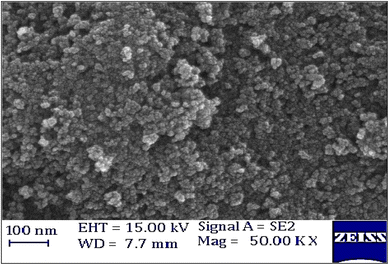
]. The nanocatalyst was then characterized by SEM analysis. The particle size was studied by SEM and the identification of Fe
3
O
4
/SiO
2
-OSO
3
H morphology was based on the analysis of SEM images. As can be seen in Fig.
1
, the obtained SEM image of the prepared catalyst showed proper dispersion of the composite nanostructure and also almost uniform sizes and good spherical morphology of the nanoparticles.
SEM image of the Fe
3
O
4
/SiO
2
-OSO
3
H nanostructureFig. 1
Furthermore, EDX analysis of the magnetic nanocatalyst indicated the presence of Si, S, O and Fe elements in the nanocomposite and the amount of iron loading in Fe 3 O 4 /SiO 2 -OSO 3 H catalyst was about enough to act in the magnetic field.
To investigate the catalytic application of the present composite nanostructure, an important organic reaction was used. A pilot experiment was started from 1 mmol of 1,3-cyclohexadione, 1 mmol of methyl acetoacetate, 1 mmol of p -methylbenzaldehyde and 1 mmol of ammonium acetate using various amounts of Fe 3 O 4 /SiO 2 -OSO 3 H at room temperature in 5 mL of EtOH. The best amount of Fe 3 O 4 /SiO 2 -OSO 3 H catalyst was 0.03 g to produce compound 4 in 97% yield after 45 min. Increasing the amounts of the catalyst did not improve the yield of the reaction. In addition, the effect of various solvents was studied in the pilot test. As a result, EtOH was the best vs different solvents with diverse range of polarities such as MeOH, H 2 O, CH 2 Cl 2 , Et 2 O and n -hexane.
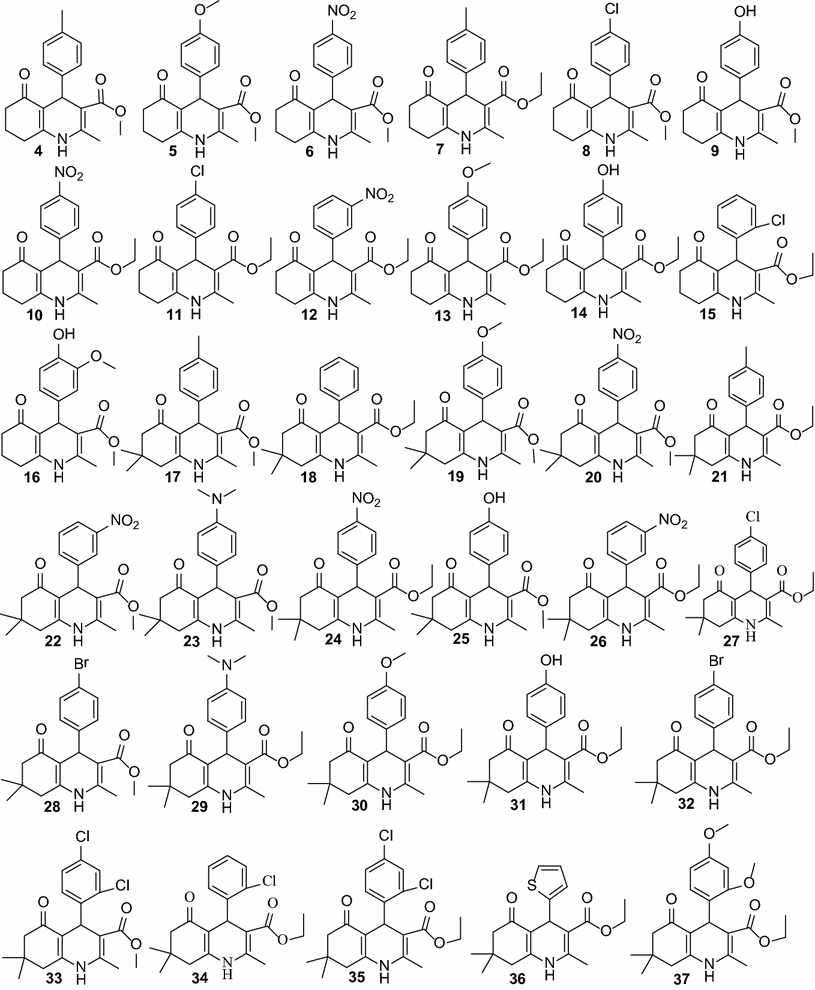
To investigate the scope and limitations of this protocol, various raw materials were tested for the synthesis of polyhydroquinoline derivatives. As can be seen in Table
1
, various aromatic and heteroaromatic aldehydes including both electron-donating and electron-accepting moieties gave efficiently the desired products in high yields. The structures of the prepared products
4
–
37
are shown in Fig.
2
.
Fe
3
O
4
/SiO
2
-OSO
3
H—catalyzed synthesis of polyhydroquinolines
4
–
37
via MCR strategy Entry Product Time (min) Yielda (%) 1 45 97 207–208 2 60 92 243–244 3 35 85 235–236 4 60 94 258–260 5 60 95 257–259 6 40 96 255–256 7 30 84 257–258 8 50 92 245–246 9 50 96 233–235 10 50 95 175–176 11 60 95 212–214 12 45 85 196–198 13 50 96 245–248 14 50 97 235–237 15 45 94 249–250 16 55 95 236–237 17 30 90 236–237 18 50 87 186–188 19 60 94 189–191 20 40 90 292–293 21 60 96 256–258 22 45 97 272–273 23 40 89 254–256 24 50 89 263–265 25 30 92 248–250 26 50 88 256–258 27 50 90 221–223 28 40 85 215–217 29 55 96 233–234 30 45 95 250–252 31 60 94 250–252 32 40 90 215–217 33 55 85 208–211 34 45 96 237–239 The chemical structures of the products
4
–
37Table 1
Fig. 2
In this study, evaluation of computer system for the prediction of biological activity on the set of well-known polyhydroquinoline derivatives using MNA descriptor was studied via PASS. Seven important activities extracted from PASS software include three classes: pharmacological effects, molecular mechanisms, and side effects/toxicity (Table
2
). In the first column of the table, biological activities of the synthesized compounds have been sorted according to the percentage of urinary incontinence treatment activity with values of 60.5–77.2% that represent the highest average activity among the seven activities are listed below in Table
2
.
The prediction of biological activities of
4
–
37 Entry Products % PASS activities ( % side effects and toxicity ( % drug likeness ( 1 77.2 61.0 61.1 55.0 60.9 47.3 47.8 – 19.3 24.6a 70.5 2 76.5 62.5 61.0 54.8 62.6 48.4 50.0 – – 31.9a 76.4 3 76.3 69.7 60.9 56.2 65.0 51.3 56.1 – 24.3 28.3b 49.9 4 76.2 58.1 58.3 53.7 59.0 45.0 43.9 17.3 24.1 21.1a 67.7 5 76.0 59.4 56.6 53.5 57.9 46.3 46.3 – – 29.5a 61.9 6 75.4 56.8 55.6 52.3 58.2 46.5 43.3 – – 24.3a 84.1 7 75.3 64.6 58.3 55.0 63.0 48.4 51.0 22.7 29.6 30.7b 47.8 8 75.0 57.1 54.5 52.3 55.1 44.3 42.6 19.1 22.3 29.4c 59.2 9 74.8 65.0 58.5 54.4 62.9 48.6 51.6 22.5 29.9 31.4b 45.2 10 74.5 58.6 57.4 53.1 61.1 45.8 46.1 – 21.5 29.0a 73.3 11 74.3 55.2 53.5 51.0 55.6 44.5 39.8 – 21.5 21.0a 81.7 12 72.0 60.4 59.1 55.2 60.1 45.3 45.0 20.4 22.7 33.5c 64.2 13 71.9 55.4 55.0 50.9 59.2 44.5 42.2 – – 31.5a 86.5 14 70.9 57.2 58.8 52.5 54.5 44.8 44.0 – – 22.8a 51.0 15 70.2 57.1 59.0 51.9 55.1 44.5 43.4 21.0 19.9 21.2a 55.3 16 69.6 58.1 58.8 52.3 57.9 45.7 46.1 – – 29.7a 58.7 17 69.6 63.1 58.8 54.0 60.7 48.1 51.1 18.8 21.7 25.6b 32.6 18 69.3 55.5 56.5 51.2 52.1 42.9 40.4 22.5 21.5 19.8a 48.7 19 69.0 63.5 58.9 53.4 60.7 48.3 51.7 18.8 22.1 26.4b 30.6 20 68.7 55.9 52.9 49.0 46.0 43.7 41.6 – – – 55.3 21 68.1 59.9 56.6 52.8 58.9 45.9 47.4 28.6 26.1 27.7b 31.4 22 67.8 54.7 53.9 49.7 51.5 44.3 39.9 – – 22.7a 69.8 23 67.5 60.2 56.8 52.2 59.0 46.2 48.0 28.2 26.5 28.6b 29.5 24 67.2 54.9 52.9 49.7 48.8 42.3 39.3 24.9 19.9 23.8a 41.7 25 67.2 54.8 52.4 49.4 45.8 42.8 40.4 – – – 36.4 26 67.1 54.6 51.0 47.7 44.2 42.1 38.4 20.3 – 20.8b 53.0 27 66.6 56.0 55.9 55.7 50.7 43.7 42.7 19.7 19.1 27.1a 56.6 28 66.2 53.6 51.9 48.4 49.3 42.6 36.8 21.0 19.1 19.8a 67.2 29 65.5 53.6 50.4 48.1 43.9 41.1 37.3 22.5 22.1 – 34.9 30 62.9 57.5 55.3 53.1 51.3 43.6 42.7 19.1 – 27.6c 43.0 31 62.2 57.1 57.2 53.0 54.0 43.3 41.6 26.4 20.4 24.4c 46.5 32 61.2 55.8 53.3 51.9 49.2 42.0 39.4 28.7 19.3 32.1c 41.4 33 60.6 55.4 46.7 39.0 46.1 39.0 32.9 – – 22.6a 27.7 34 60.5 55.7 56.9 53.0 53.6 42.9 41.3 17.0 18.8 19.2a 62.9Table 2
The compounds 4 and 5 , with the urinary incontinence treatment values of 76.5% and 77.2%, respectively, showed the highest amount of deals as a scientific achievement. Therefore, this new finding is very important for patients suffering from urinary incontinence. The second column of Table 2 shows the toxicity and side effects of synthetic drugs. This column shows that of the 34 compounds synthesized, compounds 23 and 28 did not show toxicity and side effects. These two drugs considered for completing the clinical course of further investigation can be marketed.
The percentage of similarity of the prepared products to the commercial drugs in mentioned pharmaceutical composition were 55.3 and 63.4, respectively. As a result, in this way, use of this optimal biological properties will be easy. In general, due to less toxicity and side effects of compound 23 and also its similarity to drugs and biological activity of more than 50%, it can be used in the treatment of urinary incontinence, as calcium channel antagonist and antihypertensive.
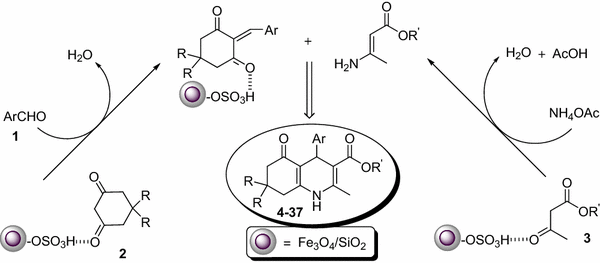
A plausible reaction mechanism in the presence of Fe
3
O
4
/SiO
2
-OSO
3
H includes a Knoevenagel reaction between aldehydes and dimedone and a parallel Michael addition of an enamine intermediate to give polyhydroquinolines
4
–
37
(Scheme
1
) [
13
].
A proposed mechanism of the synthesis of polyhydroquinolines
4
–
37Scheme 1
The recoverability of the Fe 3 O 4 /SiO 2 -OSO 3 H nanocatalyst was one of the most important advantages of the heterogeneous catalysts in both industrial and academic applications. The present nanostructure catalyst can easily be separated from the reaction pot using an external magnet, washed with a solvent like ethanol or acetone, dried at room temperature, and reused at least six times. The reusability was examined in the model reaction for the synthesis of product 4 . The isolated yields were 97, 95, 94, 92, 91 and 90% for the fresh catalyst and five subsequent recycled runs, respectively. As a result, the catalytic performance and recyclability of Fe 3 O 4 /SiO 2 -OSO 3 H were better than catalysts previously reported in the literature [ 8 , 9 , 10 , 11 – 12 ] and also our earlier works [ 13 , 20 ].
In summary, Fe 3 O 4 /SiO 2 -OSO 3 H was synthesized, characterized and efficiently used for the synthesis of biologically important polyhydroquinolines. In addition, this method has enough ability to be used in the synthesis of various other important heterocycles via MCRs or even traditional and classic parallel syntheses. The present nanocatalyst could easily be recycled from the reaction mixture and reused for at least six runs. Furthermore, for the first time, the pharmacological and biological activities of the various synthesized polyhydroquinoline derivatives were examined by PASS program (MNA descriptor). Therefore, with further chemical development, molecule 23 could potentially serve as medication for urinary incontinence treatment, calcium channel antagonist and antihypertensive.
We would like to thank the partial support of the Research Council of the Iran University of Science and Technology.
Springer Nature remains neutral with regard to jurisdictional claims in published maps and institutional affiliations.