Graphical abstract

Graphene is an one-atom thick two-dimensional (2D) transparent carbon sheet which has aroused potential interest for the ultrafast high-sensitive electronic device application. Functionalization of 2D graphene is one of the important aspects to manipulate its intrinsic properties achieving the requisite aptness for its booming applications. Here, a novel strategy for the noncovalent surface functionalization of 2D graphene layer has been proposed utilizing self-assemble monolayers (SAM) of 1,4-benzenedimethanethiol (BDMT) that can further anchor gold nanoparticles (AuNPs) on the graphene surface. Raman spectroscopy and contact angle measurements confirm the SAM modification on graphene surface. AFM and XPS verify the anchoring of AuNPs on the graphene surface. Furthermore, the AuNPs-anchored BDMT-modified graphene (AuNPs/BDMT/G) electrode is explored for highly sensitive electrochemical detection of H 2 O 2 , exhibiting an impressive detection limit of 1.8 μM (signal-to-noise ratio of 3).
In the recent years, graphene has been emerged as a most promising two-dimensional (2D) material of synthetic carbon allotrope’s family. Since the discovery of graphene [ 1 , 2 ], this one-atom thick honeycomb lattice has been investigated intensely in both the experimental and theoretical scientific studies because of its high electron mobility, large accessible surface area, excellent mechanical strength, thermal and optical properties [ 3 – 8 ]. It has shown potential applications in many areas such as nanoelectronics, catalysis, and batteries, supercapacitors, and sensors, etc [ 9 – 12 ]. Recently, graphene, mainly focused on graphene oxide (GO) or reduced graphene oxide (RGO), -based hybrid materials have been used in the development of high performance electrochemical biosensors as an advanced electrode [ 13 – 16 ]. However, the abundance of oxygen containing functional groups on the GO (or RGO) basal plane introduce a semiconducting nature which hinders the charge transfer process and hence the sensing performances.
Large scale graphene film has been successfully synthesized using the conventional thermal chemical vapor deposition (CVD) method, as reported in the literature [ 17 , 18 ]. Functionalization of this CVD-grown 2D graphene is one of the important aspects to manipulate the intrinsic graphene properties (high conductivity and electron mobility) for its booming applications. The graphene sheet can be readily functionalized via covalent C–C coupling [ 19 , 20 ] or non-covalent π–π interaction [ 21 , 22 ]. Modifying the graphene surface with desired functional groups by chemical treatment (covalent functionalization) is one of the convenient strategies to get well-dispersed functional groups on the graphene basal plane. However, such approaches lead to the presence of non-conducting agents on the graphene surface and the uncontrolled creation of defect sites that would undermine the electronic properties and alter the band structure of the pristine graphene [ 19 , 20 ]. Conversely, a non-covalent functionalization approach [ 21 , 22 ] involving van der Waals forces or π–π stacking of functionalizing moiety on the graphene sheet could provide selective functional groups on graphene surface’s nearly perfect crystal structure retaining its intrinsic electronic properties and sensitivity. With recent development, the noncovalent functionalization routes have shown great potential for effective loading and easy manipulation, hence greatly adapted in a range of graphene-based applications. In bio-sensor applications, the immobilization of bio-molecules on the electrode surface is a critical step, whereas the metal nanoparticles (NPs) anchored via noncovalent modification on graphene surface can provide simple and highly active, though nonspecific, immobilization sites for bio-molecules.
Last few years, electrochemical hydrogen peroxide (H
2
O
2
) sensor application has attracted extensive attention in the clinical, biological control and environmental protection fields [
23
–
27
]. In literature, highly sensitive and selective enzymes have been recommended as potential candidates to detect H
2
O
2
[
28
–
31
]. In 2010, Zhou et al. [
32
] demonstrated a novel H
2
O
2
biosensor, co-immobilizing horseradish peroxidase (HRP) with graphene into biocompatible polymer chitosan, with a detection limit of 1.7 μM within a board linear range from 0.005 to 5.13 mM. However, enzymes are less appreciated for pragmatic applications due to their instability, high cost and complex immobilization process. As an alternative approach, non-enzymatic electrodes modified with metal NPs have been introduced as advanced H
2
O
2
biosensor [
33
–
36
]. The metal nanoparticles are generally immobilized on the mesoporous materials by electrodeposition and solution process. Among the metal immobilization process, self-assembled monolayer (SAM) allowed the more control distribution of metals via electrostatic interaction without altering the conducting properties of the substrate. Here, we have developed an electrochemical sensor for H
2
O
2
using self-assembled monolayers (SAM) modified CVD-grown graphene anchored with gold nanoparticles (AuNPs). At first stage, the SAM of 1,4-benzenedimethanethiol (C
6
H
4
(CH
2
SH)
2
, abbreviated to BDMT), with double thiol ends on a single aromatic ring (Fig.
1
), is formed on the surface of a CVD-grown graphene on SiO
2
/Si substrate. The non-covalent π–π interaction between the aromatic rings of BDMT and graphene can provide thiol functional groups for AuNPs immobilization less affecting the intrinsic electronic properties of graphene. Subsequently, the AuNPs are anchored onto the basal plane of graphene utilizing the highly active thiol ends of BDMT via Au–S bond formation. The close proximity of AuNPs to the graphene basal plane through the short Au–S–C chains, along with the unique electronic properties of graphene, is expected to enhance the electron transfer pathway and hence the electrocatalytic activity. The aim of this study is to develop a simple strategy of non-covalent surface functionalization process via self-assembled monolayer formation on graphene followed by anchoring selective functional groups for the construction of the selective and sensitive electrochemical biosensor.
Schematic representation of the functionalization steps for a CVD-grown graphene by non-covalent process (self-assemble monolayer formation) with Au nanoparticles (AuNPs)Fig. 1

A schematic representation of the non-covalent graphene functionalization with BDMT SAM and subsequent AuNPs anchoring is shown in Fig. 1 , leading to the AuNPs-anchored BDMT-modified graphene (AuNPs/BDMT/G) electrode. Large scale graphene film has been synthesized by using the conventional CVD route [ 37 ]. Functionalization of graphene has been carried out according to the following steps: the CVD-grown single layer graphene transferred on SiO 2 /Si wafer is first immersed in a 1 mM ethanolic solution of BDMT for 24 h under a nitrogen-saturated condition, followed by washing with ethanol and drying under nitrogen flow. On the second step, the thiol-functionalized graphene is immersed in a suspension of AuNPs (with an average size of 3–5 nm) for 6 h, followed by washing with milliQ double distilled water and drying in a stream of nitrogen. Finally, the product is stored under vacuum. The detailed synthesis processes for the CVD-grown graphene [ 17 , 37 ] and AuNPs [ 38 ] are given in the supporting information.
Formation of the BDMT SAMs on CVD-grown graphene surface happens via a liquid–solid phase assembly, which provides thiol (–SH) functional groups on the graphene surface via a non-covalent process. From the contact angle measurement, it is found that the BDMT-modified graphene (BDMT/G) exhibits increase in water contact angle in comparison with the pristine CVD-grown graphene (shown in Fig S1). The less electronegativity difference is expected between S–H functional groups as compared to usual oxygen and hydrogen moieties observed on the graphene surface. Relatively less polar S–H groups increase the hydrophobicity of SAM-modified graphene.
To characterize the BDMT/G, Raman vibrational spectra for pristine and BDMT-modified graphene have been examined (Fig.
2
a). Three characteristic peaks at 1325, 1579 and 2637 cm
−1
, observed for the pristine CVD-grown graphene, are assigned to the D, G and 2D bands, respectively. With the BDMT functionalization, the 2D and G bands exhibit significant blue-shift to 2641 and 1583 cm
−1
, respectively. Bratescu et al. [
39
] reported the similar charge transfer phenomena on graphene due to charge doping on large area graphene by gold alloy NPs. Furthermore, the BDMT modification on graphene leads to an increase in
I
D
/
I
G
ratio and decrease in
I
2D
/
I
G
ratio, as listed in Table S1. Increase in D band intensity (or
I
D
/
I
G
ratio) would be attributed to the enhanced disorder of graphene basal plane as a consequence of BDMT SAM formation on CVD-grown graphene surface. Interestingly, the decrease in
I
2D
/
I
G
ratio, along with the upshift of 2D and G bands, would indicate a doping effect in the graphene for BDMT/G. Such decrease of
I
2D
/
I
G
ratio can be quite likely attributed to a rise in the aromatic ring structures attached to the surface of graphene via π–π interaction. These observations confirm the non-covalent SAM formation with BDMT molecules on the graphene surface. Further, the BDMT/G is subjected to the AuNPs functionalization that can also indirectly prove the SAM modification on graphene prior to the AuNPs anchoring. The pristine and AuNPs-anchored BDMT/G topographies are visualized in atomic force microscopy (AFM), shown in Fig.
2
b, c, which confirmed that AuNPs were uniformly distributed and anchored on the CVD-grown graphene surface.
a
Raman Spectra of CVD-grown graphene (
i
) before and (
ii
) after the BDMT modification of CVD-grown graphene on SiO
2
/Si substrate.
b
,
c
AFM images of pristine and AuNPs-anchored BDMT-modified CVD-grown grapheneFig. 2

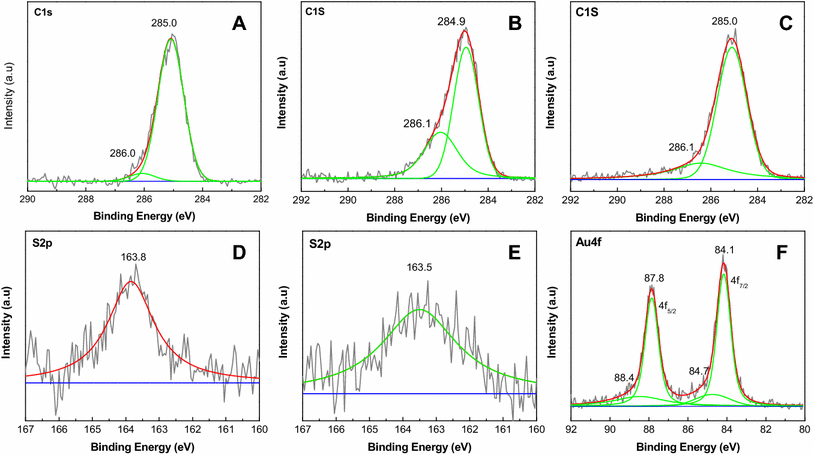
To analyze the detail composition of the pristine CVD-grown graphene, BDMT/G and AuNPs/BDMT/G, X-ray photoelectron spectroscopy (XPS) analysis has been employed (Fig.
3
). XPS spectrum of the CVD-grown graphene revealed C1s at 285.0 eV which corresponds to C–H, C–C, and C=C bonds that are characteristic of graphite/graphene, additionally low % of C1s occurred at 286.0 eV which is characteristic of C–O bonds. In comparison with the pristine CVD-grown graphene (Fig.
3
a), the C1s XPS spectra of BDMT/G and AuNPs/BDMT/G reveal two components corresponding to different functional groups: C–C (284.9 eV) of the sp
2
carbons on the basal plane of the graphene sheets, and C–S at 286.1 eV (Fig.
3
b, c). Interestingly, it can be noted that a small downshift of C=C peak is observed in BDMT/G as compared to pristine CVD-grown graphene. This could be reasonably attributed to the interfacial charge transfer between the BDMT and graphene. The BDMT/G shows the specific S2p signal at 163.8 eV ascribed to an unbound molecular thiol or disulfide (Fig.
3
d), whereas AuNPs/BDMT/G shows an additional small signal around 162.4 that attributes to the gold-bound thiol (S–Au, Fig.
3
e). Furthermore, the AuNPs anchoring on SAM-modified graphene, via available thiol groups of BDMT, exhibits double Au4f XPS peaks around 84.1 eV (4f
7/2
) and 87.8 eV (4f
5/2
), as shown in Fig.
3
f. Two additional humps at higher binding energy side for each of the deconvoluted Au4f
7/2
and Au4f
5/2
can be also observed those associate with the Au–S bonding. The above results demonstrate the covalent bonding of AuNPs to large area graphene surface via BDMT aromatic linker, which is consistent with the abovementioned AFM analysis data (Fig.
2
b, c).
X-ray photoelectron spectra:
a
–
c
C1S of pristine CVD-grown graphene, BDMT/G and AuNPs/BDMT/G,
d
–
e
S2p of BDMT/G and AuNPs/BDMT/G and
f
Au4f of AuNPs/BDMT/GFig. 3
The electrochemical H
2
O
2
sensing performance is usually investigated by monitoring the electro-reduction signal of H
2
O
2
. The H
2
O
2
electro-reduction mechanism can be expressed as following:
Figure
4
shows the typical cyclic voltammograms (CV) of the AuNPs/BDMT/G electrode in absence and presence of 2.5 mM H
2
O
2
in 0.1 M PBS (pH 7.4) buffer solution, a standard gold electrode is used as a reference. In the absence of H
2
O
2
, no obvious reduction current can be observed for AuNPs/BDMT/G electrode, but with the addition of H
2
O
2
(2.5 mM) the catalytic current increases with a reduction peak around −0.2 V (vs. Ag/AgCl). However, the reference gold electrode shows a moderate increase in the catalytic current with a reduction peak around −0.25 V in the presence of H
2
O
2
. Figure
4
exhibits a drastic change in the CV spectra of AuNPs/BDMT/G when the H
2
O
2
is added into buffer solution, revealing a superior catalytic behavior of AuNPs/BDMT/G based hybrid electrode.
CV spectra of AuNPs/BDMT/G electrode in the (
i
) absence and (
ii
) presence of 2.5 mM H
2
O
2
in 0.1 M PBS (pH = 7.4). For comparison, (
iii
) the same for a gold electrode is presentedFig. 4

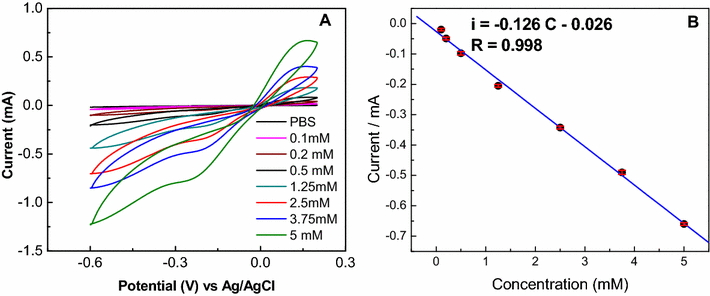
Figure
5
a displays the CVs of AuNPs/BDMT/G in 0.1 M PBS (pH 7.4) under various concentrations of H
2
O
2
. It is observed that both the reduction and oxidation currents increase steadily with increasing H
2
O
2
concentrations. The reduction peak current value at –0.2 V vs. Ag/AgCl is chosen for the detection probe for H
2
O
2
due to its sensitive response. The observed linear relation observed in Fig.
5
b indicates that the reduction current is proportional to the concentration of H
2
O
2
in a wide concentration range. Such observation supports an impressive electrocatalytic activity of the AuNPs/BDMT/G electrode.
a
CV spectra of the AuNPs/BDMT/G electrode in 0.1 M PBS (pH 7.4) with different H
2
O
2
concentrations (0, 0.1, 0.2, 0.5, 1.25, 2.5, 3.75, 5 mM) at a potential scan rate 100 mV s
−1
.
b
Plot of current responses vs. H
2
O
2
concentrations, at −0.25 V vs. Ag/AgCl REFig. 5
Typical dynamic response plot of AuNPs/BDMT/G electrode with successive addition of H
2
O
2
is shown in Fig.
6
a. The working potential is set at −0.25 V as the reduction potential. The amperometric current measured at AuNPs/BDMT/G electrode responds directly with the concentrations of H
2
O
2
exhibiting a wide linearity from 0.002 to 0.0225 mM with a correlation coefficient of 0.992 as shown in Fig.
6
b. The estimated detection limit is 1.8 μM, at a signal-to-noise ratio of 3, which is found lower than other gold-based hydrogen peroxide biosensors [
40
,
41
]. However, we believe that there is still room to improve the performance of our sensor. The overall electrochemical detection mechanism is based on the electrochemical reduction process. In the proposed solution-based surface modification or sensing process, it is hard to avoid the interfering components that can be oxidized as target analytes at particular potential. To compare the detection limit of the AuNPs/BDMT/G with other graphene-based H
2
O
2
biosensors, Table
1
lists the operating potential range, linear range, and sensitivity of different electrodes. All the data reveal that H
2
O
2
biosensing parameters of the AuNPs/BDMT/G electrode are well comparable with the literature reports.
a
Dynamic response of the AuNPs/BDMT/G electrode on successive injections of H
2
O
2
at different concentration, in 0.1 M PBS (pH 7.4) at −0.25 V vs. Ag/AgCl. The
inset
represents a magnification of the data points obtained at low H
2
O
2
concentrations.
b
Plot of current responses vs. H
2
O
2
concentrations at lower concentration region Performances of various graphene-based hydrogen peroxide biosensors Electrode materials Operating potentials (V) Linear range (mM) Limit of detection (μM) References Au-graphene-HRP-chitogen −0.3 (vs. Ag/AgCl) 0.005–5.13 1.7 [ Pt/graphene nanocomposite 0.02 (vs. SCE) 0.0025–6.65 0.8 [ Chitogen/AgNPs/graphene nanocomposite −0.5 (vs. Ag/AgCl) 0.1–10 7 [ RGO/Fe3O4 nanocomposite −0.3 (vs. Ag/AgCl) 0.1–6 3.2 [ AuNPs/Prussian Blue/graphene nanocomposite 0.1 (vs. Ag/AgCl) 0.01–3 1.5 [ AuNPs/BDMT/G −0.25 (vs. Ag/AgCl) 0.002–5 1.8 This workFig. 6

Table 1
To study the reproducibility of AuNPs/BDMT/G electrode, repetitive amperometric current measurements were carried out in 0.02 mM H 2 O 2 in PBS solution (pH 7.4). The results of ten successive measurements show a relative standard deviation of 3.1 %. Also, the AuNPs/BDMT/G electrode shows high stability. To evaluate the stability of the graphene-based H 2 O 2 sensor, the AuNPs/BDMT/G electrode was stored at 4 °C temperature and measured the amperometric current in the 0.02 mM H 2 O 2 in PBS solution at intervals of a week, and it remained about 90 % of its original sensitivity after 4 weeks. These studies implies that the AuNPs/BDMT/G electrode possess good stability and reproducibility.
In summary, we demonstrate AuNPs-modified noncovalent functionalized CVD-grown graphene electrode as a potential candidate for electrochemical H 2 O 2 sensing application. Functionalization of graphene with 1,4-benzenedimethanethiol (BDMT) via non-covalent π–π interaction between the aromatic rings can provide thiol functional groups for AuNPs immobilization without affecting the electronic properties of graphene. The anchored AuNPs on graphene can provide faster e − -transfer due to the close proximity of AuNPs to the graphene basal plane through the short Au–S-C chain playing as highly active electrocatalytic sites for H 2 O 2 detection. Using the amperometric method on the AuNPs/BDMT/G electrode, an H 2 O 2 detection limit of 1.8 μM can be achieved. We believe that this simple noncovalent modification strategy for large area graphene would open up new approach for graphene-based biosensor as well as other applications.
We thank the Ministry of Science and Technology (MOST), Academia Sinica, Technical support from Nano-Core, the Core facilities for nanoscience and nanotechnology at Academia Sinica in Taiwan, is acknowledged.