Structure, energetics, spectral and electronic properties of B3N3C54 heterofullerene

Abstract

Introduction of heteroatoms into C 60 fullerene leads to enhance its physical and chemical properties in one way or other. In this paper, we have studied C 60 fullerene in which one of C 6 hexagons is replaced by B 3 N 3 using density functional theory at B3LYP/6-31G(d) level. The resulting heterofullerene B 3 N 3 C 54 closely mimics the structure of C 60 in which the polar BN bonds are weaker than covalent CC bond. The stabilization energy of B 3 N 3 C 54 is found to be 5.35 eV. The vibrational infrared and Raman spectra of B 3 N 3 C 54 have been calculated and compared with that of C 60 . The substitution results in a number of additions peaks including the strongest peak corresponding to BN stretching due to charge transfer from B to N atoms. The NMR chemical shifts of B 3 N 3 C 54 have also been computed using GIAO approach. The electronic parameters and DOS spectrum of B 3 N 3 C 54 have been compared with C 60 and their degenerate molecular orbitals have been plotted. The HOMO–LUMO energy gap of B 3 N 3 C 54 is lowered by 0.1 eV as compared to C 60 .


Introduction

Carbon forms a variety of nanostructures in which C 60 fullerene is particularly remarkable due to its finite size and for many technological applications [ 1 , 2 ]. The electronic properties of fullerenes have been found to be affected by doping of atoms [ 3 ] and molecule [ 4 ]. Introduction of heteroatoms into C 60 fullerene leads to distinguished physical and chemical properties which make them promising materials for some unique applications [ 57 ]. In particular, BN substituted C 60 cages have been studied several times [ 814 ]. Esfarjani et al. [ 8 ] have studied the band structure and chemical bonding in BNC 58 heterofullerenes and its electronic spectra are studied by Chen et al. [ 9 ]. Krainara et al. [ 10 ] and Siddiqui et al. [ 11 ] have studied the interaction of BNC 58 with adenine Cu(II) complexes and suggested that this heterofullerene is capable to differentiate electronically equivalent tautomers of DNA base pair. A systematic study on C 60−2 x (BN) x ( x  = 1–7) hybrid fullerene has been performed by Pattanayak et al. [ 12 ] and subsequently extended up to C 12 B 24 N 24 [ 13 ]. Anafcheh et al. [ 14 ] have recently performed NMR calculations on C 60−2 x (BN) x ( x  = 1, 2, 3, 6, 9, 12, 15, 18, 21, and 24) using density functional theory (DFT). The uniqueness of BN doped C 60 is due to the fact that polar BN bond is analogous to covalent CC bond in many aspects [ 15 ]. For instance, borazine (B 3 N 3 H 6 ) shows a great similarity with that of benzene (C 6 H 6 ) [ 1618 ] and hence, it is regarded as inorganic benzene. However, it is noticeable that the polarity of the BN bond causes borazine to show a reactivity pattern different from that of benzene. For instance, benzene is aromatic, but borazine is probably non-aromatic. Furthermore, BN analogs of many carbon nanostructures such as boron-nitride nanotubes, boron-nitride nanosheets, etc., have been well studied and reported. One might, therefore, expect that BN substituted C 60 fullerenes are structurally analogous to pure C 60 . Therefore, it should be interesting to analyze the effect of this substitution on the physical and chemical properties of C 60 . In this paper, we report density functional theory-based study on a substituted C 60 in which one of C 6 hexagons is replaced by B 3 N 3 . Spectral properties such as infrared, Raman and NMR spectra provide the signature of the molecular structure. Therefore, we analyze the spectral features of B 3 N 3 C 54 and compare it with C 60 . Moreover, the electronic properties of B 3 N 3 C 54 heterofullerene have been explored and compared with those of C 60 .

Computational methods

The study was performed using density functional theory (DFT) method as implemented in Gaussian 09 program [ 19 ]. All structures considered in this were fully optimized without any symmetry constraint using B3LYP exchange–correlation functional [ 20 , 21 ] with 6-31G(d) basis set. The B3LYP scheme has already been used in our previous study on LiF nanostructures [ 22 ]. More recently, B3LYP/6-31G(d) level has been proved to yield accurate results in case various fullerene derivatives [ 23 ]. Vibrational frequency calculations and natural population analysis (NPA) have been carried out within the same computational scheme. In a recent study, we have noticed that NPA charges are more reliable than many other population schemes [ 24 ].

Results and discussion

Structure and energetics

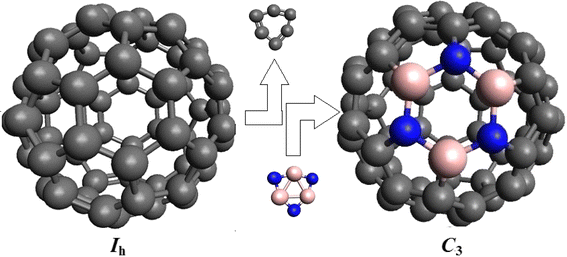
The optimized structure of B 3 N 3 C 54 along with C 60 is displayed in Fig.  1 . One can note that the structure of B 3 N 3 C 54 closely resembles that of C 60 in which one of C 6 hexagons is replaced by B 3 N 3 , but its symmetry is reduced to C 3 point group. To get further insights, we have separately optimized C 6 and B 3 N 3 . After optimization, we have found that they are almost similar in structure, also shown in Fig.  1 . Both possess D 3h symmetry and equalized bond lengths, 1.358 Å for B–N and 1.327 Å for C–C. The NPA charges on B and N atoms in B 3 N 3 are +1.04 e and −1.04 e , respectively, which suggest polarity of BN bonds. In Table  1 , we have collected the bond lengths of hexagon–hexagon and hexagon–pentagon in B 3 N 3 C 54 and C 60 . Evidently, the B–N bond lengths increase to 1.437 Å and 1.478 Å in hexagon–hexagon and hexagon–pentagon edges which indicate that B–N bonds of the substituted fullerene are weaker than those of free B 3 N 3 . Furthermore, the difference of B–N and C–C bond lengths is significantly increased. This may be expected due to redistribution of charges on B and N atoms in B 3 N 3 C 54 . For instance, NPA charges on B and N atoms in B 3 N 3 C 54 are +1.02 e and −0.88 e , respectively. One can note that the polarity of BN bonds reduces in B 3 N 3 C 54 which weakens the bond increasing its bond length.

Fig. 1

Equilibrium structures of C 60 ( left ) and B 3 N 3 C 54 ( right ) calculated at B3LYP level

Table 1

Main bond lengths (in Å) of B 3 N 3 C 54 and C 60 at B3LYP/6-31G(d) level

System (bond length)

Hexagon–hexagon

Hexagon–pentagon

C60 (C–C)

1.395

1.453

B3N3C54 (B–N)

1.437

1.478

(B–C)

1.526

1.526

(N–C)

1.434

1.434

The formation of B 3 N 3 C 54 involves two processes: the removal of C 6 hexagon from C 60 and then, inclusion of B 3 N 3 hexagon at the same place. The corresponding stabilization energy can be calculated by,

ΔE=EB3N3C54+EC6-EC60-EB3N3
where E [..] represents the total electronic energy of respective species including zero point correction. The calculated E values are −2296.5835, −2286.1742, −238.8580, and −228.2520 a.u. for B 3 N 3 C 54 , C 60 , B 3 N 3 , and C 6 , respectively, at B3LYP/6-31G(d) level. Therefore, Δ E value is found to be 5.35 eV which is positive and large enough to establish that the B 3 N 3 C 54 heterofullerene is kinetically stable.

Spectral properties

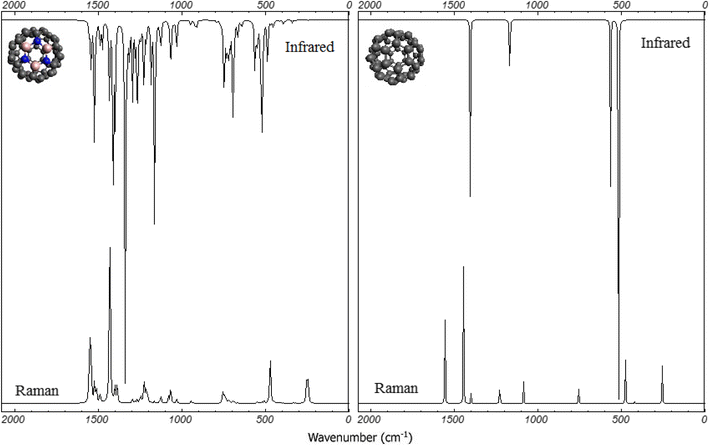
We have calculated vibrational infrared, Raman and NMR spectra of B 3 N 3 C 54 and compared with those of C 60 . The vibrational frequency calculations performed on B 3 N 3 C 54 heterofullerene reveal all real and positive values. This suggests that B 3 N 3 C 54 belongs to at least some local minimum in the potential energy surface. The calculated vibrational infrared and Raman spectra of B 3 N 3 C 54 and C 60 are depicted in Fig.  2 . For N -polyatomic systems, there are 3 N -6 normal modes of vibration. Due to extremely high symmetry of C 60 ( I h point group), however, there are only four characteristic modes possessing appreciable intensity. The mode with the highest intensity is assigned at the lowest wavenumber, 537 cm −1 . The CC stretching modes of C 60 are assigned in the higher wavenumber region, 1460 and 1214 cm −1 . The calculated wavenumbers were scaled by a factor of 0.9613 as suggested by Merrick et al. [ 25 ]. The scale wavenumbers of C 60 516, 565, 1167 and 1404 cm −1 are in accordance with the FT-IR frequencies 526, 576, 1183 and 1429 cm −1 , respectively, as reported by Chase et al. [ 26 ]. The substitution of B 3 N 3 into C 60 leads to destruction of the sharpness of peaks in the IR spectrum due to C 3 point group. As seen in Fig.  2 , a number of additional modes and mixing of various modes appear due to BN, BC and NC stretchings. For instance, the BN stretching modes appear at 1394 cm −1 . This mode possesses the strongest intensity due to charge transfer from B to N atoms. Furthermore, CC stretching modes of B 3 N 3 C 54 are shifted toward higher wavenumber region as compared to C 60 . For example, the modes calculated at 1606 and 1586 cm −1 are assigned to CC stretchings with weak intensities. However, CC stretching and lower wavenumber mode of B 3 N 3 C 54 corresponding to C 60 are obtained at 1468 cm −1 (medium) and 539 cm −1 (weak). On the contrary, Raman spectrum of B 3 N 3 C 54 closely resembles that of C 60 . There are eight distinct modes of vibrations in the Raman spectra which are in accordance with the experimental reports of Bethune et al. [ 27 , 28 ]. For instance, the most intense Raman peak calculated at 1465 cm −1 is observed at 1469 cm −1 in C 60 solid film [ 27 ] and 1470 cm −1 in C 60 thin film [ 28 ].

Fig. 2

Vibrational infrared and Raman spectra of B 3 N 3 C 54 and C 60 calculated at B3LYP/6-31G(d) level

NMR spectra of B 3 N 3 C 54 and C 60 are calculated by gauge independent atomic orbital (GIAO) approach at B3LYP/6-31G(d) level. The NMR relative chemical shifts of nucleus ‘X’ are calculated by δ  = δ ref  − δ full , where δ full are isotropic magnetic shieldings of nuclei of fullerene and δ ref are those of reference systems which are C 4 H 12 Si for C, B 2 H 6 for B and NH 3 for N nucleus. The calculated chemical shift for C 60 is 131.8 ppm whereas that of B 3 N 3 C 54 lies between 121.5 and 143.9 ppm. The minimal δ value corresponds to C attached to C–B bond whereas maximal value belongs to C bonded to C–N moiety, as expected due to lone pair of N atom. The triply degenerate NMR peaks of B and N nuclei in B 3 N 3 C 54 are found to be at 10.1 and 162.8 ppm, respectively.

Electronic properties

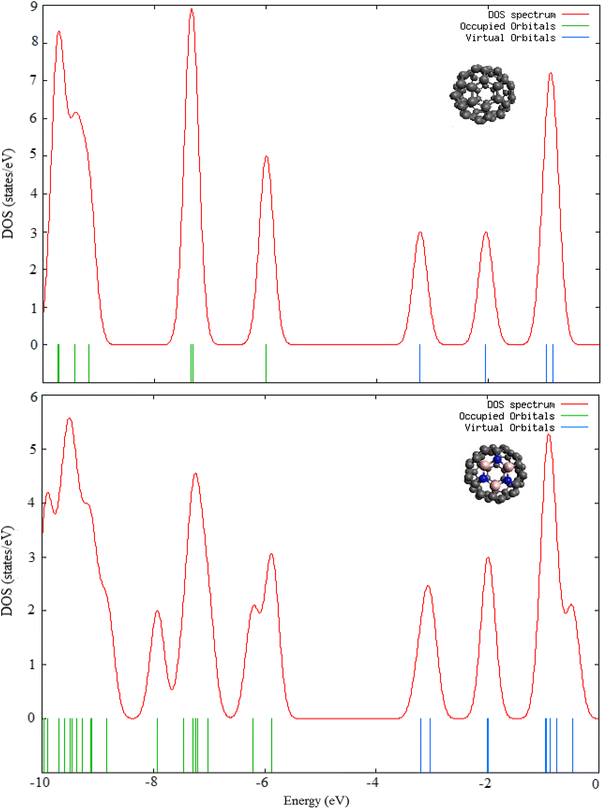
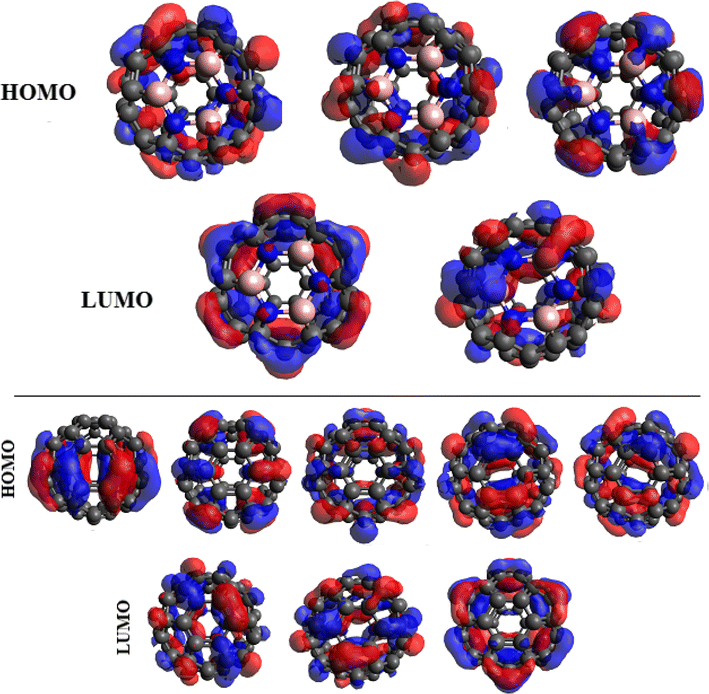
The density of states (DOS) spectra along with molecular orbital energy levels of B 3 N 3 C 54 and C 60 are plotted in Fig.  3 . One can note that the energy levels of the highest occupied molecular orbital (HOMO) and lowest unoccupied molecular orbital (LUMO) of B 3 N 3 C 54 are slightly shifted upwards relative to C 60 . Furthermore, the substitution results in additional energy levels which are closely spaced and broaden the density of states spectrum. The DOS spectra also reveal that the HOMOs of C 60 are fivefold degenerate and LUMOs are triply degenerate. This degeneracy of molecular orbitals is lowered for B 3 N 3 C 54 in which the HOMOs and LUMOs are triply and doubly degenerate, respectively. The degenerate HOMOs and LUMOs of B 3 N 3 C 54 and C 60 are displayed in Fig.  4 . Within the framework of Koopmans’ theorem, the ionization potential ( I ) and electron affinity ( A ) are approximated by the negative energy eigenvalues of the HOMO and LUMO, respectively. From Table  2 , one can note that the calculated I and A values of B 3 N 3 C 54 are lower than those of C 60 . As known, it is energetically unfavorable to add electrons to a high-lying LUMO or to extract electrons from a low-lying HOMO and so to form the activated complexes of any potential reaction [ 29 ]. Therefore, B 3 N 3 C 54 is expected to be form cationic complexes due to smaller E HOMO magnitude, i.e., I value than that of C 60 .

Fig. 3

Density of States (DOS) spectra of C 60 and B 3 N 3 C 54 calculated at B3LYP level. Occupied ( green ) and unoccupied ( blue ) molecular orbital energy levels are also displayed

Fig. 4

Degenerate HOMOs and LUMOs of B 3 N 3 C 54 ( upper set ) and C 60 ( lower set )

Table 2

Electronic parameters of B 3 N 3 C 54 and C 60 at B3LYP/6-31G(d) level

Parameter

B3N3C54

C60

I = −EHOMO (eV)

5.872

5.986

A = −ELUMO (eV)

3.205

3.228

Egap = ELUMO − EHOMO = I − A (eV)

2.667

2.758

The energy difference between HOMO and LUMO, HOMO–LUMO energy gap ( E gap ) corresponds to the band gap in solids which is equal to the difference of I and A values. In molecular system, this energy gap is generally approximated to the chemical hardness [ 30 ]. This energy gap is equivalent to the energy required to free an outer shell electron which behaves as a mobile charge carrier that moves freely within the solid material. The E gap is an important parameter that determines the electrical conductivity of a solid. Substances with larger energy gaps are generally insulators, materials with smaller energy gaps are semiconductors, and conducting materials have very small or no energy gaps. In other words, the molecules with smaller energy gaps are less hard, and hence more reactive. Our calculated E gap of C 60 at B3LYP/6-31G(d) level (2.76 eV) is in agreement with the experimental band gap value of 2.3 ± 0.1 eV [ 31 ]. This energy gap being neither too large nor too small suggests the semiconducting behavior of C 60 . In case of B 3 N 3 C 54 , this energy gap is reduced to 2.67 eV. Therefore, the conductivity of B 3 N 3 C 54 should be slightly greater than that of C 60 .

Conclusion

Using density functional theory-based calculations; we have studied the substitution of B 3 N 3 hexagon into C 60 fullerene. We noticed that the structure of B 3 N 3 C 54 closely resembles that of C 60 . However, polar B–N bonds are weaker than that of covalent C–C bonds. The stabilization energy due to substitution of B 3 N 3 into C 60 is calculated to be 5.35 eV at B3LYP/6-31G(d) level. The vibrational infrared and Raman spectra of B 3 N 3 C 54 and C 60 have been compared and it was noticed that the strongest peak in vibrational spectrum of B 3 N 3 C 54 is due to BN stretching and CC stretching modes are shifted to higher wavenumber region. The NMR chemical shifts of B 3 N 3 C 54 have also been computed. The density of states (DOS) spectrum of B 3 N 3 C 54 shows the reduction in the degeneracy of molecular orbitals, but enhancement in the peak width resulting in additional energy levels due to heteroatoms such that its HOMO–LUMO gap is reduced relative to C 60 . This study should provide better insights into the surface modification of C 60 by heteroatom.


Acknowledgments

A. K. Srivastava, wishes to acknowledge Council of Scientific and Industrial Research (CSIR), India for financial help in the form of a senior research fellowship (SRF) [Grant No. 09/107(0359)/2012-EMR-I].


References

  1. Langa and Nierengarten (2007) RSC Publishing
  2. Rao and Govindaraj (2005) RSC Publishing
  3. Misra et al. (2012) Geometrical electronic, and vibrational properties of fullerene rings doped with transition metals (pp. 64-72)
  4. Dwivedi and Pandey (2014) Ab initio study of the endohedral fullerene PbH4@C60 (pp. 679-686) 10.1080/1536383X.2012.717560
  5. Guo et al. (1991) Doping bucky: formation and properties of boron-doped buckminsterfullerene (pp. 4948-4950) 10.1021/j100166a010
  6. Pradeep et al. (1991) Interaction of nitrogen with fullerenes: nitrogen derivatives of C60 and C70 (pp. 10564-10565) 10.1021/j100179a015
  7. Jensen and Toftlund (1993) Structure and stability of C24 and B12N12 isomers (pp. 89-96) 10.1016/0009-2614(93)85039-Q
  8. Esfarjani et al. (1994) Band structure and chemical bonding in C58BN heterofullerenes (pp. 17830-17836) 10.1103/PhysRevB.50.17830
  9. Chen et al. (1998) Theoretical studies on the substituted fullerenes C60-x-yBxNy (x + y = 2) (pp. 219-225) 10.1016/S0166-1280(98)00142-0
  10. Krainara et al. (2012) Interaction of adenine Cu(II) complexes with BN-doped fullerene differentiates electronically equivalent tautomers (pp. 88-93) 10.1016/j.cplett.2012.04.017
  11. Siddiqui et al. (2015) Possible use of BN-modified fullerene as a nano-biosensor to detect adenine–thymine Watson-Crick base pair in mutagenic tautomeric form: theoretical approach 10.1142/S0219633615500030
  12. Pattanayak et al. (2001) Boron–Nitrogen (BN) substitution patterns in C/BN hybrid fullerenes: C60-2x(BN)x (x = 1−7) (pp. 8376-8384) 10.1021/jp011391m
  13. Pattanayak et al. (2002) Boron–Nitrogen (BN) substitution of fullerenes: C60 to C12B24N24 CBN ball (pp. 2970-2978) 10.1021/jp013904v
  14. Anafcheh and Hadipour (2011) A computational NICS and 13C NMR characterization of BN-substituted 60C fullerenes (pp. 400-404) 10.1016/j.physe.2011.09.005
  15. Liu and Marder (2008) B–N versus C–C: How similar are they? (pp. 242-244) 10.1002/anie.200703535
  16. Srivastava and Misra (2015) The boron–carbon–nitrogen heterocyclic rings (pp. 5-9) 10.1016/j.cplett.2015.02.021
  17. Srivastava and Misra (2015) Introducing “carborazine” as a novel heterocyclic aromatic species (pp. 2483-2488) 10.1039/C4NJ02089H
  18. Srivastava and Misra (2015) Heterocyclic C2B2N2H6 versus homocyclic C6H6 (pp. 369-375) 10.3233/MGC-150179
  19. Frisch (2010) Gaussian Inc.
  20. Becke (1988) Density-functional exchange-energy approximation with correct asymptotic behavior 10.1103/PhysRevA.38.3098
  21. Lee et al. (1988) Development of the Colle-Salvetti correlation-energy formula into a functional of the electron density 10.1103/PhysRevB.37.785
  22. Srivastava and Misra (2014) Novel planar chain like Li7F7 and Li9F9 nanostructures (pp. 302-305) 10.1016/j.cplett.2014.08.045
  23. Sikorska and Puzyn (2015) The performance of selected semi-empirical and DFT methods in studying C60 fullerene derivatives 10.1088/0957-4484/26/45/455702
  24. Srivastava and Misra (2014) Structures, stabilities, electronic and magnetic properties of small RhxMny (x + y = 2–4) clusters (pp. 1-5) 10.1016/j.comptc.2014.08.008
  25. Merrick et al. (2007) An evaluation of harmonic vibrational frequency scale factors (pp. 11683-11700) 10.1021/jp073974n
  26. Chase et al. (1992) Vibrational spectroscopy of C60 and C70 temperature-dependent studies (pp. 4262-4266) 10.1021/j100190a029
  27. Bethune et al. (1990) The vibrational Raman spectra of purified solid films of C60 and C70 (pp. 219-222) 10.1016/0009-2614(90)85335-A
  28. Bethune et al. (1991) Vibrational Raman and infrared spectra of chromatographically separated C60 and C70 fullerene clusters (pp. 181-186) 10.1016/0009-2614(91)90312-W
  29. Manolopoulos et al. (1991) Theoretical studies of the fullerenes: C34 to C70 (pp. 105-111) 10.1016/0009-2614(91)90340-F
  30. Pearson (1997) Wiley-VCH 10.1002/3527606173
  31. Lof et al. (1992) Band gap, excitons, and Coulomb interaction in solid C60 10.1103/PhysRevLett.68.3924