Results and discussion
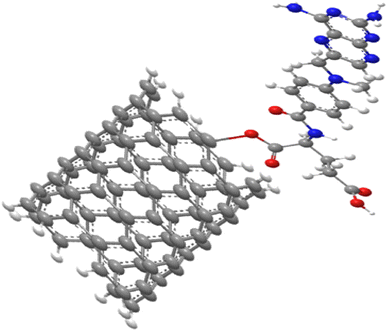
The main purpose of the present study is to investigate the combination of carbon nanotube and Methotrexate (MTX) as an ordinary form of anticancer drug which, with inhibition of dihydrofolate reductase activities, is believed to prevent synthesis of the nucleotide and the cell cycle. Thus, values of thermodynamic parameters on combination of MTX with the carbon nanotube in various environments were investigated. Figure
1
exhibits the interaction of MTX and carbon nanotube. We have got the mentioned calculations to investigate the following reaction:
Complex of MTX–CNTFig. 1
We investigated parameters of
G
,
H
,
S
,
E
and
µ
of MTX–carbon nanotube in dielectric constant solvent similar to the gas phase, aqueous solution, and ethanol solution which were compared. Thus, the values of dipole moment for MTX and carbon nanotube, MTX–carbon nanotube complex in various dielectric constant environments such as the gas phase, aqueous solution, and ethanol solution in various temperatures have been surveyed. Values of dipole moment in different environments such as gas phase, aqueous solution, and ethanol solution were obtained which showed a positive correlation with dielectric constant (Table
1
). A continuing dielectric constant exhibits solvent with the given dielectric constant in the SCRF method. Solute of cavities with radius in the electric field and the molecule that is relevant to solute through dipole of solvent will collaborate with dipole of molecular and directly to the net stabilization. Thus, first, salvation energy computed by the self-consistent reaction field technique is the distribution of electrostatic to the free energy of salvation. Therefore, radius of the cavities of MTX, CNT, and MTX–CNT complex has been measured and subsequently obtained values were replaced, while the productivity was extending. Here, we utilized the key word of “volume” and we obtained quantities of volume of MTX, CNT, and MTX–CNT complex. The consequences of computing show that the obtained volume of MTX, CNT, and MTX–CNT complex is equal to 4.15, 5.48 and 6.87 Å (Angstrom). Thus, it is obvious that with increasing dielectric constant of solvent, the dipole moment for MTX, CNT, and MTX–CNT complex in different temperatures, such as 298, 303, 307, and 312 K, will also be increased. Then, with computed Onsager template, researchers can demonstrate which values of
G
,
E
,
H
and
S
for MTX, CNT, and MTX–CNT complex are sensitive polarities of surrounding of the solvent. Based on this approach, in Table
2
, we illustrated that the values of
G
,
E
,
H
, and
S
are relevant to dielectric constant of the solvent. Table
2
clearly shows that when the temperature increases from 298 to 312 K, the values of
G
parameter of MTX, CNT, and complex of MTX–CNT in gas phase, water and ethanol solutions will be reduced so that we have the lowest value of
G
parameter at 312 K. If the dielectric constant of the solvent increases, the achieved Gibbs free energy at various temperatures will decrease. Thus, the Gibbs free energy is the most negative value when MTX, CNT, and the complex of MTX–CNT are placed in water solvent. Table
2
also shows obtained values of thermodynamic parameters
G
,
H
,
E
, and
S
in different solvents. When the temperature changes between 298 and 312 K, the alterations of
E
,
H
, and
S
of MTX, CNT, and the complex of MTX–CNT in different environments such as the gas phase, aqueous solution, and ethanol solution occur. If the temperature is increased from 298 to 312 K, the results show what the most positive value of
E
,
H
, and
S
is for 312 K we think to be true. It should be noted that by calculating
E
,
H
, and
S
according to the dielectric constant of the solvent and enhancing the values of temperatures such as 298, 303, 307, and 312 K, the value of
E
and
S
changes to negative amounts. As the lowest values of parameters of
E
and
H
and the positive value of the parameter
S
could be obtained, here the most positive value of parameter of
S
takes place when MTX, CNT, and complex of MTX–CNT are in aqueous solution. In survey reaction of Eq. (
1
), Table
2
points out everything about combination of MTX–CNT system. Values of the Gibbs free energy of the combination between solute and solvent molecule are reduced if the dielectric constant solvent increases. As long as the dielectric constant of solvent increases, the values of enthalpy of combination between solute molecule and solvent molecule are moving toward a negative value because combination of solvent molecule and solute molecule is strong. Therefore, considering the Eq. (
1
), the amounts of denoted entropy are reasonable. With coupling of MTX with CNT, the entropy decreases which is clear in the above-mentioned reaction. Here, you can observe the assessment and survey of the information from another status toward Eq. (
1
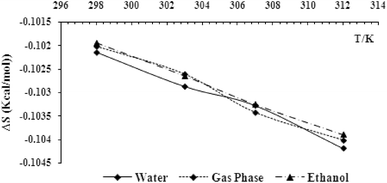
). In Figs.
2
,
3
,
4
, and
5
, the diagrams of parameters like dipole moment, Gibbs free energy, enthalpy, and entropy alterations according to the temperature alerts reveal that the changes in the value of
η
,
G
,
H
and
S
are achieved by the function of Δ
η
= Δ
η
MTX-CNT
− (Δ
η
MTX
+ Δ
η
CNT
). In this function
η
,
G
,
H
, and
S
are equal to the dipole moment, Gibbs free energy, enthalpy, and enthalpy parameter separately. Figure
2
shows that Δ
μ
reaction
will be changed through increasing dielectric constant of solvent when temperature is increased to 312 K. Figure
3
reveals that the value of Δ
G
reaction
will rise by the increase of temperature. The lowest value of Δ
G
reaction
was in 298 K which led to the highest resistance in the Eq. (
1
). Figure
5
shows that the value of Δ
S
reaction
is reduced with increasing temperature. This is the more resistant rate because here the most positive amount of Δ
S
reaction
can be seen in Eq. (
1
). The values of thermodynamic parameters of reaction was mentioned in Table
2
. Based on the dielectric constant of solvent, the value of the mentioned Δ
G
reaction
will decrease; moreover, the most negative amounts of Δ
G
reaction
are for water solution which is the best medium for Eq. (
1
). Also in Table
2
, we can observe via increasing dielectric constant solvent in different temperatures (298, 303,307, and 312 K), values of Δ
H
reaction
and Δ
S
reaction
reduce. Table
2
illustrates that the amount of Δ
S
reaction
has the most positive value in 298 K; therefore, in these situations temperature of 298 K is the best selection for Fig.
1
.
Values of [
μ
/(Debye)] in different solvents and temperatures T/K Δ MTX CNT MTX–CNT Gas phase 298 5.765 0.0095 809.2441 803.4696 303 5.768 0.0095 809.2480 803.4705 307 5.770 0.0096 809.2513 803.4717 312 5.776 0.0097 809.2580 803.4723 Aqueous solution or water 298 7.885 0.0101 981.4289 973.5338 303 7.886 0.0101 981.4303 973.5342 307 7.887 0.0102 981.4327 973.5355 312 7.891 0.0103 981.4383 973.5370 Ethanol solution 298 6.825 0.0095 865.265 858.4323 303 6.826 0.0096 865.261 858.4330 307 6.829 0.0097 865.267 858.4335 312 6.831 0.0099 865.268 858.4341 Values of thermodynamic parameters in various environments and temperatures at 6-31G level for MTX, CNT, and complex of MTX- CNT System Media Quantities T/K 298 303 307 312 Values of theoretical thermodynamic parameters (kcal/mol) MTX Gas phase −712,383.514 −712,384.007 −712,384.430 −712,384.9442 −712,353.374 −712,353.167 −712,352.949 −712,352.729 −712,353.921 −712,353.714 −712,353.496 −712,353.276 0.101132 0.101771 0.102538 0.103254 Aqueous solution or water −712,385.708 −712,386.201 −712,386.625 −712,387.1364 −712,355.53 −712,355.323 −712,355.105 −712,354.885 −712,456.121 −712,455.915 −712,455.697 −712,455.477 0.101258 0.101897 0.102664 0.10337 Ethanol solution −712,385.623 −712,386.120 −712,386.504 −712,387.0184 −712,355.450 −712,355.248 −712,355.03 −712,354.81 −712,374.871 −712,374.665 −712,374.447 −712,374.227 0.101243 0.101879 0.102510 0.103232 CNT Gas phase −1,319,201.048 −1,319,201.465 −1,319,201.756 −1,319,202.123 −1,319,167.77 −1,319,167.583 −1,319,167.394 −1,319,167.182 −1,319,167.784 −1,319,167.645 −1,319,167.46 −1,319,167.32 0.111661 0.111815 0.111917 0.111983 Aqueous solution or water −1,319,210.211 −1,319,210.630 −1,319,210.876 −1,319,211.288 −1,319,176.855 −1,319,176.668 −1,319,176.434 −1,319,176.267 −1,319,176.9 −1,319,176.761 −1,319,176.576 −1,319,176.436 0.111924 0.112078 0.11218 0.112246 Ethanol solution −1,319,208.281 −1,319,208.725 −1,319,209.008 −1,319,209.361 −1,319,175.004 −1,319,174.832 −1,319,174.626 −1,319,174.405 −1,319,175.056 −1,319,174.92 −1,319,174.769 −1,319,174.573 0.111661 0.111848 0.111975 0.112039 MTX–CNT Gas phase −2,133,768.310 −2,133,768.820 −2,133,768.867 −2,133,769.202 −2,133,735.387 −2,133,735.195 −2,133,734.781 −2,133,734.501 −2,133,735.473 −2,133,735.314 −2,133,735.038 −2,133,734.808 0.11077 0.110975 0.111028 0.111220 Aqueous solution or water −2,133,831.954 −2,133,832.411 −2,133,832.605 −2,133,832.968 −2,133,798.805 −2,133,798.623 −2,133,798.348 −2,133,798.141 −2,133,799.107 −2,133,798.832 −2,133,798.538 −2,133,798.362 0.111231 0.111499 0.111564 0.111625 Ethanol solution −2,133,818.329 −2,133,818.763 −2,133,819.046 −2,133,819.520 −2,133,785.263 −2,133,785.104 −2,133,784.896 −2,133,784.769 −2,133,785.262 −2,133,785.036 −2,133,784.833 −2,133,784.643 0.110959 0.111085 0.111237 0.111381 Gas phase Δ −102,183.748 −102,183.348 −102,182.681 −102,182.1348 Δ −102,214.243 −102,214.445 −102,214.438 −102,214.59 Δ −102,213.768 −102,213.955 −102,214.082 −102,214.212 Δ −0.102023 −0.102611 −0.103427 −0.104017 Aqueous solution or water Δ −102,236.035 −102,235.580 −102,235.104 −102,234.5436 Δ −102,266.42 −102,266.632 −102,266.809 −102,266.989 Δ −102,166.086 −102,166.157 −102,166.265 −102,166.449 Δ −0.102151 −0.102876 −0.10328 −0.104191 Ethanol solution Δ −102,224.425 −102,223.918 −102,223.534 −102,223.1406 Δ −102,254.809 −102,255.024 −102,255.24 −102,255.554 Δ −102,235.335 −102,235.451 −102,235.617 −102,235.843 Δ −0.101945 −0.102645 −0.103248 −0.10389 Theoretical dipole moment alterations computed versus temperature according to MTX + CNT → MTX–CNT Computed changes of Gibbs free energy for MTX + CNT → MTX–CNT at different temperature Computed changes of enthalpy for MTX + CNT → MTX–CNT at different temperature Computed changes of entropy for MTX + CNT → MTX–CNT at different temperatureTable 1
Table 2
Fig. 2
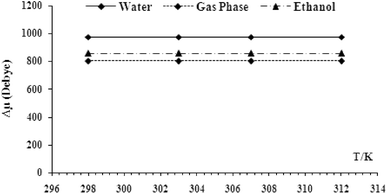
Fig. 3
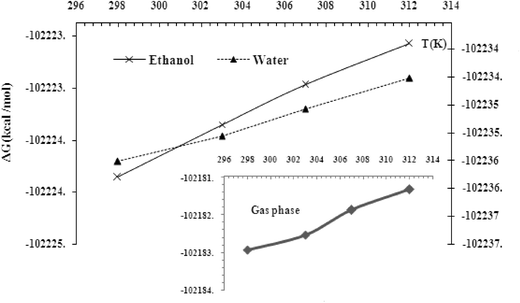
Fig. 4
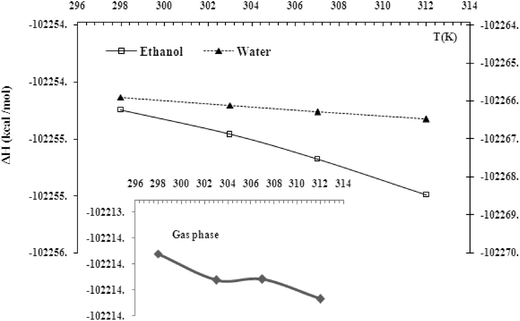
Fig. 5