Department of Applied Chemistry and Polymer Technology, Delhi Technological University (Formerly Delhi College of Engineering), Delhi, 110042, IN
Abstract
Carboxymethyl guar gum nanoparticles-based conductive polyaniline/carboxymethyl guar gum (PANI/CMGG) nanocomposites have been prepared first time by chemical oxidative method by potassium dichromate as an oxidant. The aim of the manuscript was to study the effect of CMGG nanoparticles concentrations on PANI/CMGG nanocomposites. Aniline has been polymerized in the presence of CMGG nanoparticles dispersed solution in acidic medium. Then nanocomposites have been characterized by FTIR, XRD, SEM and TEM. The size of the PANI/CMGG nanocomposites particles has been found in the range of ~90–280 nm. The results conclude that conductivity of the nanocomposites inversely depends on the concentration of the CMGG nanoparticles.
Introduction
Polysaccharides (xanthan gum, chitosan, guar gum, etc.) have been using since past years for the preparation of metallic nanocomposites as a stabilizer [
1
]. In this series, a new type of nanocomposites has been developed already by combination of natural polymers (polysaccharides) and conductive polymers. It has been found that such combination improves primary disadvantages of conducting polymers like, hydrophobic nature, low mechanical strength, non-film forming nature and non-solubility in common solvents, etc. [
2
]. To resolve these problems, synthetic polymers and natural polymers have been using as stabilizer for conducting polymers. In present time many scientists are working on this new concept to see the effects of different natural polymers on conducting polymers [
3
–
9
]. However, very limited literature is available on the concept of using polysaccharides/natural polymer in conducting polymer.
Among the polysaccharides, guar gum and their derivatives are very promising candidates due to their excellent properties like film forming property, biodegradability, hydrophilic nature and stabilizing agent. Carboxymethyl guar gum is an anionic semi-synthetic guar gum derivative. It is a galactomannan. It is synthesized by reacting guar gum with sodium monochlorate in the presence of sodium hydroxide [
10
–
13
]. CMGG is more viscous than guar gum because of the presence of charged carboxymethyl group in the CMGG molecule [
14
].
Conductive polymers are synthesized because of huge demand in electrodes, biosensors, battery, coating, gas sensors, membranes, light emitting diodes, etc. [
15
]. Polyaniline (PANI) is one of the low cost conductive polymers. But polyaniline has also hydrophobic nature, non-film forming nature and non-solubility in common solvents, etc. Only 1 % of solubility has been observed in
N
-methyl, 2-pyrrolidon (NMP) [
16
]. So in this manuscript, CMGG nanoparticles stabilized PANI/CMGG nanocomposite has been synthesized to see various effect of CMGG concentration on PANI/CMGG nanocomposite.
To the best of our knowledge, it is the first report on the effect of CMGG nanoparticles on PANI/CMGG nanocomposites. Optimum conditions were applied for getting the best conductivity of the nanocomposites. Solubility of the nanocomposite was also investigated in different solvents. The results obtained herein indicate potential uses of nanocomposites in conducting paints.
Experimental
Materials
Carboxymethyl guar gum was obtained from Hariom gum industry, Gujarat, India. Potassium dichromate (K
2
Cr
2
O
7
), hydrochloric acid (HCl), acetone (CH
3
COCH
3
) and aniline were purchased from Merck Germany and used as received. All solutions were prepared in Deionized (DI) water.
Analysis and characterizations
PANI/CMGG nanocomposites have been characterized by Scanning Electron Microscope (HITACHI-S-3700), TEM (Tecnai G2-200 kV HRTEM from SEI company Holland), X-ray Diffraction (BRUKER D8-ADVANCE) and by Fourier Transform Infrared (FTIR) spectrophotometer in (500–2000) cm
−1
wavelength range (Thermo scientific Nicolet 380), respectively. A standard four-probe Keithley 4200 semi conductor material characterization system was used for testing nanocomposites conductivity. Direct current (DC) electrical conductivity of the samples was measured by making rectangular pellets.
Synthesis of PANI/CMGG nanocomposites
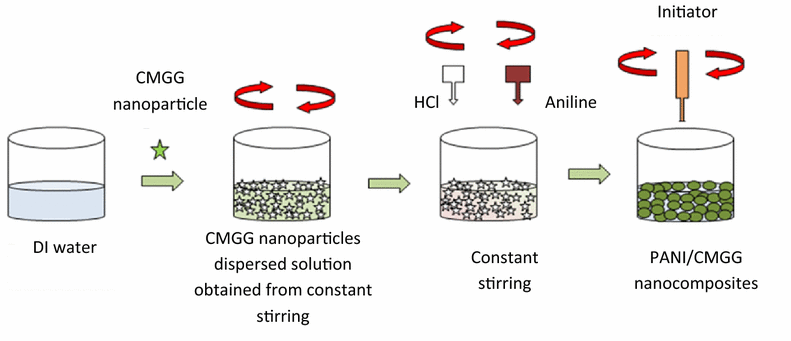
PANI/CMGG nanocomposites were synthesized by in-situ oxidative radical polymerization of aniline in the presence of CMGG nanoparticles dispersed solution with constant stirring in open atmosphere. CMGG nanoparticles were prepared by method mentioned in previous paper [
17
]. Diagrammatical presentation of synthesis of PANI/CMGG nanocomposites is shown in Fig.
1
.
Fig. 1
Diagrammatical presentation of synthesis of PANI/CMGG nanocomposite
In this procedure, 0.013 mol 50 ml aniline solution was added to 0.5 g CMGG nanoparticles dispersed acidic solution with constant stirring. Then polymerization of the aniline was initiated by adding 0.003 mol acidic solution of potassium dichromate. The change in color of the solution indicates the initiation of polymerization. This reaction was kept in this condition for 4 h at 25 °C. Subsequently, the solution was precipitated in acetone and then filtered through Whatman filter paper no. 1. The precipitation so obtained was dried at room temperature and then crushed to fine powder which was partially soluble in DMSO and DMF and forms stable solution. The optimization of conductivity of PANI/CMGG was done by varying concentrations of potassium dichromate, aniline, hydrochloric acid and CMGG nanoparticles Table
1
. Total 17 samples were prepared for obtaining maximum conductivity.
Table 1
Different composition of CMGG nanoparticles, potassiumdichromate and aniline with time to optimize best conductivity of PANI/CMGG nanocomposites
Sample code
CMGG nanoparticles (g)
Aniline (mol)
Potassium-diichromate (K2Cr2O7) (mol)
Conc. hydrochloric acid (HCl) (ml)
Time (h)
A
0
0.013
0.003
4.0
4
A1
0.25
0.013
0.003
4.0
4
A2
0.50
0.013
0.003
4.0
4
A3
0.75
0.013
0.003
4.0
4
A4
1.00
0.013
0.003
4.0
4
B1
0.50
0.026
0.003
4.0
4
B2
0.50
0.039
0.003
4.0
4
B3
0.50
0.052
0.003
4.0
4
C1
0.50
0.013
0.0005
4.0
4
C2
0.50
0.013
0.0006
4.0
4
C3
0.50
0.013
0.0007
4.0
4
D1
0.50
0.013
0.003
2.0
4
D2
0.50
0.013
0.003
3.0
4
D3
0.50
0.013
0.003
5.0
4
E1
0.50
0.013
0.003
4.0
1
Results and discussion
Determination of optimum conditions
Different variant were varied for obtaining the best conductivity of the nanocomposites as shown in Table
2
.
Table 2
Conductivity of different PANI/CMGG nanocomposites synthesized in specific conditions
Sample code
Conductivity (S/cm)
Color
A
0.13
Green
A1
0.54 × 10⁻¹
Green
A2
0.11 × 10⁻¹
Green
A3
0.30 × 10⁻²
Green
A4
0.12 × 10⁻²
Green
B1
0.52 × 10⁻³
Green
B2
0.87 × 10⁻³
Green
B3
0.50 × 10⁻³
Green
C1
0.16 × 10⁻²
Green
C2
–
Green
C3
0.13 × 10⁻¹
Green
D1
0.52 × 10⁻³
Green
D2
0.22 × 10⁻²
Green
D3
0.86 × 10⁻³
Green
E1
–
Green
E2
–
Green
E3
–
Green
F (pure CMGG)
0.3927 × 10⁻⁸
Greenish yellow
Effect of CMGG nanoparticles concentration
CMGG nanoparticles concentration was varied from 0.25 to 1.0 g, keeping the other reaction conditions constants, i.e., 0.003 mol potassium dichromate, 4 ml conc. HCl acid and 0.013 mol aniline at 25 °C for 4 h. It was found that conductivity of PANI/CMGG nanocomposites increase from 0.5412 × 10
−1
S/cm to 0.1234 × 10
−2
S/cm as the concentration of CMGG nanoparticles decrease from 1.0 to 0.25 g. This may be due to increase in viscosity of the reaction medium due to excess CMGG nanoparticles concentration that creates hindrance in polymerization of aniline. Insulating behavior of the CMGG may be also responsible for the decreasing in conductivity.
Effect of aniline concentration
A decrease in conductivity of PANI/CMGG nanocomposites from 0.5290 × 10
−3
to 0.8751 × 10
−6
S/cm was observed on increasing the concentration of the monomer (aniline) from (0.013 to 0.052) mol with fix reaction conditions, i.e., 0.003 mol potassium dichromate, 4 ml conc. HCl acid and 0.5 g CMGG nanoparticles at 25 °C for 4 h.
Effect of oxidant concentration
Conductivity of the PANI/CMGG nanocomposites was also found to increase from (0.1670 × 10
−2
–0.1123 × 10
−1
) S/cm on increasing oxidant (potassium dichromate) concentration from (0.005 to 0.007) mol. This may be due to the formation of compact structure of polyaniline, because on increasing the oxidant concentration, it creates more polyaniline free radicals which leads to excessive of grafting chains; thus it produces a compact structure. This gives a closer crystalline structure and conductivity increases.
Effect of HCl acid concentration
The effect of conc. HCl acid was studies from (2 to 5) ml, keeping the other reaction conditions constant, i.e., 0.003 mol potassium dichromate, 0.013 mol aniline, 0.5 g CMGG nanoparticles at 25 °C for 4 h. Conductivity of the PANI/CMGG nanocomposites has been found to be increased as the concentration of the conc. HCl increased from (2 to 4) ml. Maximum conductivity (0.1123 × 10
−1
) S/cm was obtained at 4 ml of conc. HCl acid. This may be due to a higher degree of protonation of the aniline, which produces, more PANI ion radicals. But as the concentration of conc. HCl acid was increased from (4 to 5) ml, the conductivity started to decrease, up to 0.86902 × 10
−3
S/cm. This may be due to the hydrolysis of PANI/CMGG nanocomposites in excess conc. HCl acid concentration. All the results were found well matched with the literature [
15
].
Mechanism for nanocomposite formation
Many researchers [
18
–
23
] have synthesized polyaniline by radical polymerization initiated by potassium dichromate, using aniline monomer in acidic medium, at room temperature. Potassium dichromate in acidic medium produces chromic acid. This chromic acid takes one electron from aniline and forms metastable complex. Then this complex dissociates and gives aniline cation radical. This aniline radical plays a very important role for the preparation of Polyaniline. Transfer of two electrons from aniline to chromic acid produces
N
-phenyl-p-phenylamine diamine (Pera Semidine salt) with chromic acid of Cr(IV). At low pH Pera Semidine salt convert to pernigraniline Salt (PS).This PS works as a catalyst for the conversion of aniline to Polyaniline. This PS converts to emeraldine salt (ES) by getting one electron from the aniline in acidic medium and converts to green color. Interaction between ES and carboxymethyl group of CMGG may be cause of PANI/CMGG nanocomposites stability
2PhNH+3+K2Cr2O7+8H+=PS+2K++2Cr3++7H2O [22].
FTIR analysis
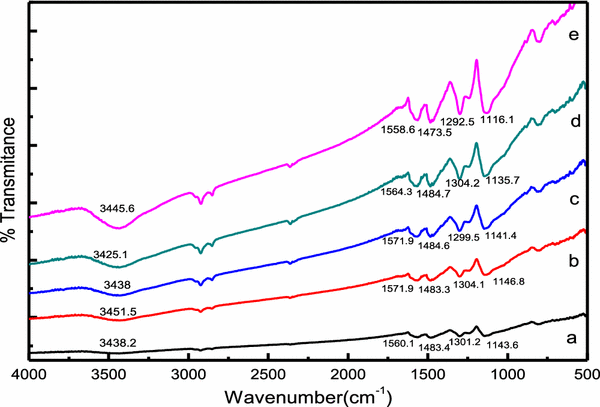
The FTIR spectra of PANI and PANI/CMGG nanocomposites with various CMGG nanoparticles concentration has been shown in Fig.
2
. FTIR feature of pure polyaniline is well known in literature [
24
,
25
]. In pure polyaniline the peaks at (3445.6, 1558.6, 1473.5 1292.5, 1116.1, 801.7) cm
−1
were found due to N–H stretching, quinoid structure, benzenoid structure and C–H and C–N stretching bands in benzene ring, respectively, as shown in Fig.
2
.
Fig. 2
FTIR Spectrum of PANI/CMGG nanocomposites with different concentrations of CMGG nanoparticles used (
a
) 0.5 g CMGG (
b
) 0.25 g CMGG (
c
) 0.75 g CMGG (
d
) 1 g CMGG (
e
) Pure polyaniline
The characteristic absorption bands of pure CMGG (3438.3 and 2928.1 cm
−1
) and PANI (3445.6, 1558.6, 1473.5, 1292.5, 1116.1 and 801.7) cm
−1
were found both present in the spectrum of their nanocomposites with slight shifting. This shifting shows the interaction between CMGG nanoparticles and polyaniline. No new peak was found in the FTIR spectrum of PANI/CMGG nanocomposites. This supports the fact that there is no grafting between CMGG nanoparticles and polyaniline. Thus, it also supports the formation of CMGG stabilized PANI/CMGG nanocomposites.
XRD analysis
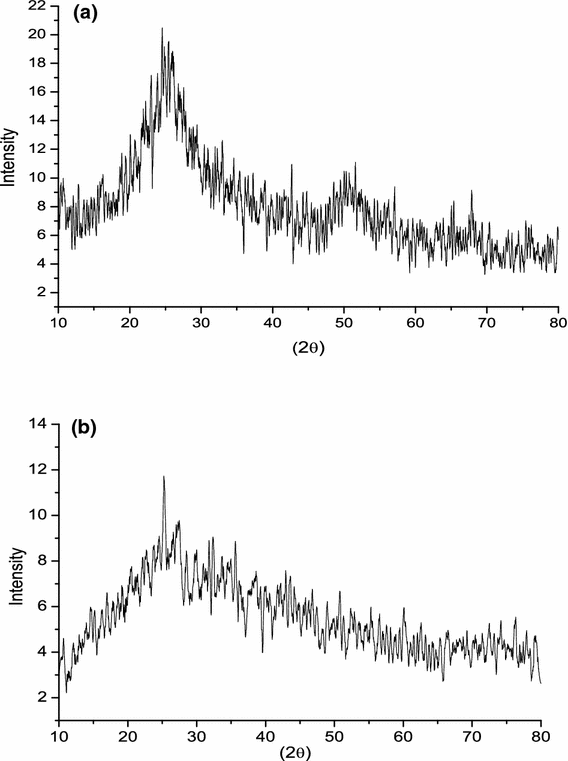
Highly ordered chain structure of polyaniline produces highly electrical conductivity, so morphology of polyaniline and PANI/CMGG nanocomposites has been studied by XRD analysis to study the nature of polyaniline in PANI/CMGG nanocomposites. The XRD patterns of polyaniline and PANI/CMGG nanocomposite have been shown in Fig.
3
a, b. The XRD pattern of pure polyaniline has been found to be of crystalline nature, while in case of PANI/CMGG nanocomposite the XRD pattern has been found nearly semicrystalline structure Fig.
3
a, b. XRD peak at 2
θ
= 25.43° was found corresponding to the emeraldine polyaniline, in pure aniline, while in PANI/CMGG nanocomposites, diffraction peaks were found blue shifted at 27.345°. This may be because of amorphous form of CMGG. This clarifies that on increasing the concentration of CMGG nanoparticles, the crystalline property of polyaniline decreases. As the crystalline property decreases, conductivity also decreases; this supports optimization conditions.
Fig. 3
a
XRD pattern of PANI and
b
PANI/CMGG nanocomposites
XRD pattern of PANI/CMGG nanocomposites shows that the crystalline structure in the nanocomposites has been decreased Fig.
3
b. This may also be because of the viscous behavior of the CMGG. As the concentration of the CMGG increases, it hinders the aniline radicals to form polyaniline chain.
SEM and TEM analysis
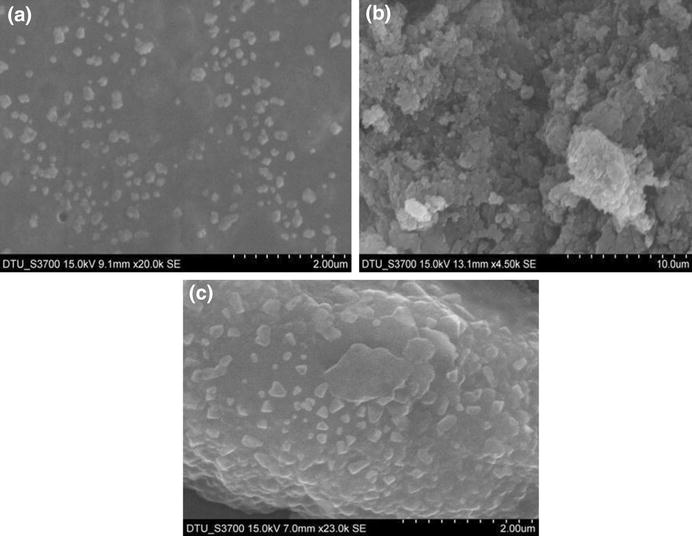
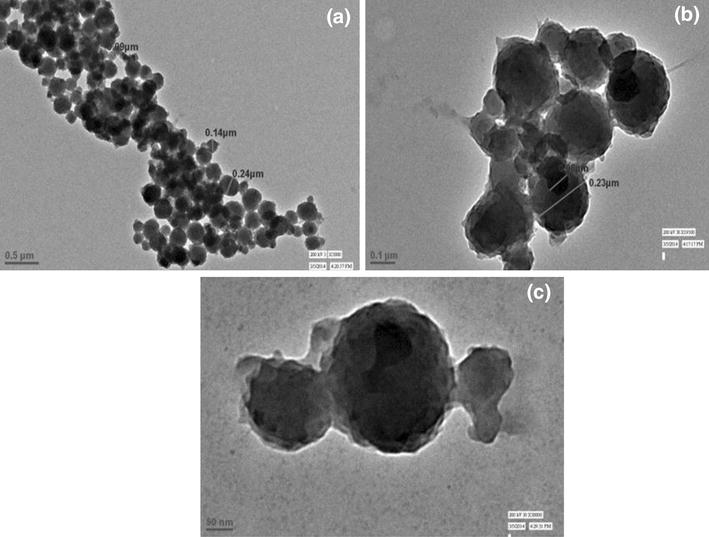
SEM and TEM analysis were used to investigate the surface morphology of polyaniline, CMGG nanoparticles and PANI/CMGG nanocomposites Figs.
4
,
5
. SEM images of PANI/CMGG nanocomposites show clearly the formation of nanocomposites Fig.
4
.
Fig. 4
SEM images of
a
CMGG nanoparticles,
b
Polyaniline and
c
PANI/CMGG nanocomposites
Fig. 5
TEM images of PANI/CMGG nanocomposites at different scales
a
500 nm,
b
100 nm and
c
50 nm
TEM images were taken at different scales (500, 100 and 50 nm) to see the formation of CMGG stabilized PANI/CMGG nanocomposites Fig.
5
. TEM images clearly show the CMGG nanoparticles stabilized PANI/CMGG nanocomposites in nanorange with spherical shape. This confirms the formation of nanocomposites. The average size of the PANI/CMGG nanoparticles has been found in the range of 90–280 nm, calculated by using image J software.
Solubility
Solubility of the nanocomposite was also tested in different solvents: acetone, DMSO, DMF and water. There were found no significant results regarding the solubility of PANI/CMGG nanocomposites in acetone and water except DMSO/DMF. PANI/CMGG nanocomposites were found partially soluble in DMSO/DMF solvents and gives stable solution.
Conclusions
CMGG nanoparticles stabilized PANI/CMGG conductive nanocomposites have been synthesized successfully. Nanocomposites have been found partially soluble in DMSO/DMF and give blue color solution. Maximum conductivity (0.5412 × 10
−1
) S/cm of the nanocomposite has been obtained at fixed reaction condition, i.e., 0.013 mol aniline, 4 ml conc. HCl 4 ml, 0.5 g CMGG nanoparticles, 0.003 mol potassium dichromate at 25 °C for 4 h. Conductivity of the PANI/CMGG nanocomposite has been found inversely proportional to the CMGG nanoparticles concentration. A detailed study is required with other conductive polymers also to study the effect of CMGG nanoparticles on other conductive polymers. Such type of nanocomposites may be also a new way for the formation of biomaterial based conductive nanopaint.
Acknowledgments
The authors are thankful to the institute for proving University fellowship to D K Verma. Author would like to thank Sandeep Mishra Technician, Advanced Instrument centre faculty- DTU, AIIMS -New Delhi and National Physical Laboratory- New Delhi, India for providing testing facilities.
References
Quintanilha et al. (2014) The use of gum Arabic as “Green” stabilizer of poly(aniline) nanocomposites: a comprehensive study of spectroscopic, morphological and electrochemical properties (pp. 18-27) 10.1016/j.jcis.2014.08.006
Palaniappan and John (2008) Polyaniline materials by emulsion polymerization pathway 33(7) (pp. 732-758) 10.1016/j.progpolymsci.2008.02.002
Zheng et al. (2015) Polysaccharide-based nanocomposites and their applications (pp. 23-32) 10.1016/j.carres.2014.07.016
Azar et al. (2014) Development of novel hybrid nanocomposites based on natural biodegradable polymer-montmorillonite/polyaniline: preparation and characterization (pp. 1591-1610) 10.1007/s00289-014-1143-0
Hu et al. (2011) Flexible electrical conductive nanocomposite membrane based on bacterial cellulose and polyaniline (pp. 8453-8457) 10.1021/jp204422v
Pande et al. (2012) Synthesis, characterization and studied of PANI-MMT nanocomposites 2(4) (pp. 90-98) 10.5923/j.nn.20120204.01
Yu et al. (2006) Facile synthesis of polyaniline-sodium alginate nanofibers (pp. 3899-3905) 10.1021/la051911v
Basavaraja et al. (2008) The study of DC conductivity for polyaniline-polymannuronate nanocomposites 29(12) (pp. 2423-2426) 10.5012/bkcs.2008.29.12.2423
Barik et al. (2010) Polyaniline-carboxymethyl cellulose nanocomposite for cholesterol detection (pp. 1-10) 10.1166/jnn.2010.1484
Gong et al. (2012) Synthesis and characterization of carboxymethyl guar gum and rheological properties of its solutions 88(3) (pp. 1015-1022) 10.1016/j.carbpol.2012.01.057
Gupta and Verma (2014) Guar gum and their derivatives: a research profile 2(1) (pp. 680-690)
Dodi et al. (2011) Carboxymethylation of guar gum: synthesis and characterization 45(3–4) (pp. 171-176)
Singh et al. (2011) Synthesis and characterization of guar gum templated hybrid nano silica (pp. 233-240) 10.1016/j.ijbiomac.2011.04.019
Unknown ()
Zareh et al. (2011) Conductive and biodegradable polyaniline/starch blends and their composites with polystyrene 20(4) (pp. 319-328)
Chen and Lee (1993) Polyaniline plasticized with 1-methyl-2-pyrrolidone: structure and doping behaviour (pp. 3254-3261) 10.1021/ma00065a002
Gupta and Verma (2014) Preparation and characterization of carboxymethyl guar gum nanoparticles (pp. 247-250) 10.1016/j.ijbiomac.2014.05.012
Sevil et al. (2007) Conductive potassium feldspar/polyaniline composites prepared by in situ chemical polymerization (pp. 702-707) 10.1016/j.synthmet.2007.07.014
Arasi et al. (2011) Synthesis and characterizations of poly(aniline)/Sb2O3 nanocomposite (pp. 635-641) 10.4067/S0717-97072011000200002
Vivekanandan et al. (2011) Synthesis, characterization and conductivity study of polyaniline prepared by chemical oxidative and electrochemical methods 3(6) (pp. 147-153)
Ayad and Shenashin (2004) Polyaniline film deposition from the oxidative polymerization of aniline using K2Cr2O7 (pp. 197-202) 10.1016/j.eurpolymj.2003.09.002
Chowdhury and Saha (2005) Potassium dichromate initiated polymerization of aniline (pp. 671-675)
Arasi et al. (2009) The structural properties of Poly(aniline)—analysis via FTIR spectroscopy (pp. 1229-1234) 10.1016/j.saa.2009.09.042
Chanshetty et al. (2012) Surface morphology studies and thermal analysis of V2O5 doped polyaniline composites 2(5) (pp. 611-616)
Tiwari and Singh (2007) Synthesis and characterization of electrical conducting chitosan-graft-polyaniline 1(5) (pp. 308-317) 10.3144/expresspolymlett.2007.44