Department of Chemistry, Yazd Branch, Islamic Azad University, Yazd, IR
Abstract
An atom-efficient, three-component synthetic methodology has been developed for the preparation of biologically important 2-amino benzo[
h
]chromene using nano-sawdust–BF
3
as a new catalyst. The reaction involves the use of 2-naphthol, malononitrile, and various aldehydes. A wide range of aldehydes is compatible in this reaction, producing excellent yields in short time. The morphology of nanocatalyst (nano-sawdust–BF
3
) was observed using a scanning electron microscopy. Also, the sawdust–BF
3
surface was studied by energy dispersive X-ray spectroscopic method to find out the chemical composition.
Introduction
Recently, multi-component, one-pot synthesis have become one of the most attractive reactions due to their vast applications such as high selectivity, mild reaction condition and construction of several bonds in a single operation. These reactions are widely applied in pharmaceutical chemistry for producing different structures and combinatorial libraries for drug discovery [
1
]. 2-amino benzo[
h
]chromene are some examples of multi-component reactions. 4
H
-chromenes and fused 4
H
-chromene derivatives are attractive, because they generally show biological properties such as anti-microbial, anti-oxidant, anti-tumor, hypotensive and antiproliferation activities [
2
–
6
].
In recent years, there has been growing interest in finding inexpensive and effective solid acid nano catalyst such as nanocrystalline TiO
2
–HClO
4
[
7
], nano-TiCl
4
·SiO
2
[
8
–
10
] nano-SnCl
4
·SiO
2
[
11
,
12
] nano-BF
3
·SiO
2
[
13
–
15
] HClO
4
–SiO
2
nanoparticles [
16
] and nano-silica sulfuric acid [
17
–
23
]. Sawdust is one of the most common materials that used for various chemical industries such as removing pollutants from water [
24
], the color removal from textile industry [
25
], the removing cationic, anionic, and disperse dyes from aqueous solution [
26
] and the CuFe
2
O
4
/sawdust composite was used for removal of cyanine acid blue from aqueous solution [
27
].
The sawdust consists of cellulose, lignin, and hemicelluloses. Cellulose is composed of a long chain of glucose molecules, lignin is a complex polymer composed of phenylpropane units, and hemicelluloses are branched polymers composed of xylose, arabinose, galactose, mannose, and glucose [
28
–
31
]. The lignocellulosic material of sawdust includes a wide variety of hydroxyl groups that can be used as active sites for the preparation of solid acid catalysts.
In this study, the sawdust has been used as adsorbent for the preparation of nano-sawdust–BF
3
whose average size is small and is well distributed. The presence of new functional groups on the surface of sawdust–BF
3
resulted in a dramatic increase of surface polarity and acidity, thereby improving the catalytic efficiency of the nano-sawdust–BF
3
.
Recently some conditions and catalysts have been applied for the 2-amino benzo[
h
]chromene synthesis [
32
–
38
]. Although many of the reported methods are effective, but, some of them suffer from disadvantages such as harsh reaction conditions, use of hazardous solvents and toxic metals, long reaction times, complex working and purification procedures, long volume of catalyst loading and moderate yields. Therefore, the development of a simple, mild, and efficient method is still needed. In continuation of our previous research on the use of solid nano catalyst in organic synthesis [
14
–
21
], the nano-sawdust–BF
3
as a new catalyst has been applied for the synthesis of 2-amino benzo[
h
]chromene derivatives.
Results and discussions
In continuation of our investigation into the application of solid acids in organic synthesis, we studied the application of sawdust as a green, inexpensive and available surface to synthesis of solid acid nano catalyst. In this study, sawdust–BF
3
nanoparticles were prepared and characterized. The catalytic activity of nanoparticles was investigated for synthesis of 2-amino benzo[
h
]chromene derivatives, by the condensation of an aldehyde 1a–k, malononitrile 2 and 2-naphthol 3 (Scheme
1
).
Scheme 1
Synthesis of 2-amino benzo[
h
]chromene derivatives in the presence of nano-sawdust–BF
3
as catalyst
Figure
1
shows the scanning electron microscopy (SEM) image of sawdust. The morphology and size of sawdust and sawdust–BF
3
was observed by SEM images. After adding the BF
3
to sawdust, the particles will be smaller and more homogeneous. As shown in Fig.
2
, the size of nano-sawdust–BF
3
is below 100 nm.
Fig. 1
SEM micrograph of sawdust
Fig. 2
SEM micrograph of nano-sawdust–BF
3
The results of EDX analyses of the sawdust and sawdust–BF
3
are given in the following Table
1
.
Table 1
Chemical analysis of sawdust and sawdust–BF
3
Sawdust
Sawdust–BF3
Element
W %
A %
W %
A %
C
56.85
65.35
57.62
64.03
O
39.89
34.42
20.60
17.19
B
–
–
8.02
9.90
F
–
–
12.53
8.80
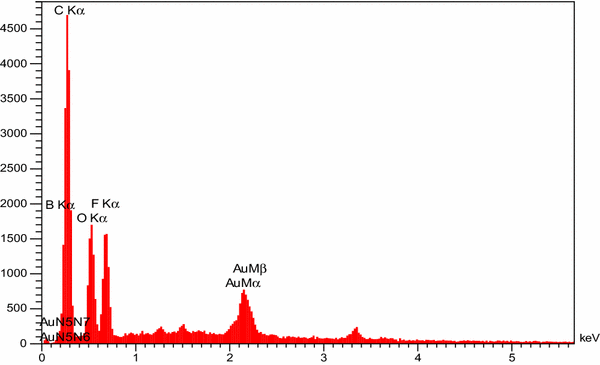
The EDX analysis show how the different elements are distributed. Chemical analysis of sawdust gave carbon and oxygen as the major elements (Fig.
3
). The elemental analysis by EDX identified the high peak of fluorine and boron in addition to other elements in the nano-sawdust–BF
3
(Fig.
4
). Presence of fluorine and boron in the EDX, indicates that the chemical interaction of boron trifluoride etherate with the surface of sawdust.
Fig. 3
EDX of sawdust
Fig. 4
EDX of nano-sawdust–BF
3
In order to determine the optimum quantity of nano-sawdust–BF
3
, the reaction of 2-naphthol, malononitrile, and benzaldehyde was carried out under reflux in ethanol using different quantities of nano-sawdust–BF
3
. As shown in Table
2
, 0.02 g of nano-sawdust–BF
3
gives an excellent yield in 20 min. The above reaction was also examined in various solvents (Table
2
, entries 1–4). Most of these solvents required a longer time and gave low yields, and the best results were obtained when ethanol was used (Table
2
, entry 2). An interesting feature of this method is that the reagent can be regenerated at the end of the reaction and can be used several times without losing its activity. To recover the catalyst, after completion of the reaction, catalyst was separated and washed with ethanol and then dries the solid residue. This process repeated for two cycles and the yield of product 4a did not change significantly (Table
2
, entries 8, 9).
Table 2
Optimization of the reaction conditions for synthesis of 4a
Entry
Catalyst (amount)
Solvent/condition
Time (min)
Yield
1
Nano-sawdust–BF3 (0.02 g)
CH2Cl2/reflux
20
Trace
2
Nano-sawdust–BF3 (0.02 g)
EtOH/reflux
20
92
3
Nano-sawdust–BF3 (0.02 g)
CH3CN/reflux
20
Trace
4
Nano-sawdust–BF3 (0.02 g)
DMF/reflux
20
46
5
Nano-sawdust–BF3 (0.02 g)
H2O/reflux
20
82
6
Nano-sawdust–BF3 (0.01 g)
EtOH/reflux
20
71
7
Nano-sawdust–BF3 (0.03 g)
EtOH/reflux
20
93
8
Nano-sawdust–BF3 (0.02 g) 2nd run
EtOH/reflux
20
91
9
Nano-sawdust–BF3 (0.02 g) 3rd run
EtOH/reflux
20
87
To study the scope of the reaction, a series of aldehydes with 2-naphthol and malononitrile were examined by nano-sawdust–BF
3
as catalyst. The results are shown in Table
3
. In all cases, aromatic aldehyde substituted with either electron-donating or electron-withdrawing groups underwent the reaction smoothly and formed products in approving yields.
Table 3
Synthesis of 2-amino benzo[
h
]chromene
Entry
Ar
Product
Time (min)
Yielda
M.P. (°C) Ref.b
1
C6H5
4a
20
92
278–280 (278–279) [32]
2
4-ClC6H4
4b
15
88
205–207 (208) [32]
3
2-ClC6H4
4c
15
86
264–265 (265–267) [32]
4
4-FC6H4
4d
10
90
234–236 (237–238) [32]
5
3-NO2C6H4
4e
10
93
235–237 (235–236) [37]
6
4-NO2C6H4
4f
10
90
182–184 (185) [33]
7
4-CH3OC6H4
4g
25
82
191–193 (193) [33]
8
4-OH–3-OCH3C6H3
4h
25
84
249–250 (252–253) [37]
9
4-Cl–3-NO2C6H3
4i
10
90
184–186 (181–183) [37]
10
4-OHC6H4
4j
30
87
288–290 (289–291) [37]
11
C5H4N
4k
20
89
172–174
The proposed mechanism for the formation of nano-sawdust–BF
3
catalyzed 2-amino benzo[
h
]chromene is illustrated in Scheme
2
. Condensation of aldehyde 1 and malononitrile 2 in the presence of the acidic catalyst of nano-sawdust–BF
3
(A
+
) produce an intermediate 5. Then the Michael addition of 2-naphthol 3 to intermediate 5 would furnish intermediate 6. Finally, the product 4 was obtained by an intramolecular cyclization and tautomerism.
Scheme 2
Plausible mechanism for the formation of 2-amino benzo[
h
]chromene derivatives
Conclusions
The present investigation shows that nano-sawdust–BF
3
a capable nanocatalyst to be used for 2-amino benzo[
h
]chromene synthesis via one-pot reaction of aldehydes, malononitrile, and 2-naphthol. Nano-sawdust–BF
3
was successfully prepared and characterized using EDX and SEM. Prominent among the advantages of this method are such as shorter reaction times, simple work-up, affords excellent yield, and re-usable for a number of times without appreciable loss of activity. The present method does not involve any hazardous organic solvent. Therefore, this procedure could be classified as green chemistry.
Methods
Instrumentation
Melting points were determined with an Electrothermal 9100 apparatus. IR spectra were recorded on a Shimadzu IR-470 spectrometer.
1
H NMR spectra were obtained using Bruker Avance 400. The morphologies of the nanoparticles were observed using FESEM of a MIRA3 TESCAN microscope with an accelerating voltage of 15 kV. The EDX analysis was done using a SAMx-analyser. The chemicals for this work were purchased from Merck or Fluka chemical companies.
Synthesis of nano-sawdust–BF3
The sawdust was collected from sawmill in Farrokhi city, Iran. Sawdust was washed several times to remove adhering dirt and then dried at 60 °C for 24 h. The dried sawdust was ground to pass through a 1 mm sieve and labeled as sawdust [
27
]. The nano-sawdust–BF
3
was prepared by combination of BF
3
·OEt
2
(0.6 g, 4.2 mmol) drop by drop over 10 min via a syringe to sawdust powder (0.4 g) in a 50 ml flask include 5 ml diethyl ether at room temperature. The reaction mixture was stirred and then after 30 min, the ashy powder was separated and dried in an oven at 60 °C for 4 h and pulverized at the mortar. The size of particles was obtained below 100 nm using SEM.
General procedure for the synthesis 2-amino benzo[h]chromenes
Nano-sawdust–BF
3
(0.02 g) was added to a stirred mixture of the aromatic aldehyde (1 mmol), malononitrile (1.2 mmol), and 2-naphthol (1 mmol) in EtOH (5 mL). The materials were mixed and refluxed for the appropriate time. The progress of the reaction was followed by TLC (
n
-hexane:ethyl acetate 5:1). After completion of the reaction, the mixture was filtered to remove the catalyst. After evaporation of the solvent, the crude product was re-crystallized from hot ethanol to obtain the pure compound.
Symeonidis et al. (2009) Synthesis of hydroxycoumarins and hydroxybenzo[f]- or [h]-coumarins as lipid peroxidation inhibitors (pp. 1139-1142) 10.1016/j.bmcl.2008.12.098
Kemnitzer et al. (2008) Discovery of 4-aryl-4H-chromenes as a new series of apoptosis inducers using a cell- and caspase-based high throughput screening assay. 4. Structure-activity relationships of N-alkyl substituted pyrrole fused at the 7,8-positions (pp. 417-423) 10.1021/jm7010657
Tandon et al. (1991) synthesis carbon-13 NMR and hypotensive action of 2,3-dihydro-2,2-dimethyl-4H-naphtho[1,2-b]pyran-4-one (pp. 22-23)
Magedov et al. (2008) Structural simplification of bioactive natural products with multicomponent synthesis. 2. Antiproliferative and antitubulin activities of pyrano[3,2-c]pyridones and pyrano[3,2-c]quinolones (pp. 2561-2570) 10.1021/jm701499n
Shirini et al. (2013) Nanocrystalline TiO2–HClO4: a novel, efficient and recyclable catalyst for the chemoselective N-Boc protection of amines under solvent-free conditions (pp. 34-36) 10.1016/j.cclet.2012.12.005
Mirjalili et al. (2012) One-pot synthesis of 1,2,4,5-tetrasubstituted imidazoles promoted by nano-TiCl4·SiO2 (pp. 565-568) 10.1016/j.scient.2011.12.013
Zamani et al. (2014) Synthesis of benzimidazoles in the presence of nano-TiCl4 center dot SiO2 as antifungal agents and tautomerism theoretical study of some products (pp. 459-474)
Mirjalili and Zamani (2014) Nano-TiCl4·SiO2: a versatile and efficient catalyst for synthesis of dihydropyrimidones via Biginelli condensation (pp. 21-26)
Mirjalili et al. (2013) Nano-SnCl4·SiO2: an efficient catalyst for one-pot synthesis of 2,4,5-tri substituted imidazoles under solvent-free conditions (pp. 587-591)
Mirjalili et al. (2012) Nano-SnCl4·SiO2—a versatile and efficient catalyst for synthesis of 14-aryl- or 14-alkyl-14H-dibenzo[a,j]xanthenes (pp. 856-860) 10.1007/s10593-012-1066-3
Rajasekhar et al. (2013) Microwave assisted synthesis of biologically active α-aminophosphonates catalyzed by nano-BF3·SiO2 under solvent-free conditions (pp. 1017-1025) 10.1080/10426507.2012.723656
Sadeghi et al. (2013) BF3·SiO2 nanoparticles: a solid phase acidic catalyst for efficient one-pot Hantzsch synthesis of 1,4-dihydropyridines (pp. 11-13) 10.3184/174751912X13542975429543
Sadeghi (2014) Silica supported boron trifluoride nanoparticles (BF3–SiO2 NPs): an efficient and reusable catalyst for one-pot synthesis of benzo[a]xanthene-11-one derivatives (pp. 708-714)
Sadeghi (2013) Synthesis of silica supported perchloric acid nanoparticles (HClO4–SiO2 NPs): efficient synthesis of biscoumarin derivatives in water (pp. 171-173) 10.3184/174751913X13605219307366
Sadeghi et al. (2011) Synthesis of nanoparticles silica supported sulfuric acid (NPs SiO2–H2SO4): a solid phase acidic catalyst for one-pot synthesis of 4H-chromene derivatives (pp. 666-668) 10.3184/174751911X13202541174086
Sadeghi et al. (2011) Nanoparticle silica supported sulfuric acid (NPs SiO2–H2SO4): a solid phase acidic catalyst for the one-pot synthesis of benzo[a]xanthene-11-one derivatives (pp. 707-708) 10.3184/174751911X13230223609418
Sadeghi and Ziya (2013) A sast, highly efficient, and green protocol for synthesis of biscoumarins catalyzed by silica sulfuric acid nanoparticles as a reusable catalyst
Sadeghi et al. (2013) A clean and expedient synthesis of spirooxindoles catalyzed by silica sulfuric acid nanoparticles as an efficient and reusable reagent10.1007/s11164-013-1509-1
Sadeghi et al. (2014) SiO2–OSO3H nanoparticles: an efficient, versatile and new reagent for the one-pot synthesis of 2-amino-8-oxo-4,8-dihydropyrano[3,2-b]pyran-3-carbonitrile derivatives in water, a green protocol (pp. 54-57) 10.3184/174751914X13866053657371
Khazaei et al. (2013) Nano-sphere silica sulfuric acid: novel and efficient catalyst in the one-pot multi-component synthesis (pp. 1297-1301) 10.1007/s13738-013-0272-y
Ghanbaripour et al. (2012) Nano-silica sulfuric acid catalyzed the efficient synthesis of 1,3,5-triarylbenzenes under microwave irradiation (pp. 791-798) 10.1007/s13738-012-0089-0
Larous and Meniai (2012) The use of sawdust as by product adsorbent of organic pollutant from wastewater: adsorption of phenol (pp. 905-914) 10.1016/j.egypro.2012.05.105
Dulman and Cucu-Man (2009) Sorption of some textile dyes by beech wood sawdust (pp. 1457-1464) 10.1016/j.jhazmat.2008.06.046
Jadhav and Vanjara (2004) Adsorption of kinetics study: removal of dyestuff using sawdust, polymerized sawdust and sawdust carbon-II (pp. 42-50)
Hashemian and Salimi (2012) Nano composite a potential low cost adsorbent for removal of cyanine acid (pp. 57-63) 10.1016/j.cej.2012.02.008
Pekkuz et al. (2008) Kinetics and thermodynamics of the adsorption of some dyestuffs from aqueous solution by poplar sawdust (pp. 2009-2017) 10.1016/j.biortech.2007.03.014
Raji and Anirudhan (1998) Batch Cr(VI) removal by polyacrylamide-grafted sawdust: kinetics and thermodynamics (pp. 3772-3780) 10.1016/S0043-1354(98)00150-X
Ladisch et al. (1983) Process considerations in the enzymatic hydrolysis of biomass (pp. 82-102) 10.1016/0141-0229(83)90042-X
Kumar et al. (2010) Diversity oriented synthesis of benzoxanthene and benzochromene libraries via one-pot, three-component reactions and their anti-proliferative activity (pp. 20-24) 10.1021/cc900143h
Pasha and Jayashankara (2007) An efficient synthesis of 2-aminobenzochromene derivatives catalysed by tetrabutylammoniumbromide (TBABr) under microwave irradiation in aqueous medium (pp. 1328-1331)
Wang et al. (2004) Synthesis of 2-aminochromene derivatives catalyzed by KF/Al2O3 (pp. 509-514) 10.1081/SCC-120027291
Maggi et al. (2004) Basic alumina catalysed synthesis of substituted 2-amino-2-chromenes via three-component reaction (pp. 2297-2299) 10.1016/j.tetlet.2004.01.115
Heravi et al. (2007) Aqua mediated synthesis of substituted 2-amino-4H-chromenes catalyzed by green and reusable Preysslerheteropolyacid (pp. 4262-4265) 10.1016/j.bmcl.2007.05.023
Moosavi-Zare et al. (2014) Tandem Knoevenagel–Michael–cyclocondensation reaction of malononitrile, various aldehydes and 2-naphthol over acetic acid functionalized ionic liquid (pp. 122-127) 10.1016/j.cej.2014.03.035
Rui-Yan et al. (2013) Meglumine: a novel and efficient catalyst for one-pot, three-component combinatorial synthesis of functionalized 2-amino-4H-pyrans (pp. 557-563) 10.1021/co400107j