Department of Chemistry, College of Chemical Engineering, Mahshahr Branch, Islamic Azad University, Mahshahr, IR
Department of Chemistry, College of Chemistry, Yadegar-e-Imam Khomeini (RAH) Branch, Islamic Azad University, Tehran, IR
Department of Chemistry, College of Chemistry, Gachsaran Branch, Islamic Azad University, Gachsaran, IR
Abstract
The adsorption behavior of ethyl acetylene (C
4
H
6
) molecule with external surface of (5, 0), zigzag aluminum nitride nanotube (AlNNT) was studied using density functional calculation, and it was found that the adsorption energy (
Ead
) of ethyl acetylene on the surface of pristine nanotubes is about −10.85 kcal/mol. However, when nanotubes have been doped with a P atom, the adsorption energy of ethyl acetylene molecule was decreased. Calculation showed when the nanotube is doped by P atom, the adsorption energy range is about −8.05 to −10.64 kcal/mol, and the amount of HOMO/LUMO energy gap (
Eg
) will reduce significantly. Pristine AlNNT is a suitable adsorbent for ethyl acetylene and can be used in separation processes or adsorption of ethyl acetylene toxic gas from environmental systems. Also the AlNNT doped by P in the presence of ethyl acetylene, an electrical signal is generated directly and therefore can potentially be used for ethyl acetylene toxic gas sensors for detection in environmental systems.
Introduction
Ethyl acetylene can be used in the synthesis of more complex organic molecules. Ethyl acetylene is very dangerous for nature and human thus ethyl acetylene detection and separation is very important. Since the discovery of carbon nanotube (CNT) by Iijima [
1
], the properties and applications of this novel material have been investigated extensively [
2
–
4
]. CNTs have recently emerged as a promising substitute for materials of different properties and various applications in hydrogen storage, gas sensors, textiles and many more [
5
,
6
]. While a few studies have been conducted into the adsorption of ethyl acetylene on nanotubes and semiconducting surfaces further study of the ethyl acetylene adsorption on nanotubes remains of interest. Aluminum nitride nanotubes (AlNNTs) are inorganic analog carbon nanotubes (CNTs). They are isoelectronic with CNTs, and have been successfully synthesized by different research groups [
7
–
9
]. These nanotubes have good physical properties for a broad variety of applications such as use in adsorption of small compounds [
10
]. Unlike carbon nanotubes (CNTs), AlNNTs exhibit electronic properties and semiconductor behavior independent of its length, tubular diameter and chirality. Tuning the electronic structures of the semiconducting AlNNTs for specific application is important in building specific electronic and mechanical devices. Improving the sensing performance of the pristine nanotubes and nano sheets by manipulating their structure is too expensive, thus finding highly sensitive pristine nanotube is of scientific interest. To the best of our knowledge, a quantum mechanical study of the interaction of the ethyl acetylene with AlNNT surface has not been reported. Therefore, it is important to understand the advantages and disadvantages of the ethyl acetylene adsorption on the nanotube. All the above-mentioned problems have motivated us to verify aluminum nitride nanotube (AlNNT) as an adsorbent, investigating their interactions with ethyl acetylene using DFT calculations.
Computational methods
Geometry optimizations and density of states (DOS) analysis were performed on a (5, 0) zigzag AlNNT (constructed of 40 Al and 40 N atoms) and different ethyl acetylene/AlNNT complexes at B3LYP level of theory with 6-31G (d) basis set as implemented in the GAMESS suite of program [
11
]. The length and diameter of the optimized pristine AlNNT were computed to be about 21.71 Å and 5.28 Å, respectively. B3LYP is a popular functional that has been commonly used for nanotube structures [
12
–
16
]. Atoms at the open ends of the tube were saturated with Hydrogen atoms to reduce the boundary effects.
Ead
of the ethyl acetylene molecule is defined as follows:
Ead=E(AlNNT / Ethylacetylene)-E(Ethylacetylene)+E(AlNNT)+δBSSE
where
E(Ethyl acetylene/AlNNT)
is the total energy of the adsorbed ethyl acetylene molecule on the AlNNT surface, and
E(AlNNT)
and
E(Ethyl acetylene)
are the total energies of the pristine AlNNT and the ethyl acetylene molecule, in addition,
δBSSE
is representing the basis set super position error. We made ethyl acetylene molecule to be close to the nanotube, and its adsorption has been calculated using Eq. (
1
). In the following steps P atom in the nanotube structure have been doped to examine the ethyl acetylene adsorption on the nanotube and conductivity which has been doped with P atom. Finally from the optimized complexes, the quantum molecular descriptors [
17
,
18
] including hardness (
η
) and electrophilicity index (
ω
) [
19
] were calculated as follows:
η=-EHOMO-ELUMO/2ω=μ2/2η
where HOMO and LUMO are the highest occupied molecular orbital and the lowest un-occupied molecular orbital (LUMO) of the structures, respectively.
Results and discussion
Figure
1
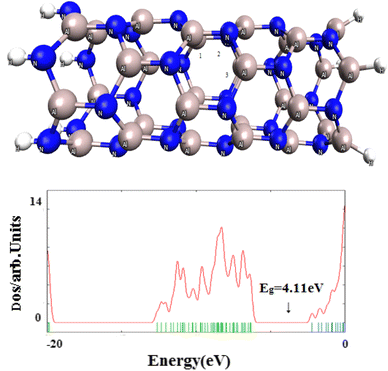
shows a partial structure of the optimized AlNNT and its DOS plot, indicating that it is considered as semiconductor with a HOMO/LUMO gap (
Eg
) of 4.11 eV. Two types of Al–N bonds can be found: one with the bond length of 1.81 Å (Al1–N2 bond, for example) and in parallel with the tube axis, and another with the bond length of 1.83 Å (N2–Al3 bond, for example), but not in parallel with the tube axis. Tomic et al. [
20
] have shown that the B3LYP provides an efficient and robust basis for the calculations of III–V semiconductors, capable of reliably predicting both the ground-state energies and the electronic structure. It has been already been shown that all zigzag AlNNTs are semiconductors [
21
] with
Eg
values ranging from 2.84 to 3.95 eV. It has also been shown that
Eg
slightly increases with increasing the diameter of the tube and saturates at a value corresponding to the gap of an AlN hexagonal sheet. The experimental value of
Eg
has been reported to be about 6.20 eV, which belongs to bulk AlN [
22
]. It is noteworthy to mention that DFT underestimates the
Eg
of semiconductors and molecules [
23
], and this aspect must be kept in mind during the following considerations.
Fig. 1
Partial structural model and density of states (DOSs) of the studied zigzag AlN nanotube
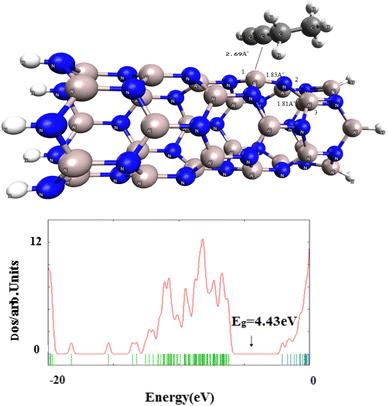
In order to determine the most stable structures for the adsorption of ethyl acetylene on the (5, 0) zigzag AlNNT, the structure was allowed to relax by all atomic geometrical parameters in the optimization at the DFT level of B3LYP exchange-functional and 6-31G (d) standard basis set (Fig.
2
).
Fig. 2
Ethyl acetylene adsorption on the AlNNT and DOS diagram for observing
Eg
of nanotube
The most stable configuration is shown in Fig.
2
, where the carbon atom of ethyl acetylene is 2.69 Å far from aluminum atom of the nanotube. Adsorption energy (
Ead
) for mentioned configuration of ethyl acetylene and nanotube is about −10.85 kcal/mol. This strong interaction means that the AlNNT is a suitable adsorbent for adsorption of ethyl acetylene molecule or separation of this gas from the environmental systems. We then calculated the HOMO/LUMO energy gap (
Eg
= 4.43 eV) for pristine nanotube since the ethyl acetylene molecule is adsorbed on the nanotubes. The diagram which shows
Eg
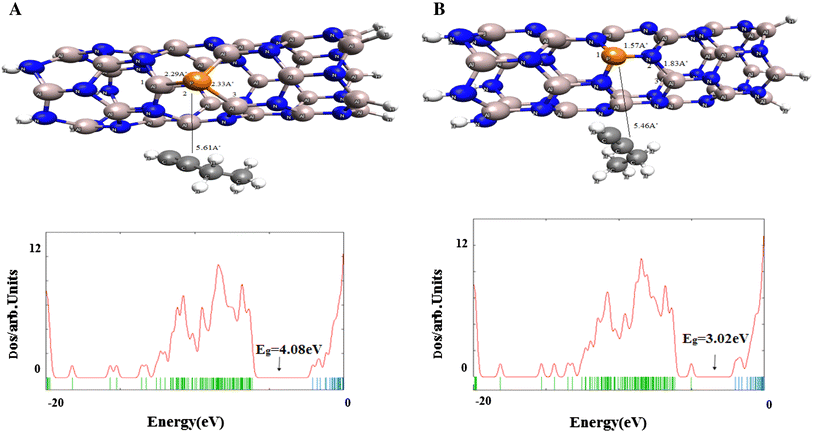
has been obtained using density of state (DOS) software. After adsorption of the ethyl acetylene molecule on the surface on AlNNT the bond length of Al1–N2 was 1.83 Å and the bond length of N2–Al3 was 1.81 Å. In the optimized complex nanotube and molecule, the Al1 atom is projected out of the surface nanotube to reduce stress on other atoms in nanotube. The sensitivity of the adsorption of ethyl acetylene on surface of AlNNT has been examined twice, once with N atom doped by P (Fig.
3
a) and in the other Al atom by P atom has been doped (Fig.
3
b).
Fig. 3
a
Ethyl acetylene adsorption on the AlNNT (N atom doped by P) and DOS diagram for observing
Eg
of nanotube.
b
Ethyl acetylene adsorption on the AlNNT (Al atom doped by P) and DOS diagram for observing
Eg
of nanotube
When N atom in AlNNT doped by P (Fig.
3
a) and ethyl acetylene closed on surface of AlNNT, the carbon atom of ethyl acetylene is 5.61 Å far from P atom of the nanotube. Adsorption energy (
Ead
) for mentioned configuration of ethyl acetylene and nanotube is about −10.64 kcal/mol and then we calculated the HOMO/LUMO energy gap (
Eg
= 4.08 eV) as shown in Table
1
. After adsorption the ethyl acetylene molecule on the surface on AlNNT the bond length of Al1–P2 was 2.29 Å and the bond length of P2–Al3 was 2.33 Å. In Fig.
3
b, Al atom in AlNNT doped by P and ethyl acetylene closed on surface of AlNNT, where the carbon atom of ethyl acetylene is 5.46 Å far from P atom of the nanotube. Adsorption energy (
Ead
) for mentioned configuration of ethyl acetylene and nanotube is about −8.05 kcal/mol and the
Eg
= 3.02 eV (Table
1
), the bond length of P1–N2 was 1.57 Å and the bond length of N2–Al3 was 1.83 Å. When P doped in AlNNT the adsorption energy range is −8.05 to −10.64 kcal/mol and this range is lower than pristine nanotube so the AlNNT doped by P is not better than pristine AlNNT for adsorption of ethyl acetylene molecule. However, these types of interactions are suitable for gas detection in sensors because according to Eq.
4
as long as adsorption energy (
Ead
) decreases, the recovery time (
τ
) becomes shorter and that is suitable for gas sensor.
τ=υ0-1exp-Ead/kT
where
T
is the temperature,
k
is the Boltzmann
’
s constant, and
υ0
is the attempt frequency. After adsorption of ethyl acetylene on the mentioned nanotube that has been doped by P, the HOMO/LUMO energy gap (
Eg
= 3.02–4.08 eV) will decrease the pristine nanotube (
Eg
= 4.43 eV) and therefore a substantial increase will occur in conductivity and this phenomenon can be explained as Eq. (
5
).
σ∝exp-Eg/2kT
where
σ
is conductance,
T
is temperature,
k
is Boltzmann constant. According to this equation as long as
Eg
is smaller, the conductivity will increase; therefore it can be concluded that if we want to use the AlNNT for ethyl acetylene toxic gas detection in environmental systems the P atom is suitable for doping in AlNNT.
Table 1
Calculated adsorption energy (
Ead
), HOMO energies (
EHOMO
), LUMO energies (
ELUMO
), HOMO–LUMO energy gap (
Eg
), hardness (
η
), and electrophilicity (
ω
) of systems,
Ead
(kcal/mol), eV for the others
SYSTEM
EHOMO
ELUMO
Eg
Ead
η
ω
AlNNT
−6.31
−2.21
4.11
–
2.05
4.43
C4H6 on AlNNT
−6.5
−2.07
4.43
−10.85
2.21
4.14
C4H6 on AlNNT (P/Al)
−5.01
−1.99
3.02
−8.05
1.51
4.05
C4H6 on AlNNT (P/N)
−6.16
2.08
4.08
−10.64
2.04
4.15
In order to consider the influence of ethyl acetylene adsorption on electronic properties of the AlNNT, the hardness (
η
) and electrophilicity (
ω
) of the complexes are analyzed. The results of Table
1
show that the ethyl acetylene adsorption on the AlNNT leads to lower hardness values than pristine AlNNT. Consequently, the stability of the complexes is lowered and their reactivity increased. The electrophilicity index is a measure of the electrophilic power of a molecule. When two molecules react with each other, one molecule behaves as a nucleophile, and the other as an electrophile. A higher electrophilicity index shows higher electrophilicity of a molecule. In ethyl acetylene adsorbed AlNNT the electrophilicity of the complexes is lower than that of the pristine forms. Therefore, adsorption of ethyl acetylene can increase the reactivity of the nanotubes.
Conclusions
DFT calculations were employed to investigate the adsorption of an ethyl acetylene molecule on the exterior resurface of AlNNT. On the basis of our calculations, it seems that pristine AlNNT can significantly detect ethyl acetylene and the pristine AlNNT can be a potential efficient adsorbent for adsorption of the ethyl acetylene from the environmental systems. When the AlNNT was doped by P atom the HOMO/LUMO energy gap (
Eg
) values and the adsorption energy (
Ead
) values were lower than pristine nanotube. Thus, AlNNT doped by P can potentially be used for ethyl acetylene toxic gas sensors for detection in environmental systems. These results may open new doors to expanding nano applications in industry and technology.
Acknowledgments
We are appreciative and thankful to the Islamic Azad University of Mahshahr in advance for to their financial support.
References
Iijima (1991) Helical microtubules of graphitic carbon (pp. 56-58) 10.1038/354056a0
Hummer (2007) Water, proton, and ion transport: from nanotubes to proteins (pp. 201-207) 10.1080/00268970601140784
Cabria et al. (2006) Density functional calculations of hydrogen adsorption on boron nanotubes and boron sheets (pp. 238-242) 10.1016/j.commatsci.2004.10.008
Tondare et al. (2002) Field emission from open ended aluminum nitride nanotubes (pp. 4813-4815) 10.1063/1.1482137
Balasubramanian et al. (2004) Scanning tunneling microscopy observation of coiled aluminum nitride nanotubes (pp. 188-191) 10.1016/j.cplett.2003.11.028
Stan et al. (2009) Elastic moduli of faceted aluminum nitride nanotubes measured by atomic force microscopy (pp. 35706-357014) 10.1088/0957-4484/20/3/035706
Ahmadi et al. (2012) Theoretical study of aluminum nitride nanotubes for chemical sensing of formaldehyde (pp. 1025-1029) 10.1016/j.snb.2011.12.001
Schmidt (1993) General atomic and molecular electronic structure system (pp. 1347-1363) 10.1002/jcc.540141112
Soltani et al. (2012) Ab initio investigation of the SCN- chemisorption of single-walled boron nitride nanotubes (pp. 9536-9543) 10.1016/j.apsusc.2012.05.109
Beheshtian et al. (2012) Functionalization of [60] fullerene with butadienes: a DFT study (pp. 8980-8984) 10.1016/j.apsusc.2012.05.134
Eid et al. (2012) DFT calculations of the CO adsorption on Mn, Fe, Co, and Au deposited at MgO (1 0 0) and CdO (1 0 0)10.1016/j.apsusc.2012.06.045
Eid and Ammar (2011) Adsorption of SO2 on Li atoms deposited on MgO (1 0 0) surface: DFT calculations (pp. 6049-6058) 10.1016/j.apsusc.2011.01.122
Eid and Ammar (2012) A density functional study of NO2 adsorption on perfect and defective MgO (1 0 0) and Li/MgO (1 0 0) surfaces (pp. 7689-7698) 10.1016/j.apsusc.2012.04.124
Chattaraj et al. (2006) Electrophilicity index (pp. 2065-2091) 10.1021/cr040109f
Hazarika et al. (2009) Molecular structure and density functional approach (pp. 1079-1085) 10.1007/s11224-009-9512-2
Parr et al. (1999) Electrophilicity index (pp. 1922-1924) 10.1021/ja983494x