Structural relationships and theoretical study of the free energies of electron transfer, electrochemical properties, and electron transfer kinetic of cephalosporin antibiotics derivatives with fullerenes in nanostructure of [R]·Cn (R = cefadroxil, cefepime, cephalexin, cefotaxime, cefoperazone and ceftriaxone) supramolecular complexes
Department of Organic Chemistry, Faculty of Chemistry, Razi University, Kermanshah, IR
Medical Biology Research Center, Kermanshah University of Medical Sciences, Kermanshah, IR
Chemistry Department, Faculty of Science, Islamic Azad University, Arak, IR
Department of Microbiology, Kurdistan University of Medical Sciences, Sanandaj, IR
Abstract
Various empty carbon fullerenes (C
n
) with different carbon atoms have been obtained and investigated.
Cephalosporin antibiotics and its derivatives have important medicinal properties. The β-lactam class of antibiotics has a broad spectrum of antimicrobial properties. Their antibacterial and pharmacokinetic properties have wide therapeutic applications. Topological indices have been successfully used to construct effective and useful mathematical methods to establish clear relationships between structural data and the physical properties of these materials. In this study, the number of carbon atoms in fullerenes was used as an index to establish a relationship between the structures of cefadroxil, cefepime, cephalexin, cefotaxime, cefoperazone and ceftriaxone (β-lactam antibiotics) and fullerenes (C
n
,
n
= 60, 70, 76, 82 and 86), which create [cefadroxil]·C
n
, [cefepime]·C
n
, [cephalexin]·C
n
, [cefotaxime]·C
n
, [cefoperazone]·C
n
and [ceftriaxone]·C
n
. The relationship between the number of fullerene carbon atoms and the free energies of electron transfer (Δ
Get(1)
–Δ
Get(4)
) are assessed using the Rehm-Weller equation for
A-1
to
A-5
,
B1
to
B-5
,
C-1
to
C-5
,
D-1
to
D-5
,
E-1
to
E-5
and
F-1
to
F-5
of the supramolecular complexes [R]·C
n
(where R = cefadroxil, cefepime, cephalexin, cefotaxime, cefoperazone and ceftriaxone) complexes. The calculations are presented for the four reduction potentials (
Red.E1
–
Red.E4
) of fullerenes C
n
. The results were used to calculate the four free energies of electron transfer (Δ
Get(1)
–Δ
Get(4)
) of the cephalosporin-fullerene supramolecular complexes
A-1
to
A-5
,
B1
to
B-5
,
C-1
to
C-5
,
D-1
to
D-5
,
E-1
to
E-5
and
F-1
to
F-5
for fullerenes C
60
–C
120
. The free energies of activation for electron transfer, Δ
Getn#
(
n
= 1–4) were also calculated for these complexes in accordance with the
Marcus
theory. In this study, was presented the calculated wavelengths (λ
(
n
)
;
n
= 1–4; in nm) of the photoelectron transfer process as well in the nanostructure complexes.
Introduction
Developments in nanoscience and nanotechnology have opened the field to tremendous theoretical and experimental advances in various fields, including biomedical sciences [
1
–
10
]. The pharmacokinetic properties of cephalosporin antibiotics are nearly identical [
11
–
13
]. Cephalosporins consist of a fused β-lactam-Δ
3
-dihydrothiazine two-ring system known as 7-aminocephalosporanic acid (7-ACA) and vary in their side chain substituents [
11
]. Cephalosporin derivatives vary in their resistance to β-lactamases. Despite relatively extensive knowledge of these drugs, their qualitative and quantitative analyses still give rise to many problems. These difficulties are due to the chemical instability of the common β-lactam nucleus and minor differences in the chemical structures of the analogs. These structures are classified into four generations based on their resistance to β-lactamase degradation. Cephalosporins have an added advantage in that the penicillin-allergic patients can be treated with these antibiotics [
11
–
14
]. Here, cefadroxil (1, first class), cefepime (2, fourth class), cephalexin (3, first class), cefotaxime (4, third class), cefoperazone (5, third class) and ceftriaxone (6, third class) were selected for the aims and viewpoints of this study.
Cefadroxil is a broad-spectrum bactericidal antibiotic of the cephalosporin type and is effective to treat Gram-positive and Gram-negative bacterial infections [
15
]. Cefadroxil is a first-generation cephalosporin antibacterial drug that is a para-hydroxy derivative of cephalexin, and it has been used similarly in the treatment of mild to moderate susceptible infections, such as the bacterium
Streptococcus pyogenes
, which causes strep throat. Cefadroxil is used as an antibiotic prophylaxis before dental procedures and can be used for treating infected wounds on animals [
15
].
Cefepime is a fourth-generation cephalosporin antibiotic developed in 1994. Cefepime has an extended spectrum of activity against Gram-positive and Gram-negative bacteria [
15
–
18
]. The combination of the syn-configuration of the methoxyimino moiety and the aminothiazolyl moiety confers extra stability to β-lactamase enzymes produced by many bacteria. These factors increase the activity of cefepime against otherwise resistant organisms, including
Pseudomonas aeruginosa
and
Staphylococcus aureus
[
15
–
18
].
Cephalexin is a first-generation cephalosporin antibiotic, introduced in 1967 by Eli Lilly and Company [
19
], and it has similar antimicrobial spectrum to the intravenous agents such as cefalotin and cefazolin. Cephalexin treats urinary tract infections, respiratory tract infections and skin and soft tissue infections. Cephalexin has been used to treat acne, and it is a useful alternative to penicillin derivatives in patients with penicillin hypersensitivity. Cephalexin and other first-generation cephalosporins are known to have a modest cross-allergy in patients with penicillin hypersensitivity [
11
–
15
,
19
].
Cefotaxime is a third-generation cephalosporin antibiotic. Like other third-generation cephalosporins, Cefotaxime has a broad spectrum of activity against Gram-positive and Gram-negative bacteria [
20
]. The stability of the β-lactamases increases the activity of cefotaxime against otherwise resistant Gram-negative organisms [
20
]. Cefotaxime is used to treat infections of the respiratory tract, skin, bones, joints, urogenital system, meningitis and septicemia. Cefotaxime is active against penicillin-resistant strains of
Streptococcus pneumoniae
and has modest activity against the anaerobic bacteria
Bacteroides fragilis
. Cefotaxime, like other β-lactam antibiotics, blocks the division of bacteria (including cyanobacteria), the division of cyanelles (the photosynthetic organelles of the glaucophytes) and the division of chloroplasts in bryophytes [
11
–
13
,
20
].
Cefoperazone is a third-generation cephalosporin antibiotic, marketed by Pfizer, and it is one of the few cephalosporin antibiotics effective in treating
Pseudomonas
bacterial infections which are otherwise resistant to these antibiotics [
11
–
13
,
21
]. Cefoperazone exerts its bactericidal effect by inhibiting bacterial cell wall synthesis, and sulbactam acts as a β-lactamase inhibitor to increase the antibacterial activity of cefoperazone against β–lactamase-producing organisms [
11
–
13
,
21
]. Cefoperazone contains an
N
-methylthiotetrazole (NMTT) side chain. As the antibiotic is broken down in the body, free NMTT is released, which can cause hypoprothrombinemia (likely due to the inhibition of the enzyme vitamin K epoxide reductase) and a reaction with ethanol similar to that produced by disulfiram (Antabuse) due to inhibition of aldehyde dehydrogenase [
11
–
13
,
21
].
Ceftriaxone is a third-generation cephalosporin antibiotic. Like other third-generation cephalosporins, ceftriaxone has a broad spectrum of activity against Gram-positive and Gram-negative bacteria. In most cases, ceftriaxone is considered to be equivalent to cefotaxime in terms of safety and efficacy [
11
–
15
,
22
]. Stability to β-lactamases increases the activity of ceftriaxone against otherwise resistant Gram-negative bacteria [
11
–
15
,
22
]. Ceftriaxone has also been investigated for efficacy in preventing relapse to cocaine addiction [
15
]. Ceftriaxone is often used (in combination, but not directly, with macrolide and/or aminoglycoside antibiotics) for the treatment of community-acquired or mild to moderate health care-associated pneumonia. Ceftriaxone is a choice drug for the treatment of bacterial meningitis [
11
–
15
,
22
].
The potential applications and physicochemical properties of fullerenes have been investigated. Various empty carbon fullerenes with different “
n
” numbers, such as C
60
, C
70
, C
76
, C
82
and C
86
, have been obtained. The chemical, physical and mechanical properties of empty, exo- and endo-hedral fullerenes have been the subject of many studies [
23
–
41
]. The compressive mechanical properties of fullerene molecules C
n
(
n
= 20, 60, 80 and 180) were investigated and discussed in detail using a quantum molecular dynamics (QMD) technique [
25
–
41
]. The unique stability of molecular allotropes, such as C
60
and C
70
, was demonstrated in 1985 [
23
,
25
]. This event led to the discovery of a whole new set of carbon-based substances known as fullerenes.
The electrochemical properties of the C
60
have been studied when these materials became available in macroscopic quantities [
26
–
31
]. In 1990, Haufler et al. [
32
] demonstrated that CH
2
Cl
2
electrochemically reduces C
60
to
C601-
and
C602-
. Xie et al. [
33
] cathodically reduced C
60
in six reversible one-electron steps for −0.97 V vs. Fc/Fc
+
(Fc = ferrocene). This result, along with the inability to perform anodic electrochemistry on fullerenes, revealed the electronic structure of fullerenes, the LUMO orbitals of C
60
can accept up to six electrons to form
C606-
, but the position of the HOMO orbitals does not allow for hole-doping under the usual reported electrochemical conditions. Jehoulet et al. [
34
] reported on the irreversible electrochemical and structural reorganization of solid fullerenes in acetonitrile. Janda et al. [
35
] improved upon the experimental conditions by investigating highly organized C
60
films on highly oriented pyrolytic graphite in an aqueous medium. The reduction of these films induces a morphological change; they re-structure into conductive nano-clusters of ~100 nm in diameter [
35
,
36
].
Graph theory has been a useful tool in assessing the quantitative structural activity relationship and quantitative structural property relationship [
42
–
53
]. A lot of studies in different areas have used topological indices [
42
–
50
]. Any extrapolation of results from one compound to other compounds must take into account considerations based on a QSAR study, which depends on how close the chemical properties are of the compounds in question. Effective mathematical methods must be employed to make good correlations between several properties of chemicals. Several applications of the indices have been reported [
42
–
53
]. The number of carbon atoms in the various fullerene structures was determined with these applications.
The Marcus theory builds on the Arrhenius equation for the rates of chemical reactions in two ways. A formula for the pre-exponential factor in the Arrhenius equation, based on the electronic coupling between the initial and final state of the electron transfer reaction (i.e., the overlap of the electronic wave functions of the two states), is provided. A formula for the activation energy, based on a parameter called the reorganization energy, and the Gibbs free energy is given. Although electrons are commonly described as residing in electron bands in bulk materials and electron orbitals in molecules, the following description will be described in molecular terms. When a photon excites a molecule, an electron in a ground state orbital can be excited to a higher energy orbital. This excited state leaves a vacancy in a ground state orbital that can be filled by an electron donor. An electron is produced in a high-energy orbital and can be donated to an electron acceptor. Photo-induced electron transfer is an electron transfer that occurs when certain photoactive materials interact with light, including semiconductors that can be photo-activated, such as many solar cells, biological systems like those used in photosynthesis, and small molecules with suitable absorptions and redox states [
54
–
62
].
The electron transfer process is one of the most important chemical processes in nature and plays a central role in many biological, physical and chemical systems. Solid-state electronics depends on the control of the electron transfer in semiconductors and the new area of molecular electronics depends critically on the understanding and control of the transfer of electrons between molecules and nanostructures. The other reason to study electron transfer is that it is a simple kind of chemical reaction, and by understanding it, one can gain insight into other kinds of chemistry and biochemistry. After all, what is important is the chemistry of the transfer of electrons from one place to another [
55
–
62
].
The free energy of electron transfer Δ
Get
is the difference between the reactants on the left and the products on the right, and Δ
Get#
is the activation energy [
55
–
62
].
The Marcus theory is currently the dominant theory of ET process in chemistry. The Marcus theory has widely accepted because it makes surprising predictions about electron transfer rates that have been supported experimentally over the last several decades. The most significant prediction is that the rate of electron transfer will increase as the electron transfer reaction becomes more exergonic, but only to a point [
55
–
62
]. Electron transfer happens in the chemical reactions. Is it any particular model and mechanism that works well in this case in analogy with many such models and mechanisms that work fine in material sciences [
63
–
69
].
Here, were calculated the first to fourth activation free energies of electron transfer Δ
Get(n)#
(
n
= 1–4) and the kinetic rate constants of the electron transfers
ket
(
n
= 1–4) using the Marcus theory and the equations on the basis of the first to fourth reduction potentials (
Red.E1
–
Red.E4
) of fullerenes C
n
(
n
= 60, 70, 76, 82 and 86) for the predicted supramolecular complexes [cefadroxil]·C
n7
–
11
and
37
–
40
; [cefepime]·C
n
,
12
–
16
and
41
–
44
; [cephalexin]·C
n
,
17
–
21
and
45
–
48
; [cefotaxime]·C
n
,
22
–
26
and
49
–
52
; [cefoperazone]·C
n
,
27
–
31
and
53
–
56
and [ceftriaxone]·C
n
,
32
–
36
and
57
–
60
(supramolecular complexes
7
–
60
). See Eqs.
2
and
3
, Tables
6
,
7
,
8
,
9
and
10
and Fig.
3
.
This study elaborates upon the relationship between the number of carbon atoms and the four free energies of electron transfer (Δ
Get(1)
–Δ
Get(4)
) of fullerenes C
n
(
n
= 60, 70, 76, 82 and 86) with cefadroxil, cefepime, cephalexin, cefotaxime, cefoperazone and ceftriaxone on the basis of the four reduction potentials (
Red.E1
–
Red.E4
) of the fullerenes.
The relationships are assessed by applying the Rehm-Weller equation [
54
] to create [cefadroxil]. C
n
,
A-1
to
A-5
; [cefepime]·C
n
,
B-1
to
B-5;
[cephalexin]·C
n
,
C-1
to
C-5;
[cefotaxime]·C
n
,
D-1
to
D-5
; [cefoperazone]·C
n
,
E-1
to
E-5
and [ceftriaxone]·C
n
,
F-1
to
F-5
. The results were extended to calculate the four free energies of electron transfer (Δ
Get(1)
–Δ
Get(4)
) of other supramolecular complexes of cefadroxil, cefepime, cephalexin, cefotaxime, cefoperazone and ceftriaxone as a class of electron-transfers with fullerenes C
60
–C
300
([cephalosporin antibiotics]·C
n
complexes: [cefadroxil]·C
n7
–
11
and
37
–
40
; [cefepime]·C
n
,
12
–
16
and
41
–
44
; [cephalexin]·C
n
,
17
–
21
and
45
–
48
; [cefotaxime]·C
n
,
22
–
26
and
49
–
52
; [cefoperazone]·C
n
,
27
–
31
and
53
–
56
and [ceftriaxone]·C
n
,
32
–
36
and
57
–
60,
supramolecular complexes
7
–
121
). This study calculated the four free energies of electron transfer (Δ
Get(1)
–Δ
Get(4)
) of
A-1
to
A-19
,
B-1
to
B-19
,
C-1
to
C-19
,
D-1
to
D-19
,
E-1
to
E-19
and
F-1
to
F-19
(see Eqs. 1–23, Tables
1
,
2
,
3
,
4
,
5
; Figs.
1
,
2
).
Table 1
The data values on the Cefadroxil
1
and the values of the 4 free energies of electron transfer (Δ
Get
), in kcal mol
−1
, between Cefadroxil and C
n
(as [Cefadroxil].C
n
;
7
–
11
and
37
–
40
) supramolecular complexes
No.
Row
Formula of [Cefadroxil]·Cn
(ΔGet) in kcal mol−1 [Cefadroxil]·Cn
ΔGet(1)
ΔGet(2)
ΔGet(3)
ΔGet(4)
7
A-1
[Cefadroxil].C60
51.70
60.80
71.08
81.71
8
A-2
[Cefadroxil].C70
50.35
59.40
67.93
77.80
9
A-3
[Cefadroxil].C76
47.28
55.87
65.79
75.09
10
A-4
[Cefadroxil].C82
42.53
50.33
63.48
72.11
11
A-5
[Cefadroxil].C86
38.41
45.51
61.84
69.96
37
A-6
[Cefadroxil].C78
45.89
54.25
65.04
74.13
38
A-7
[Cefadroxil].C84
40.56
48.03
62.67
71.05
39
A-8
[Cefadroxil].C96
24.84
29.55
57.38
64.07
40
A-9
[Cefadroxil].C120
−26.90
−31.60
44.61
46.81
Table 2
The data values on the Cefepime
2
and the values of the 4 free energies of electron transfer (Δ
Get
), in kcal mol
−1
, between Cefepime with C
n
(as [Cefepime]·C
n
,
12-16
and
41-44
) supramolecular complexes
No.
Row
Formula of [Cefepime]·Cn
(ΔGet) in kcal mol−1 [Cefepime]·Cn
ΔGet(1)
ΔGet(2)
ΔGet(3)
ΔGet(4)
12
B-1
[Cefepime].C60
50.80
59.90
70.18
80.81
13
B-2
[Cefepime].C70
49.45
58.50
67.03
76.90
14
B-3
[Cefepime].C76
46.38
54.97
64.89
74.19
15
B-4
[Cefepime].C82
41.63
49.43
62.58
71.21
16
B-5
[Cefepime].C86
37.51
44.61
60.94
69.06
41
B-6
[Cefepime].C78
44.99
53.35
64.14
73.23
42
B-7
[Cefepime].C84
39.66
47.13
61.77
70.15
43
B-8
[Cefepime].C96
23.94
28.65
56.48
63.17
44
B-9
[Cefepime].C120
−27.80
−32.50
43.71
45.91
Table 3
The data values on the Cephalexin
3
and the values of the 4 free energies of electron transfer (Δ
Get
), in kcal mol
−1
, between Cephalexin with C
n
(as [Cephalexin]·C
n
,
17–21
and
45–48
) supramolecular complexes
No.
Row
Formula of [Cephalexin]·Cn
(ΔGet) in kcal mol−1 [Cephalexin]·Cn
ΔGet(1)
ΔGet(2)
ΔGet(3)
ΔGet(4)
17
C-1
[Cephalexin].C60
38.90
47.14
57.96
68.61
18
C-2
[Cephalexin].C70
37.35
45.61
54.82
64.70
19
C-3
[Cephalexin].C76
34.26
41.99
52.69
61.99
20
C-4
[Cephalexin].C82
29.55
36.36
50.37
59.01
21
C-5
[Cephalexin].C86
25.51
31.47
48.72
56.86
45
C-6
[Cephalexin].C78
32.87
40.34
51.94
61.03
46
C-7
[Cephalexin].C84
27.62
34.03
49.56
57.95
47
C-8
[Cephalexin].C96
12.26
15.33
44.23
50.97
48
C-9
[Cephalexin].C120
−37.90
−46.34
31.32
33.71
Table 4
The data values on the Dodecahydro Cefotaxime
4
and the values of the 4 free energies of electron transfer (Δ
Get
), in kcal mol
−1
, between Cefotaxime with C
n
(as [Cefotaxime]·C
n
,
22-26
and
49-52
) supramolecular complexes
No.
Row
Formula of [Cefotaxime]·Cn
(ΔGet) in kcal mol−1 [Cefotaxime]·Cn
ΔGet(1)
ΔGet(2)
ΔGet(3)
ΔGet(4)
22
D-1
[Cefotaxime].C60
48.80
57.80
68.09
78.70
23
D-2
[Cefotaxime].C70
47.45
56.40
64.93
74.81
24
D-3
[Cefotaxime].C76
44.38
52.87
62.80
72.10
25
D-4
[Cefotaxime].C82
39.63
47.33
60.48
69.11
26
D-5
[Cefotaxime].C86
35.51
42.51
58.84
66.97
49
D-6
[Cefotaxime].C78
42.99
51.25
62.05
71.13
50
D-7
[Cefotaxime].C84
37.66
45.03
59.67
68.06
51
D-8
[Cefotaxime].C96
21.94
26.55
54.38
61.07
52
D-9
[Cefotaxime].C120
−29.80
−34.60
68.09
43.78
Table 5
The data values on the CFO
5
and ROC
6
and the values of the 4 free energies of electron transfer (Δ
Get
), in kcal mol
−1
, between CFO and ROC with C
n
(as [CFO]·C
n
,
27
–
31
and
53
–
56
and [ROC]·C
n
,
32
–
36
and
57
–
60
) supramolecular complexes
No.
Row
Formula of [CFO]·Cn
No.
Row
Formula of [ROC]·Cn
(ΔGet) in kcal mol−1 [CFO and ROC]·Cn
ΔGet(1)
ΔGet(2)
ΔGet(3)
ΔGet(4)
27
E-1
[CFO].C60
32
F-1
[ROC].C60
49.50
58.04
68.76
79.41
28
E-2
[CFO].C70
33
F-2
[ROC].C70
48.15
56.51
65.60
75.50
29
E-3
[CFO].C76
34
F-3
[ROC].C76
45.08
52.89
63.47
72.79
30
E-4
[CFO].C82
35
F-4
[ROC].C82
40.33
47.26
61.16
69.81
31
E-5
[CFO].C86
36
F-5
[ROC].C86
36.21
42.37
59.52
67.66
53
E-6
[CFO].C78
57
F-6
[ROC].C78
43.69
51.24
62.72
71.83
54
E-7
[CFO].C84
58
F-7
[ROC].C84
38.36
44.93
60.35
68.75
55
E-8
[CFO].C96
59
F-8
[ROC].C96
22.64
26.23
55.08
61.77
56
E-9
[CFO].C120
60
F-9
[ROC].C120
−29.10
−35.44
42.41
44.51
Table 6
The values of the first to forth free activation energies of electron transfer and the wavelengths of the photoelectron transfer process, Δ
Get(
n
)#
(in kcal mol
−1
,
n
-1-4) and
λet(n)
(nm,
n
= 1–4), respectively, of [Cefadroxil]·C
n
supramolecular complexes (
7
–
11
and
37
–
40
) supramolecular complexes
Id.
[Cefadroxil]·Cn
ΔGet(1)#
λet(1)
ΔGet(2)#
λet(2)
ΔGet(3)#
λet(3)
ΔGet(4)#
λet(4)
7
[Cefadroxil].C60
100.43
285
131.46
217
173.52
165
222.59
128
8
[Cefadroxil].C70
98.17
291
129.73
220
165.63
173
210.29
136
9
[Cefadroxil].C76
87.21
328
111.38
257
151.3
189
191.99
149
10
[Cefadroxil].C82
70.4
406
94.46
303
138.5
206
172.53
166
11
[Cefadroxil].C86
63.55
450
80.96
353
140.28
204
174.52
164
37
[Cefadroxil].C78
82.33
347
109.19
262
149.49
191
188.31
152
38
[Cefadroxil].C84
67.18
426
88.85
322
140.09
204
174.65
164
39
[Cefadroxil].C96
31.45
909
40.75
702
120.23
238
145.60
196
40
[Cefadroxil].C120
8.47
3,376
13.57
2,107
78.55
364
85.11
336
Table 7
The values of the first to forth free activation energies of electron transfer the wavelengths of the photoelectron transfer process, Δ
Get(
n
)#
(in kcal mol
−1
,
n
-1-4) and
λet(
n
)
(nm,
n
= 1–4), respectively, of [Cefepime]·C
n
supramolecular complexes (
12
–
16
and
41
–
44
) supramolecular complexes
Id.
[Cefepime]·Cn
ΔGet(1)#
λet(1)
ΔGet(2)#
λet(2)
ΔGet(3)#
λet(3)
ΔGet(4)#
λet(4)
12
[Cefepime].C60
97.42
293
127.97
223
169.55
169
218.09
131
13
[Cefepime].C70
95.19
300
126.26
226
161.76
177
205.92
139
14
[Cefepime].C76
84.4
339
108.2
264
147.59
194
187.81
152
15
[Cefepime].C82
67.88
421
91.53
312
134.95
212
168.57
170
16
[Cefepime].C86
61.16
467
78.26
365
136.72
209
170.54
168
41
[Cefepime].C78
79.66
359
106.12
269
145.88
196
184.27
155
42
[Cefepime].C84
64.77
441
86.07
332
136.6
209
170.76
167
43
[Cefepime].C96
29.81
959
38.88
735
117
244
142.04
201
44
[Cefepime].C120
9.35
3,058
14.68
1,948
75.94
377
82.39
347
Table 8
The values of the first to forth free activation energies of electron transfer and the wavelengths of the photoelectron transfer process, Δ
Getn#
(in kcal mol
−1
,
n
-1-4) and
λet(
n
)
(nm,
n
= 1–4), respectively, of [Cephalexin]·C
n
supramolecular complexes (
17
–
21
and
45
–
48
) supramolecular complexes
Id.
[Cephalexin]·Cn
ΔGet(1)#
λet(1)
ΔGet(2)#
λet(2)
ΔGet(3)#
λet(3)
ΔGet(4)#
λet(4)
17
[Cephalexin].C60
62.53
457
86.5
331
121.21
236
162.72
176
18
[Cephalexin].C70
59.98
477
85.1
336
114.63
249
152.23
188
19
[Cephalexin].C76
51.48
555
70.4
406
102.86
278
136.72
209
20
[Cephalexin].C82
38.75
738
57.06
501
92.26
310
120.38
238
21
[Cephalexin].C86
33.74
847
46.69
612
93.72
305
122.04
234
45
[Cephalexin].C78
48.02
595
66.58
429
101.39
282
133.77
214
46
[Cephalexin].C84
36.79
777
50.71
564
93.66
305
122.3
234
47
[Cephalexin].C96
12.51
2,285
16.34
1,750
77.44
369
98.20
291
48
[Cephalexin].C120
22.29
1,283
37.34
766
44.56
641
49.96
572
Table 9
The values of the first to forth free activation energies of electron transfer and the wavelengths of the photoelectron transfer process, Δ
Getn#
(in kcal mol
−1
,
n
-1-4) and
λet(n)
(nm,
n
= 1–4), respectively, of [Cefotaxime]·C
n
supramolecular complexes (
22
–
26
and
49
–
52
) supramolecular complexes
Id.
[Cefotaxime]·Cn
ΔGet1#
λet(1)
ΔGet2#
λet(2)
ΔGet3#
λet(3)
ΔGet4#
λet(4)
22
[Cefotaxime].C60
90.81
315
120.38
238
160.8
178
208.1
137
23
[Cefotaxime].C70
88.63
323
118.72
241
153.16
187
196.25
146
24
[Cefotaxime].C76
78.26
365
101.2
283
139.39
205
178.59
160
25
[Cefotaxime].C82
62.35
459
85.1
336
127.12
225
159.84
179
26
[Cefotaxime].C86
55.92
511
72.32
395
128.83
222
161.76
177
49
[Cefotaxime].C78
73.88
387
99.11
288
137.66
208
175.02
163
50
[Cefotaxime].C84
59.59
480
79.78
358
128.65
222
161.87
177
51
[Cefotaxime].C96
26.32
1,086
34.69
824
109.65
261
133.92
213
52
[Cefotaxime].C120
11.47
2,493
17.45
1,638
70.18
407
76.14
376
Table 10
The values of the first to forth free activation energies of electron transfer and the wavelengths of the photoelectron transfer process, Δ
Getn#
(in kcal mol
−1
,
n
-1-4) and
λet(
n
)
(nm,
n
= 1–4), respectively, of Cefoperazone]·C
n
(
27
–
31
and
53
–
56
) and [Ceftriaxone]·C
n
, (
32
–
36
and
57–60
) supramolecular complexes
Id.
[CFO]·Cn
Id.
[ROC]·Cn
ΔGet1#
λet(1)
ΔGet2#
λet(2)
ΔGet3#
λet(3)
ΔGet4#
λet(4)
27
[CFO].C60
32
[ROC].C60
92.99
307
122.88
233
163.69
175
211.44
135
28
[CFO].C70
33
[ROC].C70
90.81
315
121.21
236
155.99
183
199.45
143
29
[CFO].C76
34
[ROC].C76
80.28
356
103.53
276
142.08
201
181.64
157
30
[CFO].C82
35
[ROC].C82
64.16
446
87.21
328
129.73
220
162.72
176
31
[CFO].C86
36
[ROC].C86
57.66
496
74.26
385
131.46
217
164.66
174
53
[CFO].C78
57
[ROC].C78
75.89
377
99.09
289
140.28
204
178.05
161
54
[CFO].C84
58
[ROC].C84
61.38
466
79.48
360
131.19
218
164.79
174
55
[CFO].C96
59
[ROC].C96
27.52
1,039
34.07
839
112.07
255
136.60
209
56
[CFO].C120
60
[ROC].C120
10.71
2,670
18.63
1,535
72.27
396
78.26
365
Fig. 1
The conjectured structures of cefadroxil, cefepime, cephalexin, cefotaxime, cefoperazone (CFO) and ceftriaxone (ROC) as well as the fullerenes C
n
(
n
= 60, 70, 76, 82 and 86), which create [cefadroxil]·C
nA-1
to
A-5
; [cefepime]·C
n
,
B-1
to
B-5
; [cephalexin]·C
n
,
C-1
to
C-5;
[cefotaxime]·C
n
,
D-1
to
D-5
; [cefoperazone]·C
n
,
E-1
to
E-5
and [ceftriaxone]·C
n
,
F-1
to
F-5
Fig. 2
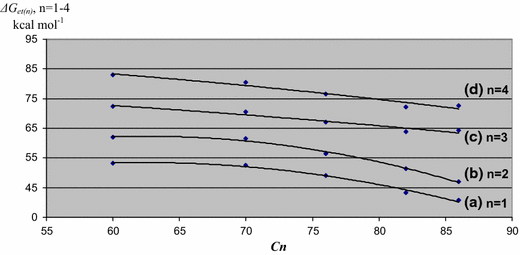
The relationship between the number of carbon atoms “n” of the fullerenes and the first (
a
) to fourth (
d
) of (Δ
Get(
n
)
,
n
= 1–4) in ET-process of [Cefadroxil]·C
n
(
n
= 60, 70, 76, 82 and 86), compounds
A-1
to
A-5 (7
–
11)
.
Asterisk
the related curves for [Cefepime]·C
n
,
B-1
to
B-5
, [Cephalexin]·C
n
,
C-1
to
C-5
, [Cefotaxime]@C
n
,
D-1
to
D-5
Cefoperazone]·C
n
,
E-1
to
E-5
and [Ceftriaxone]·C
n
,
F-1
to
F-5
have similar style to Fig. 2(
a
–
d
) [Cefadroxil]·C
nA-1
to
A-5
Also, in this study, were calculated the activate free energies of electron transfer and the maximum wave length of the electron transfers, Δ
Getn#
and
λet
, respectively, using Marcus theory and the equations on the basis of the oxidation potentials of fullerenes C
n
(
n
= 60, 70, 76, 82 and 86) to predict the data of the electron transfer process between the antibiotic compounds (cefadroxil, cefepime, cephalexin, cefotaxime, cefoperazone and ceftriaxone) and the fullerenes.
One of the aspects in this study was the relationship between the number of carbon atoms in the fullerenes C
n
(C
60,
C
70
, C
76
, C
82
and C
86
) and the data values on the electron transfer (Δ
Get
, in kcal mol
−1
) between the antibiotic compounds (cefadroxil, cefepime, cephalexin, cefotaxime, cefoperazone and ceftriaxone) with the fullerenes.
One of the other aspects of this study was the investigation of the photo-electron transfer process to find more medicinal activity conditions and properties for the antibiotics
1
–
6
in the presence of the selected fullerenes by performing the supramolecular complexes [antibiotics
1
–
6
]·C
n
.
Graphing and mathematical method
For the entire diagram operations were applied Microsoft Office Excel-2003. To investigate several properties of the fullerenes can be utilized the number of carbon atoms of the fullerenes. The values were applied to calculate Δ
Get(1)
–Δ
Get(4)
, according to the Rehm-Weller equation for the complexes [cefadroxil]·C
n7
–
11
and
37
–
40
; [cefepime]·C
n
,
12
–
16
and
41
–
44
; [cephalexin]·C
n
,
17
–
21
and
45
–
48
; [cefotaxime]·C
n
,
22
–
26
and
49
–
52
; [cefoperazone]·C
n
,
27
–
31
and
53
–
56
and [ceftriaxone]·C
n
,
32
–
36
and
57
–
60
(supramolecular complexes
7
–
60
).
The linear multiple linear regressions and nonlinear models have utilized in this study. The Eqs.
1
and 4–23 were applied to calculate the values of Δ
Get(1)
–Δ
Get(4)
for complexes that have not been reported in the literature. The best results and equations to extend the physicochemical data have chosen [
48
,
53
].
The free energy changes between an electron donor (
D
) and an acceptor (
A
) for the electron transfer (ET) were estimates by the Rehm-Weller equation:
ΔGo=e[EDo-EAo]-ΔE∗+ω1
In this equation, “
e
” is the unit electrical charge. The reduction potentials of the electron donor and acceptor were introduced as
ED0
and
EA0
, respectively. The value of Δ
E*
is the energy of the singlet or triplet excited state. The work required to bring the donor and acceptor to within the electron transfer (ET) distance has determined by
ω1
. The work term in this expression is zero if an electrostatic complex forms before the ET-process [
54
].
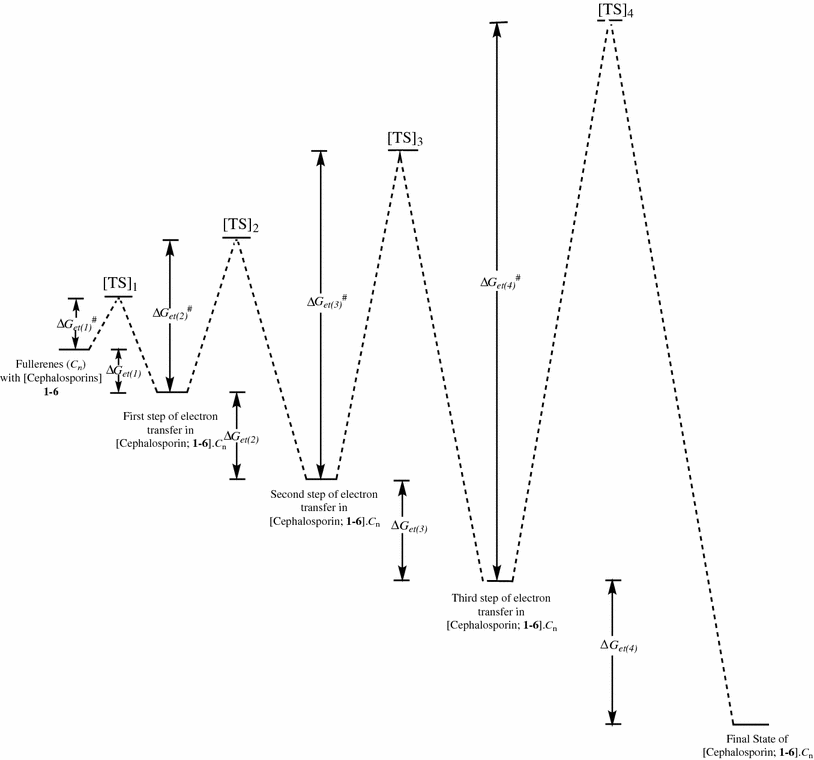
The Marcus theory of ET-process suggests rather weak electronic coupling between the initial (LE) and final (ET), locally excited and electron transfer states, respectively. The transition state (TS) is near to the crossing point of the LE and ET terms. The value of the ET rate constant is controlled by the Δ
Get#
, which is a function of the reorganization energy (RE; l/4) and the ET driving force, Δ
Get
:
ΔGet#=(l/4)(1+ΔGet/l)2,
The reorganization energy (RE) has defined as the energy required reorganizing the system structure from the initial to final coordinates without changing the electronic state. The RE was found to be in the range 0.1–0.3 eV for organic molecules. Here, the minimum amount of RE was used [
55
–
62
].
The Planck’s formula has applied to calculate the maximum wavelengths (
λ(
n
)
) of the electromagnetic photon for the ET-process in the selected nanostructure complexes:
ΔGet#=ΔE=h×c/λ(n).
In this study, has also used this formula to calculate the activation free energy of the ET-process [
63
,
69
,
70
].
Discussion
Cefadroxil is a first-generation cephalosporin and is effective against Gram-positive cocci. In 2000, the electro-oxidation of cefadroxil was investigated by Özkan et al. [
71
], and they used a glassy carbon electrode (GCE) for cyclic voltammetry (CV) and differential pulse voltammetry (DPV)
Cefepime was studied by electrochemical reduction and oxidation with a carbon electrode in an aqueous buffer solution of pH < 8.0 [
72
]. Electro-analysis of cefalexin was performed in a 0.1 M carbonate buffer (pH 9.2) using a boron-doped diamond thin-film electrodes for CV measurements [
73
].
Cefalexin was measured polarographically in pure form and in pharmaceutical preparations based on the catalytic hydrogen wave observed in the presence of cobalt (II) and the drug at a potential of −1.47 V versus SCE [
51
]. The electro-oxidation of cefalexin at boron-doped diamond electrodes and glassy carbon electrodes was investigated by CV [
75
].
In 2009, the electrochemical behavior of cefotaxime was studied using modified carbon paste electrode (Nigam et al. [
14
]). CV and DPV were used for the estimation of the drug using a modified carbon paste capillary as the working electrode [
53
]. Voltammograms were recorded in a potential window—0.2–1.1 V vs. Ag/AgCl at various scan rates and DPV with a pulse width 0.05 s [
76
].
Various concentrations of cefotaxime from 0.1 mM to 1 nM were analyzed in water and in acidified human blood samples (pH 2.3) [
76
].
Two cephalosporin antibiotic derivatives, cefoperazone and ceftriaxone, were studied with direct current, differential pulse polarography (DPP) and CV methods [
77
]. The electro-oxidation of both cephalosporin derivatives had studied at the carbon paste electrode (CPE). Both drugs gave rise to one oxidation peak at about +1.05 V vs. SCE [
77
].
The oxidation potentials of cefadroxil, cefepime, cephalexin, cefotaxime, cefoperazone and ceftriaxone, which have been previously reported [
71
–
78
] are as follows:
No.
Cephalosporin derivatives
Oxidation potential (OxE, in volts)
Reference number
1
Cefadroxil
+1.15
[71]
2
Cefepime
+0.97
[72, 73]
3
Cephalexin
+0.58
[74, 75]
4
Cefotaxime
+1.02
[76]
5
Cefoperazone
+1.05
[77]
6
Ceftriaxone
+1.05
[77]
The four reported reduction potentials (
Red.E1
–
Red.E4
) of fullerenes C
n
are as follows. For C
60
, the potentials
Red.E1
–
Red.E4
are −1.12, −1.50, −1.95 and −2.41 V, respectively [
79
]. The
Re
dEn
(
n
= 1–4) for C
70
are −1.09, −1.48, −1.87 and −2.30 V, respectively [
79
]. The values of
RedEn
(
n
= 1–4) for C
76
are −0.94, −1.26, −1.72 and −2.13 V, respectively [
79
]. The values of
RedEn
(
n
= 1–4) for C
82
are −0.69, −1.04, −1.58 and −1.94 V, respectively [
79
]. The
RedEn
(
n
= 1–4) for C
86
are −0.58, −0.85, −1.60 and −1.96 V, respectively [
79
]. C
180
and C
240
were not prepared or isolated along with the fullerenes have listed in Tables
1
,
2
,
3
,
4
.
Tables
1
,
2
,
3
,
4
and
5
contain a summary of the data. The calculated values for
6–1
of the four electron transfer free energies (Δ
Get(1)
–Δ
Get(4)
, in kcal mol
−1
) between the cephalosporin antibiotics
1
–
5
and fullerenes C
n
(
n
= 60, 70, 76, 82 and 86) as [cephalosporin antibiotics]·C
n
complexes are shown. These values were calculated using the Rehm-Weller equation (Eq.
1
). The selected cephalosporin antibiotics (
1
–
5
) were used to model the structural relationship between the number of carbon atoms (
n
) in the selected fullerenes and Δ
Get(n)
(
n
= 1–4). The data of compounds [cefadroxil]·C
n
,
A-1
to
A-19
; [cefepime]·C
n
,
B-1
to
B-19;
[cephalexin]·C
n
,
C-1
to
C-19;
[cefotaxime]·C
n
,
D-1
to
D-19
; [cefoperazone]·C
n
,
E-1
to
E-19
and [ceftriaxone]·C
n
,
F-1
to
F-19
(complexes
7
–
60
) are reported in the appropriate tables. Figure
1
depicts the structures of cefadroxil, cefepime, cephalexin, cefotaxime, cefoperazone and ceftriaxone as well as fullerenes C
n
(
n
= 60, 70, 76, 82 and 86). The fullerenes and cephalosporin antibiotics were combined to create [cefadroxil]·C
n
,
A-1
to
A-5
; [cefepime]·C
n
,
B-1
to
B-5;
[cephalexin]·C
n
,
C-1
to
C-5;
[cefotaxime]·C
n
,
D-1
to
D-5
; [cefoperazone]·C
n
,
E-1
to
E-5
and [ceftriaxone]·C
n
,
F-1
to
F-5
.
Figures
2
a, d have shown the relationships between the number of carbon atoms (
n
) in the fullerenes and the first to fourth free-energies of electron transfer (Δ
Get(1)
–Δ
Get(4)
) of [cefadroxil]·C
n
(
n
= 60, 70, 76, 82 and 86). Equations 4–7 correspond to Fig.
2
a, d. This data were fitted with a second-order polynomial equation. The R-squared values (
R2
) for these graphs are 0.9875, 0.9923, 0.9384 and 0.9478, respectively.
Equations 4–7 can be utilized to calculate the values of Δ
Get(1)
–Δ
Get(4)
of [cefadroxil]·C
n
. Table
1
contains the calculated values of the free energies of electron transfer (Δ
Get(
n
)
,
n
= 1–4) between the selected cefadroxil and C
n
(as [cefadroxil]·C
n
compounds
A-1
to
A-5
)
7
–
11
supramolecular complexes. The Δ
Get(
n
)
(
n
= 1–4) for [cefadroxil]·C
n
(C
60
, C
70
, C
76
, C
82
, C
86
, C
78
, C
84
and C
120
) are predicted using Eqs. 4–7 and the Rehm-Weller equation (see Table
1
).
Equations 8–11 have shown the relationships between the number of carbon atoms in the fullerenes and the first to fourth free energies of electron transfer (Δ
Get(1)
–Δ
Get(4)
) of [cefepime]·C
n
(
n
= selected fullerenes). These data were fitted with a second-order polynomial equation. The
R2
values for these graphs are 0.9875, 0.9924, 0.9384 and 0.9478, respectively.
Using Eqs.
1
and 8–11, the Δ
Get(1)
–Δ
Get(4)
values of [cefepime]. C
n
can be calculated. Table
2
involves the calculated values of the free energies of electron transfer (Δ
Get(
n
)
,
n
= 1–4) between cefepime and the C
n
(as [cefepime]·C
n
compounds
B-1
to
B-5
)
12–16
supramolecular complexes. The Δ
Get(
n
)
(
n
= 1–4) for [cefepime]·C
n
(C
60
, C
70
, C
76
, C
82
, C
86
, C
78
, C
84
and C
120
) have predicted using Eqs. 8–11 and the Rehm-Weller equation (see Table
2
).
The results of Rehm-Weller equation have demonstrated the free energies of electron transfer (Δ
Get(
n
)
,
n
= 1–4) between cephalexin and the selected fullerenes. Equations 12–15 have shown the relationships between the number of carbon atoms of the fullerenes and the first to fourth free energies of electron transfer of [cephalexin]·C
n
(
n
= 60, 70, 76, 82 and 86). These data were fit with a second-order polynomial. The
R2
values for these graphs are 0.9885, 0.9924, 0.9387 and 0.9478, respectively.
Using Eqs. 12–15, the values of Δ
Get(1)
–Δ
Get(4)
of [cephalexin].·C
n
can be calculated. Table
3
contains the calculated values of the free energies of electron transfer (Δ
Get(
n
)
,
n
= 1–4) between the cephalexin and the fullerenes (as [Cephalexin].·C
nC-1
to
C-5
)
17
–
21
supramolecular complexes. The ΔG
et(
n
)
(
n
= 1–4) for [cephalexin]. C
n
(C
60
, C
70
, C
76
, C
82
, C
86
, C
78
, C
84
and C
120
) are predicted using Eqs. 12–15 and the Rehm-Weller equation (see Table
3
).
Equations 16–19 have shown the relationships between the number of carbon atoms in the selected fullerenes and the Δ
Get(1)
–Δ
Get(4)
values of [cefotaxime].·C
n
(
n
= selected fullerenes). These data were fitted with a second-order polynomial equation. The
R2
values for these graphs are 0.9876, 0.9923, 0.9386 and 0.9476, respectively.
Using Eqs.
1
and 16–19, the values of Δ
Get(1)
–Δ
Get(4)
of [cefotaxime]·C
n
can be calculated. Table
4
contains the 76 calculated values of the free energies of electron transfer (Δ
Get(
n
)
,
n
= 1–4) between the cefotaxime and the fullerenes (as [cefotaxime]·C
n
, compounds
D-1
to
D-5
) 22–26 supramolecular complexes. The Δ
Get(
n
)
(
n
= 1–4) for [cefotaxime]·C
n
(C
60
, C
70
, C
76
, C
82
, C
86
, C
78
, C
84
and C
120
) are predicted using Eqs. 16–19 and the Rehm-Weller equation (see Table
4
).
Equations 20–23 demonstrate the relationships between the number of carbon atoms in the fullerenes and the first, second, third and fourth free-energies of electron transfer (Δ
Get(1)
–Δ
Get(4)
) of [cefoperazone]·C
n
and [ceftriaxone]·C
n
(
n
= 60, 70, 76, 82 and 86). These data were fitted with a second-order polynomial equation. The
R2
values for these graphs are: 0.9874, 0.9924, 0.9386 and 0.9478, respectively.
Using Eqs.
1
and 20–23, the values of Δ
Get(1)
to Δ
Get(4)
of [Cefoperazone]·C
n
and [Ceftriaxone]·C
n
can be calculated. Table
5
contains the calculated values of the free energies of electron transfer (Δ
Get(
n
)
,
n
= 1–4) between cefoperazone and ceftriaxone with the fullerenes (as [cefoperazone]·C
n
compounds
E-1
to
E-5
and [ceftriaxone]·C
n
compounds
F-1
to
F-5
)
27–31
and
32–36
complexes, respectively. The Δ
Get(
n
)
(
n
= 1–4) for [cefoperazone]·C
n
and [ceftriaxone]·C
n
(C
60
, C
70
, C
76
, C
82
, C
86
, C
78
, C
84
and C
120
) are predicted using Eqs. 8–11 and the Rehm-Weller equation (see Table
5
).
Equations 4–23
Equation No.
ΔGet(n) = a(n)2 + b(n) + c
4
ΔGet(1) = −0.0235(n)2 + 2.9201(n)−38.8596
5
ΔGet(2) = −0.0280 (n)2 + 3.4983(n) − 48.3526
6
ΔGet(3) = –0.0025 (n)2 + 0.0125(n) + 79.4105
7
ΔGet(4) = −0.0038 (n)2 + 0.1064(n) + 89.1088
8
ΔGet(1) = −0.0235(n)2 + 2.9201(n) − 39.7796
9
ΔGet(2) = −0.0280(n)2 + 3.4988(n) − 49.3125
10
ΔGet(3) = −0.0025(n)2 + 0.0125(n) + 78.4905
11
ΔGet(4) = −0.0038(n)2 + 0.1064(n) + 88.1888
12
ΔGet(1) = −0.0225(n)2 + 2.7732(n) − 46.2585
13
ΔGet(2) = −0.0281(n)2 + 3.5028(n) − 61.6624
14
ΔGet(3) = −0.0026(n)2 + 0.0259(n) + 65.7913
15
ΔGet(4) = −0.0038(n)2 + 0.1064(n) + 75.9688
16
ΔGet(1) = −0.0235(n)2 + 2.9197(n) − 41.8287
17
ΔGet(2) = −0.0280(n)2 + 3.4983(n) − 51.3526
18
ΔGet(3) = −0.0025(n)2 + 0.0076(n) + 76.6012
19
ΔGet(4) = −0.0039(n)2 + 0.1112(n) + 85.9282
20
ΔGet(1) = −0.0235(n)2 + 2.9196(n) − 41.1378
21
ΔGet(2) = −0.0281(n)2 + 3.5028(n) − 50.8224
22
ΔGet(3) = −0.0025(n)2 + 0.0036(n) + 77.4210
23
ΔGet(4) = −0.0038(n)2 + 0.1064(n) + 86.8088
By application of these results (Eqs. 4–23) and the Rehm-Weller equation, the electron transfer energies (Δ
Get(
n
)
,
n
= 1–4) of the complexes formed by the selected cephalosporin antibiotics and fullerenes (C
60
, C
70
, C
76
, C
82
, C
86
, C
78
, C
84
and C
120
) were approximated. The calculated values of the free electron transfer energies (Δ
Get(
n
)
,
n
= 1–4) for the selected [cephalosporin antibiotics
1
–
6
]·C
n
(
n
= 60, 70, 76, 82 and 86, compounds
7
–
60
) are shown in Tables
1
,
2
,
3
,
4
and
5
. The calculated and the predicted values agreed with good approximation. In lieu of increasing the number of carbons atoms (
n
) in the selected fullerene structures, the values of Δ
Get(
n
)
(
n
= 1–4) have decreased. Electron transfer (ET) appears to increase with the electron population in the
Cn
structures (see Tables
1
,
2
,
3
,
4
,
5
). These results may be related to the HOMO–LUMO gaps of the fullerenes. The tables have also shown that some of the Δ
Get(
n
)
(
n
= 1–4) values of the complexes are negative.
Tables
6
,
7
,
8
,
9
and
10
show the calculated values of the first to fourth free activation energies of electron transfer and the kinetic rate constants of the electron transfers by utilizing Eqs.
2
and
3
for
7
–
60
in accordance with the Marcus theory. Figure
3
shows the surfaces of the free energies of electron transfer between cefadroxil, cefepime, cephalexin, cefotaxime and cefoperazone and ceftriaxone and the fullerenes (
n
= 60, 70, 76, 82 and 86). The values of the first to fourth activated free energies of electron transfer for
7
–
60
increase with increasing Δ
Get(
n
)
and the number of carbon atoms in the complexes, while the kinetic rate constants of electron transfer decrease with increasing Δ
Get(
n
)
and Δ
Get(
n
)#
(
n
= 1–4) for
7
–
60
. The zero values mean that there was not any electron transfer process between those parts of the predicted complexes (see Tables
6
,
7
,
8
,
9
,
10
; Fig.
3
).
Fig. 3
The surfaces of the free energies of ET-process [Δ
Get
(n)
and Δ
Getn#
(
n
= 1–4)] between
1
and
6
and fullerenes in
7–60
complexes
By using Eq.
1
(Rehm-Weller equation), Eqs. 2 and 3 (Marcus theory) and Eqs. 4–23, the values of Δ
Get(
n
)
(
n
= 1–4), Δ
Getn#
and
λ(n)
(
n
= 1–4) were calculated for
7
–
60
. The values of the number of carbon atoms (n) show a good relationship with Δ
Get(
n
)
(
n
= 1–4), Δ
Getn#
and
ket(
n)
(
n
= 1–4) for all of the cephalosporin-fullerene complexes. Figure
3
shows the surfaces of the free energies of electron transfer Δ
Get(
n
)
and Δ
Getn#
(
n
= 1–4) between
1
and
5
and the fullerenes (C
60
, C
70
, C
76
, C
82
, C
86
, C
78
, C
84
and C
120
) for structures
7
–
60.
The free energies were calculated with Eqs. 1–23 and are shown in Tables
1
,
2
,
3
,
4
,
56
,
7
,
8
,
9
and
10
.
We determined the values of the maximum wavelengths (
λ(
n
)
;
n
= 1–4; in nm) for each stage of the electron transfer process in the nanostructure supramolecular complexes with
Planck’s
formula. Using this formula, was also determined the photonic energy of the electron transfer process. Most of the values were found in the UV (200–360 nm) range of the electromagnetic spectrum. The maximum wavelengths (
λ(
n
)
;
n
= 1–4) depended on the Δ
Getn#
value in each stage. The values of the maximum wavelengths (
λ(
n
)
;
n
= 1–4) were increased by decreasing the Δ
Getn#
value in each stage.
In this study, was investigated the photo-electron transfer process to find more medicinal activity properties for the cephalosporin antibiotics
1–6
in the presence of the selected fullerenes by performing the supramolecular complexes [cephalosporin antibiotics
1
–
6
]·C
n
. The cephalosporin–fullerene supramolecular complexes and the calculated values of Δ
Get(
n
)
, Δ
Getn#
and
λ(
n
)
(
n
= 1–4) corresponding to these complexes have not been reported before.
Conclusion
In this study, were shown the relationship between the number of carbon atoms and the four free energies of electron transfer (Δ
Get(1)
–Δ
Get(4)
) of fullerenes C
n
(
n
= 60, 70, 76, 82 and 86) with cefadroxil, cefepime, cephalexin, cefotaxime, cefoperazone and ceftriaxone on the basis of the four reduction potentials (
Red.E1
–
Red.E4
) of the fullerenes. The antibiotics
1
–
6
and fullerenes have important electron-transfer properties as the most well-known cephalosporin antibiotics (
β
-lactam class of antibiotics) and molecular conductors. The electrochemical data of the cephalosporin-fullerene complexes are reported here. These results include the four free energies of electron transfer (Δ
Get(1)
–Δ
Get(4)
), calculated using the Rehm-Weller equation, Δ
Getn#
and
λ(
n
)
(
n
= 1–4), using the Marcus theory. Using the number of carbon atoms in the fullerene molecules and the model equations, the structural relationships between the aforementioned physicochemical data can be derived. These equations allow one to calculate Δ
Get(
n
)
(
n
= 1–4), Δ
Getn#
and
λ(
n
)
(
n
= 1–4) for cephalosporin antibiotics
1
–
6
, as [cefadroxil]·C
n7
–
11
and
37
–
40
; [cefepime]·C
n
,
12
–
16
and
41
–
44
; [cephalexin]·C
n
,
17
–
21
and
45
–
48
; [cefotaxime]·C
n
,
22
–
26
and
49
–
52
; [cefoperazone]·C
n
,
27
–
31
and
53
–
56
and [ceftriaxone]·C
n
,
32
–
36
and
57
–
60
(supramolecular complexes
7
–
60
) of the fullerenes (C
60
, C
70
, C
76
, C
82
, C
86
, C
78
, C
84
and C
120
). One of the other aspects of this study was the investigation of the photo-electron transfer process to find more medicinal activity conditions and properties for the antibiotics
1–6
in the presence of the selected fullerenes by performing the supramolecular complexes [antibiotics
1–6
]·C
n
. The novel supramolecular complexes discussed have neither been synthesized nor reported before.
Acknowledgments
The corresponding author gratefully acknowledges his colleagues in the Chemistry Department of The University of New England (UNE)-Australia for their useful suggestions. The authors are grateful to the Medical Biology Research Center, Kermanshah University of Medical Sciences, Kermanshah, Iran and the Research and Computational Lab of Theoretical Chemistry and Nano Structures of Razi University Kermanshah-Iran for supporting this study.
References
Merkt et al. (1991) Energy spectra of two electrons in a harmonic quantum dot (pp. 7320-7323) 10.1103/PhysRevB.43.7320
Pfannkuche and Gerhardts (1991) Quantum-dot helium: effects of deviations from a parabolic confinement potential 44(23) (pp. 13132-13135) 10.1103/PhysRevB.44.13132
Takeda et al. (1998) Variational wave function for a two-electron quantum dot (pp. 145-149) 10.1016/S0921-4526(98)00461-X
Ezaki et al. (1997) Electronic structures in circular, elliptic, and triangular quantum dots 56(11) (pp. 6428-6431) 10.1103/PhysRevB.56.6428
Pfannkuche et al. (1993) Comparison of a Hartree, a Hartree-Fock, and an exact treatment of quantum-dot helium 47(4) (pp. 2244-2250) 10.1103/PhysRevB.47.2244
El-Shaboury et al. (2007) Analysis of cephalosporin antibiotics 45(1) (pp. 1-19) 10.1016/j.jpba.2007.06.002
Sweetman (2002) (pp. 161-179) Royal Pharmaceutical Society
Dollery (1999) (pp. 83-156) Churchill Livingstone
Nigamb et al. (2009) Trace analysis of cefotaxime at carbon paste electrode modified with novel schiff base Zn(II) complex (pp. 1426-1431) 10.1016/j.talanta.2008.09.026
Unknown ()
Yahav et al. (2007) Efficacy and safety of cefepime: a systematic review and meta-analysis 7(5) (pp. 338-348) 10.1016/S1473-3099(07)70109-3
Chapman and Perry (2003) Cefepime: a review of its use in the management of hospitalized patients with pneumonia 2(1) (pp. 75-107) 10.1007/BF03256641
Britta and Ralf (1997) β- lactam antibiotics inhibit chloroplast division in a moss (Physcomitrella patens) but not in tomato (Lycopersicon esculentum) (pp. 137-140) 10.1016/S0176-1617(97)80193-9
Stork et al. (2006) Antibiotics, antifungals, and antivirals McGraw-Hill
Bradley et al. (2009) Intravenous ceftriaxone and calcium in the neonate: assessing the risk for cardiopulmonary adverse events 123(4) (pp. e609-e613) 10.1542/peds.2008-3080
Kroto et al. (1985) C60: Buckminsterfullerene (pp. 162-163) 10.1038/318162a0
Kroto (1987) The stability of the fullerenes Cn, with n = 24, 28, 32, 36, 50, 60 and 70 (pp. 529-531) 10.1038/329529a0
Shen (2007) The compressive mechanical properties of Cn (n = 20, 60, 80, 180) and endohedral M@ C60 (M = Na, Al, Fe) fullerene molecules 105(17–18) (pp. 2405-2409) 10.1080/00268970701679467
Kimura et al. (2003) Evidence for substantial interaction between Gd ion and SWNT in (Gd@C82)@SWNT peapods revealed by STM studies (pp. 340-344) 10.1016/j.cplett.2003.08.049
Smith et al. (1998) Encapsulated C 60 in carbon nanotubes (pp. 323-324) 10.1038/24521
Miyake and Saito (2003) Electronic structure of C60-encapsulating semiconducting carbon nanotube (pp. 201-204) 10.1016/S0038-1098(02)00717-2
Zhang et al. (2003) Thermogravimetric analysis for the array of C60 molecules formed in single-wall carbon nanotube (pp. 680-683) 10.1016/S0009-2614(03)00036-8
Kavan et al. (2004) Electrochemical tuning of electronic structure of carbon nanotubes and fullerene peapods (pp. 1011-1019) 10.1016/j.carbon.2003.12.024
Sherigara et al. (2003) Electrocatalytic properties and sensor applications of fullerenes and carbon nanotubes (pp. 753-772) 10.1002/elan.200390094
Haufler et al. (1990) Efficient production of C60 (Buckminsterfullerene), C60H36, and the solvated buckide ion (pp. 8634-8636) 10.1021/j100387a005
Xie et al. (1992) Electrochemical detection of C606− and C706−: enhanced stability of fullerides in solution (pp. 3978-3980) 10.1021/ja00036a056
Jehoulet et al. (1992) Electrochemistry and Langmuir trough studies of fullerene C60 and C70 films 114(11) (pp. 4237-4247) 10.1021/ja00037a030
Touzik et al. (2002) Nanostructuring of potassium fulleride layers (pp. 411-417) 10.1209/epl/i2002-00279-7
Tsuchiya et al. (2001) Unsaturated thiacrown ethers: synthesis, physical properties, and formation of a silver complex 123(47) (pp. 11534-11538) 10.1021/ja0102742
Tsuchiya et al. (2006) Supramolecular complexes of La@C82 with unsaturated thiocrown ethers (pp. 3585-3587) 10.1039/b606183d
Anderson et al. (2000) Making connection between fullerenes and metallofullerenes (pp. 1663-1670) 10.1016/S0008-6223(00)00089-0
Taherpour (2008) Quantitative relationship study of mechanical structure properties of empty fullerenes (pp. 196-205) 10.1080/15363830802045657
Taherpour and Lajevardi (2011) structural relationships and theoretical study of free energies of electron transfer, electrochemical properties, and electron transfer kinetic of p-phenylenediamine derivatives with fullerenes in nanostructure [R]·Cn (R = TMPD, DHDMP, TMDAD and DHDAP) supramolecular complexes (pp. 5482-5498)
Taherpour (2010) Theoretical and quantitative structural relationship studies of electrochemical properties of the nanostructures of cis-unsaturated thiocrown ethers and their supramolecular complexes [X-UTY][M@C82] (M = Ce, Gd) (pp. 422-432) 10.1080/10426500902812415
Du et al. (2002) Orthogonalization of block variables by subspace-projection for quantitative structure property relationship (QSPR) research (pp. 993-1003) 10.1021/ci020283+
Randić (1975) Characterization of molecular branching (pp. 6609-6615) 10.1021/ja00856a001
Bolboaca and Jantschi (2007) How good can the characteristic polynomial be for correlations? (pp. 335-345) 10.3390/i8040335
Slanina et al. (2001) Geometrical and thermodynamic approaches to the relative stabilities of fullerene isomers (pp. 335-348)
Taherpour and Shafiei (2005) The structural relationship between Randic’ indices, adjacency matrixes, distance matrixes and maximum wave length of linear simple conjugated polyene compounds (pp. 183-188) 10.1016/j.theochem.2005.03.053
Taherpour (2009) Structural relationship between degree of unsaturation with fermi energy, chemical hardness, and theHOMO-LUMOgap of (5,5) armchair single-walled carbon nanotubes 17(1) (pp. 26-37) 10.1080/15363830802515873
Taherpour (2009) Quantitative structural relationship and theoretical study of electrochemical properties of C60@[SWCNT(5,5)-armchair-CnH20] complexes (pp. 135-139) 10.1016/j.cplett.2008.12.039
Taherpour (2009) Theoretical and quantitative structural relationship study of the electrochemical properties of [M2@Cx]@[SWCNT(5,5)-armchair-CnH20] (M = Er and Sc, x = 82 and 84, and n = 20–300) complexes 113(14) (pp. 5402-5408) 10.1021/jp8096617
Slanina et al. (1997) On applicability of the Wiener index to estimate relative stabilities of the higher-fullerene IPR isomers 62(3) (pp. 211-217)
Plavšić et al. (1993) On the Harary index for the characterization of chemical graphs (pp. 235-250) 10.1007/BF01164638
Rehm and Weller (1970) Kinetics of fluorescence quenching by electron and H-atom transfer (pp. 259-271) 10.1002/ijch.197000029
Marcus (1993) Electron transfer reactions in chemistry. Theory and experiment10.1103/RevModPhys.65.599
Unknown ()
Barbara et al. (1996) Contemporary issues in electron transfer research 100(31) (pp. 13148-13168) 10.1021/jp9605663
Newton (1991) Quantum chemical probes of electron-transfer kinetics: the nature of donor-acceptor interactions 91(5) (pp. 767-792) 10.1021/cr00005a007
Freed and Jortner (1970) Multiphonon processes in the nonradiative decay of large molecules (pp. 6272-6291) 10.1063/1.1672938
Marcus (1965) On the theory of electron-transfer reactions. VI. Unified treatment for homogeneous and electrode reactions (pp. 679-701) 10.1063/1.1696792
Marcus and Sutin (1985) Electron transfers in chemistry and biology 811(3) (pp. 265-322) 10.1016/0304-4173(85)90014-X
Unknown ()
Adamowski et al. (2000) Electron pair in a Gaussian confining potential 62(7) (pp. 4234-4237) 10.1103/PhysRevB.62.4234
De Filippo and Salerno (2000) Spectral properties of a model potential for quantum dots with smooth boundaries 62(7) (pp. 4230-4233) 10.1103/PhysRevB.62.4230
Ciftja (2013) Calculation of the Coulomb electrostatic potential created by a uniformly charged square on its plane: exact mathematical formulas 71(2) (pp. 102-108) 10.1016/j.elstat.2012.12.003
Stopa (1996) Quantum dot self-consistent electronic structure and the Coulomb blockade 54(19) (pp. 13767-13783) 10.1103/PhysRevB.54.13767
Ciftja (2007) An experimentally justified confining potential for electrons in two-dimensional semiconductor quantum dots (pp. 37-44) 10.1007/s10820-006-9035-8
Bruce and Maksym (2000) Quantum states of interacting electrons in a real quantum dot 61(7) (pp. 4718-4726) 10.1103/PhysRevB.61.4718
Unknown ()
Atkins (1998) Oxford University Press
Özkan et al. (2000) Study on electrooxidation of cefadroxil monohydrate and its determination by differential pulse voltammetry (pp. 263-273) 10.1016/S0731-7085(00)00294-6
Özkan et al. (2002) Electrochemical reduction and oxidation of the antibiotic cefepim on a carbon electrode (pp. 265-274) 10.1016/S0003-2670(02)00022-3
Chailapakul et al. (2001) Electroanalysis of glutathione and cephalexin using the boron-doped diamond thin-film electrode applied to flow injection analysis (pp. i419-i422)
Devi et al. (1994) Polarographic determination of cephalosporins in pure form and in pharmaceutical preparations 56(2) (pp. 64-66)
Chailapakul et al. (2001) The electrooxidation of sulfur-containing compounds at boron-doped diamond electrode (pp. 193-201) 10.1016/S0925-4005(01)00912-1
Nigam et al. (2009) Trace analysis of cefotaxime at carbon paste electrode modified with novel Schiff base Zn(II) complex 77(4) (pp. 1426-1431) 10.1016/j.talanta.2008.09.026
Abo El-Maali et al. (1993) Electrochemical reduction and oxidation of two cephalosporin antibiotics; Ceftriaxone (Rocephine) and Cefoperazone (Cefobid) (pp. 599-604) 10.1002/elan.1140050712
Abo El-Maali et al. (1995) Cephalosporin antibiotics at bare and modified carbon paste electrodes in both aqueous and biological media (pp. 91-97) 10.1016/0302-4598(95)01822-V