Efficient one-pot four-component synthesis of 1,4-dihydropyridines promoted by magnetite/chitosan as a magnetically recyclable heterogeneous nanocatalyst
Catalysts and Organic Synthesis Research Laboratory, Department of Chemistry, Iran University of Science and Technology, Tehran, 16846-13114, IR
Abstract
1,4-Dihydropyridines are synthesized from various aromatic aldehyde, dimedone or 1,3-cyclohexandione, ethyl acetoacetate or methyl acetoacetate and ammonium acetate catalyzed by magnetite/chitosan at room temperature under mild reaction conditions. This process offers an easy and efficient synthesis of 1,4-dihydropyridine derivatives in high yields. The benefits of this protocol are simplicity, nontoxicity, low cost, simple work-up, and an environmentally benign nature. The catalyst is recovered by filtration and reused at least five times without significant loss in catalytic activity.
Introduction
In recent years, applying heterogeneous catalysts in organic synthesis is become popular because they are removable from the reaction media by simple filtration and reusable. In addition, to achieve high activity in heterogeneous catalysts, composite nanoparticles are the logical strategy because of a large surface to volume ratio, thus increasing catalytic activity. Furthermore, magnetic nanoparticles, especially supported magnetic nanocatalysts, have attracted considerable interest in both academic and industrial researches because they are viable alternatives to conventional materials, readily available, simple separation by an external magnet and high degree of chemical stability in various organic and inorganic solvents [
1
–
10
].
Dihydropyridines are privileged heterocyclic ring systems because of their broad and significant pharmacological properties and they are also analogues of NADH coenzymes. 1,4-Dihydropyridine derivatives have applications as calcium channel blockers for the treatment of cardiovascular diseases including hypertension. They are also used as antidiabetic agents, anti-tumor, geroprotective, anti-therosclerotic, and bronchodilator [
11
–
14
]. The first molecules of 1,4-dihydropyridines were reported by Hantzch in 1882. It is a one-pot four component synthesis of 1,4-dihydropyridine by two molecules of ethyl acetoacetate, aldehyde and ammonia. This procedure does not need any additives and the reaction was done either at reflux in alcohol or in acetic acid; furthermore, the reaction suffer from long reaction times and low-yields of products [
15
]. Due to significance of dihydropyridine derivatives in the synthesis of various class of drugs several synthesis procedures have been presented such as use of microwaves [
16
,
17
], high temperature at reflux [
18
–
22
], ionic liquid [
23
], SiO
2
/HClO
4
[
24
], SiO
2
/NaHSO
4
[
25
], I
2
[
26
], Bakers
’
yeast [
27
], metal triflates [
28
], tetrabutylammonium hydrogen sulfate [
29
], organocatalysts [
30
], PTSA [
31
], iron trifluoroacetate [
32
], TMSCl [
33
] and Ni nanoparticles [
34
].
Some of the above-mentioned methods for the synthesis of 1,4-dihydropyridine derivatives have one or more negative points such as expensive reagents, tedious work-up, moisture sensitive, toxic and harsh reaction conditions, thus developing an efficient protocol with a powerful catalyst for the synthesis of 1,4-dihydropyridine is still of prime importance. On the other hand, catalysis is a key part of green chemistry, and one of the fundamental needed challenges facing chemists now is to design and apply of eco-friendly catalysts [
35
–
38
]. A stable and green catalyst is defined as low preparation cost, high activity, great selectivity, high stability, efficient recovery, and good recyclability [
39
].
In continuation of our recent works to applying heterogeneous nanocatalysts in organic synthesis [
40
–
44
], herein, we wish to report Fe
3
O
4
@chitosan as a green heterogeneous catalyst for the synthesis of 1,4-dihydropyridine derivatives
4a
–
4ai
via a one-pot four-component Hantzsch condensation reaction using various aromatic aldehyde (1) 5,5-dimethyl-1,3-cyclohexanedione (dimedone) or 1,3-cyclohexandione (2) ethyl acetoacetate or methyl acetoacetate (3) and ammonium acetate in ethanol in good to excellent yields at room temperature (Scheme
1
). The main advantages of this protocol are using ethanol as a green solvent, inexpensive catalyst and easy preparation, mild reaction conditions, high yields, easy work-up, simple filtration and ability of reusing catalyst.
Scheme 1
One-pot four-component reaction synthesis of 1,4-dihydropyridine derivatives
4a
–
4ai
Experimental
General
All solvents, chemicals and reagents were purchased from Merck, Fluka and Aldrich. Melting points were measured on an Electrothermal 9100 apparatus and are uncorrected. The scanning electron microscopy (SEM) images were obtained on a Seron AIS 2100. Fourier transform infrared (FT–IR) spectra were recorded using Perkin-Elmer spectrometer; using pellets of the nanomaterials diluted with KBr. The
1
H NMR spectra were recorded on Bruker DRX-300 Avance spectrometer at 300.13 MHz. The elemental analyses were performed with an Elementar Analysensysteme GmbH VarioEL.
Preparation of Fe3O4@chitosan nanocomposite
First, 1 g of chitosan powder was added into a 100 mL of 0.1 M acetic acid and the mixture was stirred to form a 1 % (w/v) clear chitosan solution. Then, the homogeneous solution was filtered through a synthetic cloth to remove any undissolved materials and degassed by keeping the solution into vacuum oven for 3 h to remove the trapped air bubbles. After that, 2 mL of glycolic acid and calculated amount of Fe
3
O
4
nanoparticles [black powder, average particle size 30 nm (TEM), purity 99 % and specific surface area 55 m
2
/g] were dispersed in the chitosan solution by stirring at room temperature and then it was sonicated for 1 h. The resulting solution was stirred overnight at room temperature. After that, the resulted gel separated from the reaction mixture by a permanent magnet, washed several times with EtOH, and dried on a ceramic plate at room temperature during 48 h to obtain the chitosan-supported magnetite nanoparticles.
Synthesis of dihydropyridine derivatives
A mixture of an aldehyde (1.0 mmol), dimedone or 1,3-cyclohexanedione (1.0 mmol), ethyl acetoacetate or methyl acetoacetate (1.0 mmol) and ammonium acetate (1.0 mmol) in 5 mL of EtOH was stirred at room temperature in the presence of a catalytic amount of Fe
3
O
4
@chitosan (0.03 g) for the appropriate times to obtain dihydropyridines derivatives. After completion of the reaction, as indicated by thin layer chromatography (TLC) (
n
-hexane/ethyl acetate 3/1), the catalyst was separated magnetically from the reaction mixture, washed with ethanol, and used for subsequent reactions after drying. Pure dihydropyridines
4a
–
4ai
was afforded by evaporation of the solvent, followed by recrystallization from EtOH.
The Fe
3
O
4
@chitosan nanocatalyst was first prepared by a sol–gel method modified in our previous reports [
42
]. Then, it was characterized by SEM analysis. The particle size was studied by SEM and the identification of Fe
3
O
4
@chitosan morphology was based on the analysis of SEM images. The obtained SEM images of nanoparticles clearly showed that Fe
3
O
4
nanoparticles were properly supported on chitosan.
To optimize the reaction conditions, we checked the four-component condensation reaction of dimedone (1 mmol), ethyl acetoacetate (1 mmol), 4-chlorobenzaldehyde (1 mmol) and ammonium acetate (1 mmol) in the presence of different catalytic amounts of Fe
3
O
4
@chitosan at room temperature in 5 mL of EtOH, as a model reaction. It was found that 0.03 g of catalyst was enough to catalyze the reaction to produce high yields of dihydropyridines derivatives. As shown in Table
1
(Entries 1–4), using 0.03 g of the catalyst was enough to progress the reaction and an increment of the catalyst amount did not improve the yields. In the second stage the effect of solvent was studied. As can be seen from Table
1
(Entries 5–9), it was found that EtOH is the best solvent for this reaction to produce high yields in short reaction time in comparison with other polar, non-polar, protic and aprotic solvents.
Table 1
Optimization of the reaction conditions in the model reaction
Entry
Catalyst
Amount of catalyst (g)
Solvent
Time (min)
Yielda (%)
1
Fe3O4@chitosan
0.01
EtOH
180
Trace
2
Fe3O4@chitosan
0.02
EtOH
120
51
3
Fe3O4@chitosan
0.03
EtOH
70
90
4
Fe3O4@chitosan
0.04
EtOH
70
90
5
Fe3O4@chitosan
0.03
MeOH
70
74
6
Fe3O4@chitosan
0.03
EtOAc
75
79
7
Fe3O4@chitosan
0.03
CH2Cl2
70
82
8
Fe3O4@chitosan
0.03
CH3CN
70
87
9
Fe3O4@chitosan
0.03
n-hexane
140
Trace
10
Fe3O4
0.03
EtOH
120
Trace
11
chitosan
0.03
EtOH
120
Trace
12
–
–
EtOH
150
Trace
To study the generality of this method, different types of starting material were reacted in the synthesis of 1,4-dihydropyridines. As illustrated in Table
2
, aromatic aldehyde with both electron withdrawing groups and electron donating groups react well to give the products in good to excellent yields. As it predicted starting from aldehyde with electron withdrawing groups (such as nitro group) the condensation reaction occurs in the lower time in comparison with electron donating groups (such as alkoxyl group).
Table 2
Synthesis of dihydropyridine derivatives
4a
–
4ai
in the presence of Fe
3
O
4
@chitosan
Entry
Product
Time (min)
Yield (%)a
Mp (°C)
Observed
Reported
1
60
95
207–209
207–209 [45]
2
70
90
242–244
243–245 [46]
3
75
88
235–236
234–236 [47]
4
80
92
258–260
258–260 [48]
5
85
93.5
257–259
258–259 [49]
6
40
93
255
247–249 [47]
7
50
87
257–258
255–257 [46]
8
30
90
245–246
243–245 [50]
9
130
93
233–235
233–235 [45]
10
50
92.5
175–176
174–176 [34]
11
60
95
212–214
204–206 [51]
12
55
89
196–198
201–203 [49]
13
90
91
245–248
244–246 [52]
14
54
90.5
235–237
237–238 [23]
15
90
92
249–250
252 [53]
16
75
95
236
235–237 [54]
17
70
90
236–237
236.6–237 [55]
18
140
84
186–188
188–189 [56]
19
90
92
189–191
193–195 [26]
20
78
96
293
288–290 [53]
21
82
96
256–258
257–259 [47]
22
87
97
272–273
271–273 [56]
23
43
87
254–256
252–254 [57]
24
76
89
263–265
263–264 [58]
25
33
91
248–250
250–252 [57]
26
135
86
256–258
258 [59]
27
55
91
221–223
223–224 [57]
28
58
87
215–217
219–221 [55]
29
89
97
233–234
238–240 [57]
30
85
98
250–252
248–251 [53]
31
80
96
250–252
256–257 [53]
32
73
91
216
221–223 [52]
33
85
86
208–211
208–211 [52]
34
91
97
237–239
238–240 [57]
35
85
93
222–224
223–225 [45]
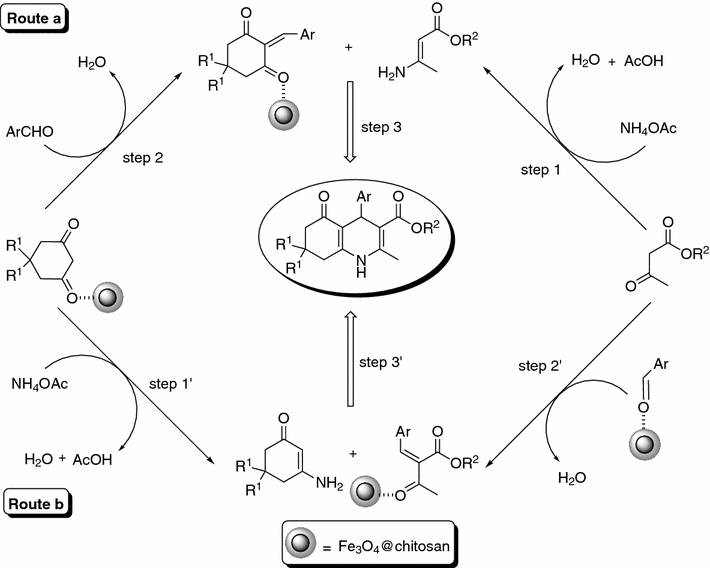
As shown in Scheme
2
, the proposed mechanism of this reaction could be in two forms. In step 2 and 2′ which are Knoevenagel reaction involves coupling of aldehyde with active methylene compound. Furthermore, in step 3 and 3′ a Michael addition of intermediates gives the target products.
Scheme 2
Two proposed mechanistic routes of the reaction
In addition, the reusability of this heterogeneous nanocatalyst is one of its important plus point and also this potency leads us to use it in commercial and industrial applications. One of the natural ability of this heterogeneous catalyst that makes it special is easy separation from the reaction media by an external magnetic bar. By washing with acetone or ethanol and drying it at room temperature it can be reused several times. As indicated in Table
3
, the reusability of the present composite nanocatalyst is examined in the model reaction.
Table 3
Reusability studies of the nanocatalyst on the model reaction
Run
Fresh
1
2
3
4
5
Isolated yield (%)
90
90
90
89
89
87
Conclusion
In summary, Fe
3
O
4
@chitosan was prepared and used as a green, magnetically recyclable and efficient composite nanocatalyst for the synthesis of chemically and biologically important dihydropyridine derivatives by a simple, clean, eco-friendly and inexpensive method. This protocol can be applied in large-scale and industrial synthesis of heterocyclic compounds, because it can be simple recovered and reused several times without significant decreasing in its catalytic activity.
Acknowledgments
The authors gratefully acknowledge the partial support from the Research Council of the Iran University of Science and Technology.
References
Gawande et al. (2013) The rise of magnetically recyclable nanocatalysts (pp. 3371-3393) 10.1039/c3cs35480f
Gawande et al. (2013) Nano-magnetite (Fe3O4) as a support for recyclable catalysts in the development of sustainable methodologies (pp. 3371-3393) 10.1039/c3cs35480f
Wang and Astruc (2014) Fast-growing field of magnetically recyclable nanocatalysts (pp. 6949-6985) 10.1021/cr500134h
Kainz et al. (2014) Palladium nanoparticles supported on magnetic carbon-coated cobalt nanobeads: highly active and recyclable catalysts for alkene hydrogenation (pp. 2020-2027) 10.1002/adfm.201303277
Shelke et al. (2014) Iron oxide-supported copper oxide nanoparticles (Nanocat-Fe-CuO): magnetically recyclable catalysts for the synthesis of pyrazole derivatives, 4-methoxyaniline, and Ullmann-type condensation reactions (pp. 1699-1706) 10.1021/sc500160f
Sá et al. (2014) Magnetically recyclable magnetite–palladium (Nanocat-Fe–Pd) nanocatalyst for the Buchwald-Hartwig reaction (pp. 3494-3500) 10.1039/c4gc00558a
Gawande et al. (2013) Magnetite-supported sulfonic acid: a retrievable nanocatalyst for the Ritter reaction and multicomponent reactions (pp. 1895-1899) 10.1039/c3gc40457a
Shokouhimehr et al. (2007) A magnetically recyclable nanocomposite catalyst for olefin epoxidation (pp. 7039-7043) 10.1002/anie.200702386
Shirini and Abedini (2013) Application of nanocatalysts in multi-component reactions (pp. 4838-4860) 10.1166/jnn.2013.7571
Montazeri et al. (2013) Separation of the defect-free Fe3O4–Au core/shell fraction from magnetite-gold composite nanoparticles by an acid wash treatment (pp. 25-28) 10.1186/2193-8865-3-25
Sausins and Duburs (1988) Synthesis of 1,4-dihydropyridines by cyclocondensation reactions (pp. 269-289) 10.3987/REV-87-370
Gaudio et al. (1994) Quantitative structure-activity relationships for 1,4-dihydropyridine calcium channel antagonists (nifedipine analogues): a quantum chemical/classical approach (pp. 1110-1115) 10.1002/jps.2600830809
Mager et al. (1992) QSAR, diagnostic statistics and molecular modelling of 1,4-dihydropyridine calcium antagonists: a difficult road ahead (pp. 273-289)
Gordeev et al. (1996) Approaches to combinatorial synthesis of heterocycles: a solid-phase synthesis of 1,4-dihydropyridines (pp. 924-982) 10.1021/jo951706s
Hantzsch (1882) Ueber die synthese pyridinartiger verbindungenaus acetessigäther und aldehyd ammoniak (pp. 1-82) 10.1002/jlac.18822150102
Agarwal and Chauhan (2005) Solid supported synthesis of structurally diverse dihydropyrido[2,3-d]pyrimidines using microwave irradiation (pp. 1345-1348) 10.1016/j.tetlet.2004.12.109
Ohberg and Westman (2001) An efficient and fast procedure for the Hantzsch dihydropyridine synthesis under microwave conditions (pp. 1296-1298) 10.1055/s-2001-16043
Breitenbucher and Figliozzi (2000) Solid-phase synthesis of 4-aryl-1,4-dihydropyridines via the Hantzsch three component condensation (pp. 4311-4315) 10.1016/S0040-4039(00)00660-2
Liang et al. (2002) Heterocyclic bibenzimidazole derivatives as topoisomerase I inhibitors (pp. 719-723) 10.1016/S0968-0896(01)00318-2
Miri et al. (2002) Synthesis and calcium channel antagonist activities of 3-nitrooxyalkyl, 5-alkyl 1,4-dihydro-2,6-dimethyl-4-(1-methyl-5-nitro-2-imidazolyl)-3,5-pyridinedicarboxylates (pp. 123-128) 10.1016/S0014-827X(01)01183-1
Dondoni et al. (2003) Model studies toward the synthesis of dihydropyrimidinyl and pyridyl α-amino acids via three-component biginelli and Hantzsch cyclocondensations (pp. 6172-6183) 10.1021/jo0342830
Dondoni et al. (2004) Multicomponent Hantzsch cyclocondensation as a route to highly functionalized 2- and 4-dihydropyridylalanines, 2- and 4-pyridylalanines, and their n-oxides: preparation via a polymer-assisted solution-phase approach (pp. 2311-2326) 10.1016/j.tet.2004.01.011
Ji et al. (2004) Facile ionic liquids-promoted one-pot synthesis of polyhydroquinoline derivatives under solvent free conditions (pp. 831-832) 10.1055/s-2004-820035
Maheswara et al. (2006) An efficient one-pot synthesis of polyhydroquinoline derivatives via Hantzsch condensation using heterogeneous catalyst under solvent-free conditions (pp. 201-206)
Chari and Syamasundar (2005) Silica gel/NaHSO4 catalyzed one-pot synthesis of Hantzsch 1,4-dihydropyridines at ambient temperature (pp. 624-626) 10.1016/j.catcom.2005.03.010
Ko et al. (2005) Molecular iodine-catalyzed one-pot synthesis of 4-substituted-1,4-dihydropyridine derivatives via Hantzsch reaction10.1016/j.tetlet.2005.05.148
Kumar and Maurya (2007) Bakers’ yeast catalyzed synthesis of polyhydroquinoline derivatives via an unsymmetrical Hantzsch reaction (pp. 3887-3890) 10.1016/j.tetlet.2007.03.130
Wang et al. (2005) Facile Yb(OTf)3 promoted one-pot synthesis of polyhydroquinoline derivatives through Hantzsch reaction (pp. 1539-1543) 10.1016/j.tet.2004.11.079
Tewari et al. (2004) Tetrabutylammonium hydrogen sulfate catalyzed eco-friendly and efficient synthesis of glycosyl 1,4-dihydropyridines (pp. 9011-9014) 10.1016/j.tetlet.2004.10.057
Kumar and Maurya (2007) Synthesis of polyhydroquinoline derivatives through unsymmetric Hantzsch reaction using organocatalysts (pp. 1946-1952) 10.1016/j.tet.2006.12.074
Cherkupally and Mekalan (2008) PTSA catalyzed facile and efficient synthesis of polyhydroquinoline derivatives through Hantzsch multi-component condensation (pp. 1002-1004) 10.1248/cpb.56.1002
Adibi et al. (2007) Iron(III) trifluoroacetate and trifluorometh-anesulfonate: recyclable Lewis acid catalysts for one-pot synthesis of 3,4-dihydropyrimidinones or their sulfur analogues and 1,4-dihydropyridines via solvent-free Biginelli and Hantzsch condensation protocols (pp. 2119-2124) 10.1016/j.catcom.2007.04.022
Sabitha et al. (2003) A novel TMSI-mediated synthesis of Hantzsch 1,4-dihydropyridines at ambient temperature (pp. 4129-4131) 10.1016/S0040-4039(03)00813-X
Sapkal et al. (2009) Nickel nanoparticle-catalyzed facile and efficient one-pot synthesis of polyhydroquinoline derivatives via Hantzsch condensation under solvent-free conditions (pp. 1754-1756) 10.1016/j.tetlet.2009.01.140
Sheldon (2012) Fundamentals of green chemistry: efficiency in reaction design (pp. 1437-1451) 10.1039/C1CS15219J
Walsh et al. (2007) A green chemistry approach to asymmetric catalysis: solvent-free and highly concentrated reactions (pp. 2503-2545) 10.1021/cr0509556
NasirBaig and Varma (2012) Stereo- and regio-selective one-pot synthesis of triazole-based unnatural amino acids and β-amino triazoles (pp. 5853-5855) 10.1039/c2cc32392c
NasirBaig and Varma (2012) Alternative energy input: mechanochemical, microwave and ultrasound-assisted organic synthesis (pp. 1559-1584) 10.1039/C1CS15204A
Gawande et al. (2012) Nanocatalysis and prospects of green chemistry (pp. 65-68) 10.1002/cssc.201100377
Maleki (2012) Fe3O4/SiO2 nanoparticles: an efficient and magnetically recoverable nanocatalyst for the one-pot multicomponent synthesis of diazepines (pp. 7827-7829) 10.1016/j.tet.2012.07.034
Maleki (2013) One-pot multicomponent synthesis of diazepine derivatives using terminal alkynes in the presence of silica-supported superparamagnetic iron oxide nanoparticles (pp. 2055-2059) 10.1016/j.tetlet.2013.01.123
Maleki et al. (2014) Chitosan-supported Fe3O4 nanoparticles: a magnetically recyclable heterogeneous nanocatalyst for the syntheses of multifunctional benzimidazoles and benzodiazepines (pp. 9416-9423) 10.1039/c3ra47366j
Maleki and Kamalzare (2014) Fe3O4@cellulose composite nanocatalyst: preparation, characterization and application in the synthesis of benzodiazepines (pp. 67-71) 10.1016/j.catcom.2014.05.004
Maleki et al. (2014) Synthesis and characterization of magnetic bromochromate hybrid nanomaterials with triphenylphosphine surface-modified iron oxide nanoparticles and their catalytic application in multicomponent reactions (pp. 29765-29771) 10.1039/C4RA04654D
Tajbakhsh et al. (2013) Proticpyridinium ionic liquid as a green and highly efficient catalyst for the synthesis of polyhydroquinoline derivatives via Hantzsch condensation in water (pp. 44-48) 10.1016/j.molliq.2012.09.017
Song et al. (2010) One-pot synthesis of hexahydroquinolines via Hantzsch four-component reaction catalyzed by a cheap amino alcohol (pp. 3067-3077) 10.1080/00397910903370626
Zare et al. (2013) Synthesis, characterization and application of ionic liquid 1,3-disulfonic acid imidazolium hydrogen sulfate as an efficient catalyst for the preparation of hexahydroquinolines (pp. 113-121) 10.1016/j.molliq.2012.10.045
Safari et al. (2011) Cobalt nanoparticles promoted highly efficient one pot four-component synthesis of 1,4-dihydropyridines under solvent-free conditions (pp. 1850-1855) 10.1016/S1872-2067(10)60295-1
Heravi et al. (2010) Brønsted acid ionic liquid [(CH2)4SO3HMIM][HSO4] as novel catalyst for one-pot synthesis of Hantzsch polyhydroquinoline derivatives (pp. 523-529) 10.1080/00397910902994194
Singh and Singh (2010) Glycine-catalyzed easy and efficient one-pot synthesis of polyhydroquinolines through Hantzsch multicomponent condensation under controlled microwave (pp. 194-198)
Surasani et al. (2012) FeF3 as a novel catalyst for the synthesis of polyhydroquinoline derivatives via unsymmetrical Hantzsch reaction (pp. 91-96) 10.1016/j.jfluchem.2011.09.005
Peng et al. (2011) p-Toluene sulfonic acid catalyzed one-pot synthesis of unsymmetrical 1,4-dihydropyridines derivatives via Hantzsch reaction (pp. 1833-1837)
Yang et al. (2011) Synthesis and antioxidant evaluation of novel 4-aryl-hexahydroquinolines from lignin (pp. 327-329)
Hong et al. (2010) Hafnium (IV) bis(perfluorooctanesulfonyl)imide complex catalyzed synthesis of polyhydroquinoline derivatives via unsymmetrical Hantzsch reaction in fluorous medium (pp. 111-114) 10.1016/j.jfluchem.2009.10.009
Li et al. (2012) DPTA-catalyzed one-pot regioselective synthesis of polysubstituted pyridines and 1,4-dihydropyridines (pp. 4138-4144) 10.1016/j.tet.2012.03.104
Mohammadi et al. (2012) FeNH4(SO4)2·12H2O (alum)-catalyzed preparation of 1,4-dihydropyridines: improved conditions for the Hantzsch reaction (pp. 931-933) 10.1007/s00706-011-0672-6
Qin et al. (2010) Silica sulfuric acid: an efficient and versatile catalyst for one-pot synthesis of substituted 5-oxo-1,4,5,6,7,8-hexahydroquinoline derivatives (pp. 1179-1182)
Nasr-Esfahani and Abdizadeh (2012) Vanadatesulfuric acid-catalyzed novel and eco-benign one-pot synthesis of polyhydroquinoline derivatives under solvent-free conditions (pp. 1249-1258) 10.13005/ojc/280321
Sainani et al. (1994) Synthesis of 4-aryl-1,4,5,6,7,8-hexahydro-5-oxo- 2,7,7-trimehyl-quinoline-3-carboxylates and amides (pp. 526-531)