In this paper, a new magnetic hybrid nanomaterial (Fe 3 O 4 @SiO 2 @PPh 3 @[CrO 3 Cl]) was reported for the first time. The magnetic Fe 3 O 4 nanoparticles were prepared by hydrothermal process and coated with a silica shell. Then, the core–shell nanoparticles (Fe 3 O 4 @SiO 2 ) were functionalized by 3-chloropropyl trimethoxysilane plus triphenylphosphine for forming the cationic part of support. Finally, anionic part of the Cr(VI) catalyst ([CrO 3 Cl] − ) was immobilized on the magnetic support (Fe 3 O 4 @SiO 2 @PPh 3 ). The structural characteristics of the product were determined using elemental analysis, X-ray fluorescence (XRF), X-ray diffraction (XRD), Fourier transform infrared (FT-IR) and solid state UV–Vis. The particle size and morphology were identified by scanning electron microscope (SEM), transmission electron microscopy (TEM) and XRD. A vibrant sample was employed to determine the magnetic properties of the prepared samples.
Chromium(VI) is the most commonly useful compound among oxidizing agents based on higher valent transition metal-oxo derivatives; similarly reagents were derived from ruthenium, osmium, iron, manganese, molybdenum and vanadium. There is excessive interest in the formation of new chromium(VI) reagents for the effective and selective oxidation of organic substrates, especially alcohols under mild conditions [ 1 ]. In recent years, Ghammamy achieved remarkable development in the application of the new oxidizing agent. Quaternary ions such as phosphonium are often used as phase transfer catalysts. This could make triphenylpropylphosphonium chlorochromate (VI), PrPh 3 P[CrO 3 Cl], PTriPPCC a more effective and strong oxidizing agent. This compound is used for quantitative oxidation of many organic substrates [ 2 ].
Simple separation and recycling of the catalyst is an essential step in catalytic technology and often affects the overall process economy. In spite of this, the homogeneous catalysts are extremely efficient, but the separation and reuse of the catalyst are very hard. As a result, making of efficient heterogeneous catalysts is completely necessary and therefore immobilization of homogeneous catalysts has attracted a lot of attention. A possible method is immobilizing catalytically active species on the surface of magnetic particles, which can be separated and reused from the reaction system through an appropriate magnetic field [ 3 ].
Among the various nanostructure materials, metal oxide nanoparticles are the remarkable class of materials. Their particular properties such as optical, magnetic, and electrical cause vast range of high tech usages of them [ 4 – 7 ]. Magnetite (Fe 3 O 4 ) nanoparticle has attracted great attention in recent years not only because of its unmatched size and morphology-related physical and chemical properties but also for its biocompatibility and significant magnetic properties. It has a cubic inverse spinel structure with oxygen, forming FCC closed packing and Fe cations occupying interstitial tetrahedral and octahedral sites. The electrons can hop between Fe 2+ and Fe 3+ ions in the octahedral sites at room temperature causing Fe 3 O 4 to be a main class of half-metallic materials [ 8 ]. They show superparamagnetism, which means that the particles are attracted to an external magnetic field, but maintain no remaining magnetization after elimination of the magnetic field. Consequently, suspended magnetite nanoparticles can be separated quickly from solution by an external magnet without agglomeration after removing external magnet. In general, to prevent direct contact between magnetite nanoparticles and prepare a chemically inert surface for modification of magnetite nanoparticles, coating of the surface with silica shell is necessary. Silica surface easily functionalized with various organic groups for appropriate purposes such as applications as adsorbent, catalysis support, enzyme immobilization, and so on [ 9 ].
In the present work, we have planned a style for creating a magnetically recoverable nanocatalyst in which chlorochromate [CrO 3 Cl] − was immobilized on triphenylphosphine-functionalized silica-coated iron oxide nanoparticles (Fe 3 O 4 @SiO 2 @PPh 3 @ [CrO 3 Cl]). Because of the presence of magnetite core, the prepared hybrid nanomaterials have superparamagnetic properties. It can be tested in different fields such as catalytic oxidation of olefins, alcohols, and multicomponent reactions where it can act as magnetically retrievable catalyst.
All chemicals were purchased from Merck, Fluka, and Aldrich chemical companies and used without further purification.
Chemical analyzes of the samples were produced with Philips-PW1480 X-ray fluorescence (XRF). The crystalline phase of the nanoparticles was characterized by means of X-ray diffraction (XRD) measurements using Cu K α radiation ( λ = 1.54 Å) on a Philips-PW1800 diffractometer in the 2 θ range of 4–90°. Fourier transform infrared (FT-IR) spectra was recorded using a Perkin–Elmer Spectrum RXI FT-IR spectrometer, using pellets of the nanomaterials diluted with KBr. Solid state UV–Vis was registered by Jasco spectrometer. Scanning electron micrograph (SEM) studies of the samples were carried out with a Zeiss-DSM 960A microscope with an attached camera. Transmission electron microscopy (TEM) analysis was performed using a Zeiss EM 900 electron microscope operating at 80 kV. Magnetic susceptibility measurements were performed with a vibrating sample magnetometer (BHV-55, Riken, Japan) in the magnetic field range of −10,000 to +10,000 Oe at room temperature.
With an improved strategy, the magnetite nanoparticles were prepared [ 10 , 11 ]. Normally, FeCl 3 ∙6H 2 O (2.7 g) dissolved in ethylene glycol (80 mL) to form a transparent solution, followed by the addition of NaAc (14.4 g) as a base. The mixture was stirred vigorously for 30 min and then transferred into a 100 mL Teflon-lined autoclave and heated at 200 °C for 10 h. Next, the reaction system was allowed to cool to room temperature. The as-synthesized black products were washed with ethanol and deionized water thoroughly.
Silica-coated magnetite nanoparticles, Fe 3 O 4 @SiO 2 , were prepared according to the modified method reported by Stober [ 12 – 19 ]. Typically, the former Fe 3 O 4 particles (1.5 g) were dispersed in 200 mL water–ethanol (1:4, v/v) solution, followed by the addition of 5 mL ammonia solution (25 wt%) and 2.0 mL tetraethyl orthosilicate TEOS consecutively. The mixture was reacted for 24 h at the room temperature under continuous stirring. Next, the product was collected by external magnet and then washed with deionized water. Finally, the resulting silica-coated magnetic nanoparticles were dried under vacuum at 60 °C for further use.
First, in the manner, the resulting silica-coated magnetic nanoparticles (1 g) were dispersed in dry toluene (80 mL) by ultrasonic treatment for 40 min [ 12 , 16 ]. Then, 3-chloropropyl-trimethoxysilane (5 g) and triphenylphosphine (8 g) were added in dispersed nanoparticles, and the mixture was refluxed at for 48 h at 110 °C under nitrogen protection. After the surface modification step, the solid product was cooled, isolated with a magnet, washed twice with deionized water (100 mL) and ethanol (100 mL), then dried in vacuum at 60 °C [ 15 ].
To a solution of CrO 3 (0.01 mol/100 mL) in H 2 O was added a solution of (0.01 mol) in HCl under stirring at room temperature until an orange solution was formed [ 2 ].
Fe 3 O 4 @SiO 2 @PPh 3 (1 g) was dispersed in 100 ml of distilled water, then [CrO 3 Cl] − (0.1 mmol) was added. The resulting mixture was left for stirring for 24 h at room temperature. Next, the resulting Fe 3 O 4 @SiO 2 @PPh 3 @[CrO 3 Cl] was washed with water and diethyl ether thoroughly and dried under vacuum at 60 °C [ 9 ].
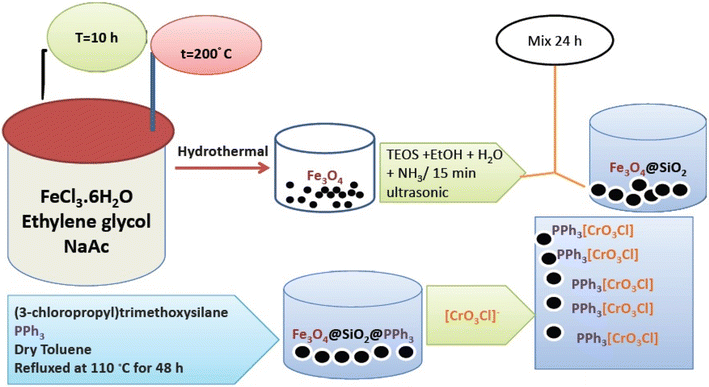
The sequence of steps in the immobilization of chlorochromate in the magnetite nanoparticles is illustrated in Fig.
1
. In the first step, hydrothermal method was applied to the synthesis of Fe
3
O
4
magnetic nanoparticles. Second, the external surface of MNPs was coated with silica shell to create SCMNPs. This silica coating protects the magnetic nanoparticles from possible decomposition induced by the surrounding environment and prevents further aggregation. In addition, the silica surface can be functionalized using a variety of known surface modifiers. The action of silanol groups of SCMNPs with triphenylphosphonium (3-chloropropyl) trimethoxysilane generated PCPTSCMNPs. The next step involves reaction of PCPTSCMNPs groups with chlorochromate to yield the magnetite chlorochromate nanomaterials CCr-PCPTSCMNPs. In this step, phosphonium groups give positively charged cations which bounds electrostatically to the chlorochromate. The excess of chlorochromate was removed by washing the resulted materials with water. The attached chlorochromate anions are stable on the surface of modified magnetite and cannot be leached to an aqueous solution [
9
].
Schematic illustration for the preparation of Fe
3
O
4
@SiO
2
@PPh
3
@[CrO
3
Cl]Fig. 1
To demonstrate the surface modification of the magnetite nanoparticles and preparation of magnetite–chlorochromate nanomaterials, the FT-IR spectra of the ready MNPS, SCMNPs, PCPTSCMNPs, and CCr-PCPTSCMNPs are illustrated in Fig.
2
.
FT-IR spectra of
a
Fe
3
O
4
,
b
Fe
3
O
4
@SiO
2
,
c
Fe
3
O
4
@SiO
2
@PPh
3
and
d
Fe
3
O
4
@SiO
2
@PPh
3
@[CrO
3
Cl]Fig. 2
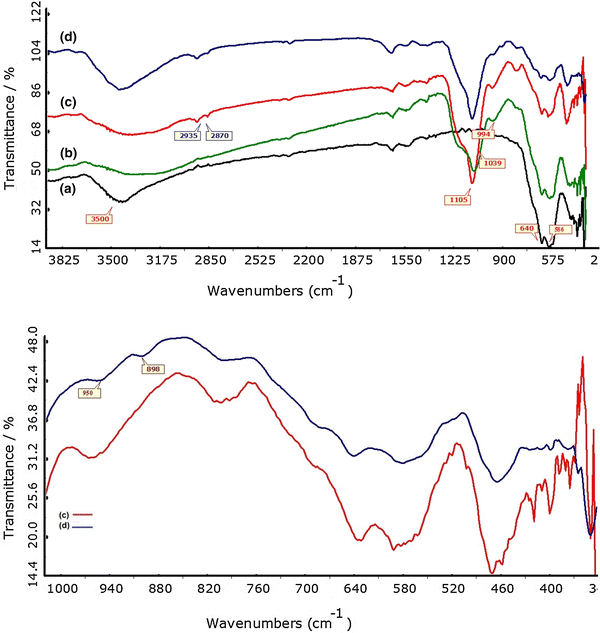
As shown in Fig. 2 a, Fe 3 O 4 typical bands centered at 586 and 640 cm −1 , which related to the Fe–O stretches. The surfaces of Fe 3 O 4 powder contain surface hydroxyl functional groups (Fe–OH) whose characteristic IR peak was at 3,500 cm −1 in FT-IR plot shown in Fig. 2 a [ 12 – 14 , 20 , 21 ]. After the coating of Fe 3 O 4 @SiO 2 core–shells, the silane framework on the surface of the MNPs was confirmed by the FT-IR bands at 1,105, 1,039 and 994 cm −1 assigned to the Si–O–H and Si–O–Si groups [ 18 ] (Fig. 2 b). These results indicate that Fe 3 O 4 @SiO 2 is formed [ 12 , 15 , 16 ]. The presence of anchored propyl and triphenylphosphine groups was confirmed by stretching vibrations appeared at about 2,935, 2,870 cm −1 (C–H stretching vibrations) in the FT-IR spectrum of PCPTSCMNPs (Fig. 2 c) [ 9 , 20 ]. The presence of absorption bands 430, 770, 805, 895, 905 (ν asymmetric Cr=O (A 1 )), 940 (ν symmetric Cr=O (E)) approbated the immobilization of chlorochromate (Fig. 2 d) [ 1 ].
The elemental analysis (XRF) of the Fe
3
O
4
@SiO
2
@PPh
3
@[CrO
3
Cl] is shown in Table
1
. As can be seen in this Table, the quantity of Chromium is approximately 1.04 %, which confirms the immobilization amount of [CrO
3
Cl]
−
which is equal to 0.02 mol/100 g. Loss on ignition (LOI) shows the quantity of organic matter in Fe
3
O
4
@SiO
2
@PPh
3
@[CrO
3
Cl].
Results of chemical analysis of XRF of the Fe
3
O
4
@SiO
2
@PPh
3
@[CrO
3
Cl] Element Fe Si O Cr P LOI (%) 24.46 27.93 33.84 1.04 1.17 11.56Table 1
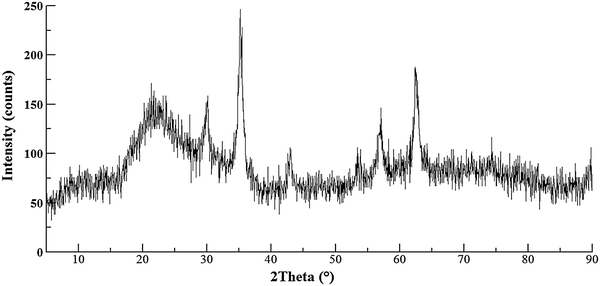
Figure
3
shows the XRD spectrum of the magnetite chlorochromate nanoparticles. The XRD data show the diffraction peaks at 2
θ
= 29.9765° (220), 35.1295° (311), 42.8283° (400), 56.9694° (511) and 62.56522° (440) for sample. The reflection peak positions and relative intensities of MNPs are well in agreement with the XRD patterns of MNPs in the literature (JCPDS Card No. 19-0629). The results indicate that the shape of the MNPs is inverse spinel Fe
3
O
4
with a face-centered cubic (FCC) structure, suggesting that the sample has a cubic crystal system. Moreover, no characteristic peaks of impurities were observed in the XRD spectrum [
20
,
22
–
24
]. This indicates that chlorochromate species well dispersed on the surface of PCPTSCMNPs and there is no crystalline phase of chlorochromate in the resulted nanomaterials. The D values calculated from the XRD spectrum were indexed to the inverse cubic spinel phase of Fe
3
O
4
. From the width of the peak at 2
θ
= 35.1295° (311), the crystallite size of the Fe
3
O
4
@SiO
2
@PPh
3
@[CrO
3
Cl] nanoparticle is calculated to be 16.3 nm using Scherrer’s equation:
D
= 0.89
λ
/(
β
cos
θ
) where
D
is the particle size,
λ
is the X-ray wavelength (nm),
θ
is Bragg’s angle;
β
is the excess line broadening (radiant) [
4
,
25
].
XRD pattern of Fe
3
O
4
@SiO
2
@PPh
3
@[CrO
3
Cl]Fig. 3
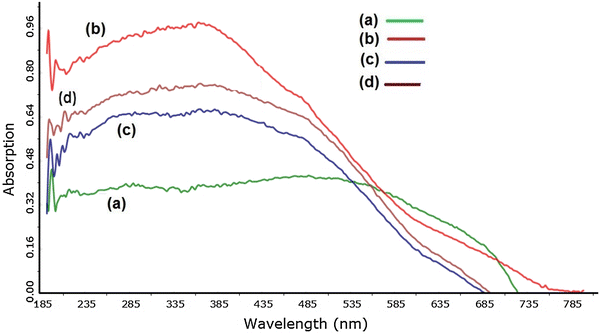
Figure
4
shows the absorption spectra of samples in the solid state. It is clear that the pure Fe
3
O
4
absorbs light with wavelengths mainly below 762 nm (Fig.
4
a). (In comparison with the optical absorption of Fe
3
O
4
, the absorption edge toward shorter wavelengths (blue shift) and increasing intensity in <502 nm was observed in the absorption spectra of Fe
3
O
4
@SiO
2
(Fig.
4
b). Fe
3
O
4
@SiO
2
and Fe
3
O
4
@SiO
2
with triphenylphosphine showed a red shift and decreasing in intensity (Fig.
4
c). The Fe
3
O
4
@SiO
2
@PPh
3
@[CrO
3
Cl] showed a little blue shift with growth intensity (Fig.
4
d).
Solid state UV–Vis spectra of
a
Fe
3
O
4
,
b
Fe
3
O
4
@SiO
2
,
c
Fe
3
O
4
@SiO
2
@PPh
3
and
d
Fe
3
O
4
@SiO
2
@PPh
3
@[CrO
3
Cl]Fig. 4
Figure
5
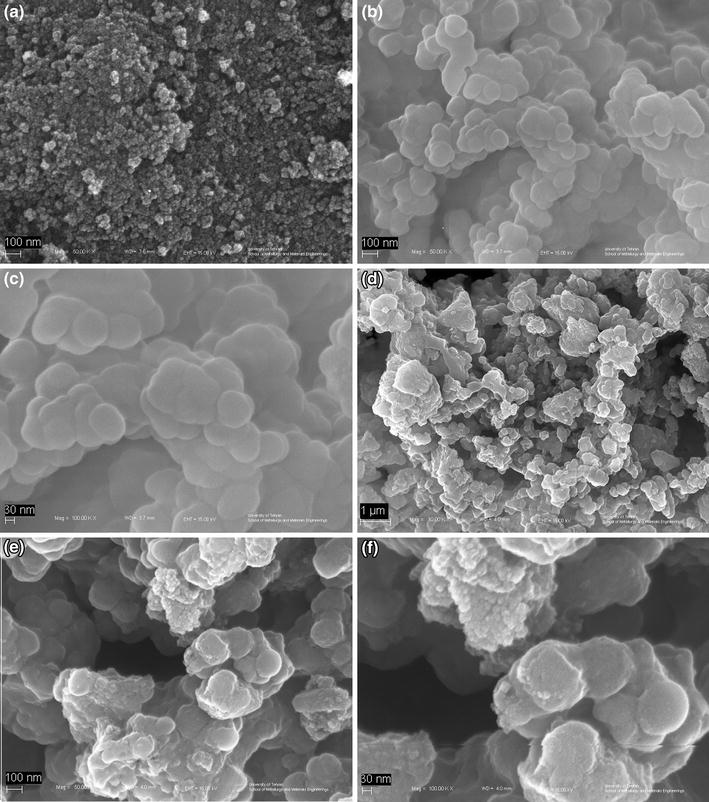
a shows the SEM images of the primary Fe
3
O
4
. The SEM images illustrate that the created Fe
3
O
4
are spherical nanoparticles with an average grain size 16 nm. Aggregation gives rise to enhancing the size of observed nanoparticles as observed in the SEM image. Figure
4
b, c shows that iron oxide nanoparticles have core–shell mode and a spherical morphology. Figure
5
d–f indicates images of obtaining Fe
3
O
4
@SiO
2
@PPh
3
@ [CrO
3
Cl].
Images of SEMs
a
Fe
3
O
4
,
b
,
c
Fe
3
O
4
@SiO
2
,
d
,
e
,
f
Fe
3
O
4
@SiO
2
@PPh
3
@[CrO
3
Cl]Fig. 5
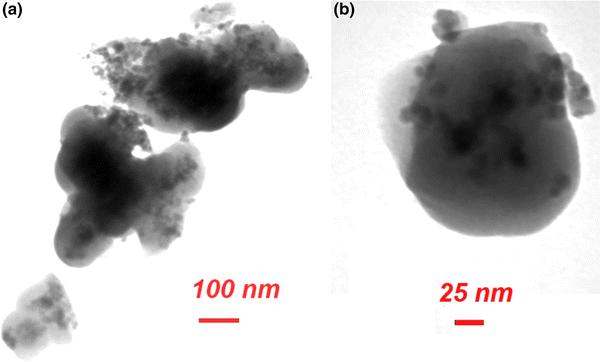
The TEM images shown in Fig.
6
demonstrated that the silica–magnetite compound made as supports of the catalyst had good spherical morphologies.
Magnetization curves of
a
Fe
3
O
4
,
b
Fe
3
O
4
@SiO
2
@PPh
3
@[CrO
3
Cl]Fig. 6
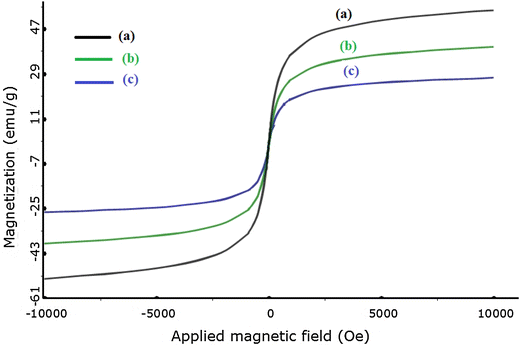
The magnetization measurements of Fe
3
O
4
, Fe
3
O
4
@SiO
2,
and Fe
3
O
4
@SiO
2
@PPh
3
@[CrO
3
Cl] nanoparticles were performed by a vibrating sample magnetometer at room temperature (Fig.
7
). Figure
7
indicates the schemes of the magnetization ‘M’ versus applied field ‘H’ (between −10,000 and +10,000 Oe) of these prepared Fe
3
O
4
, Fe
3
O
4
@SiO
2
, and Fe
3
O
4
@SiO
2
@PPh
3
@[CrO
3
Cl] samples. As can be seen in Fig.
7
, the values of the saturation magnetization were 53 emu/g for Fe
3
O
4
nanoparticles, 37 emu/g for Fe
3
O
4
@SiO
2
, and 25.4 emu/g for Fe
3
O
4
@SiO
2
@PPh
3
@[CrO
3
Cl], respectively. The reduction, nearly 25 emu/g of the saturation magnetization, proposes the presence of some SiO
2
@PPh
3
@[CrO
3
Cl] on the surface of the magnetic supports.
Applied magnetic field (Oe)Fig. 7
This paper has explained the synthesis of magnetic (Fe 3 O 4 @SiO 2 @PPh 3 @[CrO 3 Cl]) by reacting triphenylphosphine-modified silica-coated magnetite nanoparticles with chlorochromate anion. In sum, the electrostatic interaction between the cationic iron oxide nanoparticles with triphenylphosphine-modified silica-coated magnetite nanoparticles, and the chlorochromate anion, resulted in immobilization of chlorochromate on the surface of modified Fe 3 O 4 @SiO 2 @PPh 3 and preparation of magnetite chlorochromate hybrid nanomaterials (Fe 3 O 4 @SiO 2 @PPh 3 @[CrO 3 Cl]). The physicochemical specifications demonstrated the almost similar size of about 16 nm and spherical morphologies of synthesized superparamagnetic nanoparticles. In the future, we decided to test the power of catalyst in oxidation of organic matter, desulfurization of fuel and multicomponent reactions.
The authors gratefully acknowledge financial support from the Research Council of the Iran University of Science and Technology (IUST).