School of Engineering, Faculty of Science and Engineering, University of Waikato, Hamilton, 3240, NZ
Abstract
The twenty-first century is experiencing a wave of technologies and innovations making use of unique features of nanofluids, in applications such as industrial and process heating, air conditioning and refrigeration systems, heat pipes, solar energy, thermal storage systems, electronic cooling systems and others. Recent literature indicates that suspending solid nanoparticles in traditional working fluids can enhance heat transfer rates by increasing thermal conductivity and heat transfer coefficients. However, there is a wide variation in the extent of heat transfer enhancements reported in the literature. In this review, which mainly focuses on the research published within the last 5 years, experimental investigations from recent developments of nanofluids usage and performance in various heat transfer systems are summarised. In addition, heat transfer mechanisms in nanofluids, the challenges and future direction of nanofluids regarding heat transfer enhancement are discussed. Popular preparation methods of nanofluids and the models of thermophysical properties such as thermal conductivity and viscosity have been reviewed.
Introduction
The knowledge and understanding of heat transfer are important for the design of a wide range of industrial, commercial and domestic processes and appliances, including chemical processing, air conditioning and refrigeration, solar energy production and conversion, oil and gas industries and electronics cooling. In thermal engineering, the improvement in the thermal performance of systems is termed ‘heat transfer enhancement’. Over the past decade, several techniques have been proposed as ways of enhancing heat transfer [
1
,
2
–
3
]. These techniques have been classified as passive or active (Table
1
).
Table 1
Passive and active heat transfer enhancement techniques [
4
]
Passive
Active
Treated surfaces
Mechanical aids
Rough surfaces
Surface vibration
Extended surfaces
Fluid vibration
Displaced enhancement devices
Electrostatic fields
Swirl flow devices
Injection
Coiled tubes
Suction
Surface tension devices
Jet impingement
Additives for liquids
Additives for gases
Figure
1
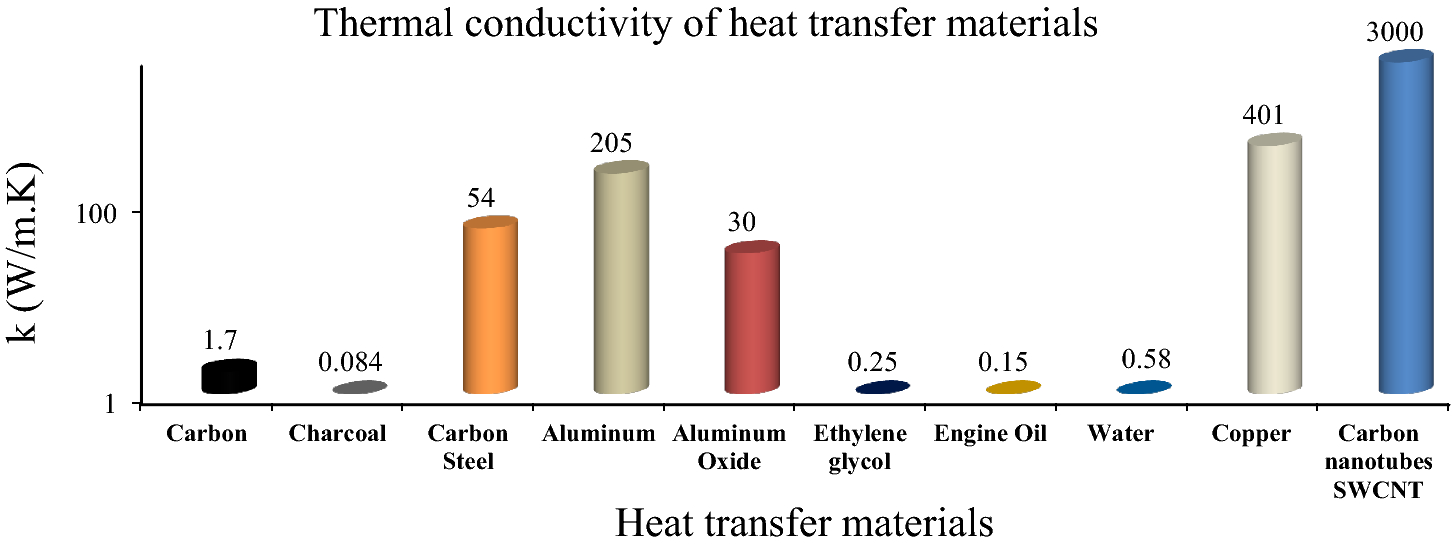
shows thermal conductivities of different materials. Since the thermal conductivity of solids may be several orders of magnitude higher than the thermal conductivities of conventional heat transfer fluids such as water, oil or ethylene glycol (EG), the addition of highly conducting solid particles to a fluid has the potential to increase the effective thermal conductivity of the fluid.
Fig. 1
Thermal conductivity of some heat transfer materials
Choi and Eastman [
5
] introduced the term “nanofluids” to describe suspensions of copper nanoparticles in water. Their investigations revealed that the thermal conductivity of the fluid was enhanced by a factor of 1.5 and 3.5 compared to water at low volume fractions of 5% and 20%, respectively. Further experiments with copper nanoparticles in acidified ethylene glycol showed apparently anomalous increases in thermal conductivity [
6
]. However, they also observed that the thermal conductivity of copper/ethylene–glycol nanofluids decreased with time, which was most likely due to agglomeration and/or sedimentation of the nanoparticles.
Similar encouraging results were observed by other researchers and subsequently the use of nanofluids for heat transfer enhancement became a very active area of research [
7
,
8
,
9
,
10
–
11
]. However, to date, it does not appear that nanofluids have received widespread usage outside the research environment. In practice, the usage of nanoparticles in heat transfer equipment still faces a number of challenges arising from issues such as (1) lack of stability of the nanofluids, (2) high variation on reported physical properties and heat transfer enhancement effects in the literature, (3) lack of understanding about the mechanisms and forces that act on the nanoparticles during and after suspension. These issues have slowed the process of standardisation and formulation of nanofluid technology. The aim of this paper is to review the recent developments and the future prospects for nanofluids in heat transfer systems.
Preparation of nanofluids
Nanoparticles used in nanofluids range in size from 1 to 100 nm and different shapes such as nanospheres (spherical), nanoreefs, nanoboxes, nanoclusters and nanotubes. Some studies [
12
,
13
,
14
–
15
] have concluded that the morphology of nanoparticles is defined during synthesis, and the average size of nanoparticles plays a significant role in the enhancement of thermal conductivity a primary factor for heat transfer enhancement.
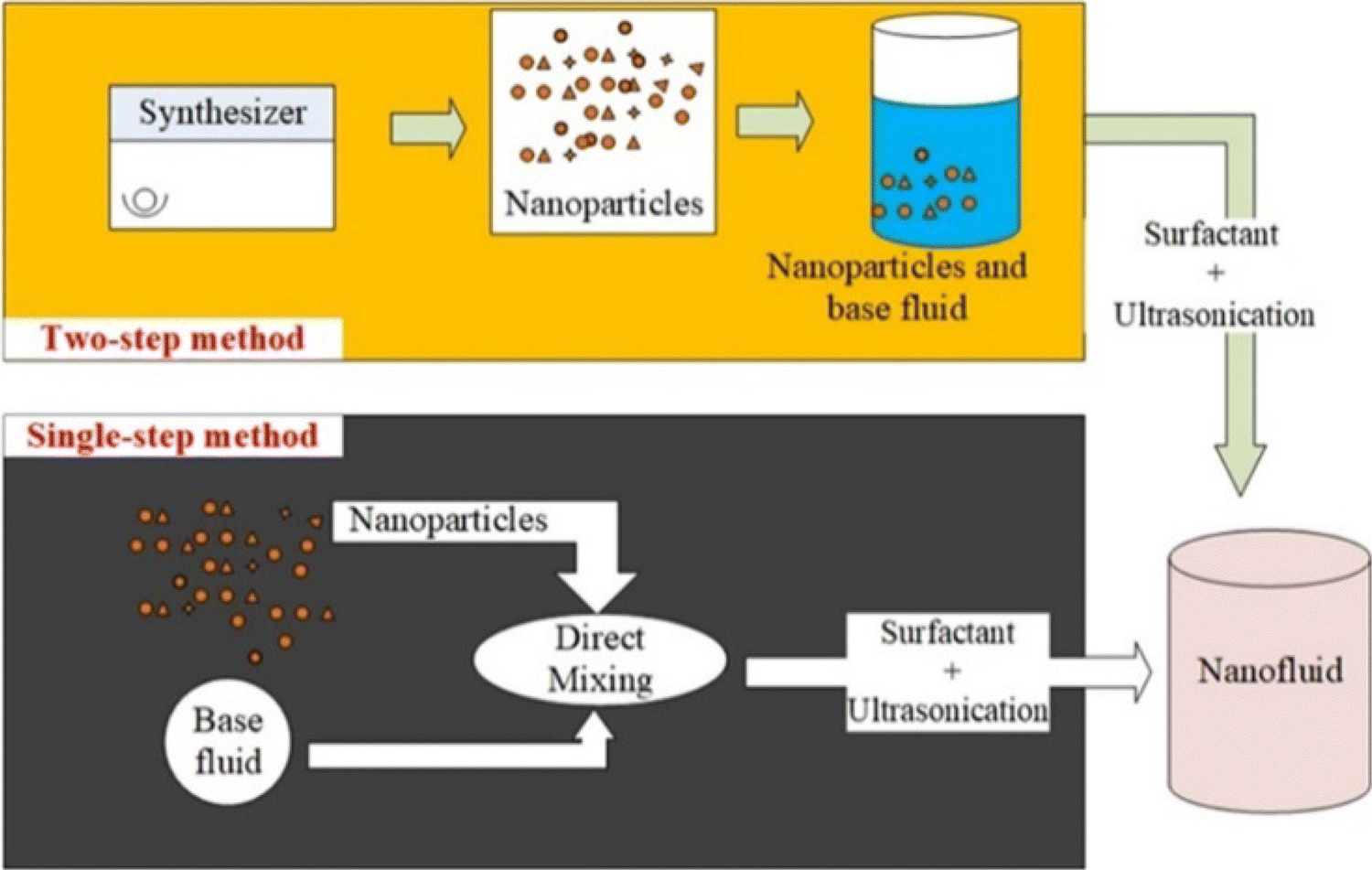
There are two popular methods used in the preparation of nanofluids: the single-step method and the two-step method [
16
] as shown in Fig.
2
. The single-step method involves the simultaneous production of nanoparticles and suspension of the particles into the base fluid. For example, the nanoparticles may be formed by condensation from the vapour phase directly into the heat transfer liquid. This method has the advantage of producing minimal nanoparticle agglomeration; however, it is characterised by high costs, and is therefore likely to be infeasible on an industrial scale. In contrast, in the two-step method, nanoparticles are produced in a separate process before being dispersed into the base fluid [
17
]. Stabilising agents such as surfactants can be added to reduce the interfacial forces between the nanoparticles and base fluid molecules. Subsequently, the solution may be mixed using mechanical devices such as homogeniser, stirrer and ultrasonicator. The two-step method appears to have received the most widespread use, since it is generally less labour intensive and more cost effective [
17
,
18
–
19
].
Fig. 2
Methods of nanofluids preparation
Mechanism of heat transfer enhancement in nanofluids
Maxwell [
20
] proposed a model for determining the electrical conductivity of a dispersion of spheres in a continuous medium that has subsequently been applied successfully to the prediction of thermal conductivities of heterogeneous materials [
21
,
22
]. Maxwell’s model and derivatives may be thought of as ‘classic theory’ for thermal conductivity modelling [
23
]. However, the rise in popularity of nanofluids has largely been due to reports of experimentally determined thermal conductivities being many times higher than those predicted by classic theory [
24
,
25
]. In the open literature, there does not appear to be any single theory that can explain the apparently anomalous heat transfer enhancement effects in nanofluids that have been reported by some researchers [
6
,
26
]. However, a variety of mechanisms have been proposed. For instance, in a review of metal-oxide nanoparticles Suganthi et al. [
27
] concluded that Brownian motion plays a significant role in increasing thermal conductivity of nanofluids. The stochastic movement of nanoparticles in a fluid depends on temperature, diameter of the particles and viscosity of the fluid. Farzaneh et al. [
28
] suggested that in addition to Brownian motion, nanoparticles once suspended also experience drag, thermophoresis, Van der Waals and electric double layer forces. The study added that a combination of inter-particle Van der Waals and electric double layer forces produces a combined force called “DLVO”, which together with other forces play a significant role in the mechanism of heat transfer in nanofluids.
Kang et al. [
29
] proposed a mechanism based on the cross coupling of thermal and electric transports in nanofluids. They explained that due to the fact that nanoparticles have surface charges, a varying electric field can be generated to accompany the particle thermal motion. Therefore, the base fluid is heated by the nanoparticles through molecular collision such that the nanoparticles may be considered as an internal heat source.
Sanukrishna et al. [
30
] reported that the mechanism of molecular layer formation inside evaporator tubes during evaporation could be the reason for heat transfer enhancement in two-phase flow boiling.
However, to date, none of these theories have been used to produce models that can accurately predict heat transfer enhancement across a wide range of applications.
Thermophysical properties of nanofluids
The thermal properties that affect conduction and convection include thermal conductivity, specific heat capacity, density and viscosity. Therefore, any heat transfer model requires accurate thermal property data. For specific heat capacity and density, it is often assumed that a weighted arithmetic mean of the components’ base fluid and nanoparticle densities or specific heat capacities can provide accurate predictions of the nanofluids density or specific heat capacity. However, determining the thermal conductivity and viscosity of nanofluids is not as straightforward.
Thermal conductivity
Thermal conductivity is the most studied transport property in nanofluids, as it is commonly assumed that the significant increases in heat transfer rates observed with nanofluids are primarily caused by the increased thermal conductivity. For nanofluids, common thermal conductivity measurement methods include the transient hot-wire device [
31
] or the thermal property analyser [
32
].
Hemmat Esfe et al. [
33
] studied the efficiency of ferromagnetic nanoparticles suspended in ethylene glycol. They focussed on the effect of particle size, temperature and concentration to determine the thermal conductivity and viscosity of the nanofluids with volume fraction of up to 3% in the temperature range of 26–55 °C. Their results showed that the efficiency of nanofluids increased with an increase in the temperature and solid volume fraction. They also concluded that the optimum particle size depended on the flow regime (i.e. the laminar vs. turbulent).
Deepak et al. [
15
] developed a model to predict the thermal conductivity of nanofluids based on particle size distribution and multi-level homogenization. They mainly focused on the effects of Brownian motion, interfacial layer formation and particle clustering. Similarly, Lee et al. [
12
] reported that the efficiency of nanofluids was improved by increasing particle size and temperature. However, particle size variation was more noticeable than temperature variation for thermal conductivity and viscosity measurements.
Ueki et al. [
34
] conducted an experiment on thermophysical properties of carbon-based material nanofluid. They concluded that nanoparticle geometry and temperature influenced thermal conductivity. In addition, they found out that carbon black and carbon nanopowder enhanced thermal conductivity by 7% and 19%, respectively.
Lenin and Roy [
35
] reported that the critical concentration for thermal conductivity enhancement varies with the surfactant used, possibly due to the difference in the degree of aggregation of the nanoparticles and conformation of the surfactant molecules on the nanoparticle’s surface. They added that base fluids with lower thermal conductivity and dielectric constant showed larger enhancement in the thermal conductivity relative to base fluids with higher thermal conductivities.
However, despite the many positive results, Hussein et al. [
36
] found that the effect of volume fraction, temperature and the size diameter on friction is not clearly elaborated in the literature yet, it is vital for developing correlations of thermal properties of nanoparticles. A large number of thermal conductivity models that have been proposed (examples shown in Tables
2
,
3
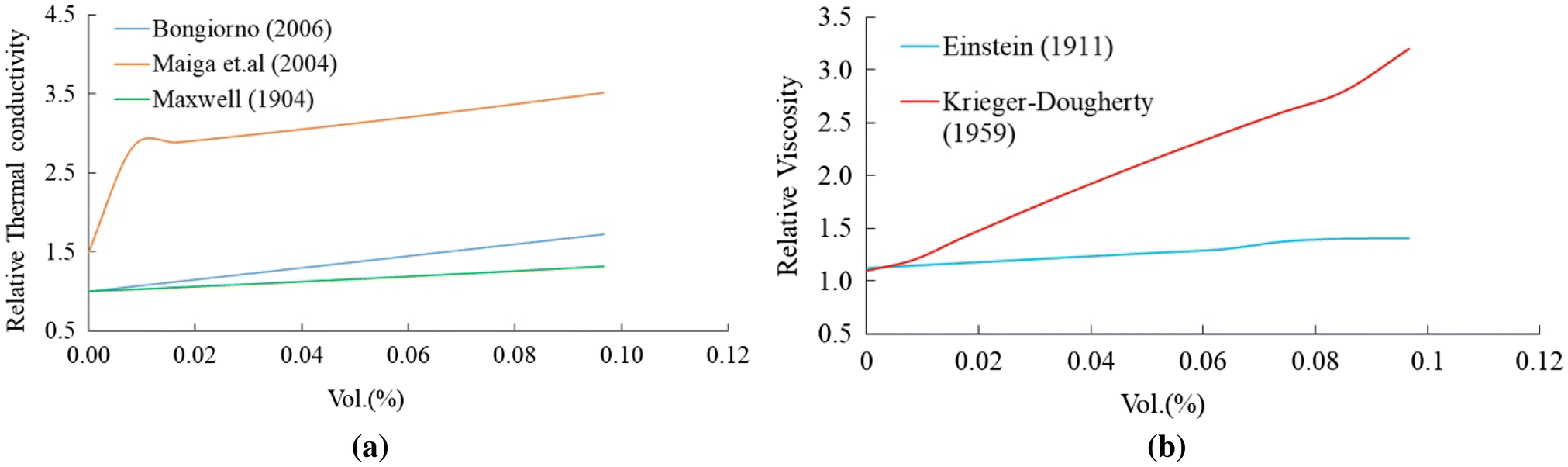
), some of which consider the morphology of nanoparticles, assume that all particles are spherical and introduce a variety of (mostly empirical) constants. Therefore, it is difficult to know which model should be used for particular nanofluids. To demonstrate, Fig.
3
shows predictions from the classical model of Maxwell [
20
], that are compared to those of Buongiorno et al. [
37
] and Maiga et al. [
38
] showing significant differences. Yang et al. [
39
] explained that factors such as particle parameters (particle type, loading, size and shape) and environmental parameters (base fluid, pH value, temperature and the standing time) influence thermal conductivity. These aforementioned factors as well as preparation methods could be significant causes of the discrepancy in thermal conductivity enhancement reported in the literature.
Table 2
Summary of models for thermal conductivity of nanofluids
Author
Empirical model
Remarks
Maxwell [20]
Knf=Kp+Kbf+2ϕ(Kp-Kbf)Kp+Kbf+ϕ(Kp-Kbf)Kbf
Volume fraction of solid spherical particles
Pak and Cho [81]
Knf = (1 + 7.74ϕ)Kbf
Depends on spherical and non-spherical particles
Maiga et al. [38]
Knf = (1 + 4.97ϕ2 + 2.72ϕ)Kbf
Considered spherical particles
Boungiorno [37]
Knf = (1 + 2.92ϕ − 11.99ϕ2)Kbf
Titania spherical and non-spherical particles
Mintsa et al. [82]
Knf = (1 + 1.7ϕ)Kbf
–
Table 3
Summary of measured thermal conductivity data of nanofluids
Author
Nanofluid
Temperature (°C)
Enhancement (%)
Ueki et al. [35]
Carbon nanopowder–water
20
19
Carbon black–water
7
Jiang et al. [25]
Ammonia–water
120
3–12
Murshed et al. [83]
TiO2–water
–
30–33
Parametthanuwat et al. [84]
Ag–water
20–80
80
Hafiz et al. [85]
TiO2–water
29.4
15.87
Karimi et al. [86]
NiFe2O4–water
25–55
17.2
Mehrail et al. [87]
Nitrogen-doped graphene–water
5–40
22.15–36.78
Kole et al. [88]
Graphene–EG/water
10–70
15
Branson et al. [89]
NanoDiamond–EG
10–80
11–12
Fig. 3
The effect of nanoparticle concentration on thermal conductivity (
a
) and viscosity (
b
) using different models for carbon–water nanofluid
Viscosity
In their landmark paper, Choi and Eastman [
5
] assumed that the addition of nanoparticles would not significantly affect the viscosity of the nanofluids; however, this is not necessarily the case. For example, Namburu et al. [
40
] measured the viscosity of copper oxide nanoparticles dispersed in a mixture of ethylene glycol and water and found that the viscosity of 6.12% volume concentration of the nanofluids was four times the value of the base fluid. In addition, they concluded that the viscosity of nanofluids increases with increasing amounts of nanoparticles. Similarly, Hemmat et al. [
41
] found that the viscosity of zinc-oxide/ethylene glycol nanofluids increased considerably with particle volume concentration significantly, as did Mariano et al. [
42
] and Yu et al. [
43
], who also made the point that heat transfer enhancement effects of the nanofluid were offset by the increased pumping power requirements.
It is also possible that the addition of nanoparticles and/or surfactants may cause the nanofluids to behave in a non-Newtonian manner, even though the base fluid may be Newtonian. While, Mariano et al. [
42
] reported that the viscosity of the nanofluids is ‘nearly independent’ of the shear rate, Kaggwa et al. [
44
] observed that the viscosity of carbon–water nanofluids decreased with an increase in shear rate and the viscosity of carbon–hexane nanofluids increased with the increase in shear rate. They concluded that base fluids, nanoparticle concentration as well as surfactants have a significant effect on viscosity measurements.
It can be difficult to model the viscosity of nanofluids. To illustrate, Fig.
3
b shows two different viscosity models, the popular Einstein [
45
] model for mixture viscosity and the Krieger–Dougherty [
46
] model for nanofluids that produce widely differing predictions. The discrepancy between predictions is due to a number of factors. For example, Einstein [
45
] assumed the particles to be rigid, uncharged and devoid of any attractive forces and in low concentration, whereas Krieger–Dougherty [
46
] considered the full range of particle volume fractions, the influence of aggregation and the formation of interfacial layers.
As with thermal conductivity, the viscosity of nanofluids remains to be an area requiring further investigation, particularly as the effect of the surfactant on viscosity is not always taken into consideration or reported in viscosity studies (Tables
4
,
5
).
Table 4
Summary of empirical models for viscosity of nanofluids
Author
Empirical model
Remarks
Einstein [45]
μnf = (1 + 2.5∅)μbf
Infinite dilution of spherical, and rigid nanoparticles devoid of any attractive forces
Mooney [90]
μnf=exp2.5ϕ1-(ϕ/ϕm)μbf
Einstein’s model extended to apply to a suspension of finite concentration
Brinkman [91]
μnf=exp1(1-ϕ)2.5μbf
Modified Einstein model of spherical particles extended up to 4% volume concentration
Batchelor [92]
μnf = (1 + 2.5ϕ + 6.2)μbf
Considered large nanoparticle concentration up to 10%
Krieger and Dougherty [46]
μnf=1-ϕϕm-ηϕmμbf
Considered the full range of particle volume fraction
Table 5
Summary of measured viscosities of nanofluids
Author
Nanofluid
Temperature (°C)
Viscosity ratio
Namburu et al. [40]
CuO–EG
− 30 to 50
6.12
Mariano et al. [42]
Co3O4–EG
10–50
40
Hemmat et al. [41]
ZnO–EG
50
30
Yu et al. [43]
SiC–water
Al2O3–water
25–70
8
6
Jiang et al. [25]
Ammonia–water
120
2–7
He et al. [93]
TiO2–water
22
11
Ding et al. [94]
CNT–water
25–40
–
Das et al. [95]
Al2O3–water
20–60
45
Potential applications of nanofluids
Solar applications
As society makes attempts to combat climate change and provide sustainable energy access for all, solar energy stands out as a primary means of reducing global carbon emissions to the Earth’s atmosphere. In fact, Lewis et al. [
47
] pointed out that more energy from sunlight strikes the Earth in 1 h (4.3 × 10²⁰ J) than all the energy consumed on the planet in a year (4.1 × 10²⁰ J). They added that 120,000 TW of radiation arrives at the surface of the Earth, far exceeding human needs even in the most aggressive energy demand scenarios. However, many solar capture devices suffer from relatively low collection efficiencies. Recent studies [
48
,
49
] indicate that nanofluids can be used specifically in low optical and thermal performance solar energy conversion systems to boost their performance.
Kabeel et al. [
50
] investigated thermal solar water heater with Al
2
O
3
/H
2
O nanofluid in forced convection, and their results showed an increased solar collector efficiency of 11% for 3% nanoparticle concentration. An enhancement of 21% in average heat transfer coefficient was reported by Ebrahimnia et al. [
51
] after conducting laminar flow convective heat transfer experiments of water-based TiO
2
nanofluid flowing through a uniformly heated tube.
Al-Waeli et al. [
52
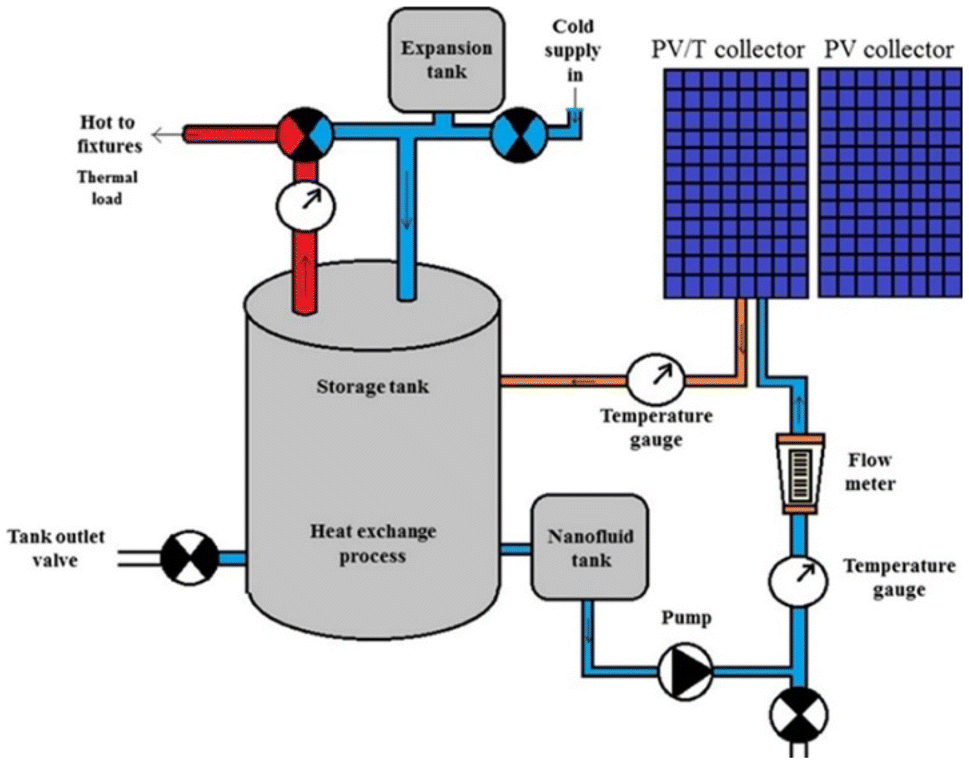
] conducted an experimental investigation of SiC/water nanofluid as a working fluid for a photovoltaic/thermal (PV/T) system (Fig.
4
). They concluded that the thermal conductivity was enhanced by up to 8.2% for the temperature range of 25–60 °C, and the thermal efficiency of the collector was increased by up to 100.19% compared to the efficiency when water was used as the working fluid.
Fig. 4
A schematic diagram of the experimental rig [
52
].
Reproduced with permission from Elsevier
Luo et al. [
53
] investigated thermal energy storage enhancement of a binary molten salt nanoparticles. They observed 4.71% enhancement of the total storage capacity at temperature range of 160–300 °C. Their results also indicated an improvement in specific heat of the nanosalt by 11.48%.
With these promising results, it seems likely that solar energy capture devices may be one of the first applications to have the wide spread uptake of nanofluids technology, although the stability of nanofluids remains a significant barrier.
Nanorefrigerants
The refrigeration industry is progressively making efforts to replace traditional refrigerants with ones that have less impact on the environment. However, studies on potential replacements such as R1234ze or R1234yf or R450A have indicated that they yield lower heat transfer performance than the refrigerants they are intended to replace [
54
,
55
]. Therefore, the suspension of solid nanoparticles in low performing heat transfer refrigerants produces a solution termed ‘nanorefrigerant’ that can enhance refrigeration system performance. Several experimental and numerical investigations [
56
,
57
,
58
–
59
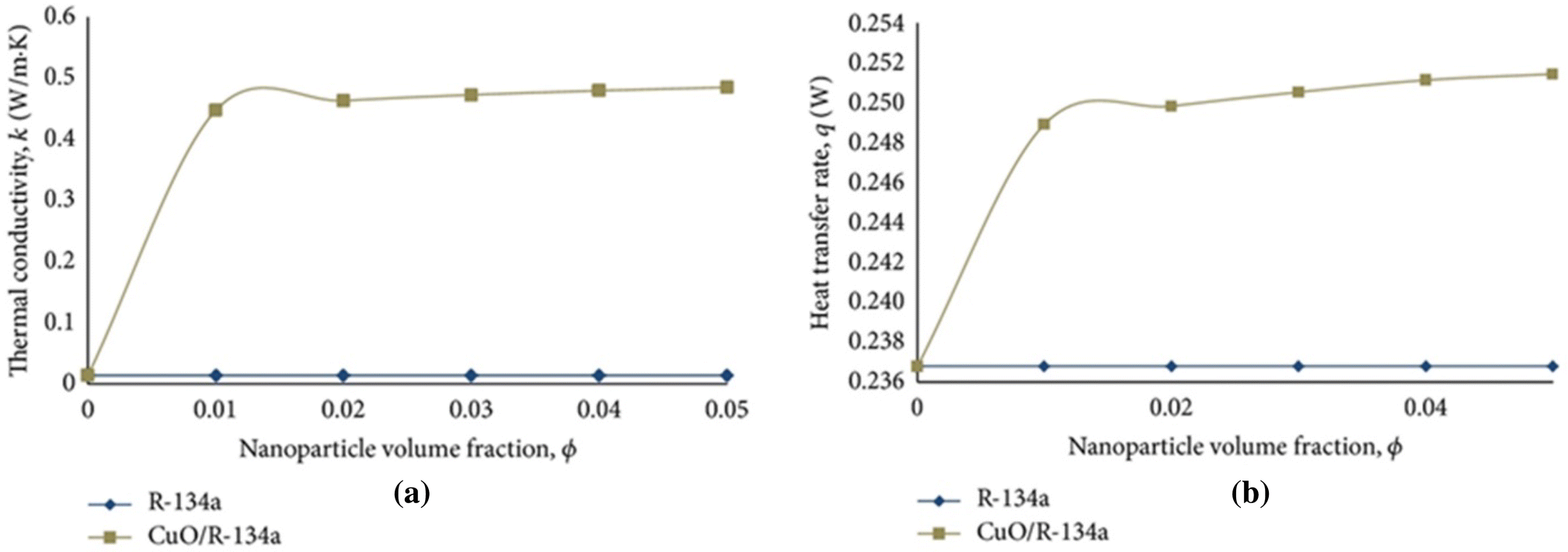
] have concluded that nanorefrigerants improve thermophysical properties, energy efficiency and the overall system performance. For instance, Fig.
5
indicates that the thermal conductivity and heat transfer of nanorefrigerant (CuO/R-134a) are higher than R-134a alone [
60
].
Fig. 5
Thermal conductivity (
a
) and heat transfer rate (
b
) as function of nanoparticle volume fraction, Fadhilah et al. [
60
]
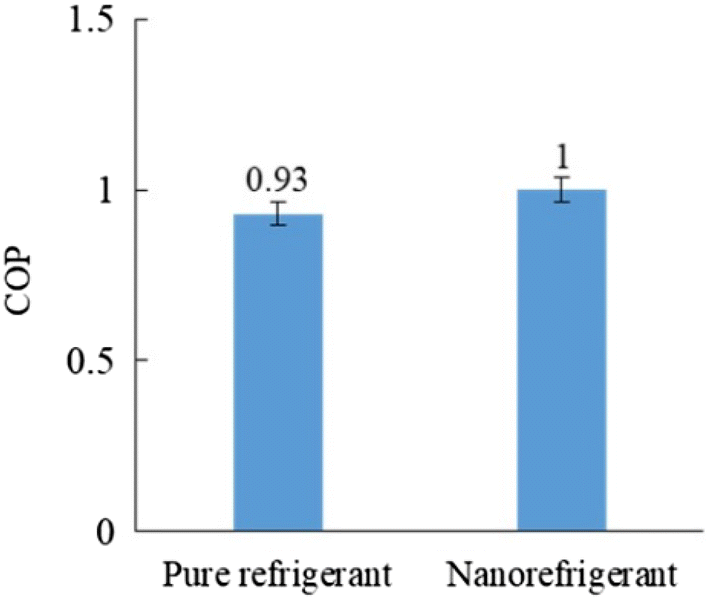
Sanukrishna et al. [
30
] dispersed copper oxide nanoparticles in R-134a and polyalkylene glycol. Their results revealed 12.67% increase in thermal conductivity and a flow boiling heat transfer enhancement of 37%. The coefficient of performance (COP) of nanorefrigerant was 7.5% higher than pure refrigerant as shown in Fig.
6
.
Fig. 6
Comparison of the coefficient of performance, Sanukrishna et al. [
30
].
Reproduced with permission from Springer
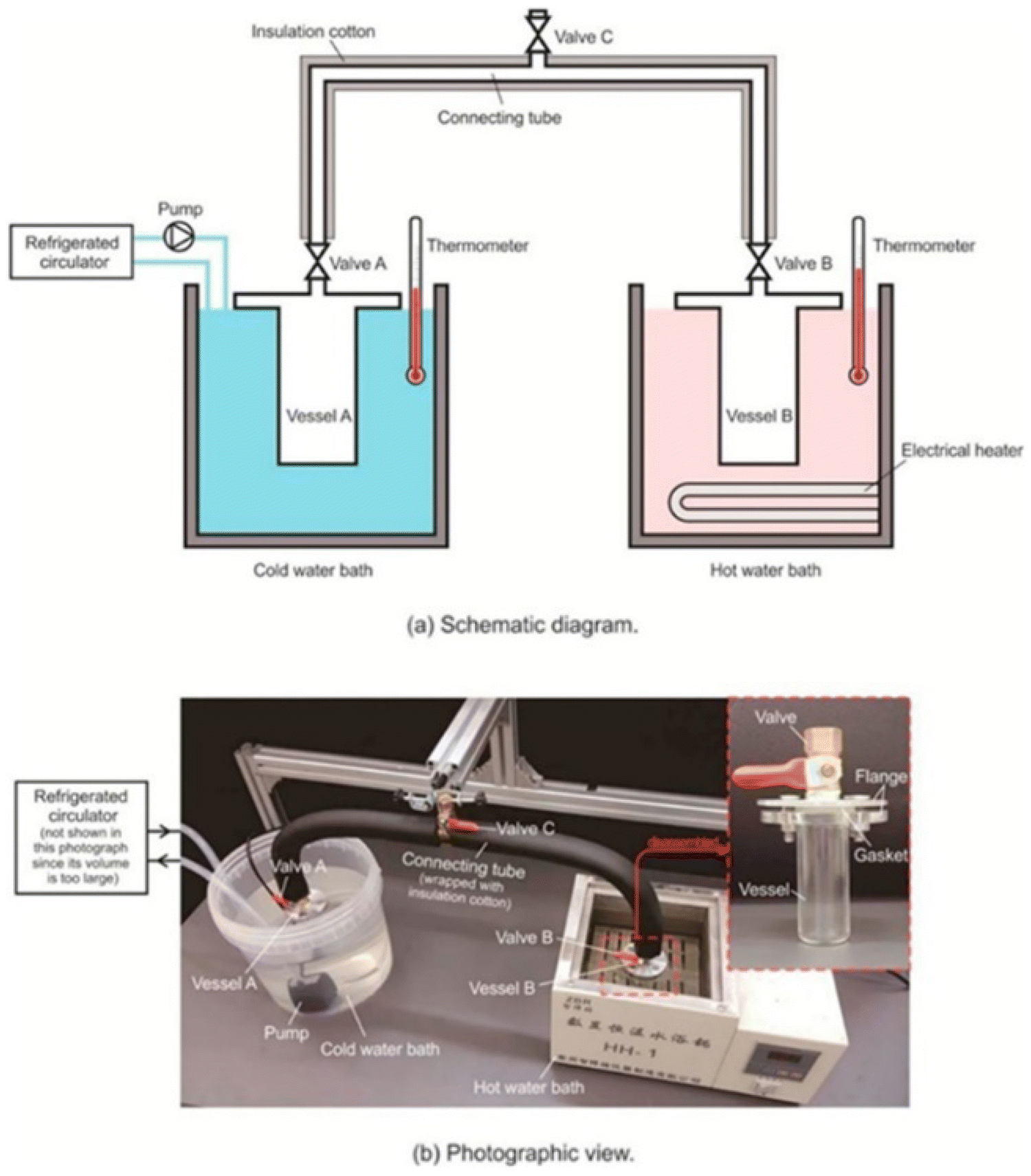
However, Lin et al. [
61
] carried out an experiment (Fig.
7
) to evaluate the degradation of a nanolubricant–refrigerant mixture during continuously alternating condensation and evaporation processes. They discovered that the mixture degrades by 28–77% after 20 cycles for nanoparticle concentrations of 0.2–1.0%, heating and temperature of 50–80 °C and 5–15 °C, respectively. They concluded that degradation would be reduced by low heating and cooling temperatures, and low nanoparticle concentrations.
Fig. 7
Experimental setup for condensation–evaporation alternation, Lin et al. [
61
].
Reproduced with permission from Elsevier
Lin et al. [
62
] conducted an experiment using TiO
2
nanoparticles and concluded that only a small fraction of the total number of nanoparticles circulate by migration from the mixture to vapour with refrigerant dry-out process. Lee et al. [
63
]. concluded that nanoparticles should not be used in two-phase micro-channel heat sinks due to the clustering phenomenon that propagates upstream to fill the entire channel, thus preventing coolant from entering the heat sink and causing catastrophic failure of the cooling system.
It appears, therefore, that the use of nanofluids in two-phase flow has more technological hurdles to overcome than for single-phase applications (Table
6
).
Table 6
A summary of additional research on nanorefrigerants
Author
Nanorefrigerant
Results
Lim et al. [58]
Al2O3/water–EG
Convective heat transfer coefficient enhanced by 25.4%
Redhwan et al. [96]
Al2O3/PAG
SiO2/PAG
Enhancement was 1.04 times higher than the base lubricant
Wang et al. [97]
Al2O3/R-22
Nanoparticles can enhance the heat transfer characteristic of the refrigerant, and the bubble size diminishes and moves quickly near the heat transfer surface
Jiang et al. [98]
CNT-R-113
Measured thermal conductivities of four kinds of 1.0 vol. % CNT– R113 nanorefrigerant increase to 82%, 104%, 43% and 50%, respectively
Tazarv et al. [99]
TiO2/R-141B
Enhancement of convective heat transfer coefficient and higher vapour qualities
Current challenges and the future of nanofluids
Despite the promising heat transfer enhancement potential observed by many researchers, there are several barriers to widespread implementation in industrial settings. Most studies on nanofluids largely rely on commercially available nanoparticles. Nanoparticles are not cheap and there is no standard price for these particles as at present (for example, at the time of writing, 100 g of the commonly studied alumina or copper oxide nanoparticles cost $492.00 and $80.00 US dollars, respectively [
64
]). In addition, it seems that the properties of nanoparticles differ according to the manufacturer, which adds to the uncertainty of physical property data. Equally important, some nanomaterials are toxic and therefore extra measures taken in preparation increase production cost. Mahian et al. [
65
] explained that challenges such as the high cost of nanoparticles, instability and agglomeration, pumping power and pressure drop, erosion and corrosion of components make nanofluid usage commercially unattractive. However, they concluded that the general application of nanofluids is still in its infant stages and, therefore, future investigations will increase the potential applications of nanofluids.
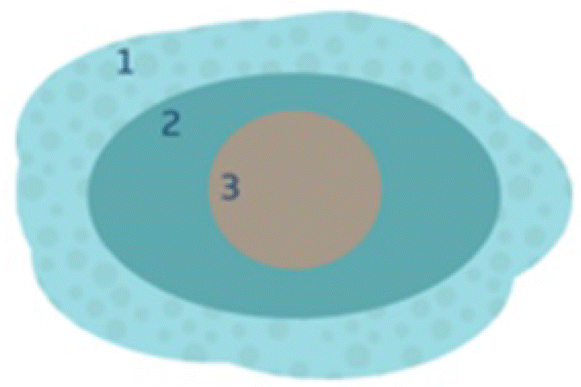
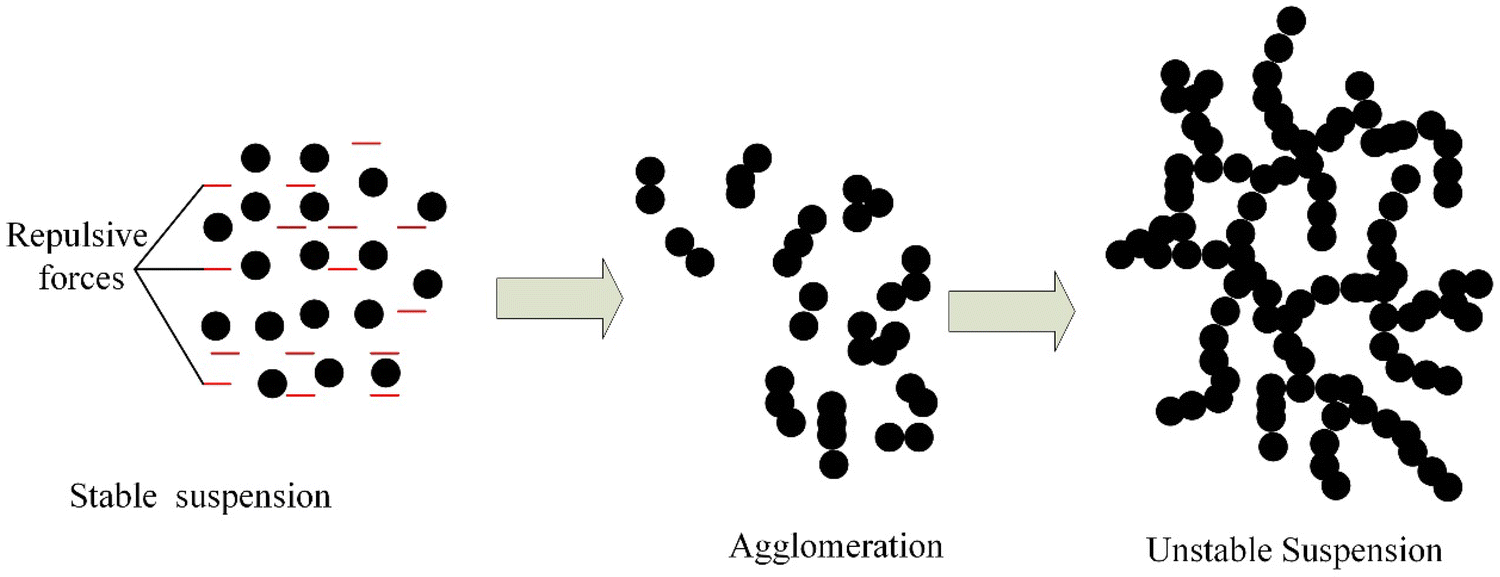
Nanofluids experience a number of effective forces during and after suspension such as drag, thermophoresis, Brownian, Van der Waals and electric double layer forces. Interfacial layers (Fig.
8
) can build bridges between nanoparticles within the base fluid molecules, reducing their effectiveness [
66
]. This is a major challenge with no solution cited in the current literature, yet is one of the primary factors that many researchers think it contributes to aggregation and subsequent sedimentation [
67
,
68
–
69
].
Fig. 8
Structure of nanoparticle in the base fluid. Molecules of the liquid (1) can form a specific, highly ordered layer (2) near the nanoparticle surface (3) [
66
].
Reproduced with permission from ACS publications
The sedimentation of nanoparticles over time (Fig.
9
) is still a major challenge [
70
,
71
,
72
–
73
] that needs to be overcome before there can be widespread uptake of nanofluids [
48
]. Simple methods have been proposed such as adding stabilising agents (surfactants) to the base fluid before the suspension of nanoparticles to lower the interfacial forces between the fluid molecules and the nanoparticles. However, even with the addition of surfactants there is no guarantee of permanent stability.
Fig. 9
Suspension and stability of nanoparticles
In short, the use of nanofluids in a wide range of applications appears to be growing steadily. However, currently it appears that material scientists and chemists perform most investigations of nanofluids characterisation, whereas thermal and mechanical engineering researchers carry the experiments on the application of nanofluids, and there is not always close collaboration or communication between the two groups, which may contribute to the agreements of results. Yu et al. [
74
] suggested that a systematic summary of dispersing strategies of nanofluids in thermal applications is needed to provide general guideline on the preparation and characterization of stably dispersed thermal nanofluids, and also to help bridge the gap between researchers in different disciplines.
Despite the fact that the field of nanofluids is still in the infancy, the future of nanofluids seems promising. Apart from solar and refrigeration applications, industrial and research institutions have progressively gained interest in the usage of nanofluids in other applications [
75
] including drug delivery for cancer treatment [
76
] and surface and subsurface defect sensors [
77
]. It is clear based on the review of the recent literature that significant efforts continue to be devoted to theoretical and experimental studies to improve the general performance and potential applications of nanofluids. In addition, efforts are being made to reduce the production costs of nanofluids by developing large-scale production methods [
17
,
78
], and to improve the stability of nanofluids [
79
,
80
].
Conclusion
This paper has reviewed experimental and theoretical developments of nanofluids in different applications. The challenges and the future insights about the potential usage of nanofluids have been discussed. The following major conclusions are drawn from this review study:
There are wide ranges in heat transfer enhancements data reported by different studies.
There is no universal formulation of nanofluids which may contribute to the wide range of physical property data reported, as well as wide ranges in price.
Stability tests reveal there is currently no solution to the sedimentation of nanoparticles over time; however, stabilising agents, such as surfactants, have been shown to improve stability significantly.
Nanofluids have a wide range of potential applications for heat transfer enhancement, with solar thermal, and refrigeration applications in particular currently being the focus of many studies.
Publisher's Note
Springer Nature remains neutral with regard to jurisdictional claims in published maps and institutional affiliations.
References
Khaled et al. (2010) Recent advances in heat transfer enhancements: a review report10.1155/2010/106461
Léal et al. (2013) An overview of heat transfer enhancement methods and new perspectives: focus on active methods using electroactive materials (pp. 505-524) 10.1016/j.ijheatmasstransfer.2013.01.083
Sheikholeslami et al. (2015) Review of heat transfer enhancement methods: focus on passive methods using swirl flow devices (pp. 444-469) 10.1016/j.rser.2015.04.113
Grassi and Testi (2006) Heat transfer enhancement by electric fields in several heat exchange regimes (pp. 527-569) 10.1196/annals.1362.062
Choi and Eastman (1995) Enhancing thermal conductivity of fluids with nanoparticles (pp. 99-105) 10.1115/1.1532008
Eastman et al. (2001) Anomalously increased effective thermal conductivities of ethylene glycol-based nanofluids containing copper nanoparticles (pp. 718-720) 10.1063/1.1341218
Alawi et al. (2015) Nanorefrigerant effects in heat transfer performance and energy consumption reduction: a review (pp. 76-83) 10.1016/j.icheatmasstransfer.2015.10.009
Lefebvre and Tezel (2017) A review of energy storage technologies with a focus on adsorption thermal energy storage processes for heating applications (pp. 116-125) 10.1016/j.rser.2016.08.019
Gorji and Ranjbar (2017) A review on optical properties and application of nanofluids in direct absorption solar collectors (DASCs) (pp. 10-32) 10.1016/j.rser.2017.01.015
Kasaeian et al. (2015) A review on the applications of nanofluids in solar energy systems (pp. 584-598) 10.1016/j.rser.2014.11.020
Khairul et al. (2014) Heat transfer performance and exergy analyses of a corrugated plate heat exchanger using metal oxide nanofluids (pp. 8-14) 10.1016/j.icheatmasstransfer.2013.11.006
Lee et al. (2016) Effects of the particle size and temperature on the efficiency of nanofluids using molecular dynamic simulation (pp. 996-1013) 10.1080/10407782.2015.1109369
Harikrishnan et al. (2017) Particle and surfactant interactions effected polar and dispersive components of interfacial energy in nanocolloids10.1063/1.4997123
Chen et al. (2009) Predicting thermal conductivity of liquid suspensions of nanoparticles (nanofluids) based on rheology (pp. 151-157) 10.1016/j.partic.2009.01.005
Deepak Selvakumar and Dhinakaran (2016) A multi-level homogenization model for thermal conductivity of nanofluids based on particle size distribution (PSD) analysis (pp. 310-317) 10.1016/j.powtec.2016.05.049
Sharma et al. (2016) Preparation and evaluation of stable nanofluids for heat transfer application: a review (pp. 202-212) 10.1016/j.expthermflusci.2016.06.029
Lee et al. (1999) Measuring thermal conductivity of fluids containing oxide nanoparticles10.1115/1.2825978
Xing et al. (2016) Experimental investigation and modelling on the thermal conductivity of CNTs based nanofluids (pp. 404-411) 10.1016/j.ijthermalsci.2016.01.024
Jiang et al. (2017) Experimental investigation on influence of high temperature on viscosity, thermal conductivity and absorbance of ammonia-water nanofluids (pp. 189-198) 10.1016/j.ijrefrig.2017.05.030
Leong et al. (2018) Thermal conductivity of an ethylene glycol/water-based nanofluid with copper-titanium dioxide nanoparticles: an experimental approach (pp. 23-28) 10.1016/j.icheatmasstransfer.2017.10.005
Suganthi and Rajan (2017) Metal oxide nanofluids: review of formulation, thermo-physical properties, mechanisms, and heat transfer performance (pp. 226-255) 10.1016/j.rser.2017.03.043
Farzaneh et al. (2016) Stability of nanofluids: molecular dynamic approach and experimental study (pp. 1-14) 10.1016/j.enconman.2015.12.044
Kang and Wang (2017) Effect of thermal-electric cross coupling on heat transport in nanofluids10.3390/en10010123
Sanukrishna et al. (2017) Nanorefrigerants for energy efficient refrigeration systems (pp. 3993-4001) 10.1007/s12206-017-0746-4
Duangthongsuk and Wongwises (2009) Measurement of temperature-dependent thermal conductivity and viscosity of TiO2-water nanofluids (pp. 706-714) 10.1016/j.expthermflusci.2009.01.005
Kannaiyan et al. (2017) Comparison of experimental and calculated thermophysical properties of alumina/cupric oxide hybrid nanofluids (pp. 469-477) 10.1016/j.molliq.2017.09.035
Hemmat Esfe et al. (2014) Efficiency of ferromagnetic nanoparticles suspended in ethylene glycol for applications in energy devices: effects of particle size, temperature, and concentration (pp. 138-146) 10.1016/j.icheatmasstransfer.2014.08.035
Lenin and Joy (2017) Studies on the role of unsaturation in the fatty acid surfactant molecule on the thermal conductivity of magnetite nanofluids (pp. 162-168) 10.1016/j.jcis.2017.07.038
Hussein et al. (2016) Nanoparticles suspended in ethylene glycol thermal properties and applications: an overview (pp. 1324-1330) 10.1016/j.rser.2016.12.047
Buongiorno (2006) convective transport in nanofluids10.1115/1.2150834
Maïga et al. (2004) Heat transfer behaviours of nanofluids in a uniformly heated tube (pp. 543-557) 10.1016/j.spmi.2003.09.012
Yang et al. (2017) Recent developments on viscosity and thermal conductivity of nanofluids (pp. 348-369) 10.1016/j.powtec.2017.04.061
Namburu et al. (2007) Viscosity of copper oxide nanoparticles dispersed in ethylene glycol and water mixture (pp. 397-402) 10.1016/j.expthermflusci.2007.05.001
Hemmat Esfe and Saedodin (2014) An experimental investigation and new correlation of viscosity of ZnO–EG nanofluid at various temperatures and different solid volume fractions (pp. 1-5) 10.1016/j.expthermflusci.2014.02.011
Mariano et al. (2015) Co3O4 ethylene glycol-based nanofluids: thermal conductivity, viscosity and high pressure density (pp. 54-60) 10.1016/j.ijheatmasstransfer.2015.01.061
Abdul et al. (2018) Physical properties and rheological characteristics of activated carbon nanofluids with varying filler fractions and surfactants (pp. 58-65) 10.4028/www.scientific.net/AMM.884.58
Einstein (1906) Eine neue Bestimmung der Moleküldimensionen (pp. 289-306) 10.1002/andp.19063240204
Krieger and Dougherty (1959) A mechanism for non-newtonian flow in suspensions of rigid spheres (pp. 137-152) 10.1122/1.548848
Lewis et al. (2005) Basic research needs for solar energy utilization10.2172/899136
Colangelo et al. (2013) A new solution for reduced sedimentation flat panel solar thermal collector using nanofluids (pp. 80-93) 10.1016/j.apenergy.2013.04.069
Alim et al. (2013) Analyses of entropy generation and pressure drop for a conventional flat plate solar collector using different types of metal oxide nanofluids (pp. 289-296) 10.1016/j.enbuild.2013.07.027
Kabeel et al. (2015) Thermal solar water heater with H 2 O-Al 2 O 3 nano-fluid in forced convection: experimental investigation (pp. 1-9) 10.1080/01430750.2015.1041653
Ebrahimnia-Bajestan et al. (2016) Experimental and numerical investigation of nanofluids heat transfer characteristics for application in solar heat exchangers (pp. 1041-1052) 10.1016/j.ijheatmasstransfer.2015.08.107
Al-Waeli et al. (2017) An experimental investigation of SiC nanofluid as a base-fluid for a photovoltaic thermal PV/T system (pp. 547-558) 10.1016/j.enconman.2017.03.076
Luo et al. (2017) Thermal energy storage enhancement of a binary molten salt via in situ produced nanoparticles (pp. 658-664) 10.1016/j.ijheatmasstransfer.2016.09.004
Kaggwa and Wang (2016) Investigation of thermal-hydrodynamic heat transfer performance of R-1234ze and R-134a refrigerants in a microfin and smooth tube (pp. 221-239) 10.1615/JEnhHeatTransf.2017019585
Mendoza-Miranda et al. (2016) Comparative evaluation of R1234yf, R1234ze(E) and R450A as alternatives to R134a in a variable speed reciprocating compressor (pp. 753-766) 10.1016/j.energy.2016.08.050
Sharif et al. (2017) Performance analysis of SiO2/PAG nanolubricant in automotive air conditioning system (pp. 204-216) 10.1016/j.ijrefrig.2017.01.004
Lim et al. (2016) Investigation of thermal conductivity and viscosity of Al2O3/water–ethylene glycol mixture nanocoolant for cooling channel of hot-press forming die application (pp. 182-189) 10.1016/j.icheatmasstransfer.2016.09.018
Nair et al. (2016) Nanorefrigerants: a comprehensive review on its past, present and future (pp. 290-307) 10.1016/j.ijrefrig.2016.01.011
Fadhilah et al. (2014) Copper oxide nanoparticles for advanced refrigerant thermophysical properties: mathematical modeling (pp. 1-5) 10.1155/2014/890751
Lin et al. (2017) Experimental research on degradation of nanolubricant–refrigerant mixture during continuous alternation processes of condensation and evaporation (pp. 97-108) 10.1016/j.ijrefrig.2016.12.021
Lin et al. (2017) Experimental investigation on TiO2 nanoparticle migration from refrigerant–oil mixture to lubricating oil during refrigerant dryout (pp. 75-86) 10.1016/j.ijrefrig.2017.02.026
Lee and Mudawar (2007) Assessment of the effectiveness of nanofluids for single-phase and two-phase heat transfer in micro-channels (pp. 452-463) 10.1016/j.ijheatmasstransfer.2006.08.001
Sizochenko et al. (2017) Predicting physical properties of nanofluids by computational modeling (pp. 1910-1917) 10.1021/acs.jpcc.6b08850
Pal (2014) A novel method to determine the thermal conductivity of interfacial layers surrounding the nanoparticles of a nanofluid (pp. 844-855) 10.3390/nano4040844
Machrafi and Lebon (2016) The role of several heat transfer mechanisms on the enhancement of thermal conductivity in nanofluids (pp. 1461-1475) 10.1007/s00161-015-0488-4
Pinto and Fiorelli (2016) Review of the mechanisms responsible for heat transfer enhancement using nanofluids (pp. 720-739) 10.1016/j.applthermaleng.2016.07.147
Aref et al. (2017) Thermophysical properties of paraffin-based electrically insulating nanofluids containing modified graphene oxide (pp. 2642-2660) 10.1007/s10853-016-0556-6
Chen et al. (2017) Experimental investigation of SiC nanofluids for solar distillation system: stability, optical properties and thermal conductivity with saline water-based fluid (pp. 264-270) 10.1016/j.ijheatmasstransfer.2016.11.048
Chen et al. (2008) Nanofluids containing carbon nanotubes treated by mechanochemical reaction (pp. 21-24) 10.1016/j.tca.2008.08.001
Timofeeva et al. (2011) Improving the heat transfer efficiency of synthetic oil with silica nanoparticles (pp. 71-79) 10.1016/j.jcis.2011.08.004
Yu et al. (2017) Dispersion stability of thermal dispersion stability of thermal nanofluids (pp. 531-542) 10.1016/j.pnsc.2017.08.010
Bhardwaj and Kaushik (2017) Biomedical applications of nanotechnology and nanomaterials10.3390/mi8100298
Yang et al. (2009) Hydrophilic multi-walled carbon nanotubes decorated with magnetite nanoparticles as lymphatic targeted drug delivery vehicles10.1039/b908012k
Mahendran and Philip (2013) Naked eye visualization of naked eye visualization of defects in ferromagnetic materials and components (pp. 100-109) 10.1016/j.ndteint.2013.07.011
Gharehkhani et al. (2015) Spongy nitrogen-doped activated carbonaceous hybrid derived from biomass material/graphene oxide for supercapacitor electrodes (pp. 40505-40513) 10.1039/c5ra01525a
Devendiran and Amirtham (2016) A review on preparation, characterization, properties and applications of nanofluids (pp. 21-40) 10.1016/j.rser.2016.01.055
Fuskele and Sarviya (2017) Recent developments in nanoparticles synthesis, preparation and stability of nanofluids (pp. 4049-4060) 10.1016/j.matpr.2017.02.307
Pak and Cho (1998) Hydrodynamic and heat transfer study of dispersed fluids with submicron metallic oxide particles (pp. 151-170) 10.1080/08916159808946559
Mintsa et al. (2009) New temperature dependent thermal conductivity data for water-based nanofluids (pp. 363-371) 10.1016/j.ijthermalsci.2008.03.009
Parametthanuwat et al. (2015) Experimental investigation on thermal properties of silver nanofluids (pp. 80-90) 10.1016/j.ijheatfluidflow.2015.07.005
Ali and Arshad (2015) Thermal performance investigation of staggered and inline pin fin heat sinks using water based rutile and anatase TiO2 nanofluids (pp. 793-803) 10.1016/j.enconman.2015.10.015
Karimi et al. (2015) Experimental investigation on thermal conductivity of water based nickel ferrite nanofluids (pp. 1529-1536) 10.1016/j.apt.2015.08.015
Mehrali et al. (2014) Preparation, characterization, viscosity, and thermal conductivity of nitrogen-doped graphene aqueous nanofluids (pp. 7156-7171) 10.1007/s10853-014-8424-8
Kole and Dey (2013) Investigation of thermal conductivity, viscosity, and electrical conductivity of graphene based nanofluids10.1063/1.4793581
Branson et al. (2013) Nanodiamond nanofluids for enhanced thermal conductivity (pp. 3183-3189) 10.1021/nn305664x
Mooney (1951) The viscosity of a concentrated suspension of spherical particles (pp. 162-170) 10.1016/0095-8522(51)90036-0
Brinkman (1952) The viscosity of concentrated suspensions and solutions (pp. 571-571) 10.1063/1.1700493
Batchelor (1977) The effect of Brownian motion on the bulk stress in a suspension of spherical particles10.1017/S0022112077001062
He et al. (2007) Heat transfer and flow behaviour of aqueous suspensions of TiO2 nanoparticles (nanofluids) flowing upward through a vertical pipe (pp. 2272-2281) 10.1016/j.ijheatmasstransfer.2006.10.024
Redhwan et al. (2017) Thermal conductivity enhancement of Al2O3 and SiO2 nanolubricants for application in automotive air conditioning (AAC) system A.A.M.10.1016/j.ijrefrig.2016.06.025
Unknown ()
Jiang et al. (2009) Measurement and model on thermal conductivities of carbon nanotube nanorefrigerants (pp. 1108-1115) 10.1016/j.ijthermalsci.2008.11.012
Tazarv et al. (2016) Experimental investigation of saturated flow boiling heat transfer to TiO2/R141b nanorefrigerant10.1080/08916152.2014.973976