Department of Physics, Faculty of Sciences, Science and Research Branch, Islamic Azad University, Tehran, IR
Abstract
In this paper, plasma disruption was investigated in IR-T1 tokamak. Moreover, the time evaluation of plasma parameters such as plasma current,
Ip
; loop voltage,
Vloop
; power heating; and safety factor was illustrated. The results of diamagnetic loop and Mirnov oscillations in a major disruption were compared with their results in a normal shot. In addition, plasma disruption in different tokamaks was investigated and the results were compared with the IR-T1 tokamak.
Introduction
Among various tools of magnetic confinement, tokamak containing hot plasma is one of the best and developed devices [
1
]. Tokamaks are divided into two groups: first, the large tokamaks for studying large plasmas such as DIII-D [
2
] and Tore–Supra [
3
] with high-cost testing conditions and second, small tokamaks such as STOR-M [
4
] and ISTTOK [
5
] which have close relationship with the first group so that most of the experiments are initially carried out by them. One of the applications of tokamaks is in the field of nanoscience. Neverov et al. [
6
] developed a theoretical model for neutron and X-ray diffraction of carbon nanomaterials and hydrocarbon films deposited inside a vacuum vessel of the tokamak T10. Nechaev and Alexeeva [
7
] answered to some problems about thermodynamic analysis of hydrogen storage in carbon-based nanomaterials with sp’ hybridization which was used in atomic hydrogen adsorption in carbon nanostructures. In addition, Kukushkin et al. [
8
] stimulated the fine structure of the deposited films deposited in the vacuum vessel of high-temperature plasma such as stellarators and tokamaks. They also created the nanomaterials based on the carbon nanostructures.
IR-T1 tokamak is the small type of tokamak which is used in this experiment. As an important phenomenon, tokamak disruptions cause plasma confinement to be destroyed by restriction of current and density which ends to large mechanical stresses. Plasma disruption is caused by strong stochastic magnetic field formed due to nonlinearity excited low-mode number magneto–hydro–dynamics (MHD) modes. The safety factor (
q
) is very important in determining stability and transport theory [
9
,
10
,
11
,
12
–
13
]. The paper is organized as follows: in Sect.
2
, time evaluation of plasma parameters and safety factor is summarized; Sect.
3
presents time evaluation of diamagnetic loop and Mirnov oscillations in a major disruption. Moreover, the results are compared with a normal shot; in Sect.
4
, we investigate the plasma disruption in the different tokamaks and finally, Sect.
5
includes a summary and conclusions.
The time evaluation of plasma parameters and safety factor
The IR-T1 tokamak parameters in the disruptive discharges have the density limit
n¯e∼1.5×10¹⁹m-3
, the approximate plasma current (
30KA)
is obtained for
5ms
approximately and the loop voltage is
(2V)
, major radius is 45 cm, minor radius is 12/5 cm and toroidal field is 1/0 T.
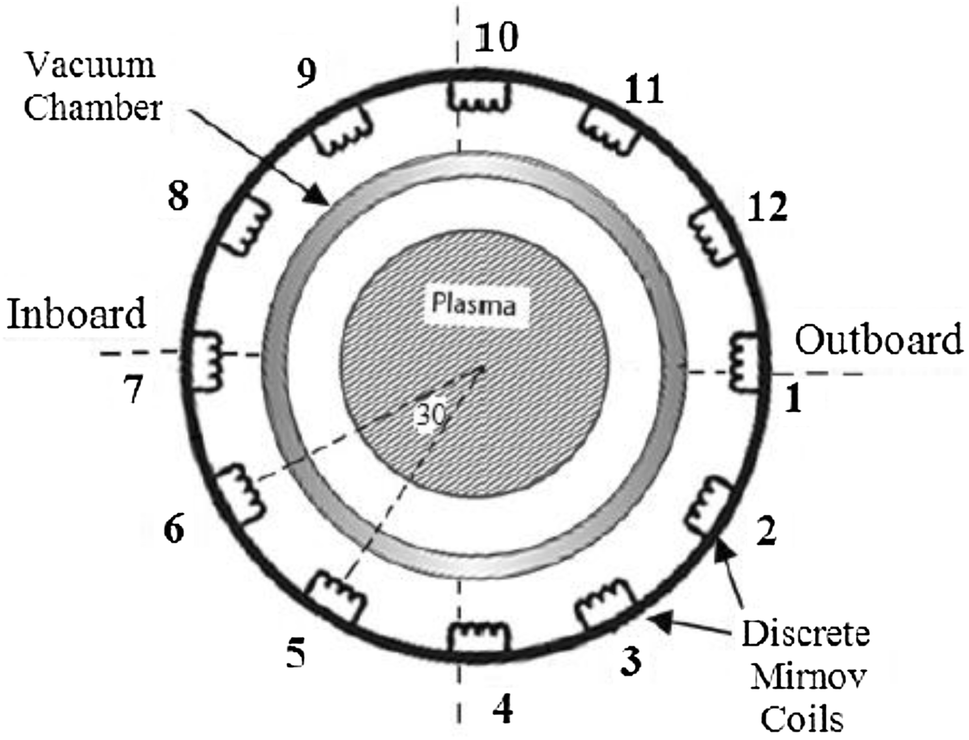
Figure
1
shows the position of poloidal array of 12 Mirnov coils [
14
].
Fig. 1
Position of poloidal array of 12 Mirnov coils
Pohmic
is the rate of input heating power. The ohmic heating power is
Pohmic=VRIP-12LIP2.
If the plasma is in thermal equilibrium
(L˙=0,I˙=0)
, then we have [
15
]:
Pohmic=VRIP.
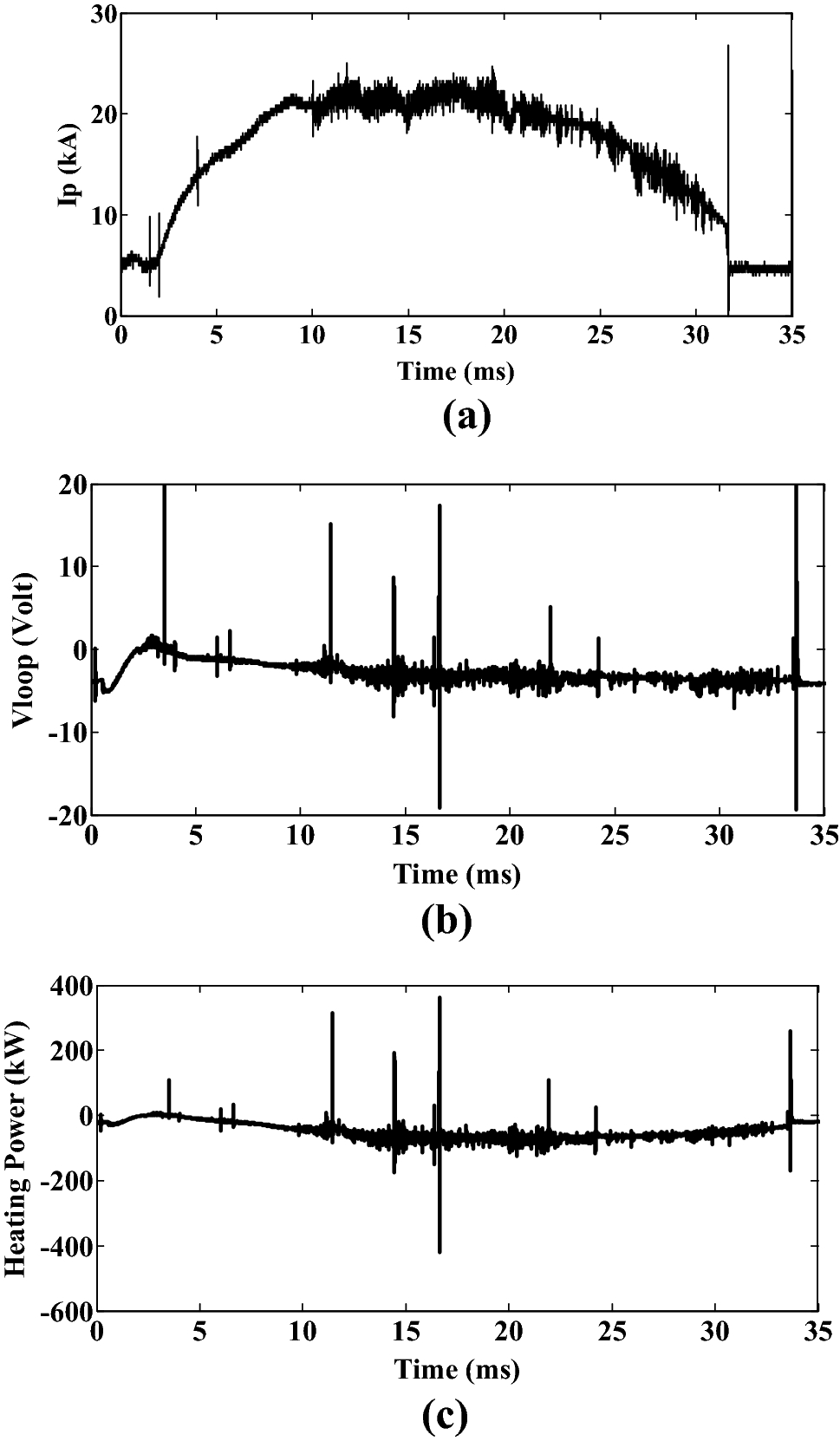
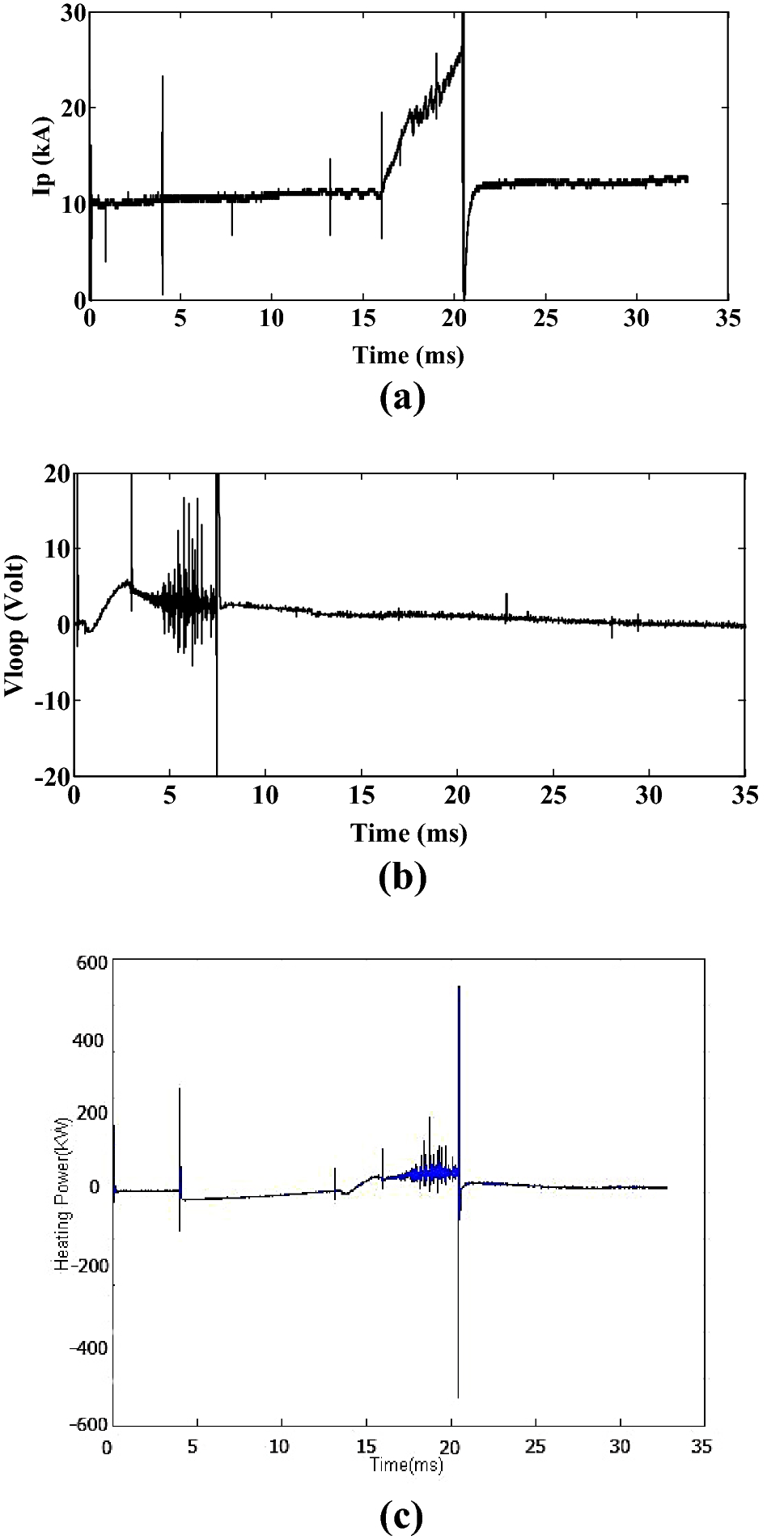
Figures
2
and
3
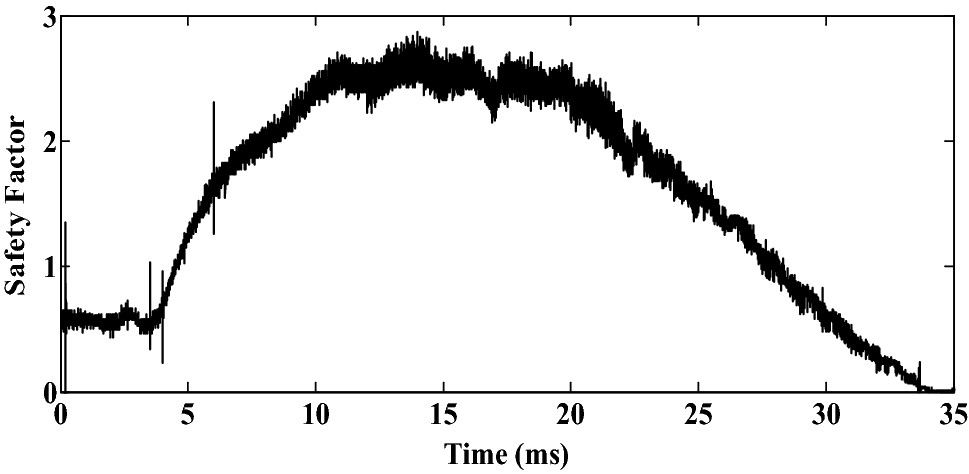
show the experimental signals of a discharge (plasma current, loop voltage and heating power). Figure
4
shows the time evaluation of safety factor. Major disruption is observed in
t=20ms
that annihilates plasma in
t=15ms
.
Pohmic
is the rate of input heating power [
15
].
Fig. 2
a
Plasma current,
b
loop voltage,
c
heating power in a normal shot
Fig. 3
a
Plasma current,
b
loop voltage,
c
heating power in a disruption shot
Fig. 4
Time evaluation of safety factor in IR-T1 tokamak
In this section, we will compare experimental results in the normal and disruption shots obtained in the IR-T1 tokamak.
Plasma evaluations in a normal shot of IR-T1 tokamak,
Plasma evaluations during a disruption of IR-T1 tokamak.
We conclude an increase in MHD oscillations and a loop voltage peak in pre-disruption stage that generate high-energy runaway electrons.
With looking up to above plots in IR-T1 tokamak, we can say that regarding the short discharge duration, plasma disruption will happen very soon and it produces runaway electrons.
In this section, we have the time evaluation of safety factor in IR-T1 tokamak. The safety factor, q, is so called because of the role it plays it determining the stability. If
q=mn
, where m and n are integers, the field line joins up on itself after m toroidal and n poloidal rotations round the torus [
1
].
The safety factor (q) is very important in determining stability and transport theory.
The time evaluation of diamagnetic loop and Mirnov oscillations
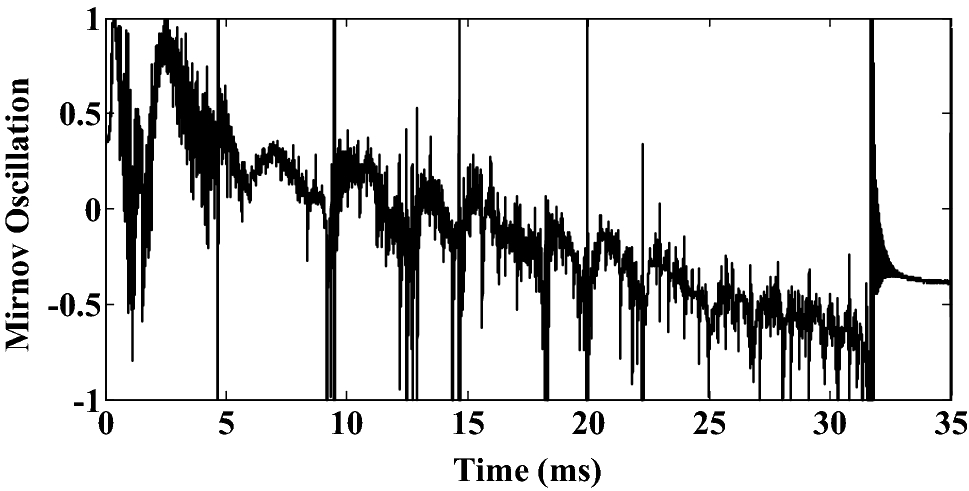
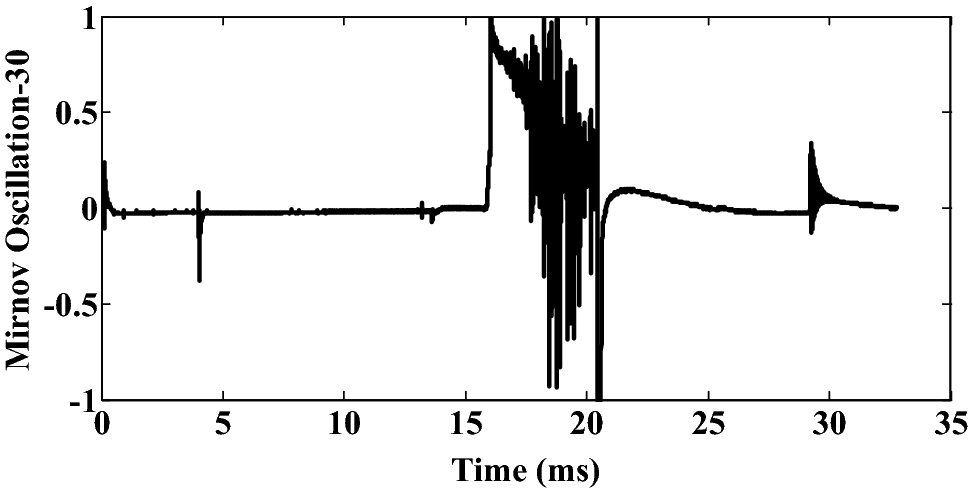
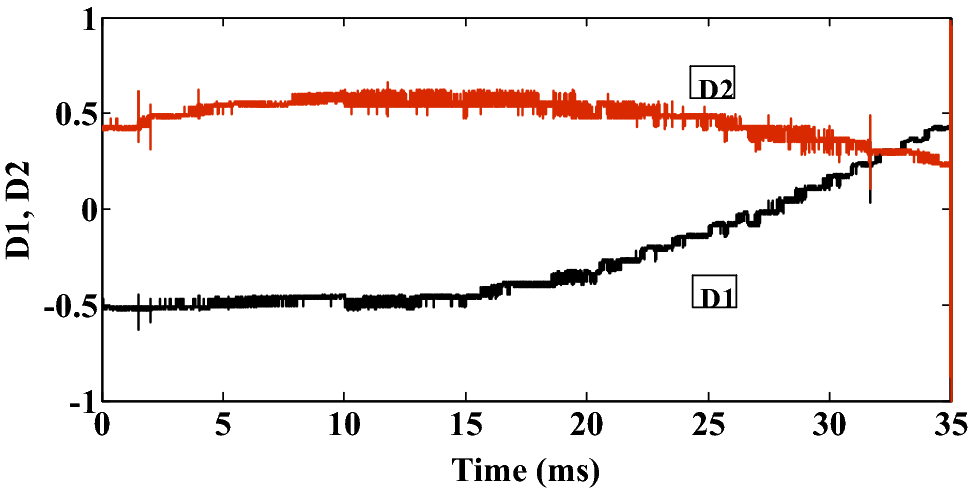
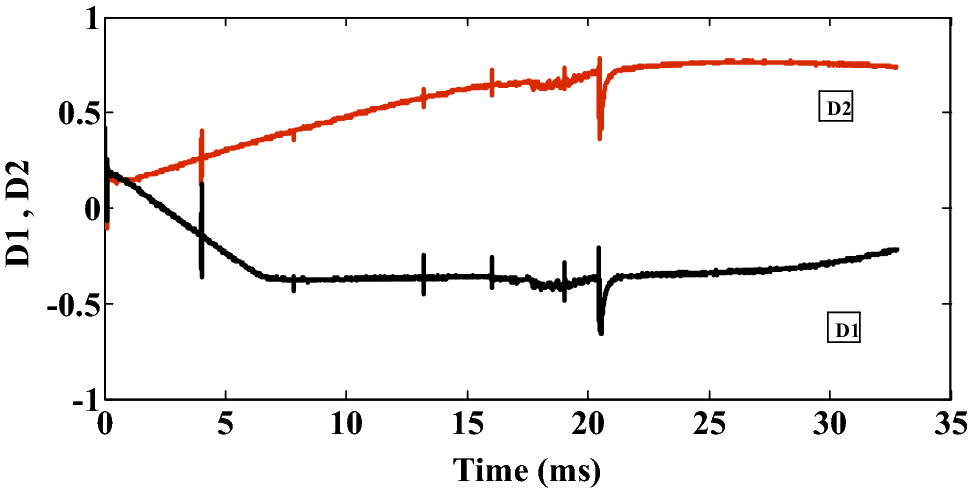
In this section, we study time evaluation of Mirnov oscillations and diamagnetic loop in IR-T1 tokamak in a normal shot and a disruption shot. Figures
5
and
6
show the time evaluation of Mirnov oscillations. Figures
7
and
8
show the time evaluation of diamagnetic loop.
Fig. 5
Time evaluation of Mirnov oscillations in IR-T1 tokamak in a normal shot
Fig. 6
Time evaluation of Mirnov oscillations in IR-T1 tokamak in a disruption shot
Fig. 7
Time evaluation of diamagnetic loop in IR-T1 tokamak in a normal shot
Fig. 8
Time evaluation of diamagnetic loop in IR-T1 tokamak in a disruption shot
We conclude that in pre-disruption stage, increase in MHD oscillations and loop voltage peak causes generation of high-energy runaway electrons.
The plasma disruption in different tokamaks
In this section, we will investigate the plasma disruption in different tokamaks (JET, TEXTOR, TCV, COMPASS, ASDEX Upgrade, and MAST) and we will compare the results with the IR-T1 tokamak.
In JET, a major disruption occurs in the time t = 14/5 (s), and I = 1/2 MA and B = 1/2 T [
16
,
17
].
In TEXTOR, disruption occurs in the time t = 2/01(s), and I = 350 KA and B = 2/4 T [
18
].
In TCV, disruption occurs in the time t = 1/5 (s), and I = 200 KA and B = 1/43 T [
19
].
In COMPASS, disruption occurs in the time t = 1/12 (s), and I = 80 KA and B = 1/15 T [
19
].
In ASDEX Upgrade, disruption occurs in the time t = 1 (s), and I = 0/8 MA and B = 2/5 T [
19
].
In MAST, disruption occurs in the time t = 0/5 (s) and I = 400 KA [
20
].
In IR-T1, disruption occurs in the time t = 20 (ms) [
15
].
We conclude that plasma disruption occurs late in large tokamaks, but early in small tokamaks.
By the way, with looking up to the above plots in IR-T1 tokamak, it is concluded that regarding the short discharge duration, the plasma disruption will happen very soon and it produces runaway electrons, but in large tokamaks like JET, the discharge duration is longer than plasma disruption and production of runaway electrons will happen later.
Conclusions
Many applications of tokamaks such as nanotechnology, plasma disruption, and plasma heating have been investigated recently. In the present study, some disruption parameters in tokamak were analyzed and measured. We showed the time evaluation of Plasma current,
Ip
, loop voltage,
Vloop
and power heating in a major disruption, and then we compared the results with a normal shot. We also showed the time evaluation of plasma safety factor. We showed an increase in MHD oscillations and loop voltage peak in pre-disruption stage that causes generation of high-energy runaway electrons. We also showed the time evaluation of diamagnetic loop and Mirnov oscillations in a major disruption and then we compared the results with a normal shot. We also investigated the plasma disruption in the different tokamaks and then we compared the results with the IR-T1 tokamak. We conclude that plasma disruption occurs late in large tokamaks, but early in small tokamaks.
Publisher's Note
Springer Nature remains neutral with regard to jurisdictional claims in published maps and institutional affiliations.
Burrell et al. (2004) Improved charge-coupled device detectors for high-speed, charge exchange spectroscopy studies on the DIII-D tokamak10.1063/1.1787949
Hennequin et al. (2006) Fluctuation spectra and velocity profile from Doppler backscattering on Tore Supra10.1088/0029-5515/46/9/S12
Onchi et al. (2013) Effects of compact torus injection on toroidal flow in the STOR-M tokamak10.1088/0741-3335/55/3/035003
Gomes et al. (2003) High dispersion spectrometer for time resolved Doppler measurements of impurity lines emitted during ISTTOK tokamak discharges10.1063/1.1537039
Neverov et al. (2015) Influence of molecular clustering on the interpretation of diffractograms of hydrocarbon films from tokamak T-1010.1134/S1063778815100075
Nechaev and Alexeeva (2003) On the nature, capability and reversibility of hydrogen storage in novel carbon nanomaterials for mobile power units10.1016/S0360-3199(03)00004-1
Constantinescu et al. (2008) On the accuracy of some mapping teqniques used to study the magnetic field dynamics in tokamaks10.1088/0029-5515/48/2/024017