Department of Chemistry, Doroud Branch, Islamic Azad University, Doroud, IR
Abstract
One of the pollutants emitted from automobile exhaust is unburned hydrocarbons that include benzene, propane, formaldehyde, butadiene, etc. Due to the carcinogenicity of these substances, eliminating and reducing them in the source of production is essential. Catalytic converters have been developed to reduce these pollutions to low-risk materials in automobile exhaust. In this study, the mechanism of converting butadiene to carbon dioxide is simulated and calculated by rutile titanium dioxide (Titania) nanoparticles (
r
TiO
2
-NP). Then the geometric structure of simulated steps (the conversion butadiene to carbon dioxide) is optimized by DFT method and semi-empirical (ZINDO/S) method is used to calculate the thermodynamic properties. There are three different locations of physical chemistry on the
r
TiO
2
-NPs to get closer pollutants, namely Ti–O (1), Ti–O (2), and Ti–Ti. The results show the approaching possibility of butadiene to Ti–O (1) is more than other locations, because the bond length, electronegativity and spatial structure of this position are different from others.
Introduction
The motor vehicles pollute the air more than any other activity of human [
1
,
2
,
3
–
4
]. By regular inspection and repair of engines and using clean fuel, entry of pollutants into the environment can be decreased [
5
,
6
]. The gases released by vehicles included unburned hydrocarbons, carbon monoxide and nitrogen oxides [
7
,
8
]. There are many ways to get better fuel burning. The main source of unburned hydrocarbon emissions from the automobile exhaust is the design of the combustion chamber. For better burning, fuel should have more contact with the combustion chamber wall, so the surface of the combustion chamber walls should be minimized as possible; for this, the chamber should be of spherical shape but practically it is not possible [
9
,
10
–
11
]. Hydrocarbons in the fuel are composed of 20 species and 100 subspecies, of which the majority of them are in the exhaust gases, e.g., benzopyrene, formaldehyde, butadiene, etc. [
12
].
The aim of this study is an evaluation of low-cost methods that can reduce many of these pollutants. Using suitable nano-filters in the exhaust of an automobile can be converted unburned hydrocarbons to low-risk compounds [
13
,
14
,
15
–
16
]. The titanium dioxide is include photo-chemistry material of the semiconductor and nano-magnets. TiO
2
(titania) has some unique characteristics such as photo-physical and photocatalysts, if their dimensions are nanoscale, these features will appear. Because of smaller dimensions of semiconductor particles, there is increased number of atoms located on the surface, and increased surface to volume ratio. This gives greater access to active sites and is increasing the amount of electrical charge carrier transfer [
17
].
Therefore, the interaction of rutile titanium dioxide nanoparticles (
r
TiO
2
-NP) and butadiene is simulated by software GaussView 5.0.
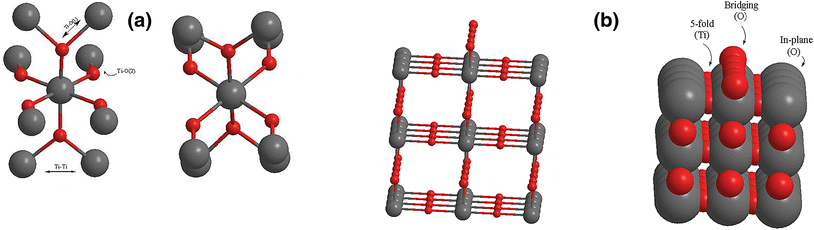
Butadiene interaction on different places of rutile titanium dioxide nanoparticles is simulated and is optimized. The geometric structures of converting them to low-risk products are calculated. Figure
1
is a model of the ball and spring for rutile titanium dioxide nanoparticles (
r
TiO
2
-NP), which shows the two views and another size for it [rutile TiO
2
(110) nano-surface] [
18
,
19
]. In this study, rutile titanium dioxide nanoparticles (
r
TiO
2
-NP) are used, the pollutants close to the cross bridges of Ti–O (1), Ti–O (2) and Ti–Ti on
r
TiO
2
-NP and the thermodynamic properties were evaluated by semi-empirical (ZINDO/S) method [
20
,
21
].
Fig. 1
Ball-and-stick model configuration of
a
rutile TiO
2
nanoparticle front view (to specify the location of
three
) and
top view
,
b
rutile TiO
2
(110) nano-surface
Computational methods
Basically, the behavior of titanium dioxide photocatalysts is dependent on the electrical structure and its dimensions. A nano-material may have a different behavior which is determined using electrical structure, quantum size and the effects of the surface [
22
]. The electronic structure design is important based on changes in the composition and physical structure. For this purpose, the thermodynamic and electrical properties of chemical process are calculated semi-empirically; the ZINDO/S method is widely used to calculate the heat of formation, the geometry of the molecule, ionization energy, electron continuity, and other features [
23
]. The geometric structures are optimized by the DFT because the results could be obtained with a better accuracy [
24
,
25
].
Rutile is a body-centered tetragonal unit cell, with unit cell parameters
a
=
b
= 4.584 Å, and
c
= 2.953 Å. The titanium cations have a coordination number of 6 meaning they are surrounded byQuery an octahedron of 6 oxygen atoms. The oxygen anions have a coordination number of 3, they result in a trigonal planar coordinated structure. The rutile also shows a screw axis when its octahedra is viewed sequentially [
26
]. This k-point grid constrained the total energy within 0.01 eV Å
−1
/atom and the diagonal elements of the response matrix within 1%. However, convergence of the final results was not achieved, due to numerical instability of the inversion of a near-singular matrix. A cutoff of 500 eV, and k-point mesh of 4 × 4 × 6, centered on the Γ point, was found to be sufficient for rutile TiO
2
-NP [
27
].
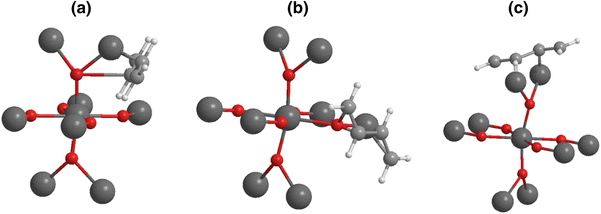
In this study is calculated and studied the approaching pollutants to Ti–O bond (the first and second probability are two different locations of Ti–O on
r
TiO
2
-NP and the third probability is Ti–Ti bond) (Fig.
2
). So geometrical structures of them are optimized by B3LYP/6-31G. Their thermodynamic properties are assessed by the ZINDO/S in semi-empirical method.
Fig. 2
Probability of butadiene interaction with different location of
r
TiO
2
-NP;
a
Ti–O (1),
b
Ti–O (2) and
c
Ti–Ti
Results and discussion
The Z-matrix files write for titanium dioxide nanoparticles structure (angles and length of bonds between oxygen and titanium) by experimental data of X-ray diffraction (Fig.
1
) [
28
], then Z-matrix files are optimized by the B3LYP method with 6-31G-based set on the GAMESS program package under Linux [
29
]. Oxidation of butadiene into carbon dioxide and oxygen is:
C4H6+rTiO2-NP→C4H4-rTiO2-NP+H2C4H4-rTiO2-NP+2H2→2C2H4+rTiO2-NP2C2H4-rTiO2-NP+4O2→4CO2+4H2+rTiO2-NP
Pollutants near the outside surface of TiO
2
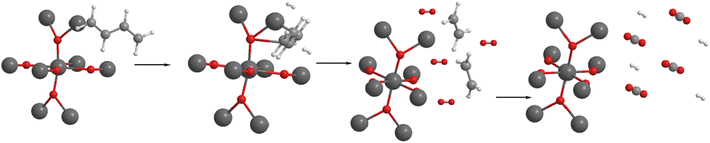
(titania) nano-structure and are bonded to the surface and electron exchange takes place between them, then the pollutants are converted to carbon dioxide. Figure
3
shows all steps of the simulation for butadiene interaction to CO
2
and H
2
.
Fig. 3
Ball-and-stick model configuration of butadiene interaction on cross bridge of Ti–O in rutile TiO
2
nanoparticle
In this study, the interaction of butadiene with
r
TiO
2
nanoparticles have been simulated in nine steps (Fig.
3
); from first and second steps butadiene is closed in
r
TiO
2
-NPs, then in the third step, transition state of conversion of butadiene to ethylene occurs, in the fourth step product generated from the surface is removed. In fifth and sixth steps, the ethylene molecules are closed on the surface and in the seventh and eight step transition state conversion of them to CO
2
and H
2
, respectively. Then conversion was completed in ninth step and CO
2
molecules are produced, then it is excreted from
r
TiO
2
-NPs. The electronic structure and the thermodynamic properties are calculated for all steps by ZINDO/S-DFT.
The thermodynamic properties of these interactions on Ti–O and Ti–Ti cross bridges are shown in Tables
1
,
2
, and
3
. All thermodynamic properties are shown in the table except that the dipole moment and RMS gradient are obtained by the following equation:
ETinitial=ET(clean surface)+ET(molecule)ETfinal=ET(surface with molecule)Eads=ΔET=ETfinal-ETinitial.
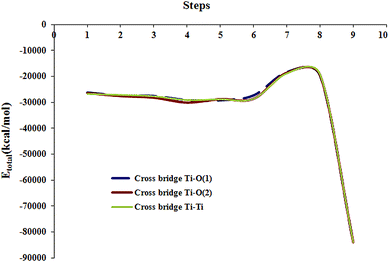
From Fig.
4
and Tables
1
,
2
, and
3
, the lowest energy is in the final product (CO
2
), which shows molecules of carbon dioxide are more stable than butadiene molecules. In third and sixth steps, a sudden change in energy and other thermodynamic parameters calculated is observed. For the intermediate to product, this sudden change in energy can be seen in seventh and eighth steps.
Table 1
The thermodynamic properties of butadiene interaction on Ti–O (1) cross bridge in
r
TiO
2
-NP at 298 K by ZINDO/S-DFT
Cross bridge of Ti–O(1) in rutile
Etotal (kcal/mol)
Dipol moment (D)
RMS (kcal/mol Å)
Ebin (kcal/mol)
H (kcal/mol)
Gele (kcal/mol)
Enuc (kcal/mol)
rTiO2-NP
−67,934.53
3.81
415.1
−12,183.09
−10,815.04
−237,906.98
169,972.45
Butadiene
−16,581.28
0.0006
181.7
−3476.01
−2479.84
−39,587.18
23,005.89
Steps
ΔEtotal (kcal/mol)
Dipol moment (D)
RMS (kcal/mol Å)
ΔEbin (kcal/mol)
ΔH (kcal/mol)
ΔGele (kcal/mol)
ΔEnuc (kcal/mol)
1
−26,458.97
5.44
344.0
−5577.57
−6223.88
−172,072.64
145,613.68
2
−27,619.08
12.41
356.2
−6737.68
−7384.00
−187,887.55
160,268.48
3
−28,226.18
29.17
400.1
−7344.79
−7991.10
−195,280.72
167,054.54
4
−30,119.62
10.1
359.4
−8635.87
−9177.98
−214,876.40
184,756.79
5
−28,789.34
92.87
350.0
−7305.49
−7847.60
−203,010.80
174,221.57
6
−28,678.36
9.835
340.3
−7194.61
−7736.72
−201,480.16
172,801.81
7
−18,629.06
12.93
382.5
−3999.13
−5091.42
−118,905.54
100,276.87
8
−19,487.68
5.64
394.5
−4857.75
−5950.05
−125,876.54
106,388.87
9
−83,987.85
3.08
429.0
−8596.51
−9078.97
−428,239.59
344,251.75
Table 2
The thermodynamic properties of butadiene interaction on Ti–O (2) cross bridge in
r
TiO
2
-NP at 298 K by ZINDO/S-DFT
Cross bridge of Ti–O(2) in rutile
Etotal (kcal/mol)
Dipol moment (D)
RMS (kcal/mol Å)
Ebin (kcal/mol)
H (kcal/mol)
Gele (kcal/mol)
Enuc (kcal/mol)
rTiO2-NP
−67,934.53
3.81
415.1
−12,183.09
−10,815.04
−237,906.98
169,972.45
Butadiene
−16,581.28
0.0006
181.7
−3476.01
−2479.84
−39,587.18
23,005.89
Steps
ΔEtotal (kcal/mol)
Dipol Moment (D)
RMS (kcal/mol Å
ΔEbin (kcal/mol)
ΔH (kcal/mol)
ΔGele (kcal/mol)
ΔEnuc (kcal/mol)
1
−26,232.51
4.31
342.3
−5351.12
−5997.43
−164,271.48
138,038.97
2
−27,467.56
1.59
346.1
−5986.16
−6632.48
−177,283.27
150,415.72
3
−27,589.74
3.15
360.5
−6708.35
−7354.66
−192,223.27
164,633.54
4
−29,167.95
9.74
350.8
−7684.19
−8226.30
−210,184.10
181,016.17
5
−29,217.84
12.52
350.5
−7734.09
−8276.20
−209,506.96
180,289.13
6
−27,355.74
4.36
334.0
−5871.99
−6414.10
−177,516.90
150,161.17
7
−18,382.37
5.03
364.6
−3752.43
−4844.73
−113,035.17
94,652.82
8
−19,626.32
10.20
386.4
−4996.38
−6088.68
−132,141.66
112,515.35
9
−83,987.85
3.08
429.0
−8596.51
−9078.97
−428,239.59
344,251.75
Table 3
The thermodynamic properties of butadiene interaction on Ti–Ti cross bridge in
r
TiO
2
-NP at 298 K by ZINDO/S-DFT
Cross bridge of Ti–Ti in rutile
Etotal (kcal/mol)
Dipol moment (D)
RMS (kcal/mol Å)
Ebin (kcal/mol)
H (kcal/mol)
Gele (kcal/mol)
Enuc (kcal/mol)
rTiO2-NP
−67,934.53
3.81
415.1
−12,183.09
−10,815.04
−237,906.98
169,972.45
Butadiene
−16,581.28
0.0006
181.7
−3476.01
−2479.84
−39,587.18
23,005.89
Steps
ΔEtotal (kcal/mol)
Dipol moment (D)
RMS (kcal/mol Å)
ΔEbin (kcal/mol)
ΔH (kcal/mol)
ΔGele (kcal/mol)
ΔEnuc (kcal/mol)
1
−26,814.27
8.77
348.0
−5932.87
−6579.19
−172,332.05
145,517.80
2
−27,178.88
4.35
349.0
−6297.49
−6943.80
−176,624.66
149,445.78
3
−27,676.93
4.70
359.0
−6795.54
−7441.86
−182,809.02
155,132.09
4
−29,156.8
4.72
346.0
−7673.06
−8215.17
−199,896.91
170,746.12
5
−28,840.93
9.51
348.4
−7357.18
−7899.29
−196,659.05
167,818.12
6
−28,700.85
9.29
354.3
−7217.10
−7759.20
−197,025.66
168,324.79
7
−18,932.02
2.96
374.9
−4302.08
−5394.38
−115,417.08
96,485.07
8
−19,155.24
2.83
384.1
−4525.31
−5617.60
−117,886.44
98,731.21
9
−83,987.85
3.08
429.0
−8596.51
−9078.97
−428,239.59
344,251.75
Fig. 4
The total energy of butadiene interaction on
r
TiO
2
-NP by ZINDO/S method
The third step is transitioning state of butadiene to ethylene molecules. The sixth step is transitioning state of ethylene to CO
2
. Dipole moments for all steps are calculated and are shown in Tables
1
,
2
, and
3
, most changes of which are in the transition state of intermediates (third and sixth steps).
As the results show, from comparisons of data in Tables
1
,
2
and
3
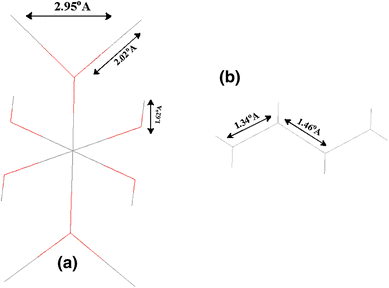
, the probability of pollutant interaction on cross bridge of Ti–O (2) is more than other locations. The distance of Ti–O (1), Ti–O (2) and Ti–Ti bonds are equal to 2.02, 1.62 and 2.95 Å, respectively (Fig.
5
). The electronegativity difference (Δχ) of Ti–O and Ti–Ti are 2.90 and 0. The bond number of Ti–O is more in the structure of
r
TiO
2
-NP and space inhibited of Ti–O is also less than Ti–Ti. Bond length of Ti–O (2) is closer to the bond lengths of C=C and C–C in butadiene (Fig.
5
).
Fig. 5
The stick model configuration of
r
TiO
2
-NP and butadiene with their bond length
To access to the electrical properties these interactions are used the electrical energy and it is obtained from the following equation [
30
]:
Eelec=RI,
where
R
is the electrical resistance and
I
is the current intensity per (A), that
I
can be found from
I=qt
yielding the following equation:
R=EelectnF.
The electrical resistance of all steps and conversions are computed based on electrical data, Eqs. (
2
) and (
3
), as can be seen in Fig.
6
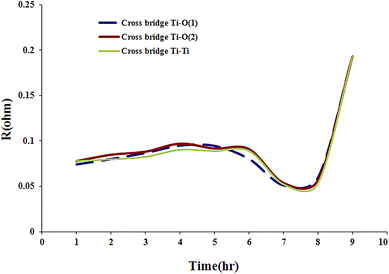
. The electrical resistance of Ti–O bonds is different from Ti–Ti for the second to seventh steps, but for all bonds in the transition state of intermediate, the electrical resistance increases, the electrical resistance of CO
2
is decreased; in these conditions increases the electrical conductivity and the electron exchange of butadiene and
r
TiO
2
-NP is easier to occur than in transition state steps.
Fig. 6
The electrical resistance of butadiene interaction on
r
TiO
2
-NP by ZINDO/S method
Equation constant and other thermodynamic parameters such as Gibbs free energy, enthalpy and entropy of the whole reactions were computed through the following equation:
K=exp-ΔGeleRt.
where
T
is the reaction temperature that is considered to be 298 K. The entropy reactions are computed by:
ΔSele=ΔHeleT
Other thermodynamic properties of intermediate with raw materials and intermediate with products are shown in Table
4
. These data show
r
TiO
2
-NP acts as photo-catalyst for the removal of pollutants in the source of production. These interactions are spontaneous and favorable. The thermodynamic parameters in Table
4
show the interaction of butadiene with the Ti–O (2) bound is more possible.
Table 4
The thermodynamic properties of butadiene interaction on
r
TiO
2
-NP by ZINDO/S method
LnK
ΔSele (cal/K mol)
ΔHele (kcal/mol)
ΔGele (kcal/mol)
Cross bridge of Ti–O(1)
Butadiene to ethylene
−23,208.08
−1767.22
71.95
9,367,268
Ethylene to CO2
−6971.00
−858.63
20.51
2,813,642
Cross bridge of Ti–O(2)
Butadiene to ethylene
−27,951.79
−1357.23
89.24
11,281,928
Ethylene to CO2
−19,106.49
−1243.95
59.94
7,711,780
Cross bridge of Ti–Ti
Butadiene to ethylene
−10,476.97
−862.67
32.26
4,228,725
Ethylene to CO2
−2469.36
−223.22
7.54
996,685.5
Conclusion
Anatase and rutile have the same chemical formula (TiO
2
) and have same geometrical symmetry (tetragonal) but show different physicochemical properties. Titanium dioxin molecules on the metal surface are activated by ultraviolet radiation and during some chemical processes make bacteria, algae and fungi disappear [
31
]. When ultraviolet ray is radiating to titanium dioxide, the electrochemical reactions are happening and is created the production of free radicals. Free radicals are combined with pollutants and destroy them.
After attraction of the sun’s ultraviolet by
r
TiO
2
-NP, the electrons of capacity balances are displaced to guide band balance, and an empty hole appears in capacity balance, so the following can be considered:
TiO2+hν→TiO2ecb-+holevb+H2O→OH-+H+
The results show that the approach and conversion of this interaction are endothermic reaction and for this conversion sunlight (solar energy) or other energies are necessary. As the high temperature (900 °C) of automotive exhaust gases can provide energy for this interaction, in this study, all of the possibilities of interaction between butadiene interaction on
r
TiO
2
-NP are investigated, the cross bridge of Ti–O (2) is suitable for converting this interaction. The use of nano-catalysts for the conversion of unburned hydrocarbons (butadiene) to low-risk products is affordable. Dipole moments of
r
TiO
2
structure on the location of Ti–O are more than Ti–Ti, which is related to the electronegativity difference.
References
Ogwu et al. (2015) An Investigative approach on the effect of air pollution on climate change and human health in the niger delta region of Nigeria 2(5) (pp. 37-49)
Razak et al. (2013) Economics of air pollution in Malaysia 3(13) (pp. 173-177)
Ahmad Khan and Ghouri (2011) Environmental pollution: its effects on life and its remedies (pp. 276-285)
Small and Kazimi (1995) On the costs of air pollution from motor vehicles (pp. 7-32)
Naima and Liazid (2013) Waste oils as alternative fuel for diesel engine: a review 4(3) (pp. 30-43)
Wang et al. (2003) Progress of waste plastics pyrolysis 22(2) (pp. 130-134)
Unknown ()
Heinsohn and Kabel (1999) (pp. 652-666) Prentice Hall
Unknown ()
Orlandini and Riedel (2004) Oxidation of propene and the formation of methyl nitrate in non-thermal plasma discharges (pp. 83-88) 10.1016/j.cattod.2003.11.018
Unknown ()
Martyr and Plint (2007) Butterworth-Heinetmann
Dhage et al. (2004) Synthesis of nanocrystalline TiO2 at 100 °C 58(17–18) (pp. 2310-2313) 10.1016/j.matlet.2004.02.021
Torres et al. (2007) A comparison between bulk and supported TiO2 photocatalysts in the degradation of formic acid 24(2) (pp. 185-192) 10.1590/S0104-66322007000200003
Jones et al. (2007) Cleavage of peptides and proteins using light-generated radicals from titanium dioxide 79(4) (pp. 1327-1332) 10.1021/ac0613737
Salarvand and Mahdavian (2016) Thermodynamic study of dioxin reduced by TiO2 nanoparticles from environment 5(1) (pp. 18-22) 10.1166/eef.2016.1185
Salarvand and Mahdavian (2015) Comparison of Ti-Ti and Ti-O bonds in nano-surfaces of rTiO2 (110) for Conversion Dibenzodioxine to CO2 9(5) (pp. 648-655)
Ridley and Zerner (1973) An intermediate neglect of differential overlap technique for spectroscopy: pyrrole and the azines 32(2) (pp. 111-134) 10.1007/BF00528484
Becke (1993) Density functional thermochemistry. III. The role of exact exchange (pp. 5648-5652) 10.1063/1.464913
Yang and Parr (1988) Development of the Colle-Salvetti correlation-energy formula into a functional of the electron density (pp. 785-789) 10.1103/PhysRevB.37.785
Ulrike (2003) The surface science of titanium dioxide (PDF) 48(5–8) (pp. 53-229)
Zhang et al. (2007) Structure of rutile TiO2 (110) in water and 1 molal Rb+ at pH 12: inter-relationship among surface charge, interfacial hydration structure, and substrate structural displacements (pp. 1129-1143) 10.1016/j.susc.2006.12.007
Unknown ()
Unknown ()
Unknown ()
Varghese et al. (2009) Grimes high-rate solar photocatalytic conversion of CO2 and water vapor to hydrocarbon fuels 9(2) (pp. 731-737) 10.1021/nl803258p