Department of Electronics Engineering, Indian School of Mines, Dhanbad, Jharkhand, 826004, IN
Abstract
Optical fiber loss is a limiting factor for high-speed optical network applications. However, the loss can be compensated by variety of optical amplifiers. Raman amplifier and EDFA amplifier are widely used in optical communication systems. There are certain advantages of EDFA over Raman amplifier like amplifying the signal at 1550 nm wavelength at which the fiber loss is minimum. Apart from that there is no pulse walk-off problem with an EDFA amplifier. With the advent of optical amplifiers like EDFA, it is feasible to achieve a high bit rate beyond terabits in optical network applications. In our study, a MATLAB simulink-based forward pumped EDFA (operating in C-band 1525–1565 nm) simulation platform has been devised to evaluate the following performance parameters like gain, noise figure, amplified spontaneous emission power variations of a forward pumped EDFA operating in C-band (1525–1565 nm) as functions of Er
3+
fiber length, injected pump power, signal input power, and Er
3+
doping density. The effect of an input pump power on gain and noise figure was illustrated graphically. It is possible to completely characterize and optimize the EDFA performance using our dynamic simulink test bed.
Introduction
Scattering and absorption-induced loss in an optical fiber communication system is the major factor for a limiting the high bit rate. Since the inception of single mode laser in early 1990 such as DFB laser which enables the optical signal to be directly amplified in optical domain, transmission distances exceed several thousand kilometers. The loss compensation by electrical repeaters is obsolete at present due to high installation costs and complexity. With the advent of single-mode laser more advanced optical amplifiers are developed like semiconductor laser amplifier, Raman amplifiers, Brillouin amplifier, and rare-earth-doped fiber amplifiers (EDFA) [
1
–
3
]. EDFA amplifier is a lumped amplifier in nature compared to Raman amplifier which is distributed in nature. Forward Raman amplifier suffers pulse smearing and data loss due to the pulse walk-off effect in DWDM amplification systems. However, the backward and bidirectional Raman amplifier does not suffer so much. EDFA amplifier does not suffer for gain equalization problem compared to Raman amplifier. Recently, hybrid amplifiers which include the quality of both amplifiers are also developed to achieve the extremely high data rates. Due to these reasons, EDFA amplifier is a good contender for high-bit-rate systems beyond terabits [
4
].
Modeling followed by optimization of such amplifier is a great concern for researchers at present. To model such optical amplifiers, several models have been proposed based on application oriented tools. These models are mostly static. Here we proposed for the first time a MATLAB based dynamic simulink test bed to model forward pump EDFA performance [
5
–
14
]. Here the dynamic models mean a user has a choice to choose the input variables to study its performance. Section “
Mathematics foundation
” describes the necessary background like the governing equations for signal and pump along with its implications. In Fig.
1
, the devised dynamic simulink test bed is presented followed by graphical results and their interpretations in Sect. “
Performance evaluation by our proposed simulink test bed
”. Finally in Sect. “
Conclusion
”, the complete work is summarized.
Fig. 1
EDFA simulink model
Mathematics foundation
In this paper, a three-level rate equation model is applied for EDFA modeling. The EDFA gain is dependent on so many parameters like Erbium ion (Er
3+
) concentration, fiber length (
L
), core radius, and pump power to mention a few. We develop the simulink model because the governing equation does not lead to analytical result for certain conditions. The population densities of the state
N2
is given as [
2
]
∂N2∂t=Pp0,t1-expGp-Ps0,t1-expGs-N2τ
with
Gp=ΓpσpaN2A-ΓsσpaρL
and
Gs=ΓsσseN2A-ΓsσsaN1A,
where
σpa
area of absorption at the pump frequency
ωp
(m
2
),
σpe
area of emission at the pump frequency
ωp
(m
2
),
σsa
absorption cross section at the signal frequency
ωs
(m
2
),
σse
area of emission at the signal frequency
ωs
(m
2
),
τ
spontaneous lifetime of the excited state (about 10 ms for EDFAs),
φj
photon flux for the pump and signal waves =
ΓjPjAhvj
with
j
=
p
,
s
,
Pj
optical power of pump and signal waves in mW with
j
=
p
,
s
, respectively,
A
cross-sectional area of the fiber,
vj
frequency of the signal with
j
=
p
,
s
,
N1
erbium ion populations at the ground state,
N2
erbium ion populations at excited state.
Also
Nt
= total population of erbium ion =
N1
+
N2
=
ρ
AL with the assumption that
N3
= 0, where
ρ
is density of erbium ions (ions/m
3
).
The pump and signal powers are in mW and are related to the power in photons per second as
Pj(photon persec)=Pj(in mW)hvj
Total erbium ion population can be given as
Nt=N1+N2=ρLA
For multichannel amplification, the modeling equations can be summarized as
∂N2∂t=∑λ0λnPp0,t1-expGp-Ps0,t1-expGs-N2τ.
The designed EDFA dynamic model for multichannel amplification is based on the Eqs. (
2
) and (
4
).
Performance evaluation by our proposed simulink test bed
Figure
1
reveals our proposed dynamic simulink test bed model for EDFA. This figure is drawn for one-signal wavelength and one-pump wavelength. For the present case, the input signal power is assumed to be 0.14 mw. The wavelength of pump and signal are 1480 and 1555 nm, respectively. In Fig.
1
, the blue color shows the input pump and input signal source. Apparently, the readings are then taken directly from the display blocks in the model. The yellow color is used to highlight the display blocks. The required data to run the simulation are indicated in Table
1
. Designing of simulator is started with the signal source and pump source which is shown in Fig.
1
. Here only a single channel is incorporated of 1550 nm and a single pump source of 1480 nm for better understanding and less complexity. However, the simulator can be extended for multiple signal sources using the switches. This parameter with flexibility to change is supplied to calculate the Gs, the amplification gain of the signal and Gp, and the absorption attenuation of the pump power evolution using Eqs. (
2
) and (
3
), respectively. The next section of simulator is implemented to solve the coupled Eq. (
4
) with adequate accuracy by converting power to mW after the calculation being done in terms of photon/sec. The simulation time taken is kept 5 s due to processor limitations. It can be done for desired duration depending upon the level of extension of model. The observing parameters are extracted directly using display block and imported to workspace also for graph generation. Moderately stiff differential equations solver, ode23t (ordinary differential equations 23t) with Trapezoidal rule is used for the evaluation of the differential equations. Practice is done to keep minimum simulation stages to reduce propagation delay.
Table 1
Parameter values for the EDFA simulink environment
Designated parameter
Symbol (unit)
Value
Core radius of EDF
r (μm)
2
Core area of EDF
A (m2) = πr2
12.56e−12
Length of the erbium fiber
L (m)
Variable
Overlap factor of EDFA at wavelength (λ)
Γs, Γp
0.4
Ion density (Er3+) of erbium-doped fiber
ρ (ions/m3)
6.3e24
Population density in ground state
N1 (ions)
Simulated
Population density in meta-stable state
N2 (ions)
Simulated
Signal power
Psig (μW)
140
Signal wavelength (C-band)
λs (nm)
1555
Pump power
Ppump (dBm)
Variable
Pump wavelength
λp (nm)
1480
Florescence lift time of EDFA
τ (ms)
10
Area pump absorption
σpa (m2)
0.75e−25
Area signal absorption
σsa (m2)
2.40e−25
Area signal emission
σse (m2)
3.80e−25
Plank constant
h (Js)
6.626e−34
Speed of light
c (m/sec)
2.9e8
Optical bandwidth
Nm
25
Scattering loss factor
γ
0
For very high-spectral efficiency and long-haul communication system, a quantum well laser is model based on the rate equations [
3
]. This quantum well laser is used as the pump source in Fig.
1
. It is apparent from the literature that ASE noise by adding to the signal leads to reduce signal-to-noise ratio (SNR) at the end of amplifier. Also noise figure (NF) is defined as for similar to electronic amplifier as the ratio of input signal-to-noise ratio with output signal-to-noise ratio. By the definition of an optical amplifier, the noise figure in terms of gain is given as [
7
]
NFOPT=(S/N)in(S/N)out=nspG-1G+1G.
The attenuation depends on input pumps power. A fixed input signal power and different attenuation-dependent input pump powers were applied on to the input of erbium doped fiber for a variable length of fiber. We assumed constant erbium doping density for present case. Figure
2
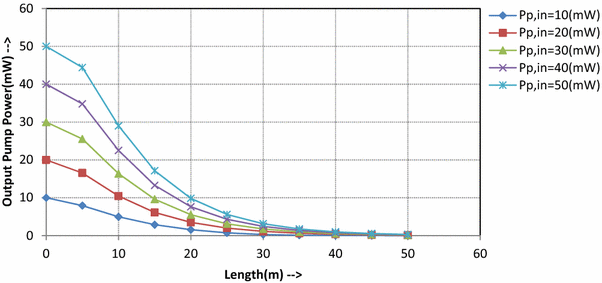
reveals the output pump power variations along the length of fiber for input pump power 10, 20, 30, 40, and 50 mw, respectively, while a fixed input signal power is −8.401 dBm. It is apparent from the Fig.
2
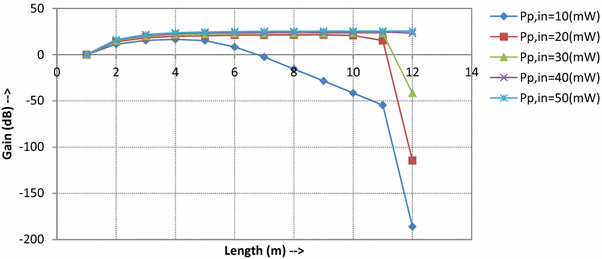
that pump power rapidly depletes along the fiber length due to erbium absorption which is expected as pump power transfers to the signal rapidly. The fiber intrinsic loss, which is less dominating for short length fiber may cause higher pump depletion for longer than effective length of fiber. Due to high pump depletion beyond the effective length of fiber, the gain experienced by the amplifier begins to decrease after a saturation level. The variation of gain versus fiber length is shown in Fig.
3
for different input pump powers as mentioned; this figure corresponds to constant signal input power and erbium density. This graph corresponds to five different input pump power levels while input signal power level is 140 mw with ion density of EDFA of 6.3e24. Figure
3
reveals that gain increases up to a certain limit than begins to decrease after a saturation point. The reason for gain reduction is insufficient population inversion due to excessive pump depletion.
Fig. 2
The attenuation of pump power along an erbium doped fiber
Fig. 3
The variation of gain with fiber length for different pump power (mW)
It is also apparent that after a saturation point, the total loss which is an intrinsic fiber loss and Er
3+
absorption loss is more dominant with respect to the delivered gain at the given signal frequency. Figure
4
reveals the variation of gain with input pump power (mW) for various length of fiber, with a fix signal power and erbium ion doping density. In this case, a fix 140 μW signal power is supplied to the input of an EDFA for 11 different fiber length cases, while the supplied input pump power is enhanced from 0 to 50 mw. It is apparent that the gain of the EDFA enhances with respect to the pump power and finally goes into saturation level after pump power is substantial. It happens when the population inversion occurred in erbium ions, as a result of which amplifier goes into saturation. In turns, a higher gain can be achieved if a sufficiently lengthy erbium doped fiber is chosen with substantially high pump power.
Fig. 4
The variation of gain with input pump power (mW) observed for various fiber lengths (m)
Figure
5
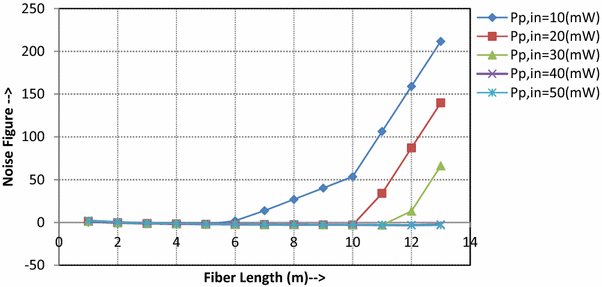
reveals the noise figure versus variable fiber length while pump power vary for constant input signal power and erbium ion density. This plot corresponds to input signal power of 140 μW. The noise figure substantially increases while input pump power keeps on increasing from 10 to 30 mw along the fiber length. It happens due to decreases in gain with excessive pump depletion. Figure
6
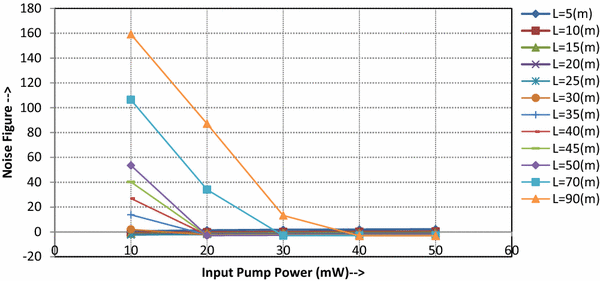
reveals the change in noise figure with respect to pump power while the length of fiber varies at a constant input signal power. This plot corresponds to 1040 μW input signal power while the pump power is enhanced from 0 mw up to 50 mw for six different fiber lengths. It is apparent from this plot as input pump power increases, the noise figure keeps on decreasing corresponding to these parameters. Moreover, the noise figure changes in linear fashion versus ASE power which shows inverse behavior gain of amplifier. Apparently, as the gain further increases the noise figure tends to be minimum for EDFA.
Fig. 5
The variation of noise figure with fiber length taking input pump power from 10 to 50 mW
Fig. 6
The variation of noise figure with pump power
Figure
7
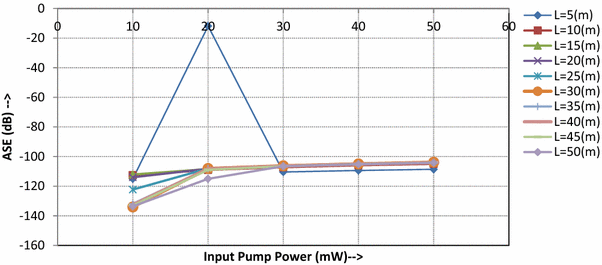
corresponds to the dependency of ASE power in EDFA with respect to pump power variation from 10 to 50 mw. This plot corresponds to 140 μW signal input power. The amplified spontaneous emission power travels round trip in the EDFA. This graph corresponds to the forward ASE while considering the noise figure effect. It is apparent that ASE power enhance with length of fiber because of the gain delivered by EDFA and achieves the maximum quantity for extra pump power.
Fig. 7
The variation of ASE power for different fiber lengths
Conclusion
In this paper, an EDFA working in C-band is modeled using MATLAB simulink with Quantum well laser as the pump source for the first time, providing better gain and less attenuation. The pump source is operating at 1480 nm. An accurate model with supporting mathematics is elaborated and the results are presented graphically. The model is characterized on the basis of rate equations. It has been demonstrated that the pump power applied to EDFA dramatically affects the absorption peak of EDFA. Moreover, the gain and noise figure are also highly dependent on pump power versus fiber length. These properties of EDFA are very decisive for its deployment in local area network. It is shown that when pump is provided with sufficient high power then EDFA may go into saturation region while providing maximum gain having less noise figure.
References
Novak and Gieske (2002) Simulink model for EDFA dynamics 20(6) (pp. 986-992) 10.1109/JLT.2002.1018810
Novak and Gieske (2002) Analytic model for gain modulation in EDFAs 20(6) (pp. 975-985) 10.1109/JLT.2002.1018809
Unknown ()
Keiser (2000) (pp. 400-417) McGraw Hill
Yahaya et al. (2013) A review of routing strategies for optical burst Switched Networks (pp. 315-336) 10.1002/dac.1345
Roy and Priye (2013) Performance analysis of dynamic erbium-doped fiber amplifier simulator 52(4) (pp. 1-11)
Roy and Priye (2013) Performance analysis of an optically amplified add/drop wavelength division multiplexing fiber communication link 52(7) (pp. 1-11)
Unknown ()
Biswas (2012) Modeling of wide-band optical signal amplification in an EDFA network 4(4) (pp. 158-160)
Altuncu et al. (1996) Gain and noise figure characterization of a 68 km long distributed erbium doped fibre amplifier 32(19) (pp. 1800-1801) 10.1049/el:19961180
Giles and Desurvire (1991) Propagation of signal and noise in concatenated erbium-doped fiber optical amplifiers 9(2) (pp. 147-154) 10.1109/50.65871