Institute of Chemistry, University of the Punjab, Lahore, 54590, PK
Interdisciplinary Research Centre in Biomedical Materials, COMSATS Institute of Information Technology, Lahore, 54000, PK
Center for Nano and Micro Mechanics, Tsinghua University, Beijing, 100084, CN
Department of Applied Chemistry, GC University Faisalabad, Faisalabad, 38000, PK
Abstract
Uniform porous anodized aluminum oxide (AAO) membrane has been synthesized by two-step anodization for fabricating tungsten trioxide (WO
3
) nanowires. Under assayed conditions, uniform porous structure of alumina (Al
2
O
3
) membrane with long range ordered hexagonal arrangements of nanopores was achieved. The self-assembled template possesses pores of internal diameter of 50 nm and interpore distance (
dint
) of 80 nm with a thickness of about 80 µm, i.e., used for fabrication of nanostructures. WO
3
nanowires have been fabricated by simple electroless deposition method inside Al
2
O
3
nanopores. SEM images show tungsten trioxide nanowire with internal diameter of about 50 nm, similar to porous diameter of AAO template. XRD results showed that nanowires exist in cubic crystalline state with minor proportion of monoclinic phase.
Introduction
Porous anodized alumina (PAA) is one of the most exciting nanostructured material which has gained significant attention for applications in gas separation [
1
], drug delivery [
2
], bone fixation [
3
], and a template for nanostructures formation [
4
,
5
]. PAA membrane consists of an ordered hexagonal arrangement of cells with a central pore per cell that elongates from top to bottom of the layer, resembling a honeycomb network [
6
,
7
]. Porous alumina template is formed by the anodization of aluminum metal, which is a self-organized material used for depositing layer of nanoporous oxide [
8
]. These pores are used as template for synthesis/growth of one dimensional (1D) nanostructure and thus, their degree of ordering plays an important role in the homogeneity of the resulting nanomaterials. Therefore, it is important to understand and control the pore size and morphology of PAA membranes [
9
–
11
]. The anodization conditions such as voltage, current density, pH, temperature, and time of anodization play a critical role in controlling the textural properties of AAO membrane in specific electrolyte [
12
,
13
].
Tungsten trioxide (WO
3
) is one of the most promising inorganic materials, which exhibits excellent electrochromic, photochromic, and gasochromic properties and is widely used in electrochemical, solar energy, optical modulation, flat panel displays, and sensors applications [
14
,
15
]. WO
3
nanowires are mainly used for sensing various nitrogen oxides, while nanoporous WO
3
is used for sensing alcohol [
16
,
17
]. The most important feature of sensor based on WO
3
nanowires is that their response is not affected by the extent of humidity. Diverse forms of WO
3
nanowires such as monoclinic [
18
], hexagonal [
19
], and cubic [
20
] have recently been synthesized by adopting different methodologies. Various methods such as electrochemical deposition, electroless deposition, electrophoretic deposition, template filling, sol–gel method, and pressure injection techniques have been employed for the fabrication of tungsten trioxide on template. Among different techniques, electroless deposition is a straightforward and room temperature method for growing nanostructures. It is actually a deposition process that involves the coating of a material on template surface using a chemical agent without applying electric current. Herein, we report the synthesis of highly ordered hexagonal porous anodized alumina structure using two-step anodization, the two-step anodization is a favorable method for generating template nanostructures of improved morphology and for fabricating cubic tungsten trioxide nanowires by simple electroless deposition method.
Materials and methods
Materials and chemicals
High purity (99.99 %) aluminum foil was used for fabrication of PAA membrane. All chemicals and solvents were of analytical grade and were used without any further purification. The anodization voltage was selected after plotting voltage versus time plot.
Fabrication of anodized aluminum oxide templates
For anodization, aluminum foil was degreased with acetone to remove any dirt or grease if present. Then, to minimize the mechanical stress and to change grain boundaries, it was subjected to annealing at 450 °C in a furnace for 5 h at the heating rate of 1 °C/min. The oxides were removed by chemical washing using dilute oxalic acid solution and rinsed with deionized water. Annealed foil was polished electrically in a mixture of ethanol and perchloric acid (1:4 by volume) at 12 V for 3 min at 10 °C.
PAA was fabricated by two-step anodization that was carried out in a specially designed two electrodes cell system using graphite as counter electrode. The distance between two electrodes was 25 mm. First anodization was carried out at 40 V and 5 °C temperature for 300 min with constant stirring in 0.3 M oxalic acid electrolyte. Then, anodized aluminum substrate was washed with chromic acid and phosphoric acid mixture for 30 min to remove oxide layer. In the second anodization, the substrate was again anodized at 40 V for 120 min at 5 °C in 0.3 M oxalic acid with constant stirring. After second anodization, the membrane was immersed in phosphoric acid for 90 min to increase the width of pores.The morphology of all synthesized membranes was studied by Hitachi S-4700 scanning electron microscope (SEM) using.
Generation of tungsten trioxide nanowire by electroless deposition method
Self-assembled PAA was used as template for fabrication of nanowires. The membrane was sonicated in sensitizing mixture of 0.3 wt% SnCl
2
and 2.5 wt% HCl. The sensitization time was optimized to 5 min after a number of experiments, since prolonged dipping of AAO template in SnCl
2
solution results in dissolution of the template. The membrane was rinsed with deionized water and immersed in 0.1 wt% PdCl
2
and 1 wt% HCl mixture for 3 min. The template was again rinsed with deionized water. The sensitized and activated PAAs were immersed in deposition bath for 30 min and washed with deionized water. The composition of deposition bath was sodium tungstate 2.3 × 10
−2
M, Hydrazine hydrate 3.1 × 10
−1
M, sodium potassium tartarate 1.77 × 10
−1
M, and acetic acid 10
−2
M. The WO
3
nanowires were deposited in the pores of alumina membrane and characterized by powder XRD using Rigaku D/Max 2500 VBZ+/PC diffractometer. In order to remove aluminum oxide, the template is dipped in 5 wt% NaOH for 5 min at 25 °C. Then, to remove Al
2
O
3
residues, the template was thoroughly washed with deionized water for 2–3 times. The samples were analyzed by SEM.
Result and discussion
Measurement of current density for anodization
Nanotexturing and self-ordering of pores of anodized alumina mainly depend upon voltage and current density used during the anodization. Optimized value of voltage was measured viz. 40 V. This value agrees with the voltage corresponding to self-ordered anodizing at constant current available in literature [
21
,
22
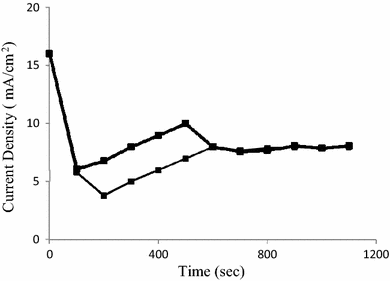
]. Therefore, anodization was carried out in electrolytic solution of 0.3 M oxalic acid at the voltage of 40 V at 5 °C temperature. The variation of current densities with anodization time for both first and second steps of anodization is graphically represented in Fig.
1
. Figure
1
shows that both steps consist of three major parts; (i) formation of barrier oxide layer, (ii) generation of pores, and (iii) growth of pores. The main difference between 1st and 2nd step anodization is quite clear from the graph. For 1st step anodization, the time for the minimum and constant current density is greater than second step (first two parts). The reason is that in 1st step anodization pores begin to form, and the generation and growth of these pores take more time compared to 2nd step anodization where already nanotexture exists in aluminum surface [
23
]. Treatment with phosphoric and chromic acids for the removal of oxide layer results in the formation of concave-shaped spots on the surface of aluminum template. These nuclei act as a base for the generation of new pores during 2nd step. The constant current density in this case was 8 mA cm
−2
obtained from current density versus time graph for first and second anodization at
Vplateau
= 40 V and was used for two-step anodization.
Fig. 1
Plot of current density (mA/cm
2
) versus time (s) for first (
thin
) and second (
thick
) step of anodization at constant voltage of 40 V
Surface morphology of anodized aluminum oxide (AAO) membrane
SEM was used to study the morphology of PAA membrane. Figure
2
a, b, and c represent SEM images for anodized aluminum oxide template after two-step anodization. SEM image shows that membrane was highly ordered with uniform distribution of perfect hexagonal porous structure having diameter about 50 nm. The interpore distance (
dint
) was also homogenous and equal to about 80 nm and the thickness of PAA film was about 80 μm (Fig.
2
c). The order domain covers almost 85 % of the surface of aluminum substrate, while the density of pores was also high. These results were in accordance with current density versus time plot. However, according to some reports [
23
,
24
], longer first anodization could result in increased voltage due to enrichment of Al
+3
and change the local pH due to electrochemical reactions; thus, leading to short range ordering. However, in present experiments, the continuous stirring kept the voltage constant avoiding any change in etching rate and, therefore, resulted in homogeneous structure with large domain of hexagonal ordered structure.
Fig. 2
a
and
b
On-top SEM image of PAA after two step anodizing with two different zoom
c
cross sectional view of PAA
Tungsten trioxide nanowire
WO
3
nanowires were synthesized by electroless deposition method at room temperature. Hydrazine hydrate (N
2
H
4
·H
2
O) was taken as a reducing agent, sodium potassium tartarate as a complexing agent, and acetic acid was used to maintain pH. The mechanism of electroless deposition is as follows:
At elevated temperature, hydrolysis of stannous chloride results in the formation of Sn (OH)
4
Sn(OH)
4
reduced PdCl
2
into Pd°
Here, we used small amount of PdCl
2
, since it was acting as a catalyst for reducing metal to be deposited. The standard electrode potential of Pd is 915 mV [
25
]. Hydrazine reduces sodium tungstate by following mechanism:
Standard reduction potential of tungsten is higher than that of reducing agent which is an important condition for reducing agent to have lower reduction potential than metallic ion to convert W
+6
to WO
3
.
SEM analysis of tungsten trioxide nanowire
SEM images of WO
3
nanowires are shown in Fig.
3
. The PAA template with tungsten trioxide nanowires was dipped in 5 wt% NaOH for 5 min at room temperature to dissolve aluminum. Then it was washed 2–3 times with deionized water. Figure
3
a shows the bundles of tungsten trioxide nanowires with very small diameter, while Fig.
3
b demonstrates that the diameter of nanowires was about 50 nm. These images depict that regular array of WO
3
nanowires was formed by electroless deposition method with constant diameter throughout the length.
Fig. 3
a
On-top SEM image of tungsten trioxide nanowires grown on PAA template
b
SEM image of tungsten trioxide nanowires grown on PAA template (side view)
XRD analysis
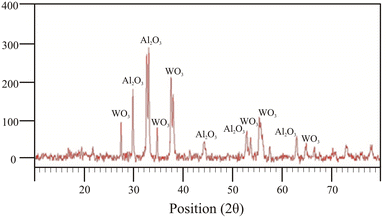
The structure of synthesized tungsten trioxide nanowires was further studied by XRD to confirm the oxidation sate and crystalline character. Figure
4
shows the XRD pattern of WO
3
nanowires fabricated in nanopores of Al
2
O
3
. The peaks at 2
θ
values 30°, 33°, 44°, 53°, and 63° are the characteristics peaks of anodized alumina [
26
]. There is no broad peak centered at 25°, which shows that there is no amorphous alumina since such broad peak indicates that synthesized layer is highly disordered [
27
]. Accordingly, we may say that alumina is properly anodized.
Fig. 4
XRD pattern of WO
3
/Al
2
O
3
composite
The peaks at 2
θ
values 28°, 35°, 38°, 54°, 56°, and 65° correspond to diffraction pattern of WO
3
(JCPDS no 41-1230). These diffraction peaks of XRD pattern correspond to the (002), (012), (112), (222), and (023) reflections related to the cubic (Pm-3
n
) structure of WO
3
. Thus, XRD spectrum and SEM confirm the formation of tungsten trioxide nanowires by electroless deposition method.
Conclusion
PAA was synthesized by two-step anodization method with longer first anodization interval (
t1AN
= 300 min;
t2AN
= 120 min) at 8 mA cm
−2
,
Vplateau
= 40 V, 0.3 M oxalic acid, 5 °C temperature. SEM images depict uniform porous structure with long range hexagonal arrangements of pores which showed that self-ordering works under these conditions. The constant current density for anodization was found to be 8 mA cm
−2
from current density versus
time
plot which also showed that for first anodization, the time interval required to attain constant current density at 40 V was greater than for the second anodization. The self-assembled template was used for the fabrication of 1D nanostructure of tungsten trioxide nanowires by electroless deposition method. The XRD and SEM results revealed that a uniform array of WO
3
nanowires has been generated within pores of self-assembled PAA, and the diameter of the WO
3
nanowire was similar to the diameter of PAA membrane, i.e., 50 nm.
Acknowledgments
We are grateful to PITMAEM, PCSIR for providing us facility for SEM analysis for morphological study of our samples. We are also grateful to Dr. Shahzad Naseem, Centre of Solid State Physics, University of the Punjab, Lahore for XRD analysis of our samples.
References
Gorokh et al. (2006) Anodic formation of low aspect ratio porous alumina film for metal-oxide sensor application (pp. 1771-1780) 10.1016/j.electacta.2006.01.081
Kang et al. (2007) Controlled drug release using nanoporous anodic aluminum oxide on stent (pp. 5184-5187) 10.1016/j.tsf.2006.10.029
Briggs et al. (2004) Formation of highly adherent nano-porous alumina on Ti-based substrates: a novel bone implant coating (pp. 1021-1029)
Nielsch et al. (2002) Self-ordering regimes of porous alumina: the 10 porosity rule (pp. 677-680) 10.1021/nl025537k
Masuda and Fukuda (1995) Ordered metal nanohole arrays made by a two-step replication of honeycomb structures of anodic alumina (pp. 1466-1468) 10.1126/science.268.5216.1466
Chen et al. (2005) Characterization and manipulation of the electroosmotic flow in porous anodic alumina membranes (pp. 8102-8108) 10.1021/ac0513055
Huczko (2000) Template-based synthesis of nanomaterials (pp. 365-376) 10.1007/s003390051050
Itoh et al. (1996) Preparation of a tubular anodic aluminum oxide membrane (pp. 189-196) 10.1016/0376-7388(96)00063-4
Belwalkar et al. (2008) Effect of processing parameters on pore structure and thickness of anodic aluminum oxide (AAO) tubular membranes (pp. 192-198) 10.1016/j.memsci.2008.03.044
Li et al. (1998) On the growth of highly ordered pores in anodized aluminum oxide (pp. 2470-2480) 10.1021/cm980163a
Gu et al. (2002) Tungsten oxide nanowires on tungsten substrates (pp. 849-851) 10.1021/nl025618g
Zhao and Miyauchi (2008) Nanoporous-walled tungsten oxide nanotubes as highly active visible-light-driven photocatalysts (pp. 7159-7163) 10.1002/ange.200802207
Rout et al. (2006) Sensors for the nitrogen oxides, NO, NO2 and N2O, based on In2O3 and WO3 nanowires (pp. 241-246) 10.1007/s00339-006-3707-9
Zeng et al. (2014) Preparation, characterization and gas sensing properties of sub-miron porous WO3 spheres (pp. 41-44) 10.1016/j.matlet.2013.11.080
Cao et al. (2009) Growth of monoclinic WO3 nanowire array for highly sensitive NO2 detection (pp. 2323-2327) 10.1039/b816646c
Meng et al. (2012) Preparation of tungsten oxide nanowires and their application to NO2 sensing (pp. 113-120) 10.1016/j.snb.2012.04.001
Ali et al. (2010) Novel structure formation at the bottom surface of porous anodic alumina fabricated by single step anodization process (pp. 560-564) 10.1016/j.micron.2010.04.010
Zaraska et al. (2010) Porous anodic alumina formed by anodization of aluminum alloy (AA1050) and high purity aluminum (pp. 4377-4386) 10.1016/j.electacta.2009.12.054
Montero-Moreno et al. (2010) Self-ordered porous alumina by two-step anodizing at constant current: behaviour and evolution of the structure (pp. 68-74) 10.1016/j.micromeso.2010.07.022
Ghorbani et al. (2006) On the growth sequence of highly ordered nanoporous anodic aluminium oxide (pp. 983-988) 10.1016/j.matdes.2005.02.018
Yuan et al. (2004) Fabrication of Ni–W–P nanowire arrays by electroless deposition and magnetic studies (pp. 75-80) 10.1016/j.physe.2004.01.011
Lee et al. (2011) Cr2O3 sealing of anodized aluminium alloy by heat treatment (pp. 2803-2808) 10.1016/j.proeng.2011.04.466
Pionern et al. (2011) Progress in nano-engineered anodic aluminium oxide membrane development (pp. 487-526) 10.3390/ma4030487