Ultrasensitive determination of lead and chromium contamination in well and dam water based on fluorescence quenching of CdS quantum dots

Abstract

We report lead (Pb 2+ ) and chromium (Cr 3+ ) determination in several water samples obtained from Nahand dam, Karkaj and Azarshahr well, tab and mineral waters to study their contamination in these systems. Determination method is based on the characteristic aggregation and fluorescence quenching of synthesized CdS quantum dots (QDs) at 555 nm by considered cations. Water-soluble and biocompatible CdS QDs modified with thioglycolic acid have been synthesized in one step and characterized by fluorescence and absorption spectroscopy. The fluorescence intensity of CdS QDs is linearly proportional to Pb 2+ and Cr 3+ concentration from 0.8 to 100 and 3 to 400 ng mL −1 with a detection limit of 0.3 and 1.2 ng mL −1 , respectively. Other potentially interfering ions such as iron, sodium, potassium, calcium, and magnesium ions did not affect the luminescence. The method showed lower detection blank and higher sensitivity.


Introduction

Pollution by heavy metal ions, particularly lead (Pb 2+ ) and chromium (Cr 3+ ), causes a serious hazard to human life and the environment. Pb 2+ , the heaviest stable element, is one of the four metals that have the greatest effects on human health. Due to its characteristics as a very toxic poison to humans, even at low concentrations, Pb 2+ has been studied extensively. Many diseases are spread because of the toxic effects of Pb 2+ , such as respiratory diseases like asthma and allergies, lowered IQ and other nervous system disorders, impaired biosynthesis of hemoglobin and anemia, high blood pressure, kidney damage and brain [ 1 ]. The use of Pb 2+ in electronics has been restricted by European Parliament to reduce unsafe chemical waste leakage to the groundwater [ 2 ]. Also Environmental Protection Agency (EPA) set the allowed limit of Pb 2+ in drinking water as 15 ng mL −1 . Unfortunately, Pb 2+ is still used in refineries to increase gasoline octane number. Cigarette smoke has also a small amount of Pb 2+ . Also, Pb 2+ enters drinking water and soil due to corrosion of water lead pipes.

Non-degradable and bio-fermentation Cr 3+ in nature as well as its extensive usage is the main reason that it is considered a serious environmental pollutant. Cr 3+ is one of the main pollutants in water, because of its lower storage requirements in some industrial activities. Chromium is known to be toxic to plants and animals because of its potentially carcinogenic effect duo to permeability of cell membranes.

Therefore, due to health concerns and legal restrictions, rapid and sensitive methods are critical for evaluation of heavy metals. Several methods have been reported for Pb 2+ and Cr 3+ determination based on electrothermal atomic absorption spectrometry [ 3 , 4 ], X-ray fluorescence [ 5 ], chromatography [ 6 ], electrochemical methods [ 79 ], mass spectroscopy [ 10 , 11 ] and photometric methods [ 12 ]. These methods often require complex and expensive equipment, skilled labor, and high time for preparation of samples. Also, it is necessary to further improve their sensitivity and selectivity. In the meantime, fluorescence recently has attracted much attention, because of its high sensitivity.

Several fluorescent probes based on organic luminescent dyes [ 1316 ] have been reported for detection of Pb 2+ or Cr 3+ . These methods generally displayed relatively high detection limits. In contrast, quantum dots (QDs) displayed superior luminescence properties and stability in aqueous solutions [ 17 , 18 ]. There are several reports for ion detection based on the fluorescence intensity of quantum dots. Since, Chen and Rosenzweig showed that fluorescence intensity of thioglycerol-coated CdS QDs was reduced selectively in the presence of Cu 2+ [ 19 ], several research groups have applied different types of quantum dots as luminescence probe for Hg 2+ [ 2024 ], Cu 2+ [ 2529 ], Ag + [ 25 , 30 ], Pb 2+ [ 3133 ] based on their fluorescence quenching effect. All the reports show the interaction between the analyte and quantum dots which change their physical and photochemical features.

This paper describes a sensitive method for the determination of Pb 2+ and Cr 3+ contaminations in several environmental water samples, based on fluorescence quenching of thioglycolic acid (TGA) capped cadmium sulfide (CdS) quantum dots (QDs). The quenched intensity of fluorescence was proportional to the concentration of Pb 2+ and Cr 3+ in different conditions. The procedure is simple, convenient and sensitive with a detection limit of 0.3 and 1.2 ng mL −1 for Pb 2+ and Cr 3+ , respectively. It does not need any pretreatments for samples. The proposed method was successfully applied to the determination of Pb 2+ and Cr 3+ in real samples including Nahand dam, Karkaj and Azarshahr well, tab and mineral waters.

Experimental

Apparatus

Fluorescence measurements were performed on a RF-5301 spectrofluorophotometer (Shimadzu, Japan) equipped with a xenon lamp source, using 1.0 cm quartz cell with a cell holder kept in a constant-temperature water circulating device, thermo bath TB-85. The widths of both excitation and emission slits were set at 5 nm. The optimum excitation and emission wavelengths for CdS QDs were found to be 427 and 555 nm, respectively. Absorption spectra were recorded by a UV-1800 spectrophotometer (Shimadzu, Japan).

Materials

All experiments were carried out with analytical grade chemicals and solvents. Doubly distilled deionized water was used for the preparation of all solutions. Cadmium chloride (CdCl 2 ·5H 2 O), sodium sulfide (Na 2 S·9H 2 O) and thioglycolic acid (TGA) were all purchased from sigma Aldrich and were used without further purification. Buffer solutions of acetate and phosphate (0.5 mol L −1 ) were prepared by dissolving the appropriate amount of sodium acetate (Merck) or NaH 2 PO 4 ·2H 2 O (Merck) in double distilled water, respectively. The pHs of these buffer was adjusted to 5 and 6, respectively. Stock standard solutions of 100 mg L −1 Pb 2+ and Cr 3+ were prepared in water from lead nitrate (Merck) and chromium (III) nitrate (Merck), respectively.

Synthesis of TGA-capped CdS quantum dots

TGA-capped CdS QDs were synthesized in aqueous solution using a simple reported procedure [ 28 ]. Briefly, 100 ml of TGA (0.05 mol L −1 ) solution and 100 ml of CdCl 2 (0.02 mol L −1 ) solution were mixed in a round bottom flask. The pH of this solution was adjusted in 8 by NaOH (1 mol L −1 ) solution. White residue, appear in the solution, was dissolved by adding NaOH solution and finally, the clear solution was obtained. This was probably due to formation of Cd-thioglycolic complexes with different structures at different pH values because of different dissociation of Carboxylate and sulfhydryl group. The reaction mixture was then heated up to 90 °C in the argon atmosphere. Then 50 ml of Na 2 S (0.02 mol L −1 ) was added. After refluxing for 2 min, the flask was submerged in the ice-water bath until it cooled to room temperature. After purification, QDs were used as fluorescent nanoparticles.

General procedure

For Pb 2+ determination, 75 µL synthesized QDs solution and 200 µL phosphate buffer (pH = 5) were transferred to 5 mL volumetric flask. Then an appropriate volume of sample or standard Pb 2+ solution was added and the final volume was made to 5 mL with distilled water. The fluorescence intensity of the solution was recorded as analytical signal.

For Cr 3+ determination, 100 µL synthesized QDs solution and 200 µL acetate buffer (pH = 5) were transferred to 5 mL volumetric flask. Then an appropriate volume of sample or standard Cr 3+ solution was added and the final volume was made to 5 mL with distilled water. The fluorescence intensity of the solution was recorded as analytical signal.

Results and discussion

Characterization of thioglycolic acid-capped CdS quantum dots

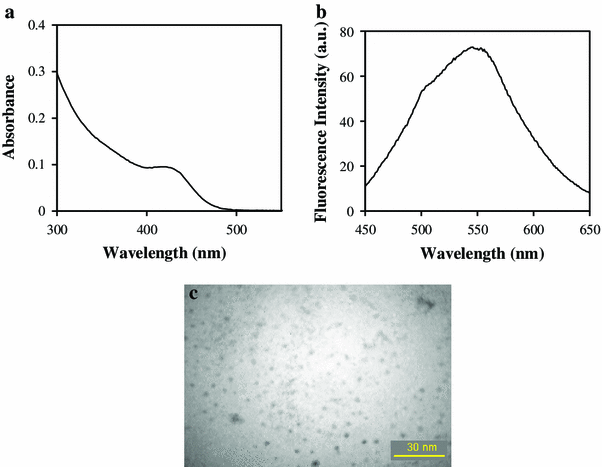
Synthesized thioglycolic acid-capped CdS QDs (TGA-capped CdS QDs) are optically characterized by UV–vis absorption spectroscopy and fluorometry. The TGA-capped CdS QDs show long emission wavelengths and a high separation between the excitation and emission wavelengths (ca. 125 nm) simplifying fluorescence measurements. The absorption spectrum shows well-defined excitonic absorption peak at wavelength of 427 nm, and a sharp band edge emission peak ( λ  = 555 nm), which was independent of the excitation wavelength, was obtained in the FL spectrum (Fig.  1 ).

Fig. 1

a Absorption, b Fluorescence spectra and c TEM image of synthesized aqueous TGA-capped CdS QDs

Also TEM (transmission electron microscopy) image of Synthesized QDs is shown in Fig.  1 c.

Effect of cations on the fluorescence of QDs

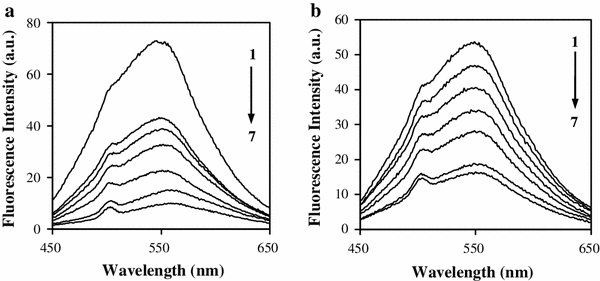
The fluorescence intensity ( λ ex  = 427 nm) of quantum dots drastically decreases with some cations in a certain condition. It is observed that synthesized QDs have high tendency for Pb 2+ and Cr 3+ . The more the Pb 2+ or Cr +3 concentration, the lower was the FL intensity obtained. This decrease was proportional to each cation concentration (Fig.  2 ).

Fig. 2

Fluorescence spectra of aqueous TGA-capped CdS QDs in the presence of different concentrations of a Cr 3+ and b Pb 2+ . a QDs 75 µL, phosphate buffer 0.01 M, pH = 6 (1–7: 0, 25, 50, 100, 200, 300, 400 ng mL −1 ). b QDs 100 µL, acetate buffer 0.01 M, pH = 5 (1–7: 0, 1, 2.5, 5, 10, 50, 75 ng mL −1 )

Optimization of condition

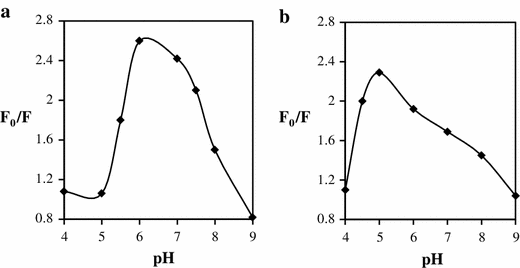
It is clear that pH influences the fluorescence intensity of the complex significantly. To investigate the effects of pH on determinations, the pH ranges between 4 and 9. At lower pHs, there is no fluorescence intensity because of the protonation of the thiol groups and aggregation of the QDs [ 35 ]. The maximum value of F 0 / F was obtained when pH was 6 and 5 for Cr 3+ and Pb 2+ , respectively (Fig.  3 ). ( F 0 and F are the fluorescence intensity of the aqueous CdS QDs without and at a given analyte concentration). Therefore, these optimal pH values were chosen to be applied in further experiments.

Fig. 3

Effects of pH on the F 0 / F for a Cr 3+ 10 ng mL −1 (QDs = 100 µL, phosphate buffer 0.05 M) and b Pb 2+ 5 ng mL −1 (QDs = 75 µL, acetate buffer 0.05 M)

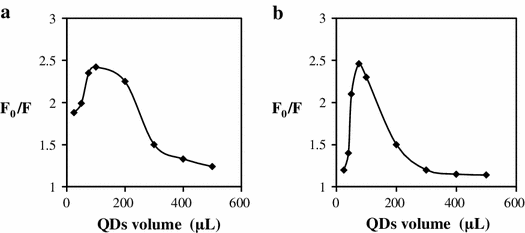
It was found that the concentration of QDs affected not only the fluorescent intensity but also the sensitivity of the assay. As shown in Fig.  4 , high concentration of aqueous QDs decreases the sensitivity and causes self-quenching of the QDs fluorescence. Also, very low concentration of QDs gives very weak fluorescence intensity, which may result in narrow linear range. Thus, 100 and 75 µL of QDs was chosen for Cr 3+ and Pb 2+ determinations, respectively. In selected optimal values of the quantum dots, wide linear range and low detection limit concentrations are achieved.

Fig. 4

Effects of QDs amount on the F 0 / F for a Cr 3+ 10 ng mL −1 (phosphate buffer 0.05 M, pH = 6) and b Pb 2+ 5 ng mL −1 (acetate buffer 0.05 M, pH = 5)

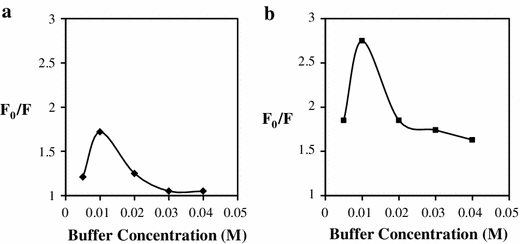
The effect of buffer solution on fluorescence intensity system was discussed. To do so, different buffer solutions such as phosphate, tris and acetate were investigated. The results showed that phosphate and acetate have the greatest effect on the fluorescence quenching of TGA-capped CdS QDs in the presence of Cr 3+ and Pb 2+ , respectively. Hence, these buffers were selected in all experiments. Optimization of buffer concentration was carried out and the result is showed in Fig.  5 . Maximum signal was obtained in 0.01 M for both states.

Fig. 5

Effects of buffer concentration on the F 0 / F for a Cr 3+ 10 ng mL −1 (QDs = 100 µL, phosphate buffer pH = 6) and b Pb 2+ 5 ng mL −1 (QDs = 75 µL, acetate buffer pH = 5)

In results, the best optimal conditions for the measurement of Cr 3+ are: QDs = 100 µL, phosphate buffer 0.01 M, pH = 6, and for Pb 2+ are: QDs = 75 µL, acetate buffer 0.01 M, pH = 5.

Quantitative characteristics

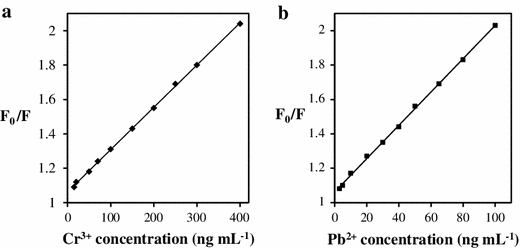
Under optimal condition, the ratio of FL intensity ( F 0 / F ) in the absence ( F 0 ) and presence of analyte ( F ) was plotted versus the concentration of each analyte in ng mL −1 . Calibration graphs and corresponding FL spectra are shown in Fig.  6 . Obtained analytical characteristics are indicated in Table  1 .

Fig. 6

Calibration curve of the a Cr 3+ and b Pb 2+ in optimum condition

Table 1

Analytical characteristics of the method for the determination of Cr 3+ and Pb 2+

Parameter

Cr3+

Pb2+

Linear range (ng mL−1)

3–400

0.8–100

Slope

0.0024

0.0098

Intercept

1.065

1.057

Correlation coefficient (r)

0.9993

0.9979

Number of points

10

10

LOD (ng mL−1)

1.2

0.8

RSD% (n = 5)

3.2 (8 ng mL−1)

2.1 (5 ng mL−1)

RSD% (n = 5)

3.0 (50 ng mL−1)

3.9 (10 ng mL−1)

RSD% (n = 5)

1.4 (300 ng mL−1)

2.4 (50 ng mL−1)

The quenching ability of Cr 3+ and Pb 2+ can be expressed by Stern–Vollmer equation: where F and F 0 are fluorescence quantum yield or fluorescence intensity of quantum dots with ( F ) and without ( F 0 ) extinguishing or analyte. K sv is the Stern–Vollmer constant. Linear equations between concentration and relative fluorescence intensity obtained for Cr 3+ and Pb 2+ ( y  = 0.0024 x  + 1.065 and y  = 0.0098 x  + 1.057, respectively) are consistent with Stern–Vollmer equation.

Interference of coexisting foreign substances

In order to investigate the effect of coexisting substances on Cr 3+ and Pb 2+ determination in real samples, various concentrations of interfering ions are added to determination solution (1 μg mL −1 analyte) and, F / F 0 value is measured versus interference ion concentration. Interference limit is considered 5 % deviation from the initial F / F 0 value (Table  2 ). The results show that the method for analysis of Cr 3+ and Pb 2+ is free from any interference.

Table 2

Interfering effects of some coexisting ions on Cr 3+ and Pb 2+ determination

Coexisting ions

Interference ratio for Cr3+

Interference ratio for Pb2+

Hg2+, Fe3+

800

800

Cd2+

300

300

Zn2+

500

300

Na+

2,000

2,000

Co2+

150

150

Cu2+

200

250

Li+, Ni2+, K+, NO3

500

500

CO32-

5,000

4,000

SO42-

4,000

400

Cl

7,000

600

Analysis of real samples

The represented method was successfully applied to the quantitative determination of Cr 3+ and Pb 2+ in the real samples of various compositions such as Nahand dam, Karkaj and Azarshahr well, tab and mineral waters. The real samples were spiked with standard solution of each analyte, and then were analyzed by standard addition method. In Tables  3 and 4 , the obtained recovery values in real samples are listed.

Table 3

Results for the determination of Pb 2+ in the real samples

Sample (Pb2+)

Add (ng mL−1)

Founda (ng mL−1) purposed method

Recovery %

Founda (ng mL−1) standard method

Karkaj well water

0

4.22 ± 0.2

4.51 ± 0.3

5

9.28 ± 0.1

101 ± 2.0

10

14.40 ± 0.3

102 ± 2.9

Nahand dam water

0

0

Not detect

5

4.85 ± 0.11

97.2 ± 2.2

10

10.38 ± 0.21

104 ± 2.3

Azarshahr well water

0

Not detect

Not detect

5

5.12 ± 0.1

102 ± 2.1

10

10.14 ± 0.2

101 ± 1.9

Mineral water

0

Not detect

Not detect

5

5.21 ± 0.1

104 ± 1.8

10

10.38 ± 0.3

104 ± 2.9

Tabriz tab water

0

Not detect

Not detect

5

5.11 ± 0.1

102 ± 1.7

10

10.09 ± 0.3

101 ± 2.5

a Mean of three determinations ± standard deviation

Table 4

Results for the determination of Cr 3+ in the real samples

Sample (Cr3+)

Add (ng mL−1)

Founda (ng mL−1) purposed method

Recovery %

Founda (ng mL−1) standard method

Karkaj well water

0

5.81 ± 0.12

5.48 ± 0.31

5

10.72 ± 0.18

97.2 ± 3.6

10

15.58 ± 0.25

97.7 ± 2.4

Nahand dam water

0

12.50 ± 0.20

4.51 ± 0.14

5

17.70 ± 0.15

104 ± 2.8

10

22.29 ± 0.32

97.9 ± 3.3

Azarshahr well water

0

9.16 ± 0.11

4.51 ± 0.22

5

14.37 ± 0.15

104 ± 3.1

10

19.00 ± 0.30

98.4 ± 3.2

Mineral water

0

Not detect

Not detect

5

5.13 ± 0.14

103 ± 2.8

10

10.05 ± 0.12

101 ± 1.1

Tabriz tab water

0

Not detect

Not detect

5

4.88 ± 0.19

97.6 ± 3.7

10

9.72 ± 0.30

97.2 ± 2.9

a Mean of three determinations ± standard deviation

The recoveries were between 97 and 104 %, showing that the proposed procedure is applicable to the determination of Cr 3+ and Pb 2+ in environmental samples.

On the other hand, the results were compared with those obtained by a standard method using electrothermal atomic absorption spectroscopy. Statistical analysis using Student t test showed that there are no significant differences between the results of two methods.

Conclusion

A simple, sensitive and rapid method for determination of Cr 3+ and Pb 2+ contamination has been offered based on the quenching of the fluorescence of TGA-capped CdS quantum dots. The preparation of quantum dots is very simple, fast and economical. Also the method does not need any pretreatment steps in analysis. The procedure possesses the advantage of wide dynamic range, selectivity and high sensitivity (expressed by the detection limits) which may be an incentive to other workers to consider it for determination of Cr 3+ and Pb 2+ in traces. Finally, this procedure was successfully applied to determine Cr 3+ and Pb 2+ in environmental real samples.


Acknowledgments

This work was supported by Islamic Azad University, Tabriz Branch, Tabriz, Iran.


References

  1. Landrigan and Todd (1994) Lead poisoning (pp. 153-159)
  2. Unknown ()
  3. Sadeghi and Mogaddam (2012) Preconcentration and speciation of trace amount of chromium in saline samples using temperature-controlled microextraction based on ionic liquid as extraction solvent and determination by electrothermal atomic absorption spectrometry (pp. 758-766) 10.1016/j.talanta.2012.07.018
  4. Sardans et al. (2010) Determination of As, Cd, Cu, Hg and Pb in biological samples by modern electrothermal atomic absorption spectrometry (pp. 97-112) 10.1016/j.sab.2009.11.009
  5. Orescanin et al. (2004) Determination of Cr(III) and Cr(VI) in industrial and environmental liquid samples by ED-XRF method (pp. 125-129) 10.1016/j.aca.2004.09.027
  6. Threeprom et al. (2005) Simultaneus determination of Cr(III)-EDTA and Cr(VI) by ion interaction chromatography using a C18 column (pp. 291-295) 10.1016/j.chroma.2004.09.053
  7. Dominguez and Arcos (2002) Simultaneus determination of chromium(VI) and chromium(III) at trace levels by adsorptive stripping voltammetry (pp. 241-252) 10.1016/S0003-2670(02)00757-2
  8. Li et al. (2009) Combining chemical reduction with an electrochemical technique for the simultaneous detection of Cr(VI), Pb(II) and Cd(II) (pp. 273-277) 10.1039/B804670K
  9. Yasri et al. (2011) Chronoamperometric determination of lead ions using PEDOT: PSS modified carbon electrodes (pp. 2528-2533) 10.1016/j.talanta.2011.08.013
  10. Milne et al. (2010) Determination of Mn, Fe Co, Ni, Cu, Zn, Cd and Pb in seawater using high resolution magnetic sector inductively coupled mass spectrometry (HR-ICP-MS) (pp. 200-207) 10.1016/j.aca.2010.03.027
  11. Beceiro-Gonzalez et al. (2009) Optimisation of a headspace-solid-phase micro-extraction method for simultaneous determination of organometallic compounds of mercury, lead and tin in water by gas chromatography–tandem mass spectrometry (pp. 5563-5569) 10.1016/j.chroma.2009.05.056
  12. Chai et al. (2010) Colorimetric detection of Pb2+ using glutathione functionalized gold nanoparticles (pp. 1466-1470) 10.1021/am100107k
  13. Hosseini and Belador (2009) Cr(III)/Cr(VI) speciation determination of chromium in water samples by luminescence quenching of quercetin (pp. 1062-1067) 10.1016/j.jhazmat.2008.10.084
  14. Kwon et al. (2005) A highly selective fluorescent chemosensor for Pb2+ (pp. 10107-10111) 10.1021/ja051075b
  15. Chen and Huang (2002) A highly selective fluoroscent chemosensor for lead ions (pp. 6246-6247) 10.1021/ja025710e
  16. Bozkurt et al. (2009) Fluorescence-based sensor for Pb(II) using tetra-(3-bromo-4-hydroxyphenyl) porphyrin in liquid and immobilized medium (pp. 880-883) 10.1016/j.saa.2008.12.012
  17. Michalet et al. (2005) Quantum dots for live cells, in vivo imaging, and diagnostics (pp. 538-544) 10.1126/science.1104274
  18. Alivisatos (2004) The use of nanocrystals in biological detection (pp. 47-52) 10.1038/nbt927
  19. Chen and Rosenzweig (2002) Luminescent CdS quantum dots as selective ion probes (pp. 5132-5138) 10.1021/ac0258251
  20. Xia and Zhu (2008) Use of surface-modified CdTe quantum dots as fluorescent probes in sensing mercury (II) (pp. 215-221)
  21. Cai et al. (2006) Preparation, characterisation and evaluation of water-soluble l-cysteine capped CdS nanoparticles as fluorescence probe for detection of Hg(II) in aqueous solution (pp. 234-239) 10.1016/j.aca.2005.11.061
  22. Li et al. (2008) A luminescent nanosensor for Hg(II) based on functionalised CdSe/ZnS quantum dots (pp. 119-123) 10.1007/s00604-007-0816-x
  23. Chen and Gao (2006) A novel fluorescent array for mercury (II) ion in aqueous solution with functionalized cadmium selenide nanoclusters (pp. 77-84) 10.1016/j.aca.2006.06.039
  24. Koneswaran and Narayanaswamy (2009) Mercaptoacetic acid capped CdS quantum dots as fluorescence single shot probe for mercury(II) (pp. 91-96) 10.1016/j.snb.2008.09.011
  25. Unknown ()
  26. Fernandez-Arguelles et al. (2005) Surface-modified CdSe quantum dots for the sensitive and selective determination of Cu(II) in aqueous solutions by luminescent measurements (pp. 20-25) 10.1016/j.aca.2005.06.013
  27. Xie and Liang (2004) Luminescent CdSe- ZnS quantum dots as selective Cu2 + probe (pp. 2527-2530) 10.1016/j.saa.2003.12.039
  28. Zhang and Zhang (2008) l-Cysteine-coated CdSe/CdS core-shell quantum dots as selective fluorescence probe for copper(II) determination (pp. 142-147) 10.1016/j.microc.2008.01.008
  29. Koneswaran and Narayanaswamy (2009) L-Cysteine-capped ZnS quantum dots based fluorescence sensor for Cu2+ ion (pp. 104-109) 10.1016/j.snb.2008.09.028
  30. Chen and Zhu (2005) Functionalised cadmium sulfide quantum dots as fluorescence probe for silver ion determination (pp. 147-153) 10.1016/j.aca.2005.05.006
  31. Ali et al. (2007) Ultrasensitive Pb2+ detection by glutathione capped quantum dots (pp. 9452-9458) 10.1021/ac062068o
  32. Wu et al. (2008) A novel method for the determination of Pb2+ based on the quenching of the fluorescence of CdTe quantum dots (pp. 81-86) 10.1007/s00604-007-0801-4
  33. Cai et al. (2012) Ultrasensitive and rapid lead sensing in water based on environmental friendly and high luminescent L-glutathione-capped-ZnSe quantum dots (pp. 909-914) 10.1016/j.saa.2012.07.069
  34. Winter et al. (2005) Variation of cadmium sulfide nanoparticle size and photoluminescence intensity with altered aqueous synthesis conditions (pp. 147-157) 10.1016/j.colsurfa.2004.11.024
  35. Wang et al. (2011) Ultrasensitive cysteine sensing using citrate-capped CdS quantum dots (pp. 943-947) 10.1016/j.talanta.2010.10.047