Department of Physics, Faculty of Sciences, Science and Research Branch, Islamic Azad University, Tehran, IR
The Directorate of Research, Development and Innovation Management (DMCDI), Technical University of Cluj-Napoca, Cluj-Napoca, Cluj county, 400020, RO
School of Physics, Institute for Research in Fundamental Sciences (IPM), Tehran, IR
Physics Department, Alzahra University, Tehran, 1993891167, IR
Abstract
The aim of the present study is to explore the 3-D micromorphology of human canine teeth materials using multifractal analysis through atomic force microscopy (AFM). The 3-D surfaces of ten extracted canine teeth of a group of 40 year old men were studied (enamel, inter enamel, inter dentin, and cementum) by AFM images in tapping mode and on square areas of 1 μm × 1 μm (512 × 512 points). The AFM images and surface multifractal analysis confirm the dependency of surface micromorphology to their structure–property of these materials across the length scales of the teeth structural architecture. Surface statistical parameters and hence, multifractal approach have been considered as reliable and sensitive tools for quantifying the 3-D surface microtexture changes of human canine teeth materials. The surface of inter dentin had the most irregular topography (the width spectrum Δ
α
= 2.8361, value bigger than all the other Δ
α
sample values), while the most regular topography (the width spectrum Δ
α
= 2.6804, value lower than all the other sample values) was found in cementum. It has been concluded that multifractal analyses can be used as mathematical tools to explore the 3-D micromorphology of human canine teeth materials.
Introduction
The tooth represents one of the most interesting tissues in the human body, as to the performances in terms of material response [
1
]. This is also the case thanks to the stability of the adult teeth [
2
], which present a large mineralized portion in terms of their constituent materials and organization [
3
]. In this respect, the teeth are similar to bones, yet their degree of mineralization is higher, and, even if they are also live organs—which is especially clear when considering their interfaces at the periodontum ligament. The main teeth function is connected to the mechanical properties, mainly the elastic ones—stiffness and hardness [
4
]. This observation does not intend to minimize the effect of the biological interactions of the teeth with the body as well as with the environment. Nevertheless, for many applications still a simplified field of material-science may successfully apply to the investigation of their properties, which is also functional to the identification of appropriate substituting materials i.e., implants (metal/ceramics for the crowns and titanium alloy for the screws replacing the roots) and restorations (glass-monomer cements [gic] and resin composites) [
5
,
6
–
7
].
Several studies have already been carried out on the materials constituting the teeth, over the past decades, with the most disparate techniques, yet based mainly on a combination of microscopy and elastic characterization [
8
,
9
]. Enamel, the universally recognized hardest and stiffest material in our body is composed of both organic and inorganic phase [
10
]. Dentin is obviously less stiff and plays a support role in buffering biting forces [
2
] that comprises a higher amount of organic phase [
11
]. For dentin, the situation is more difficult, since the material is a porous composite, and therefore a correct characterization should account for the porosity. The dentin microstructure consists of dentinal tubules that radiate outward through its volume, from the pulpal chamber to the exterior enamel or cementum [
2
]. Cementum is the last hard tissue of the tooth, which covers the surface in the sub-gingival region, with the compact structure like enamel (i.e., non-porous). However, it has the highest percentage of organic materials compared to the other regions [
12
].
On the other hand, different experimental and theoretical studies have reported the materials constituting human teeth, but there still remain many questions at basic levels about the structure–property relationship of these 3-D bio-structures across the length scales of the human teeth structural architecture [
13
,
14
,
15
,
16
–
17
].
Several recent nano-technological research lines emerge in dentistry that can provide new innovative ideas and concepts for solving pathological mechanisms and lead to novel therapeutic orientations [
18
,
19
–
20
]. In this context the 3-D shape models can be used to design, model, simulate, and visualize the teeth 3-D geometry and to help in computer-aided diagnosis [
21
,
22
–
23
].
Although the 3-D surface morphology of the human teeth is an extremely irregular and complex bio-structure with fine anatomic detail and surface texture, it can be analyzed quantitatively by applying the stereometric [
24
,
25
–
26
], fractal [
27
,
28
–
29
] or multifractal [
17
,
20
] analyses of AFM micrograph samples.
The aim of this research was to examine the 3-D micromorphology of human canine teeth materials using AFM images and multifractal analysis.
Experimental details
Ten extracted permanent canine teeth of 40 year old men were collected for the experiment. Because of their similarity in their results, we represent the results of one of these specimens.
As the first step, all samples were placed in saline and brought to the laboratory. They were then brushed with standard dentifrice and tooth brush and kept in acetone and alcohol baths to remove their impurities ultrasonically. After drying them in air, all samples were cross-sectioned so that we were able to access to the inner parts.
AFM (Veeco, Santa Barbara, CA) images were applied to provide quantitative data about surface roughness and morphology for studying the structural topography of enamel, dentin, and cementum in the healthy tooth. The room temperature and ambient pressure was the same for all steps of experiments as 297 ± 1 K and 50 ± 1%, respectively.
Multifractal analysis of the 3-D surface micro-texture
The analysis of surface topography with the fractal method attracts a lot of interest in the field of biomaterials surface [
18
,
19
,
20
,
21
–
22
] since it is considered as a useful tool for analysing irregular and complex structures of various types of biomaterials [
26
,
27
–
28
].
For a 3-D fractal surface, the statistical index
D
is defined as fractal dimension with 2 ≤
D
≤ 3 which extracts the complexity of structure [
17
]. It should be noted that higher
D
values refer to the irregular surface with more complexity since it gives information about non-differentiability and self-similarity mathematically [
17
,
22
].
However, when fractal analysis cannot describe surface topography due to its complexity, multifractal analysis is the most appropriate tool for characterization of surface morphology [
30
,
31
,
32
,
33
–
34
].
By considering
q
as the order moment with real values from −
∞
(less dense areas) to +
∞
(dense areas)
, Dq
and
α
(
q
) represent information about fractal/multifractal geometry and are measured as the generalized dimension of Hölder exponents of
q
while
f
(
α
) refer to singularity spectrum. Two multifractal parameters are related by the Legendre transformation [
32
,
33
–
34
].
The generalized fractal dimensions
Dq
can be computed using the following formula [
17
]:
Dq=τ(q)/q-1
where
τ
(
q
) is the mass (or correlation) exponent of the
q
th order; and
q
is the order moment.
The multifractal spectrum function can be expressed as [
17
]:
fαq=qα(q)-τq
where
α
(
q
) =
dτ
(
q
)
/dq
.
αq
represents Hölder exponents of the
q
th order moment.
On the other hand,
Dq
for
q
= 0, 1, 2 is known as the capacity, information entropy, and correlation dimensions, respectively. The relation between these parameters is
D0
>
D1
>
D2
. In addition,
αmax
=
D−
∞
and
αmin
=
D+
∞
for
q
= ± ∞ with the width spectrum of Δ
α
=
αmax
−
αmin
, and heights difference of Δ
f
=
f
(
αmin
)−
f
(
αmax
) [
32
,
33
–
34
].
When Δ
f
< 0 and Δ
f
> 0, the fragments are explained by the low and high probability value predominate, respectively. The left arm (positive
q
) and right arm (negative
q
) of multifractal spectrum are related to irregular and flat areas, respectively [
35
]. By decreasing the value
Dq
affected by increase of
q
, multifractal structure is created which demonstrated the dependency of
f
(
α
) to
α
and
Dq
to
q
by box counting method [
17
].
Statistical analysis
The GraphPad InStat version 3.20 computer software package (GraphPad, San Diego, CA, USA) was applied here to perform statistical investigations. Meanwhile, Kolmogorov–Smirnov test was applied to extract normal distributions. Moreover,
T
test and Mann–Whitney
U
test were used to compare various areas in typical sample and reveal statistical differences, respectively.
Results and discussion
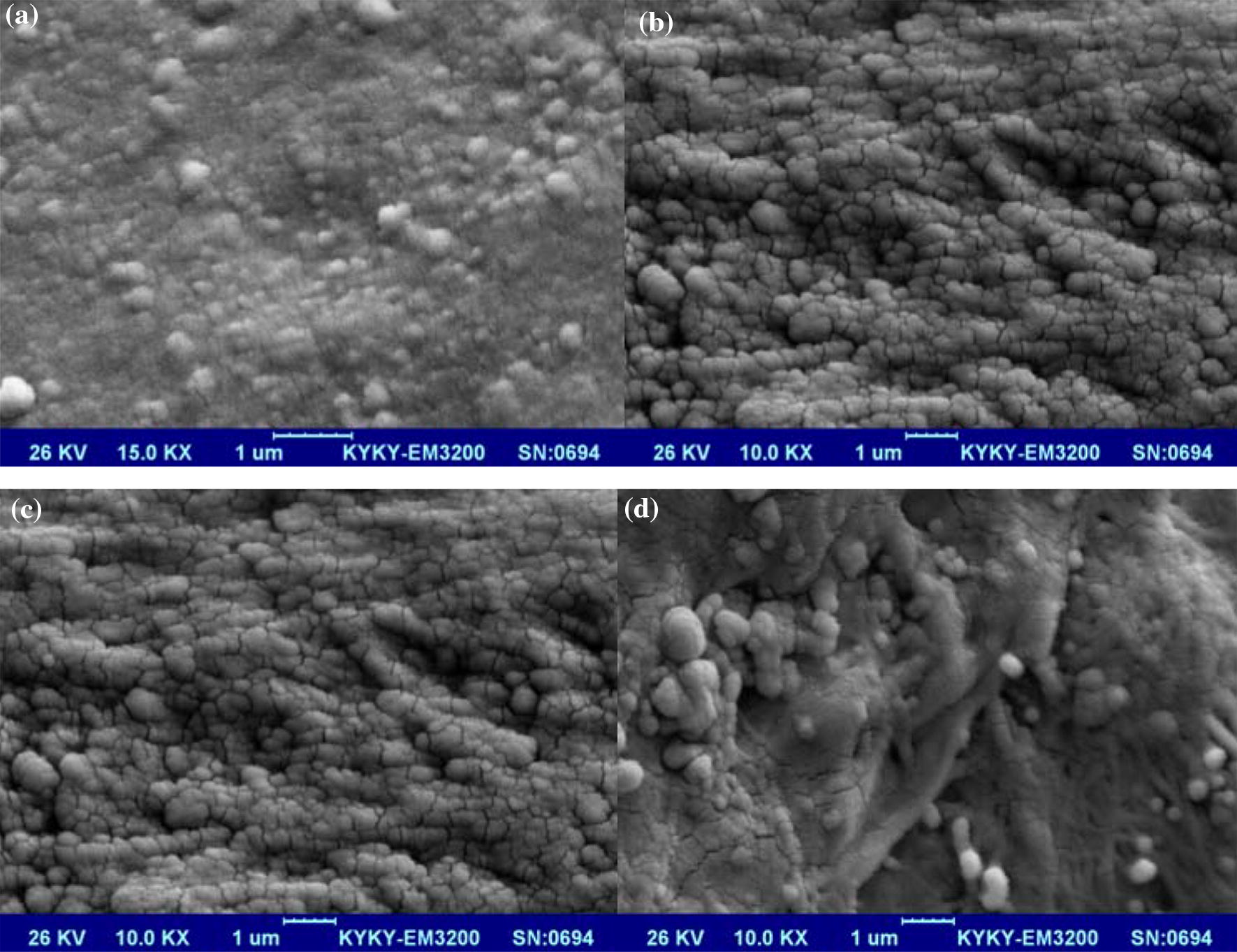
Scanning electron microscopy (SEM) images shown in Fig.
1
reveal the presence of granular structures on different hard dental tissues. The sizes of these grains are about 70–150 nm.
Fig. 1
SEM images of:
a
enamel,
b
inter enamel,
c
inter dentin, and
d
cementum
The representative 3-D AFM images for 1 µm × 1 μm scanning square areas of hard dental tissue of the human canine teeth are shown in Fig.
2
.
Fig. 2
AFM micrographs of the human canine teeth materials:
a
enamel,
b
inter enamel,
c
inter dentin, and
d
cementum
The functional dependences
R2
-error versus
q
are shown in Fig.
3
. After small values of
R2
-error in low values of
q
, it is rapidly raised. For
q
> − 1.2, fractal properties exist for all samples.
Fig. 3
The graphs of coefficient
R2
-error versus
q
for all dental tissue
Figure
4
shows multifractal analysis based on the box-counting method which determines functional dependency of
f
(
α
) to
α
and
q
to
Dq
on each region of interest (ROI) (where − 20 ≤
q
≤ 20 for successive 1.0 steps).
Fig. 4
Generalized
a
fractal and
b
multifractal spectrum for each tissue
AFM images of each tissue exhibit multifractal nature of dental surface along with non-homogeneous nature.
For the surfaces of the human canine teeth, different fractal dimensions follows
D0
>
D1
>
D2
(Fig.
4
a) which indicates the non-uniform features of 3-D surfaces. Figure
4
b illustrates the asymmetric non-linear curve of
f
(
q,r
)
−α
(
q,r
) with two arms and Δ
α
width.
All the values of Δ
α
> 0 and Δ
f
> 0 (Tables
1
,
2
,
3
and
4
).
Table 1
The values of
Dq
,
R2
-error,
f
(
α
) for the surfaces of enamel on square areas of 1 μm × 1 μm
q
Dq
R2-error
α
f(α)
q
Dq
R2-error
α
f(α)
− 20
4.4190
0.93785
4.6388
0.023686
0.1
2.2536
0.97930
2.3514
2.263420
− 19
4.4080
0.93786
4.6387
0.025532
1
2.1730
0.00584
2.1666
2.166626
− 18
4.3959
0.93788
4.6385
0.027667
2
2.1236
0.97519
2.0821
2.040774
− 17
4.3824
0.93789
4.6384
0.030154
3
2.0914
0.97442
2.0351
1.922521
− 16
4.3673
0.93791
4.6382
0.033068
4
2.0675
0.97408
2.0024
1.807126
− 15
4.3504
0.93793
4.6380
0.036505
5
2.0482
0.97389
1.9770
1.692316
− 14
4.3312
0.93796
4.6377
0.040582
6
2.0321
0.97377
1.9566
1.579417
− 13
4.3094
0.93799
4.6374
0.045449
7
2.0182
0.97369
1.9400
1.471104
− 12
4.2841
0.93804
4.6369
0.051296
8
2.0061
0.97363
1.9266
1.369818
− 11
4.2548
0.93810
4.6363
0.058371
9
1.9956
0.97358
1.9157
1.277087
− 10
4.2239
0.93817
4.6355
0.066059
10
1.9862
0.97353
1.9070
1.193479
− 9
4.1786
0.93828
4.6343
0.077650
11
1.9780
0.97349
1.8999
1.118830
− 8
4.1281
0.93844
4.6327
0.090960
12
1.9706
0.97346
1.8941
1.052532
− 7
4.0651
0.93866
4.6304
0.107923
13
1.9641
0.97343
1.8894
0.993763
− 6
3.9846
0.93901
4.6270
0.130168
14
1.9582
0.97341
1.8856
0.941643
− 5
3.8779
0.93958
4.6213
0.160736
15
1.9529
0.97339
1.8824
0.895322
− 4
3.7300
0.94057
4.6109
0.206564
16
1.9481
0.97337
1.8797
0.854026
− 3
3.5120
0.94252
4.5865
0.288599
17
1.9438
0.97335
1.8775
0.817072
− 2
3.1636
0.94696
4.4958
0.499443
18
1.9398
0.97333
1.8756
0.783869
− 1
2.5996
0.95914
3.7242
1.475003
19
1.9362
0.97332
1.8740
0.753911
− 0.1
2.2822
0.97841
2.4111
2.269390
20
1.9329
0.97330
1.8727
0.729369
Table 2
The values of
Dq
,
R2
-error,
f
(
α
) for the surfaces of inter dentin on square areas of 1 μm × 1 μm
q
Dq
R2-error
α
f(α)
q
Dq
R2-error
α
f(α)
− 20
4.4475
0.94493
4.6668
0.029603
0.1
2.2525
0.97982
2.3591
2.263200
− 19
4.4365
0.94493
4.6684
0.030973
1
2.1620
0.12049
2.1545
2.154500
− 18
4.4243
0.94494
4.6668
0.032499
2
2.1011
0.98521
2.0476
1.994000
− 17
4.4107
0.94495
4.6682
0.034196
3
2.0589
0.98586
1.9843
1.835100
− 16
4.3956
0.94496
4.6681
0.036120
4
2.0274
0.98616
1.9431
1.690300
− 15
4.3786
0.94497
4.6679
0.038319
5
2.0002
0.98630
1.9149
1.562800
− 14
4.3593
0.94498
4.6677
0.040860
6
1.9834
0.98635
1.8949
1.452100
− 13
4.3373
0.94500
4.6675
0.043839
7
1.9675
0.98635
1.8803
1.356800
− 12
4.3119
0.94503
4.6672
0.047380
8
1.9543
0.98632
1.8694
1.275000
− 11
4.2823
0.94506
4.6669
0.051662
9
1.9432
0.98627
1.8611
1.204600
− 10
4.2473
0.94510
4.6663
0.056942
10
1.9338
0.98621
1.8548
1.143900
− 9
4.2054
0.94515
4.6656
0.063605
11
1.9256
0.98615
1.8498
1.091300
− 8
4.1544
0.94523
4.6646
0.072266
12
1.9186
0.98608
1.8458
1.045400
− 7
4.0907
0.94535
4.6630
0.083963
13
1.9124
0.98602
1.8624
1.004900
− 6
4.0090
0.94553
4.6604
0.100570
14
1.9069
0.98596
1.8399
0.968980
− 5
3.9008
0.94584
4.6558
0.125700
15
1.9021
0.98591
1.8377
0.936800
− 4
3.7505
0.94642
4.6464
0.167030
16
1.8977
0.98586
1.8358
0.907730
− 3
3.5287
0.94765
4.6232
0.245030
17
1.8938
0.98581
1.8342
0.881250
− 2
3.1732
0.95077
4.5347
0.450310
18
1.8902
0.98576
1.8328
0.856940
− 1
2.6034
0.96051
3.6909
1.515900
19
1.8870
0.98572
1.8316
0.834460
− 0.1
2.2835
0.97805
2.4230
2.269500
20
1.8841
0.98569
1.8307
0.815560
Table 3
The values of
Dq
,
R2
-error,
f
(
α
) for the surfaces of inter enamel on square areas of 1 μm × 1 μm
q
Dq
R2-error
α
f(α)
q
Dq
R2-error
α
f(α)
− 20
4.2530
0.91390
4.4646
0.021436
0.1
2.2530
0.97964
2.3574
2.263400
− 19
4.2424
0.91391
4.4645
0.023228
1
2.1609
0.13939
2.1528
2.152800
− 18
4.2307
0.91392
4.4643
0.025327
2
2.0918
0.97999
2.0266
1.961300
− 17
4.2177
0.91393
4.4642
0.027806
3
2.0381
0.97879
1.9383
1.738600
− 16
4.2032
0.91394
4.4640
0.030754
4
1.9550
0.97790
1.8769
1.522700
− 15
4.1870
0.91396
4.4638
0.034285
5
1.9605
0.97727
1.8360
1.338200
− 14
4.1685
0.91398
4.4635
0.038541
6
1.9330
0.97681
1.8093
1.190700
− 13
4.1474
0.91401
4.4631
0.043706
7
1.9110
0.97647
1.7916
1.075200
− 12
4.1232
0.91405
4.4626
0.050017
8
1.8931
0.97621
1.7795
0.984290
− 11
4.0949
0.91410
4.4619
0.057790
9
1.8784
0.97600
1.7709
0.911140
− 10
4.0616
0.91416
4.4610
0.067457
10
1.8661
0.97584
1.7646
0.850800
− 9
4.0217
0.91426
4.4597
0.079632
11
1.8557
0.97571
1.7597
0.799770
− 8
3.9731
0.91439
4.4579
0.095243
12
1.8468
0.97560
1.7559
0.755680
− 7
3.9127
0.91459
4.4551
0.115790
13
1.8391
0.97550
1.7528
0.716910
− 6
3.8354
0.91492
4.4507
0.143860
14
1.8324
0.97543
1.7502
0.682380
− 5
3.7334
0.91547
4.4432
0.184420
15
1.8264
0.97536
1.7481
0.651310
− 4
3.5926
0.91648
4.4287
0.248050
16
1.8212
0.97530
1.7463
0.623160
− 3
3.3867
0.91865
4.3947
0.362590
17
1.8164
0.97525
1.7447
0.597490
− 2
3.0637
0.92435
4.2765
0.637960
18
1.8122
0.97521
1.7434
0.573990
− 1
2.5708
0.94507
3.5079
1.633600
19
1.8083
0.97517
1.7422
0.552400
− 0.1
2.2827
0.97809
2.4166
2.269300
20
1.8048
0.97514
1.7413
0.534430
Table 4
The values of
Dq
,
R2
-error,
f
(
α
) for the surfaces of cementum on square areas of 1 μm × 1 μm
q
Dq
R2-error
α
f(α)
q
Dq
R2-error
α
f(α)
− 20
4.1992
0.94635
4.4061
0.060802
0.1
2.2534
0.97944
2.3560
2.263700
− 19
4.1889
0.94637
4.4060
0.062811
1
2.1598
0.00030
2.1513
2.151300
− 18
4.1774
0.94639
4.4059
0.064974
2
2.0882
0.98228
2.0224
1.956500
− 17
4.1647
0.94641
4.4058
0.067320
3
2.0353
0.98254
1.9398
1.748800
− 16
4.1506
0.94643
4.4056
0.069880
4
1.9945
0.98250
1.8840
1.522400
− 15
4.1346
0.94646
4.4054
0.072701
5
1.9622
0.98232
1.8444
1.373300
− 14
4.1166
0.94649
4.4052
0.075840
6
1.9359
0.98210
1.8152
1.211900
− 13
4.0960
0.94653
4.4049
0.079383
7
1.9140
0.98188
1.7933
1.068900
− 12
4.0722
0.94658
4.4046
0.083447
8
1.8956
0.98167
1.7767
0.944300
− 11
4.0445
0.94664
4.4042
0.088208
9
1.8800
0.98148
1.7642
0.837830
− 10
4.0119
0.94672
4.4036
0.093932
10
1.8667
0.98132
1.7548
0.748100
− 9
3.9727
0.94682
4.4029
0.101040
11
1.8552
0.98118
1.7477
0.673170
− 8
3.9250
0.94695
4.4018
0.110210
12
1.8452
0.98106
1.7423
0.610830
− 7
3.8654
0.94714
4.4001
0.122640
13
1.8364
0.98096
1.7382
0.558950
− 6
3.7892
0.94741
4.3973
0.140520
14
1.8288
0.98087
1.7350
0.515600
− 5
3.6882
0.94784
4.3922
0.168240
15
1.8220
0.98079
1.7324
0.479150
− 4
3.5482
0.94857
4.3814
0.215760
16
1.8159
0.98073
1.7305
0.448280
− 3
3.3425
0.95000
4.3530
0.311010
17
1.8105
0.98067
1.7289
0.421900
− 2
3.0177
0.95340
4.2395
0.574250
18
1.8057
0.98062
1.7276
0.399160
− 1
2.5337
0.96337
3.3763
1.691100
19
1.8013
0.98058
1.7265
0.379380
− 0.1
2.2820
0.97846
2.4107
2.269200
20
1.7974
0.98054
1.7257
0.363670
Compared to other tissue, longer right shoulder of
f
(
α
) along with the most irregular topography (Δ
α
= 2.8361) are illustrated in inter dentin. On the other hand, the most regular topography was observed in cementum (Δ
α
= 2.6804) (according Table
5
).
Table 5
The multifractal width spectrum, Δ
α
=
αmax
−
αmin
and the spectrum arms’ height Δ
f
=
f
(
αmin
)−
f
(
αmax
)
The multifractal width spectrum
Enamel
Inter dentin
Inter enamel
Root
Δα = αmax− αmin
Δα =2.7661
Δα =2.8361
Δα =2.7233
Δα = 2.6804
Δf = f(αmin)− f(αmax)
Δf = 0.7056
Δf = 0.7859
Δf = 0.5129
Δf = 0.3028
A similar situation is observed for values of Δ
f:
the maximum value Δ
f
= 0.7859 is illustrated in inter dentin and the minimum value of Δ
f
= 0.3028 is observed in cementum (according Table
5
).
Due to increasing surface roughness, the
f
(
q,r
)
−α
(
q,r
) curve deviation and hence, the inhomogeneity are increased. Larger values of Δ
α
end to more differences between the lowest and highest probability along with wider probability distributions [
35
].
The Δ
f
=
f
(
αmin
) −
f
(
αmax
) is considered as the ratio of maximum-to-minimum probability. Here, the negative values of Δ
f
indicate the fragments explained by low probability value predominate. Moreover, significant correlation (
P
< 0.05) confirmed to accuracy of multifractal theory in estimating surface morphology which reveal non-uniform surfaces depend to human teeth materials. In addition, statistical parameters in Tables
1
,
2
,
3
and
4
are used to represent a powerful complement for 3-D surface morphology investigations more explicitly.
Conclusions
The micromorphology of human canine teeth materials can be evaluated by multifractal analysis and revealed the multifractal geometry of samples at nanometer scale. The results represented here are new insights for the understanding of the structure–properties relationships (local composition, crystalline structure, local mechanical information) and to study of various physical phenomena at the nanoscale scale, for both experimental and theoretical perspectives.
These models provide a basis for further research and analysis with 3-D modern mathematical methods for the simulation of mechanical and physical phenomena at different length and time scales, such as fracture and cracks evolution of nanocrystalline human canine teeth materials for fatigue loading using computer graphics.
Publisher's Note
Springer Nature remains neutral with regard to jurisdictional claims in published maps and institutional affiliations.
References
Nezafat et al. (2019) Microstructure, micromorphology, and fractal geometry of hard dental tissues: evaluation of atomic force microscopy images (pp. 1884-1890)
Driessens (1980) The mineral in bone, dentin and tooth enamel
Sehroeder and Frank (1985) High-resolution transmission electron microscopy of adult human peritubular dentine (pp. 449-451)
Rey et al. (1991) A resolution-enhanced fourier transform infrared spectroscopic study of the environment of the CO3(2−) ion in the mineral phase of enamel during its formation and maturation (pp. 259-268) 10.1007/BF02556215
Arora et al. (2004) Spatial distribution of lead in the roots of human primary teeth (pp. 135-139) 10.1016/j.jtemb.2004.07.001
Feilzer et al. (1988) Curing contraction of composites and glass-ionomer cements (pp. 3-297) 10.1016/0022-3913(88)90176-X
Barfeie et al. (2015) Implant surface characteristics and their effect on osseointegration10.1038/sj.bdj.2015.171
Povolo and Hermida (2000) Measurement of the elastic modulus of dental pieces (pp. 392-395) 10.1016/S0925-8388(00)00970-1
Zhang et al. (2015) The effects of three different food acids on the attrition-corrosion wear of human dental enamel10.1088/0022-3727/48/28/285401
Pramanik et al. (2008) Machining of metal matrix composites: effect of ceramic particles on residual stress, surface roughness and chip formation (pp. 1613-1625) 10.1016/j.ijmachtools.2008.07.008
Carlén et al. (1998) Composition of pellicles formed in vivo on tooth surfaces in different parts of the dentition, and in vitro on hydroxyapatite (pp. 447-455) 10.1159/000016486
Ghose et al. (1999) A knowledge-based approach in designing combinatorial or medicinal chemistry libraries for drug discovery. 1. A qualitative and quantitative characterization of known drug databases (pp. 55-68) 10.1021/cc9800071
Selvig (1970) Periodic lattice images of hydroxyapatite crystals in human bone and dental hard tissues (pp. 227-238) 10.1007/BF02196203
Cao et al. (2015) Methods for biomimetic mineralisation of human enamel: a systematic review (pp. 2873-2886) 10.3390/ma8062873
Salerno and Diaspro (2015) Dentistry on the bridge to nanoscience and nanotechnology (pp. 1-10) 10.3389/fmats.2015.00019
Ţălu (2015) Napoca Star Publishing House
González-Nilo et al. (2011) Nanoinformatics: an emerging area of information technology at the intersection of bioinformatics, computational chemistry and nanobiotechnology (pp. 43-51) 10.4067/S0716-97602011000100006
Morozov et al. (2010) Experimental investigation of the influence of bleaching on enamel surface microstructure 14(1) (pp. 56-63)
Morozov et al. (2013) Impact of whitening on the microstructure of human tooth enamel 4(1) (pp. 71-76) 10.1134/S2075113313010085
Ţălu (2012) Texture analysis methods for the characterisation of biological and medical images (pp. 8-12)
Dejam et al. (2019) Correlation between surface topography, optical band gaps and crystalline properties of engineered AZO and CAZO thin films (pp. 78-90) 10.1016/j.cplett.2019.01.042
Mahmoodi et al. (2018) Structural, morphological and antibacterial characterization of CuO nanowires 10(4) (pp. 1427-1431) 10.1007/s12633-017-9621-2
Zare et al. (2018) Evolution of rough-surface geometry and crystalline structures of aligned TiO2 nanotubes for photoelectrochemical water splitting 8(1) 10.1038/s41598-018-29247-3
Grmela et al. (2017) Influence of scanning rate on quality of AFM image: study of surface statistical metrics 80(11) (pp. 1328-1336)
Solaymani et al. (2018) The effect of different laser irradiation on rugometric and microtopographic features in zirconia ceramics: study of surface statistical metrics (pp. 180-185) 10.1016/j.jallcom.2018.06.213
Ţălu et al. (2018) The effect of dental LED light-curing unit photoactivation mode on 3D surface morphology of dental nanocomposites evaluated by two-dimensional multifractal detrended fluctuation analysis 81(10) (pp. 1223-1230) 10.1002/jemt.23123
Solaymani et al. (2018) The relation between structural, rugometric and fractal characteristics of hard dental tissues at micro and nano levels 82(4) (pp. 421-428) 10.1002/jemt.23183
Hara et al. (2016) Dental surface texture characterization based on erosive tooth wear processes 95(5) (pp. 537-542) 10.1177/0022034516629941
Dalouji et al. (2018) Gap states of ZnO thin films by new methods: optical spectroscopy, optical conductivity and optical dispersion energy 35(2) 10.1088/0256-307X/35/2/027701
Dalouji et al. (2016) Porosity evaluation and the power spectral densities analyses of carbon–nickel composite films annealed at different temperatures 33(8) 10.1088/0256-307X/33/8/086601
Ţălu and Stach (2014) Multifractal characterization of unworn hydrogel contact lens surfaces 54(5) (pp. 1066-1080) 10.1002/pen.23650
Ţălu et al. (2014) Multifractal characterization of single wall carbon nanotube thin films surface upon exposure to optical parametric oscillator laser irradiation (pp. 97-106) 10.1016/j.apsusc.2013.10.114
Ţălu et al. (2015) Multifractal characteristics of titanium nitride thin films 33(3) (pp. 541-548) 10.1515/msp-2015-0086
Kwaśny (2009) Predicting properties of PVD and CVD coatings based on fractal quantities describing their surface 2(37) (pp. 125-192)