Findings
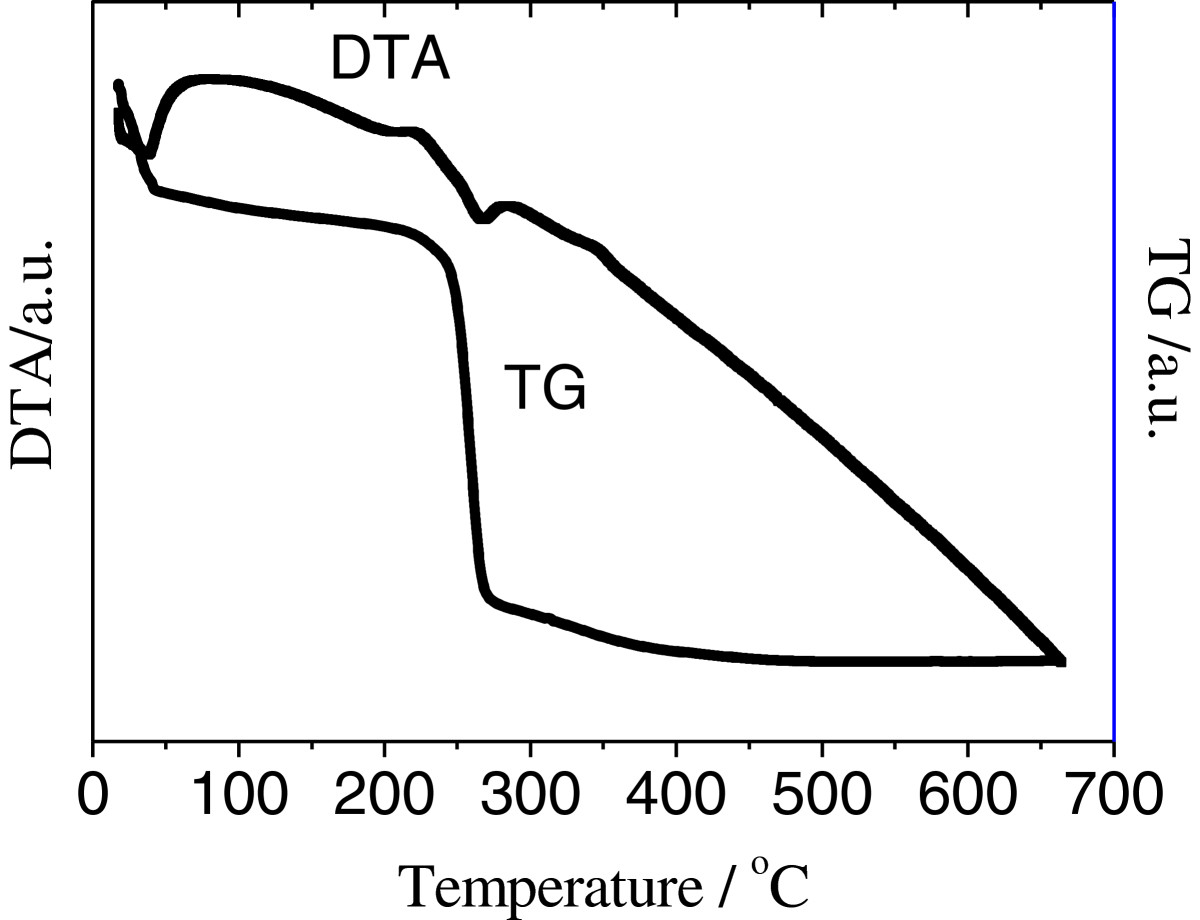
The TGA-DTA analysis for precursors suggests two steps of losing weight: the weight loss below 100°C is mainly due to dehydration of physically absorbed water, while the decomposition of NO
3
−
and CO
3
2−
ions, together with the dehydration of OH groups between brucite layers of Co(OH)
2
during which occurs a simultaneous conversion into spinel Co
3
O
4
, contribute to the greater weight loss observed between 200°C and 500°C. Correspondingly, two endothermic peaks are shown in the DTA curve. The precursors have transformed completely into Co
3
O
4
above 500°C (Figure
1
).
Thermogravimetric analysis (TGA) and differential thermal analysis (DTA) curves of precursors obtained hydrothermally (180°C, 4 h).Figure 1
The precondition to obtain the 1D nanostructures of Co
3
O
4
is synthesizing the 1D precursor. The molar ratio of starting reactants was found as an important parameter; therefore, some experiments were carried out by varying both Co(NO
3
)
2
and HMT amounts. Only within a very narrow range of the molar ratio of [Co
2+
] to [(CH
2
)
6
N
4
] (2:1 ~ 4:1), the wirelike precursors of cobalt basic nitrate carbonate could be obtained. The precursors and final products calcined at 500°C were further characterized by TEM and SEM techniques. A typical TEM image of Figure
2
a reveals that the precursors display almost perfect 1D morphologies with widths about 100 nm. The lengths are estimated about 3 to 10 μm. Apparently, the aspect ratios of these 1D nanostructures are notably large. In addition, the precursors have proved the copiousness in quantity, and the uniformity in size distribution. The calcined products exhibit rough surfaces, as shown in Figure
2
b, c, suggesting the polycrystalline feature. The energy dispersive spectrum (EDS) of the selected field, which is white framed in Figure
2
c, was measured for the 500°C-calcined products, and the result displayed in Figure
2
d indicates the molar ratio of Co/O equal to 0.72, in good agreement with the theoretic value of Co
3
O
4
.
The morphology of the precursor (a), the calcined products (b and c), and EDS (d).
SAED of the calcined products is inset in
(b)
, and EDS results white framed in
(c)
are also exhibited in
(d)
.Figure 2

As shown in Figure
3
, XRD, TEM, and IR techniques were employed combinationally in order to gain some insights on the function of anions in the formation of 1D Co
3
O
4
.
Temporal evolution of XRD patterns, TEM images, and IR spectrum.
For precursors taken out of the autoclave at different stages of hydrothermal treatment:
(a)
20,
(b)
60, and
(c)
120 min.Figure 3
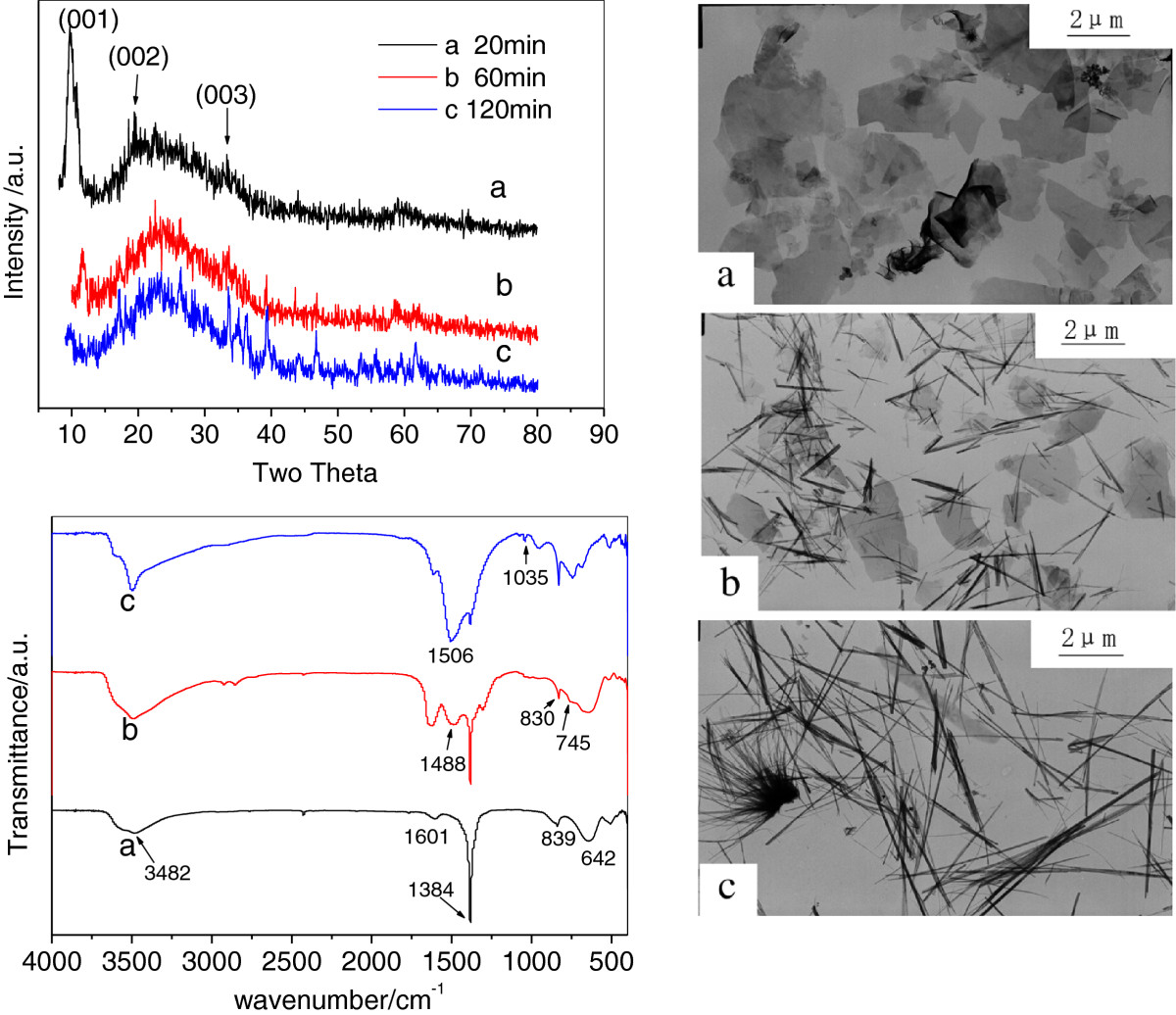
Reaction time dependence of XRD patterns for precursors exhibited a phase transformation from initial metastable α -Co(OH) 2 to the thermodynamically stable phase, which showed a similarity with Co(CO 3 ) 0.35 Cl 0.2 (OH) 1.1 ·0.74H 2 O, implying that NO 3 − ions occupied the same position as Cl − ions in the NO 3 − intercalated cobalt carbonate hydroxide.
The phase transformations were accompanied by the morphology alterations. As shown in Figure 3 , nanosheets were obtained after 20 min of hydrothermal treatment. When the holding time was prolonged to 1 h, 1D nanostructures with the length of 2 μm coexisted with the nanosheets. After the holding time increased above 2 h, only nanowires were obtained.
FT-IR technique is an effective way to investigate the kind of anions intercalated between the Co(OH) 2 layers. The precursor α -Co(OH) 2 taken from solution at 20 min has a large interlayer space, designated literally as a pre-hydrotalcite-like phase as confirmed by IR and XRD. Water bending mode is also found at 1,601/cm, about 30/cm red shift due to strong interactions with the interlayer anions of NO 3 − and/or CO 3 2− . In agreement with the structural assignment, absorption peaks at 1,384 and 839/cm ( ν 3 and ν 2 vibration modes of NO 3 − with D 3h symmetry) indicate that a large number of NO 3 − anions are included [ 19 , 20 ]. With increasing the holding time, the intensity of the peak at 1,384/cm decreased obviously, and the ν 2 vibrational modes appear at 830/cm, apparently lower than NO 3 − with D 3h symmetry, indicating an increment in the perturbation of the intercalated NO 3 − . Simultaneously, two peaks appear at 1,480 and 1,312/cm, which can be assigned to symmetric vibrational mode ( ν s (ONO 2 )) and asymmetric vibrations ( ν as (ONO 2 ))on monodentate nitrate, respectively. In addition, the appearance of a tiny peak at 1,312/cm suggests that the amount of NO 3 − is significantly reduced [ 19 , 21 ]. The IR spectra for sample prepared after the holding time above 2 h shows two more absorptions at 1,506 and 1,035/cm, which belong to the ν 3 and ν 1 vibrational modes of carbonate anions with C 2V symmetry. Compared with the data from Xu and Zeng [ 20 ], the two absorptions exhibited blue and red shifts, respectively. The perturbation can be attributed to stronger electrostatic interactions between the divalent CO 3 2− anions and the brucite-like sheets.
In summary, the probable procedure for the formation of 1D Co 3 O 4 could be described as follows: initially, a large amount of NO 3 − ions intercalated between the brucite layers, adopting D 3h symmetry. The amount of CO 3 2− gradually produced by hydrolysis and oxidation of HMT increased, leading to the substitution for some of NO 3 − ions and the alteration of symmetry from D 3h to C 2v . Consequently, the modification of interlayer forces resulted in the instability of intralayer interactions, and the two-dimensional nanosheets eventually transformed to 1D nanostructures. The morphology was preserved in calcination to produce 1D Co 3 O 4 .