Free energies, kinetics, and photoelectron-transfer properties, and theoretical and quantitative structural relationship studies of [SWCNT(5,5)-armchair-CnH20][R] (R = η2-CmPd(dppf), η2-CmPd(dppr), and η2-CmPd(dppcym)2, n = 20 to 300 and m = 60 and 70) nanostructure complexes
Department of Organic Chemistry, Faculty of Chemistry, Razi University, Kermanshah, IR
Chemistry Department, Faculty of Science, Islamic Azad University, Arak, IR
Abstract
Metal complexes containing one or several bis(triorganylphosphine)palladium fragments attached to the C
60
core and coordinated in olefinic
η2
mode have been previously described. The number of carbon atoms of the single-walled carbon nanotubes (SWCNTs) is the useful numerical and structural electrochemical properties contributing to the relationship between the structures of the
η2_
C
m
Pd(dppf),
η2_
C
m
Pd(dppr), and
η2_
C
m
Pd(dppcym)
2
(
m
= 60 and 70) ligands (A to E) and [SWCNT(5,5)-armchair-C
n
H
20
] (
n
= 20 to 190) 1 to 18 and the production of the [SWCNT(5,5)-armchair-C
n
H
20
][
R
] (
R
=
η2
-C
m
Pd(dppf),
η2
-C
m
Pd(dppr), and
η2
-C
m
Pd(dppcym)
2
,
n
= 20 to 300 and
m
= 60 and 70) complexes 30 to 174. In this study, the relationship between the number of carbon atoms index and the first and second free energies of electron transfer (
ΔGet(
n
)
,
n
= 1,2) using the Rehm-Weller equation based on the first and second oxidation potentials (
oxE1
and
oxE2
) of A to E for the predicted complexes 30 to 174 between 1 and 29 with exohedral metallofullerenes A to E, as [SWCNT(5,5)-armchair-C
n
H
20
][
R
] (
R
=
η2
-C
m
Pd(dppf),
η2
-C
m
Pd(dppr), and
η2
-C
m
Pd(dppcym)
2
,
n
= 20 to 300 and
m
= 60 and 70) 30 to 174 was assessed. Here, the first and second free activation energies of electron transfer and the wavelengths of the electromagnetic photons in the photoelectron transfer process,
ΔG#et(
n
)
and
λ(
n
)
(nm), respectively, for 30 to 174 in accordance with the Marcus theory and Planck's equation were also calculated.
Background
The first metal complexes containing one or several bis(triorganylphosphine)platinum fragments attached to the C
60
core and coordinated in the olefinic
η2
mode were described in 1991 [
1
–
3
], revealing that fullerenes, at least buckminsterfullerene C
60
, can function as ligands in reactions with transition metals. Electronic structures of exohedral palladium complexes of [60] and [70] fullerenes with diphenylphosphinoferrocenyl, diphenylphosphinoruthenocenyl, and diphenylphosphinocymantrenyl ligands were studied by cyclic voltammetry and semi-empirical quantum chemical calculations in 2004 [
1
]. The probable sites of the electronic changes in these complexes under electrochemical oxidation and reduction have also been determined [
1
–
4
].
The bulk of fullerene metal complexes consist of heteroligand complexes. The only exceptions known to date are polymeric homoligand complexes of C
60
with palladium or platinum, which are prepared by the direct reaction of fullerene with zero-valent complexes of these metals with a weakly bound ligand, dibenzylideneacetone [
1
–
8
]. The platinum and palladium complexes (C
60
)
Mx
(
M
= Pt and Pd) can also be prepared from the Pt(0) and Pd cyclooctadiene complexes. Two C
60
molecules are bound to the metal atom in
η2
mode. However, instead of separate (C
60
)
2M
molecules, a polymeric chain is formed, which is probably indicative of enhanced reactivity (with respect to ligand-free palladium) of the other fullerene double bonds upon coordination of one bond. If an excess of the
M
(0) compound is present, the specific content of the metal increases [
1
–
8
]. According to elemental analysis, the insoluble precipitates have compositions of (C
60
)Pd
x
, where
x
= 1, 2, 3, and more. Some free metal is always present. C
60
molecules are presumably linked by metal atoms into one-dimensional chains or two- and three-dimensional frameworks. The palladium (platinum) fullerene polymer reacts heterogeneously with P ligands (tertiary phosphines or tertiary phosphites) in solution to give the C
60
ML
2
complexes, which can also be synthesized by other methods [
1
–
8
]. The electrochemical synthesis of the (
η2
-C
60
M(PPh
3
)
2
(
M
= Pt, Pd) complexes was performed by reacting the dianion of C
602-
prepared by electrochemical reduction (at a Pt electrode in a toluene-acetonitrile solution in the presence of Bu
4
NBF
4
as the supporting electrolyte) with the ML
2
Cl
2
complex or with a divalent metal chloride in the presence of triphenylphosphine [
1
–
4
]. The palladium derivatives of C
60
and C
70
with cymantrenyldiphenylphosphine ligand were prepared in a similar way [
7
,
8
]. A series of new exohedral Pd(0) complexes with C
60
and C
70
fullerenes containing bisdiphenylphosphinoferrocene (dppf), bisdiphenylphosphinoruthenocene (dppr), or two diphenylphosphinocymantrene (dppcym) molecules as stabilizing ligands have been synthesized. These complexes contain a strongly electron-withdrawing fullerene cage and a metallocene group, which can be either electron releasing (ruthenocene) or electron withdrawing (cymantrene) and is linked with the cage through a bisdiphenylphosphine palladium bridge. The electrochemical pattern is impeded because the bisdiphenylphosphine palladium fragment linking these terminal groups is also redox active [
1
–
8
].
Metal complexes with fullerenes have attracted attention due to the prospects of their application in catalysis, in materials for nonlinear optics, for designing artificial photosynthesis systems, and in the development of supra- and nanomaterials [
4
]. More specifically, metal-fullerene interactions are of particular importance. Platinum was the first metal found to form
π
-complexes with fullerenes. However, evidence for the existence of similar complexes for palladium was obtained soon thereafter. The most practical preparation of palladium
η2
complexes appeared to be by direct synthesis using Pd
2
(dba)
3
, fullerene, and a free phosphine ligand. Almost all known complexes of fullerenes with an undisturbed electronic system involve only
η2
coordination, which is typical of an isolated olefinic double bond. The
η2
coordination is probably due to the nonplanar surface geometry, which makes the axes of the pseudo-
π
-orbitals nonparallel and, thus, hampers their bonding to metal orbitals [
1
–
8
].
Nanotubes of type (
n
,
n
) are called
armchair nanotubes
because of their ‘W’ shape perpendicular to the tube axis. They are symmetrical along the tube axis, with a short unit cell (0.25 nm or 2.5 Å) that is repeated along the entire section of a long nanotube. All other nanotubes are called
chiral nanotubes
and have longer unit cell sizes along the tube axis [
9
–
11
]. The simplest type of nanotube is a cylindrical structure, which conceptually could be formed by folding and gluing a pair of opposite sides of a rectangular graphite sheet [
9
–
24
]. If both ends are capped, it will have at least two pentagons and be a type of fullerene. Nanotubes are large, linear fullerenes with aspect ratios as large as 103 to 105 [
11
]. The walls of such tubes can have various sizes of polygons [
25
]. Although many nanoscale fullerene materials occur regularly in applications, controlled production of numerous fullerenes and nanotubes with well-defined characteristics has not yet been achieved [
16
–
19
,
25
].
Carbon nanotubes possess many special properties, such as an open mesoporous structure, high electrical conductivity and chemical stability, and extremely high mechanical strength and modulus [
11
,
19
–
21
]. These properties not only help in the transportation of ions but also facilitate the charging of the double layer and confer advantages in the development of electrochemical capacitors [
22
]. Single-walled carbon nanotubes have been recognized as potential electrode materials for electrochemical capacitors [
23
,
24
].
One of the most widely recognized structures of nanotubes is the (5,5) tube, which can be built by successively adjoining sections of ten C atoms. In the infinite tube, the periodic unit cell has two sections, each consisting of 20 C atoms [
9
]. The electronic structures and electrical properties of single-walled nanotubes can be simulated from those of a graphite layer (graphene sheet) [
19
–
24
].
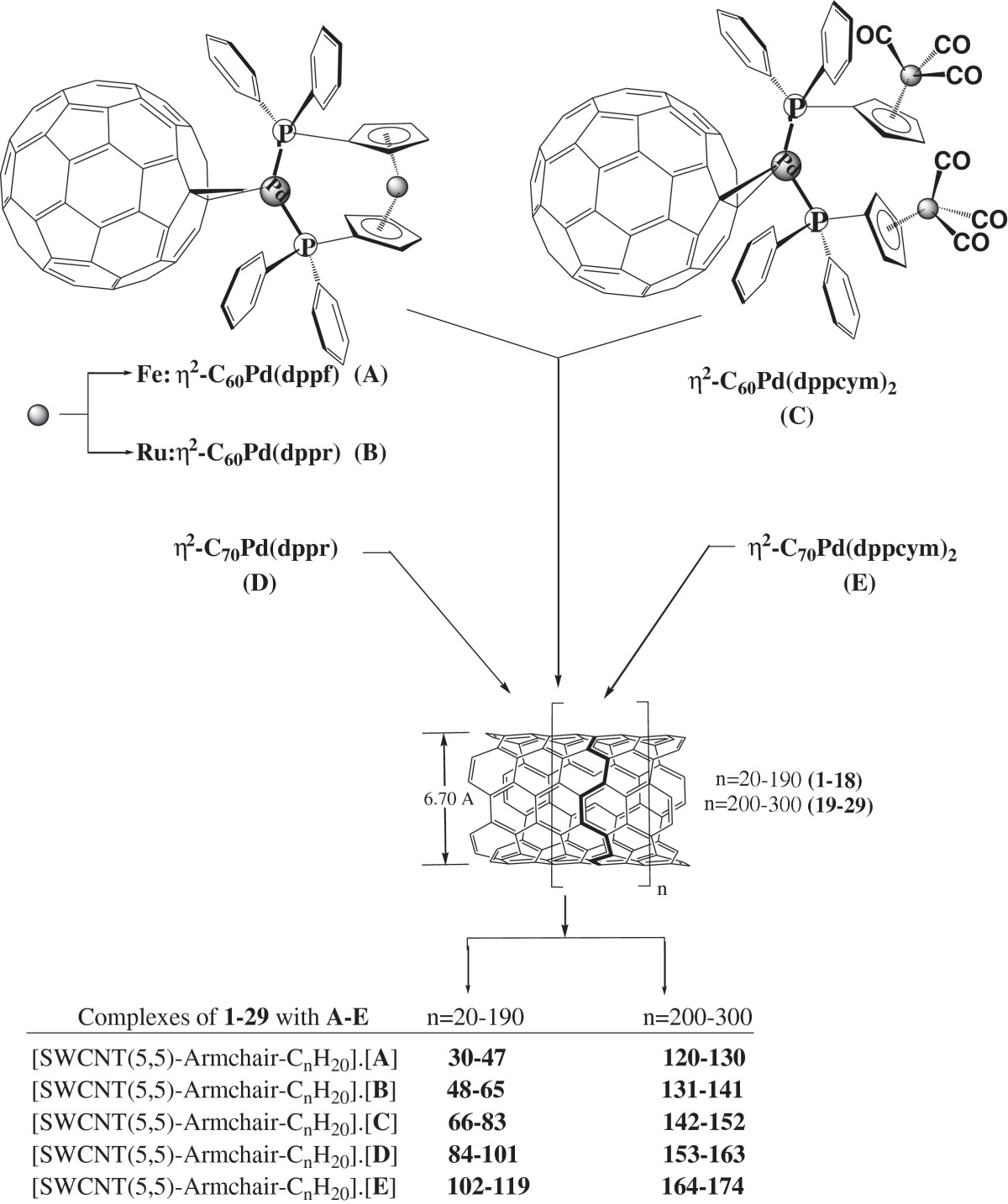
Figure
1
shows the (5,5)
armchair
form with the imaginary structures of the
η2_
C
m
Pd(dppf),
η2_
C
m
Pd(dppr), and
η2_
C
m
Pd(dppcym)
2
(
m
= 60 and 70) ligands (A to E) and 1 to 174 as [SWCNT(5,5)-armchair-C
n
H
20
][
R
] (
R
=
η2
-C
m
Pd(dppf),
η2
-C
m
Pd(dppr), and
η2
-C
m
Pd(dppcym)
2
,
n
= 20 to 300 and
m
= 60 and 70) 30 to 174. The nanotubes may not contain any hydrogen atoms (there is no hydrogen in the electric arc technique), and the nanotubes can be easily closed at both ends.
Figure 1
Schemes.A
to
E
and [SWCNT(5,5)-armchair-C
n
H
20
][
R
] (
R
=
η2
-C
m
Pd(dppf),
η2
-C
m
Pd(dppr), and
η2
-C
m
Pd(dppcym)
2
,
n
= 20 to 300 and
m
= 60 and 70) complexes.
Electronic structures of tubular aromatic molecules derived from the metallic (5,5) armchair SWCNT for C
20
H
20
up to C
210
H
20
(see Figure
1
) were reported by Zhou et al. in 2004 [
9
]. The authors considered how the electronic structures of short molecular sections of the (5,5) tube relate to, differ from, and asymptotically approach those of an infinite metallic tube [
9
]. Some of the structural and electronic properties were investigated, such as the ionization potential, electron affinity, Fermi energy, chemical hardness, and relative energetic stability. All of these metrics show the length periodicity in the frontier orbital (i.e., highest occupied molecular orbital-lowest unoccupied molecular orbital) gap, in contrast to the optical ‘charge transfer’ transition and the static axial polarizability [
9
]. The (5,5) nanotubes have two types of symmetry. For nanotubes with odd identification numbers (1 to 17), the point group is
D5
d
, whereas nanotubes with even identification numbers (2 to 18) have a point group of
D5
h
. Static and time-dependent density function theory calculations were used to independently optimize the structure for neutral, cationic, and anionic complexes [
9
]. The hybrid nonlocal Becke, three-parameter, Lee-Yang-Parr (B3LYP) function was applied [
9
].
Infinite-length SWCNTs are
π
-bonded aromatic structures that can be either semi-conducting or metallic, depending upon the diameter and helical angle of the SWCNTs. In a pioneering 1992 DFT calculation, Mintmire et al. predicted that the infinite length (5,5) armchair SWCNT (6.70 Å diameter) would be metallic with a very low transition temperature separating the uniform (high-temperature) structure from the Peierls bond alternating (low-temperature) structure [
23
,
26
]. This specific SWCNT is the elongated tube of the C
60
, C
70
, etc. molecular family [
9
]. Most of the previous studies have dealt with C
60
@SWCNT and C
70
@SWCNT structures [
18
,
27
–
30
].
The diameter sizes of C
60
and [SWCNT(5,5)-armchair-C
n
H
20
] 1 to 18 were reported to be 6.70 and 6.94 Å, respectively [
28
–
30
]. With these diameters, C
60
and larger fullerenes cannot be encapsulated inside the [SWCNT(5,5)-armchair-C
n
H
20
] in the structure of C
n
@[SWCNT(5,5)-armchair-C
n
H
20
].
Any extrapolation of results from one compound to other compounds must take into account considerations based on a Quantitative Structural Analysis Relationship Study, which mostly depends on the similarity of the physical and chemical properties of the compounds in question. Numerous studies in the above areas have also used topological indices [
31
–
35
]. In previous studies, the relationship between the
DU
index and electron affinity, reduction potential (
Red.E1
) of [SWCNT(5,5)-armchair-C
n
H
20
] as well as the free energy of electron transfer (Δ
Get
) between [SWCNT(5,5)-armchair-C
n
H
20
] structures and fullerene C
60
in C
60
@[SWCNT(5,5)-armchair-C
n
H
20
] complexes was investigated [
28
]. In some studies, the relationship between the
DU
index and the free energy of electron transfer (Δ
Get
) using the Rehm-Weller equation based on the first oxidation potential (
oxE1
) of Sc
2
@C
84
and Er
2
@C
82
for the predicted supramolecular complexes between SWCNT(5,5)-armchair-C
n
H
20
and the endohedral metallofullerenes Sc
2
@C
84
and Er
2
@C
82
as [M
2
@C
x
]@[SWCNT(5,5)-armchair-C
n
H
20
] (
M
= Er and Sc,
x
= 82 and 84) [
28
–
30
,
36
] was assessed.
To characterize the structural properties of the
π
-bonds, we investigated the relationship between the number of carbon atoms of the SWCNT (C
n
) index and electron affinity,
Red.E1
of [SWCNT(5,5)-armchair-C
n
H
20
] 1 to 18 (and extension of the results to 19 to 29) as well as the first and second free energies of electron transfer (Δ
Get(
n
)
,
n
= 1,2) using the Rehm-Weller equation [
36
] based on the first and second oxidation potential (
oxE1
and
oxE2
) of the
η2_
C
m
Pd(dppf)),
η2_
C
m
Pd(dppr), and
η2_
C
m
Pd(dppcym)
2
(
m
= 60 and 70) ligands (A to E) for the predicted [SWCNT(5,5)-armchair-C
n
H
20
][
R
] (
R
=
η2
-C
m
Pd(dppf),
η2
-C
m
Pd(dppr), and
η2
-C
m
Pd(dppcym)
2
,
n
= 20 to 300 and
m
= 60 and 70) supramolecular complexes 30 to 174. We also calculated the first and second activation free energies of electron transfer and the wavelengths of the electromagnetic photons in the photoelectron transfer process, Δ
G#et(
n
)
, and
λ(
n
)
(nm) using the Marcus theory, Planck's equation, and the equations based on the first and second oxidation potentials (
oxE1
and
oxE2
) of A-E for the predicted supramolecular complexes 30 to 174. The Marcus theory is based on the traditional Arrhenius equation for the rates of chemical reactions in two ways. First, it provides a formula for the pre-exponential factor in the Arrhenius equation, based on the electronic coupling between the initial and final states of the electron-transfer reaction (i.e., the overlap of the electronic wave functions of the two states). Second, it provides a formula for the activation energy, based on a parameter called the
reorganization energy
, as well as the
Gibbs
free energy. The reorganization energy is defined as the energy required to reorganize the structure of the system from initial to final coordinates without changing the electronic state [
37
–
42
].
Although electrons are commonly described as residing in electron bands in bulk materials and electron orbitals in molecules, the following description will be described in molecular terms. When a photon excites a molecule, an electron in a ground state orbital can be excited to a higher energy orbital. This excited state leaves a vacancy in a ground state orbital that can be filled by an electron donor. An electron is produced in a high-energy orbital and can be donated to an electron acceptor. Photo-induced electron transfer is an electron transfer that occurs when certain photoactive materials interact with light, including semiconductors that can be photo-activated, such as many solar cells, biological systems like those used in photosynthesis, and small molecules with suitable absorptions and redox states [
36
–
42
].
Methods
The number of carbon atoms of the SWCNTs (C
n
) was used as a structural index (1 to 29). All mathematical and graphing operations were performed using
MATLAB-7.4.0(R2007a)
and
Microsoft Office Excel 2003
programs. The number of carbon atoms in the SWCNTs (C
n
) is a useful numerical and structural value in characterizing the empty fullerenes. However, we used other selected indices and the best results and equations for extending the physicochemical and electrochemical data.
The Rehm-Weller equation estimates the free energy change between an electron donor (
D
) and an acceptor (
A
) as
ΔGet°=eED°-EA°-ΔE*+ω1,
where
e
is the unit electrical charge,
ED
° and
EA
° are the reduction potentials of the electron donor and acceptor, respectively, Δ
E*
is the energy of the singlet or triplet excited state, and
ω1
is the work required to bring the donor and acceptor within the electron transfer (ET) distance. The work term in this expression can be considered to be ‘0’ in so far as an electrostatic complex exists before the electron transfer [
36
].
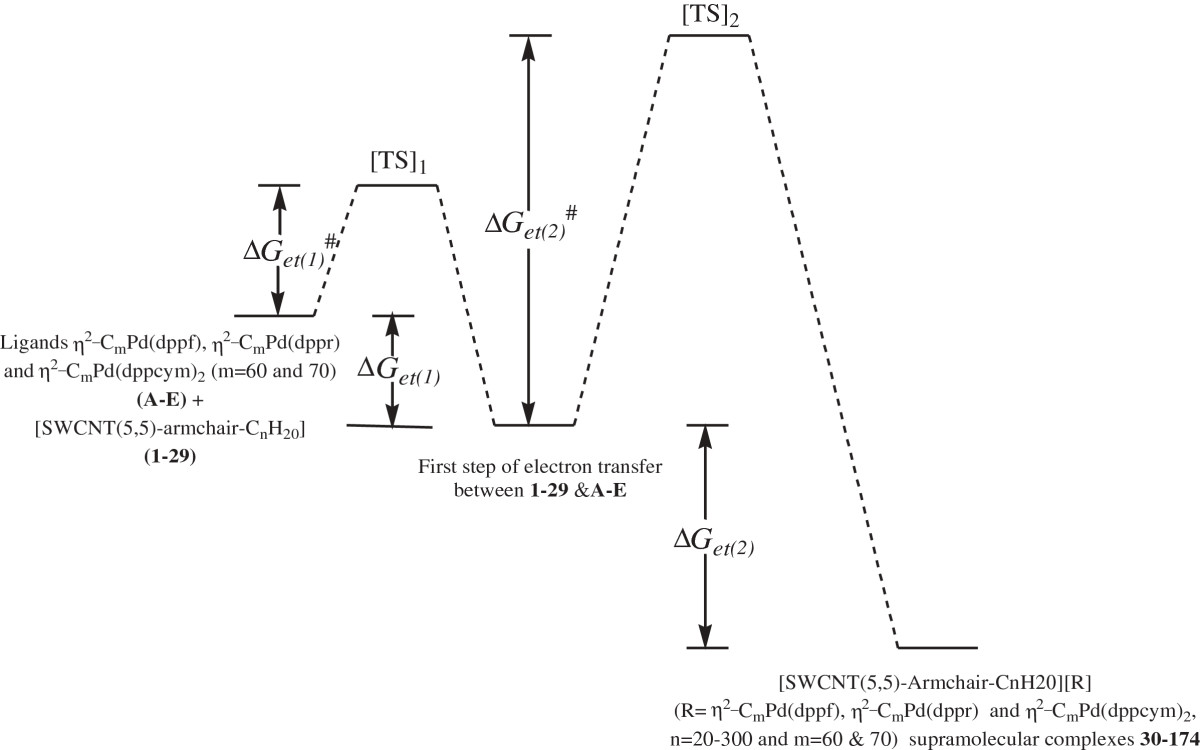
The Marcus theory of electron transfer implies rather weak (<0.05 eV) electronic coupling between the initial (locally excited (LE)) and final (ET) states, and presumes that the transition state is close to the crossing point of the LE and CT terms. The value of the electron transfer rate constant
ket
is controlled by the activation free energy Δ
G#et
, which is a function of the reorganization energy (
l
/4) and the electron transfer driving force Δ
Get
:
ΔG#et=l/41+ΔGet/l2,ket=k0exp-ΔG#et/RT.
The reorganization energy of organic molecules ranges from 0.1 to 0.3 eV. In this study, we used the minimum amount of reorganization energy [
37
–
42
].
To calculate the maximum wavelengths (
λ(
n
)
;
n
= 1 to 2 of the electromagnetic photon for the electron transfer process in the nanostructure supramolecular complexes, we used Planck's formula:
ΔG#et=ΔE=h.c/λn.
In this study, this formula was also used to calculate the activation free energy of the electron transfer process [
43
].
Results and discussion
The electronic structures of the exohedral palladium complexes of [60]_ and [70]_fullerenes with diphenylphosphinoferrocenyl, diphenylphosphinoruthenocenyl, and diphenylphosphinocymantrenyl ligands (
η2_
C
m
Pd(dppf),
η2_
C
m
Pd(dppr), and
η2_
C
m
Pd(dppcym)
2
(
m
= 60 and 70) (A to E), respectively) were studied by cyclic voltammetry and semi-empirical quantum chemical calculations. The C
60
Pd(dppf), C
60
Pd(dppcym)
2
, C
60
Pd(dppr), C
70
Pd(dppr), and C
70
Pd(dppcym)
2
complexes were synthesized using the Schlenk technique by a previously described method [
1
,
2
,
5
,
6
]. The reaction required equivalent amounts of the respective fullerene, Pd
2
(dba)
3
complex (where dba is dibenzylideneacetone) and phosphine ligand under argon. Measurements of
OxE
and
RedE
have been previously reported [
1
,
2
]. Voltammograms were recorded with 0.15 МBu
n4
NBF
4
as a supporting electrolyte in
ortho-
dichlorobenzene at 20°C in a 10-mL electrochemical cell vs. Ag/AgCl/KCl. Oxygen was removed by passing dry argon through the cell [
1
,
2
]. The CV curves were recorded on a stationary graphite electrode with sweep rates of 100 and 200 mV s
-1
. The potentials of the peaks, which were often poorly pronounced in the CV curves, were determined [
1
,
2
]. The first and second reported oxidation potential (
oxE1
and
oxE2
in volt) states of A to E are as follows [
1
,
2
]:
The energy (
Ea
) is released upon the attachment of an electron to an atom or a molecule (A), resulting in the formation of the negative ion A
-
, i.e., A + e
-
→ A
-
+
Ea
. As in the case of the ionization potential, the adiabatic electron affinity (
Eaa
) and vertical electron affinity can be defined. The adiabatic
Ea
is equal to the difference between the total energies of a neutral system (A) and the corresponding anion (A
-
). The vertical
AX
is equal to the difference between the total energies of A and the anion A
-
in the equilibrium geometry of A [
44
]. The free energy of this reaction (
ΔEs
(A→A
-
)) corresponds to the absolute redox energy for the above process. The free energy of an electron (e
-
) at rest in the gas phase is set to zero [
45
,
46
]. The redox energy of the reaction (A + e
-
→ A
-
+
Ea
) can be calculated using a thermodynamic equation (see Equation 5). In this equation, Δ
Gs
(A) and Δ
Gs
(A
-
) are the solvation energies of molecule A and its anion A
-
, respectively, and Δ
Eg
(A→A
-
) is the energy difference between molecule A and its anion (which is defined as the redox energy in the gas phase). Based on this thermodynamic cycle, we can obtain Δ
Es
(A→A
-
), the absolute redox energy [
45
,
46
]:
ΔEsA→A-=ΔEgA→A-+ΔGsA-AGsA-.
By calculating the gas phase energies and solvation energies of molecule A and its anion A
-
, the absolute redox potential (scaled) of molecule A in solution can be derived. A scaling coefficient that translates electron affinity into standard redox potentials can be extracted [
44
–
46
]. As seen in the results of [
16
], the static TD-DFT and independently optimized structure were used to calculate the physicochemical and electronic structure of tubular aromatic molecules derived from the metallic (5,5) armchair single-walled carbon nanotubes using the hybrid nonlocal B3LYP function [
8
,
47
,
48
].
The reduction potential (
RedE
) of 1 to 18 can be calculated using the Gibbs equation (
ΔG
= -
nFE
) and the definition of adiabatic electron affinity. In this equation,
ΔG
is equal to the adiabatic electron affinity (the free energy of electron transfer,
ΔGet
in J mol
-1
, 1 eV = 96,471 J mol
-1
,
F
= 96,495 coulomb, and
n
= 1). For example, the reduction potentials (
RedE
) of C
20
H
20
and C
30
H
20
are equal to -0.34 and -0.89 V, respectively. The
RedE
of [SWCNT(5,5)-armchair-C
n
H
20
] (
n
= 20 to 190) 1 to 18 were calculated and are presented in Table
1
. The amount of
RedE
(in V) =
-Eaa
(in eV), where
Eaa
is the adiabatic electron affinity (see Table
1
for more details).
Table 1
The values of the coefficients of SWCNT 1 to 18 and the complexes 30 to 119
Number
Molecular formula
Point group
Eaa(eV)
RedE(V)
[SWCNT][η2-C60Pd(dppf)]
[SWCNT][η2-C60Pd(dppr)]
[SWCNT][η2-C60Pd(dppcym)2]
[SWCNT][η2-C70Pd(dppr)]
[SWCNT][η2-C70Pd(dppcym)2]
(30 to 47)
(48 to 65)
(66 to 83)
(84 to 101)
(102 to 119)
ΔGet(1)
ΔGet(2)
ΔGet(1)
ΔGet(2)
ΔGet(1)
ΔGet(2)
ΔGet(1)
ΔGet(2)
ΔGet(1)
ΔGet(2)
1
C20H20
D5d
0.34
-0.34
27.2108
35.2818
26.0578
33.8982
30.9004
40.3550
26.9802
34.8206
30.9004
38.2796
2
C30H20
D5h
0.89
-0.89
39.8938
47.9648
38.7408
46.5812
43.5834
53.0380
39.6632
47.5036
43.5834
50.9626
3
C40H20
D5d
0.67
-0.67
34.8206
42.8916
33.6676
41.5080
38.5102
47.9648
34.5900
42.4304
38.5102
45.8894
4
C50H20
D5h
1.14
-1.14
45.6588
53.7298
44.5058
52.3462
49.3484
58.8030
45.4282
53.2686
49.3484
56.7276
5
C60H20
D5d
1.56
-1.56
55.3440
63.4150
54.1910
62.0314
59.0336
68.4882
55.1134
62.9538
59.0336
66.4128
6
C70H20
D5h
1.34
-1.34
50.2708
58.3418
49.1178
56.9582
53.9604
63.4150
50.0402
57.8806
53.9604
61.3396
7
C80H20
D5d
1.61
-1.61
56.4970
64.5680
55.3440
63.1844
60.1866
69.6412
56.2664
64.1068
60.1866
67.5658
8
C90H20
D5h
1.98
-1.98
65.0292
73.1002
63.8762
71.7166
68.7188
78.1734
64.7986
72.6390
68.7188
76.0980
9
C100H20
D5d
1.71
-1.71
58.8030
66.8740
57.6500
65.4904
62.4926
71.9472
58.5724
66.4128
62.4926
69.8718
10
C110H20
D5h
1.91
-1.91
63.4150
71.4860
62.2620
70.1024
67.1046
76.5592
63.1844
71.0248
67.1046
74.4838
11
C120H20
D5d
2.24
-2.24
71.0248
79.0958
69.8718
77.7122
74.7144
84.1690
70.7942
78.6346
74.7144
82.0936
12
C130H20
D5h
2.06
-2.06
66.8740
74.9450
65.7210
73.5614
70.5636
80.0182
66.6434
74.4838
70.5636
77.9428
13
C140H20
D5d
2.13
-2.13
68.4882
76.5592
67.3352
75.1756
72.1778
81.6324
68.2576
76.0980
72.1778
79.5570
14
C150H20
D5h
2.43
-2.43
75.4062
83.4772
74.2532
82.0936
79.0958
88.5504
75.1756
83.0160
79.0958
86.4750
15
C160H20
D5d
2.35
-2.35
73.5614
81.6324
72.4084
80.2488
77.2510
86.7056
73.3308
81.1712
77.2510
84.6302
16
C170H20
D5h
2.23
-2.23
70.7942
78.8652
69.6412
77.4816
74.4838
83.9384
70.5636
78.4040
74.4838
81.8630
17
C180H20
D5d
2.53
-2.53
77.7122
85.7832
76.5592
84.3996
81.4018
90.8564
77.4816
85.3220
81.4018
88.7810
18
C190H20
D5h
2.45
-2.45
75.8674
83.9384
74.7144
82.5548
79.5570
89.0116
75.6368
83.4772
79.5570
86.9362
The values of the relative structural coefficients of the (5,5) armchair SWCNT for C
20
H
20
up to C
190
H
20
([SWCNT(5,5)-armchair-C
n
H
20
], 1 to 18), the adiabatic electron affinity (
Eaa
in eV) and the reduction potentials (
RedE
in V) of 1 to 18 are shown in Table
1
. The absolute value of
Eaa
or
RedE
increases with the number of carbon atoms in 1 to 18. From C
20
H
20
up to C
190
H
20
, the point groups alternate between
D5
d
and
D5
h
[
9
]. Using the equations 8 to 16 in Table
2
, the values in Table
1
, and the Rehm-Weller equation, we extended our results to compounds 19 to 29.
Table 2
The Nieperian relationship equations 8 to 16
Complexes of 1 to 18 with ligands A to E [SWCNT(5,5)-armchair-CnH20][ R] (R= η2-CmPd(dppf), η2-CmPd(dppr), and η2-CmPd(dppcym)2, n= 20 to 300 and m= 60 to 70)
Equation
R2
ΔGet( n) = a Ln( n) + b
Stage ( n)
Liganda
a
b
1
A
8
0. 9461
22.416
40.789
9
0. 9461
22.416
32.718
2
1
B
10
0.9461
22.416
41.942
2
11
0.9461
22.416
34.102
1
C
12
0.9461
22.416
37.100
2
13
0.9461
22.416
27.645
1
D
14
0.9461
22.416
41.020
2
15
0.9461
22.416
33.180
1
E
16
0.9461
22.416
37.100
Equations 6 and 7 show the relationship between the number of carbon atoms (
n
) of [SWCNT(5,5)-armchair] and the adiabatic electron affinity (
Eaa
in eV) and reduction potential (
RedE
in V) of [SWCNT(5,5)-armchair-C
n
H
20
] (
n
= 20 to 190) 1 to 18, respectively. Equation 6, like Equation 7, shows the
Nieperian
logarithmic behavior of the relationship. The
R
squared value (
R2
) for the graphs was 0.9461.
Eaa=22.417Lnn-66.853RedE=0.9721Lnn–2.6088.
Using these equations, we derived a good approximation for extending the formulas for the
Eaa
and the
RedE
to [SWCNT(5,5)-armchair-C
n
H
20
] (
n
= 200 to 300) 19 to 29.
The relative structural coefficients, the
Eaa
(in eV), and the
RedE
(in V) of [SWCNT(5,5)-armchair-C
n
H
20
] (
n
= 20 to 190) 1 to 18 are found in Table
1
. The relationship between this index and the first and second free energies of electron transfer (
ΔGet(
n
)
,
n
= 1,2), as assessed using the Rehm-Weller equation based on the first and second oxidation potentials (
oxE1
and
oxE2
) of A to E for the predicted supramolecular complexes between 1 to 18 with the
η2_
C
m
Pd(dppf),
η2_
C
m
Pd(dppr), and
η2_
C
m
Pd(dppcym)
2
(
m
= 60 and 70) ligands (A to E) as [SWCNT(5,5)-armchair-C
n
H
20
] (
n
= 20 to 190) 1 to 18 to produce [SWCNT(5,5)-armchair-C
n
H
20
][
R
] (
R
=
η2
-C
m
Pd(dppf),
η2
-C
m
Pd(dppr), and
η2
-C
m
Pd(dppcym)
2
,
n
= 20 to 300 and
m
= 60 and 70) 30 to 119, is presented.
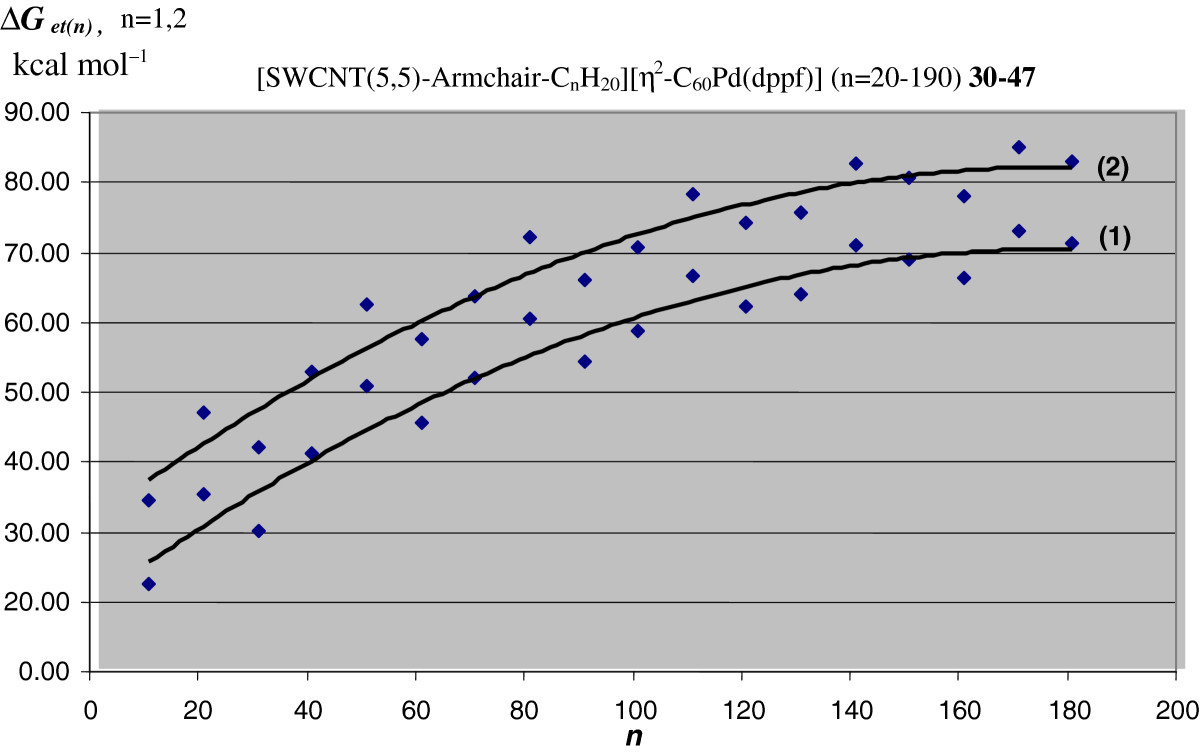
Figure
2
shows the relationship between the number (
n
) of carbon atoms in the [SWCNT(5,5)-armchair] 1 to 18 and the first and second free energies of electron transfer (
ΔGet(
n
)
,
n
= 1,2 kcal mol
-1
) of the ligands
η2_
C
60
Pd(dppf) (A). These data were fit using a regression with a second-order polynomial. The
R2
values for these graphs were 0.9461. We calculated the values of
ΔGet(1)
and
ΔGet(2)
of [SWCNT(5,5)-armchair-C
n
H
20
][
η2
-C
60
Pd(dppf)] (
n
= 20 to 190) 30 to 47 using equations 1, 8, and 9 (see Tables
1
and
2
). The predicted values of
ΔGet(
n
)
(
n
= 1,2) for [SWCNT(5,5)-armchair-C
n
H
20
][
η2
-C
60
Pd(dppf)] (
n
= 20 to 300) 30 to 47, and 120 to 130 were calculated using equations 8 and 9 (see Tables
2
and
3
).
Figure 2
The relationship between the number of carbon atoms and free energies of ET.
[SWCNT(5,5)-armchair-C
n
H
20
][
η2
-C
60
Pd(dppf)] complexes 30 to 47. The free energies of ET were calculated using the Rehm-Weller equation. The related curves for other complexes [SWCNT(5,5)-armchair-C
n
H
20
][
η2
-C
60
Pd(dppf)] (
n
= 20 to 190) 30 to 47 have similar structures with this figure.
Table 3
Values of the relative coefficients of SWCNT 19 to 29 and the complexes 120 to 174
Number
Molecular formula
Point group
Adiabatic electron affinity (eV)
RedE(V)
[SWCNT][η2-C60Pd(dppf)]
[SWCNT][η2-C60Pd(dppr)]
[SWCNT][η2-C60Pd(dppcym)2]
[SWCNT][η2-C70Pd(dppr)]
[SWCNT][η2-C70Pd(dppcym)2]
(120 to 130)
(131 to 141)
(142 to 152)
(153 to 163)
(164 to 174)
ΔGet(1)
ΔGet(2)
ΔGet(1)
ΔGet(2)
ΔGet(1)
ΔGet(2)
ΔGet(1)
ΔGet(2)
ΔGet(1)
ΔGet(2)
19
C200H20
D5d
2.49
-2.49
76.7898
84.8608
75.6368
83.4772
80.4794
89.9340
76.5592
84.3996
80.4794
87.8586
20
C210H20
D5h
2.53
-2.53
77.7122
85.7832
76.5592
84.3996
81.4018
90.8564
77.4816
85.3220
81.4018
88.7810
21
C220H20
D5d
2.57
-2.57
78.6346
86.7056
77.4816
85.3220
82.3242
91.7788
78.4040
86.2444
82.3242
89.7034
22
C230H20
D5h
2.60
-2.60
79.3264
87.3974
78.1734
86.0138
83.0160
92.4706
79.0958
86.9362
83.0160
90.3952
23
C240H20
D5d
2.64
-2.64
80.2488
88.3198
79.0958
86.9362
83.9384
93.3930
80.0182
87.8586
83.9384
91.3176
24
C250H20
D5h
2.67
-2.67
80.9406
89.0116
79.7876
87.6280
84.6302
94.0848
80.7100
88.5504
84.6302
92.0094
25
C260H20
D5d
2.71
-2.71
81.8630
89.9340
80.7100
88.5504
85.5526
95.0072
81.6324
89.4728
85.5526
92.9318
26
C270H20
D5h
2.74
-2.74
82.5548
90.6258
81.4018
89.2422
86.2444
95.6990
82.3242
90.1646
86.2444
93.6236
27
C280H20
D5d
2.77
-2.77
83.2466
91.3176
82.0936
89.9340
86.9362
96.3908
83.0160
90.8564
86.9362
94.3154
28
C290H20
D5h
2.80
-2.80
83.9384
92.0094
82.7854
90.6258
87.6280
97.0826
83.7078
91.5482
87.6280
95.0072
29
C300H20
D5d
2.83
-2.83
84.6302
92.7012
83.4772
91.3176
88.3198
97.7744
84.3996
92.2400
88.3198
95.6990
The first and second free energies of electron transfer (
ΔGet(
n
)
,
n
= 1,2 in kcal mol
-1
) of the supramolecular complexes between the ligand
η2
-C
60
Pd(dppr) B and [SWCNT(5,5)-armchair-C
n
H
20
] (
n
= 20 to 190) 1 to 18 as presented [SWCNT(5,5)-armchair-C
n
H
20
][
η2
-C
60
Pd(dppr)] (
n
= 20 to 190) 48 to 65 are shown in Table
1
. Equations 10 and 11 show the second-order polynomial behavior between the number of carbon atoms of 1 to 18 and the free energies of electron transfers in the supramolecular nanostructures of 48 to 65. Using these equations, we achieved a good approximation for extending the first and second free energies of electron transfer (Δ
Get(
n
)
;
n
= 1,2 in kcal mol
-1
) for the other [SWCNT(5,5)-armchair-C
n
H
20
][
η2
-C
60
Pd(dppr)] (
n
= 200 to 300) 131 to 141. The
R2
values for the relationships were 0.9461. The predicted values of Δ
Get(
n
)
(
n
= 1,2) for [SWCNT(5,5)-armchair-C
n
H
20
][
η2
-C
60
Pd(dppr)] (
n
= 200 to 300) 131 to 141 were calculated using equations 10 and 11 (see Tables
2
and
3
). Tables
1
and
3
show that the values of the first and second free energies of electron transfer (Δ
Get(
n
)
,
n
= 1,2) increased in the supramolecular complexes of [SWCNT(5,5)-armchair-C
n
H
20
][
η2
-C
60
Pd(dppr)] (
n
= 20 to 300) 48 to 65 and 131 to 141 with increasing numbers of carbon atoms in the [SWCNT(5,5)-armchair-C
n
H
20
] structures.
The free energies of electron transfer (
ΔGet(
n
)
,
n
= 1,2 in kcal mol
-1
) of the complexes between the ligand
η2_
C
60
Pd(dppcym)
2
C and [SWCNT(5,5)-armchair-C
n
H
20
] (
n
= 20 to 190) 1 to 18, as presented in [SWCNT(5,5)-armchair-C
n
H
20
][
η2
-C
60
Pd(dppcym)
2
] (
n
= 20 to 190) 66 to 83, are shown in Table
1
. Equations 12 and 13 show the second-order polynomial relationship between the number of carbon atoms of 1 to 18 and the free energies of electron transfers at the supramolecular nanostructures of 66 to 83. Using these equations, we were able to extend the first and second free energies of electron transfer (Δ
Get(
n
)n
= 1,2 in kcal mol
-1
) for [SWCNT(5,5)-armchair-C
n
H
20
][
η2
-C
60
Pd(dppcym)
2
] (
n
= 200 to 300) 142 to 152. The
R2
values for the relationships were 0.9461. The predicted values of Δ
Get(
n
)
(
n
= 1,2) for [SWCNT(5,5)-armchair-C
n
H
20
][
η2
-C
60
Pd(dppcym)
2
] (
n
= 200 to 300) 142 to 152 were calculated using equations 12 and 13 (Tables
2
and
3
). The values of the first and second free energies of electron transfer (Δ
Get(
n
)
,
n
= 1,2) increased in the supramolecular complexes of [SWCNT(5,5)-armchair-C
n
H
20
][
η2
-C
60
Pd(dppcym)
2
] (
n
= 20 to 300) 66 to 83 and 142 to 152 with increasing numbers of carbon atoms in the [SWCNT(5,5)-armchair-C
n
H
20
] structures (Tables
1
and
3
).
The first and second free energies of electron transfer (Δ
Get(
n
)
,
n
= 1,2 in kcal mol
-1
) of the supramolecular complexes between the ligands
η2_
C
70
Pd(dppr) D and
η2_
C
70
Pd(dppr) E with [SWCNT(5,5)-armchair-C
n
H
20
] (
n
= 20 to 190) 1 to 18 as presented in [SWCNT(5,5)-armchair-C
n
H
20
][
η2
-C
70
Pd(dppr)] and [SWCNT(5,5)-armchair-C
n
H
20
][
η2
-C
70
Pd(dppcym)
2
] (
n
= 20 to 190) 84 to 101 and 102 to 119, respectively, are shown in Table
1
. Equations 14 to 15 and 16 to 17 show the second-order polynomial relationship between the number of carbon atoms of 1 to 18 and the free energies of electron transfers in the 84 to 101 and 102 to 119 nanostructures. Using these equations, we extended the first and second free energies of electron transfer (Δ
Get(
n
)
,
n
= 1,2 in kcal mol
-1
) for [SWCNT(5,5)-armchair-C
n
H
20
][
η2
-C
70
Pd(dppr)] and [SWCNT(5,5)-armchair-C
n
H
20
][
η2
-C
70
Pd(dppcym)
2
] 153 to 163 and 164 to 174. The
R2
for the relationships were 0.9461. The predicted values of Δ
Get(
n
)
(
n
= 1,2) for [SWCNT(5,5)-armchair-C
n
H
20
][
η2
-C
70
Pd(dppr)] and [SWCNT(5,5)-armchair-C
n
H
20
][
η2
-C
70
Pd(dppcym)
2
] 153 to 163 and 164 to 174 were calculated using equations 14 to 15 and 16 to 17 (Tables
2
and
3
, respectively). The values of the first and second free energies of electron transfer (Δ
Get(
n
)
,
n
= 1,2) increased in the supramolecular complexes of [SWCNT(5,5)-armchair-C
n
H
20
][
η2
-C
70
Pd(dppr)] and [SWCNT(5,5)-armchair-C
n
H
20
][
η2
-C
70
Pd(dppcym)
2
] 84 to 119 and 153 to 174 with increasing numbers of carbon atoms in the [SWCNT(5,5)-armchair-C
n
H
20
] structures (Tables
1
and
3
).
The Marcus theory is currently the dominant theory of electron transfer in chemistry. This theory is widely accepted because it accurately predicts electron transfer rates. The most significant prediction is that the rate of electron transfer will increase as the electron transfer reaction becomes more exergonic, but only to a point [
37
–
42
].
ET is one of the most important chemical processes in nature and plays a central role in many biological, physical, and chemical (both organic and inorganic) systems. Solid-state electronics depends on controlling ET in semiconductors. Current molecular electronics depends critically on understanding and controlling the transfer of electrons in and between molecules and nanostructures. Electron transfer is a very simple chemical reaction, which can be used to gain insight into other kinds of chemistry and biochemistry. Electron transfer is fundamental in chemistry [
37
–
42
].
The free energy of electron transfer Δ
Get
is the difference between the reactants and the products, and Δ
Get#
is the activation energy. The reorganization energy is the energy required to force the reactants to have the same nuclear configuration as the products without permitting the electron transfer. If the entropy changes are ignored, the free energy becomes energy or potential energy [
37
–
42
].
Using Equation 2, we calculated the first and second activation free energies of electron transfer, Δ
G#et(
n
)
, for 30 to 174 in accordance with the Marcus theory; see Table
4
. Figure
3
shows the surfaces of the free energies of electron transfer Δ
Get(
n
)
and Δ
Get(
n
)#
(
n
= 1,2) between [SWCNT(5,5)-armchair-C
n
H
20
] (
n
= 20 to 300) 1 to 29 and the ligands
η2_
C
m
Pd(dppf),
η2_
C
m
Pd(dppr), and
η2_
C
m
Pd(dppcym)
2
(
m
= 60 and 70) A to E to produce [SWCNT(5,5)-armchair-C
n
H
20
][
R
] (
R
=
η2
-C
m
Pd(dppf),
η2
-C
m
Pd(dppr), and
η2
-C
m
Pd(dppcym)
2
,
n
= 20 to 300 and
m
= 60 and 70) 30 to 174. The values of the first and second activation free energies of electron transfer Δ
G#et(
n
)
(
n
= 1,2) for 30 to 174 increased with increasing Δ
Get(
n
)
and the numbers of carbon atoms in the complexes, while the kinetic rate constants of the electron transfers decreased with increasing
ΔGet(
n
)
and
ΔGet(
n
)#
(
n
= 1,2) (see Tables
1
,
3
, and
4
, and Figure
3
).
Table 4
The values of the first and second free activation energies of electron transfer
Number of SWCNT(5,5)-armchair-CnH20
[SWCNT][η2-C60Pd(dppf)]
[SWCNT][η2-C60Pd(dppr)]
[SWCNT][η2-C60Pd(dppcym)2]
[SWCNT][η2-C70Pd(dppr)]
[SWCNT][η2-C70Pd(dppcym)2]
(30 to 47)
(48 to 65)
(66 to 83)
(84 to 101)
(102 to 119)
ΔG1#
ΔG2#
ΔG1#
ΔG2#
ΔG1#
ΔG2#
ΔG1#
ΔG2#
ΔG1#
ΔG2#
1
35.9794
53.6851
33.7382
50.3991
43.6353
66.6218
35.5254
52.5782
43.6353
61.1609
2
65.3881
88.6426
62.3542
84.4054
75.5806
105.0671
64.7755
87.2187
75.5806
98.1794
3
52.5782
73.6133
49.8615
69.7565
61.7561
88.6426
52.0291
72.3162
61.7561
82.3256
4
81.6382
107.4149
78.2440
102.7453
92.9837
125.4248
80.9536
105.8468
92.9837
117.8885
5
112.9940
143.0080
108.9945
137.6120
126.2766
163.6813
112.1883
141.1978
126.2766
155.0554
6
95.9354
123.7299
92.2530
118.7143
108.2033
143.0080
95.1931
122.0465
108.2033
134.9529
7
117.0655
147.5840
112.9940
142.1015
130.5787
168.5744
116.2455
145.7450
130.5787
159.8188
8
149.4346
183.6859
144.8298
177.5634
164.6542
207.0226
148.5078
181.6335
164.6542
197.3071
9
125.4248
156.9521
121.2091
151.2967
139.3991
178.5766
124.5759
155.0554
139.3991
169.5616
10
143.0080
176.5531
138.5041
170.5518
157.9048
199.4459
142.1015
174.5411
157.9048
189.9121
11
174.5411
211.4155
169.5616
204.8434
190.9599
236.4010
173.5395
209.2133
190.9599
226.0111
12
156.9521
192.0105
152.2320
185.7497
172.5407
215.8546
156.0023
189.9121
172.5407
205.9316
13
163.6813
199.4459
158.8603
193.0641
179.5927
223.7339
162.7114
197.3071
179.5927
213.6293
14
194.1205
232.9118
188.8672
226.0111
211.4155
259.1022
193.0641
230.6000
211.4155
248.2193
15
185.7497
223.7339
180.6117
216.9715
202.6758
249.4170
184.7164
221.4682
202.6758
238.7416
16
173.5395
210.3130
168.5744
203.7582
189.9121
235.2351
172.5407
208.1165
189.9121
224.8710
17
204.8434
244.6435
199.4459
237.5699
222.5996
271.4681
203.7582
242.2741
222.5996
260.3258
18
196.2420
235.2351
190.9599
228.2998
213.6293
261.5523
195.1798
232.9118
213.6293
250.6175
19
200.5197
239.9162
195.1798
232.9118
218.0914
266.4871
199.4459
237.5699
218.0914
255.4486
20
204.8434
244.6435
199.4459
237.5699
222.5996
271.4681
203.7582
242.2741
222.5996
260.3258
21
209.2133
249.4170
203.7582
242.2741
227.1540
276.4952
208.1165
247.0245
227.1540
265.2491
22
212.5210
253.0273
207.0226
245.8326
230.6000
280.2957
211.4155
250.6175
230.6000
268.9718
23
216.9715
257.8814
211.4155
250.6175
235.2351
285.4035
215.8546
255.4486
235.2351
273.9759
24
220.3397
261.5523
214.7405
254.2365
238.7416
289.2646
219.2141
259.1022
238.7416
277.7591
25
224.8710
266.4871
219.2141
259.1022
243.4574
294.4531
223.7339
264.0139
243.4574
282.8439
26
228.2998
270.2185
222.5996
262.7817
247.0245
298.3748
227.1540
267.7280
247.0245
286.6877
27
231.7544
273.9759
226.0111
266.4871
250.6175
302.3224
230.6000
271.4681
250.6175
290.5574
28
235.2351
277.7591
229.4484
270.2185
254.2365
306.2959
234.0720
275.2341
254.2365
294.4531
29
238.7416
281.5684
232.9118
273.9759
257.8814
310.2954
237.5699
279.0260
257.8814
298.3748
Figure 3
The values of
Δ
Get(n)and
Δ
Get(n)#of ET between 1 to 29 and A to E in the structures 30 to 174.
Because of the good linear correlations between Δ
Get(
n
)
(
n
= 1,2),
Eaa
and
RedE
of 1 to 18 with the ligands A to E, we used the values of
Eaa
and
RedE
to calculate the free energies of electron transfer (Δ
Get
in kcal mol
-1
) of [SWCNT(5,5)-armchair-C
n
H
20
] (
n
= 20 to 190) 1 to 18 to produce [SWCNT(5,5)-armchair-C
n
H
20
][
R
] (
R
=
η2
-C
m
Pd(dppf),
η2
-C
m
Pd(dppr), and
η2
-C
m
Pd(dppcym)
2
,
m
= 60 and 70)
n
= 20 to 190, 30 to 119, and
n
= 200 to 300, 120 to 174. The electron affinity and reduction potential have the same magnitude with opposite signs. The free energy of electron transfer can be calculated with the Rehm-Weller equation, which we determined was linearly dependent on the electron affinity of the compounds studied here. In Tables
1
and
3
, the values of the first and second free energies of electron transfer (Δ
Get(
n
)
,
n
= 1,2) obtained for supramolecular complexes 30 to 119 and 120 to 174 from equations 8 to 17 (Table
2
) are compared with those obtained with the Rehm-Weller equation.
The number of carbon atoms (
n
),
Eaa
,
RedE
, and Δ
Get(
n
)
(
n
= 1,2) of [SWCNT(5,5)-armchair-C
n
H
20
] (
n
= 20 to 300) 1 to 29 and their complexes with the ligands
η2_
C
m
Pd(dppf),
η2_
C
m
Pd(dppr), and
η2_
C
m
Pd(dppcym)
2
(
m
= 60 and 70) (A to E) as [SWCNT(5,5)-armchair-C
n
H
20
][
R
] (
R
=
η2
-C
m
Pd(dppf),
η2
-C
m
Pd(dppr), and
η2
-C
m
Pd(dppcym)
2
,
n
= 200 to 300 and
m
= 60 and 70) supramolecular complexes 120 to 174 are shown in Table
3
. The
RedE
were extended for C
200
H
20
up to C
300
H
20
([SWCNT(5,5)-armchair-C
n
H
20
], 19 to 29). The calculated results for
RedE
as well as the free energies of electron transfer (Δ
Get(
n
)
,
n
= 1, 2, in kcal mol
-1
) according to the Rehm-Weller equation between A to E with 19 to 29 in structures 120 to 174 are presented in Table
3
.
As shown in Figure
2
, the periodicity of the plotted points is 3, which is common among benzenoids. Using Equation 1 (Rehm-Weller equation) and equations
2
to 17, the values of
Eaa
,
RedE
, Δ
Get(
n
)
(
n
= 1,2), Δ
G#et(
n
)
, and
ket(
n
)
(
n
= 1,2) for 30 to 174 were calculated. The number of carbon atoms showed a good relationship with the values of the
Eaa
, the
RedE
of [SWCNT(5,5)-armchair-C
n
H
20
] (
n
= 20 to 190) 1 to 18 and 19 to 29, and the Δ
Get
in [SWCNT(5,5)-armchair-C
n
H
20
][
R
] (
R
=
η2
-C
m
Pd(dppf),
η2
-C
m
Pd(dppr), and
η2
-C
m
Pd(dppcym)
2
,
n
= 20 to 300 and
m
= 60 and 70) supramolecular complexes 30 to 174. Figure
3
shows the free energy surfaces of electron transfer Δ
Get(
n
)
and Δ
Get(
n
)#
(
n
= 1,2) between 1 to 29 and the ligands A to E in the structures of 30 to 174, which were calculated using equations
1
to 17 and are shown in Tables
1
,
2
,
3
,
4
, and
5
. With the appropriate equations, we calculated the
Eaa
, the
RedE
in 1 to 18 and 19 to 29, the first and second free energies of electron transfer (Δ
Get
in kcal mol
-1
), and the first and second activation free energies of electron transfer Δ
G#et(
n
)
for 30 to 174 in accordance with the Marcus theory.
Table 5
Values of the first and the maximum wave lengths for each stage of the ET process
Number of SWCNT(5,5)-armchair-CnH20
Molecular formula
[SWCNT][η2-C60Pd(dppf)]
[SWCNT][η2-C60Pd(dppr)]
[SWCNT][η2-C60Pd(dppcym)2]
[SWCNT][η2-C70Pd(dppr)]
[SWCNT][η2-C70Pd(dppcym)2]
λ(1)
λ(2)
λ(1)
λ(2)
λ(1)
λ(2)
λ(1)
λ(2)
λ(1)
λ(2)
1
C20H20
794
532
847
567
655
429
804
543
655
467
2
C30H20
437
322
458
339
378
272
441
328
378
291
3
C40H20
543
388
573
410
463
322
549
395
463
347
4
C50H20
350
266
365
278
307
228
353
270
307
242
5
C60H20
253
200
262
208
226
175
255
202
226
184
6
C70H20
298
231
310
241
264
200
300
234
264
212
7
C80H20
244
194
253
201
219
169
246
196
219
179
8
C90H20
191
156
197
161
174
138
192
157
174
145
9
C100H20
228
182
236
189
205
160
229
184
205
169
10
C110H20
200
162
206
168
181
143
201
164
181
150
11
C120H20
164
135
169
139
150
121
165
137
150
126
12
C130H20
182
149
188
154
166
132
183
150
166
139
13
C140H20
175
143
180
148
159
128
176
145
159
134
14
C150H20
147
123
151
126
135
110
148
124
135
115
15
C160H20
154
128
158
132
141
115
155
129
141
120
16
C170H20
165
136
169
140
150
121
166
137
150
127
17
C180H20
139
117
143
120
128
105
140
118
128
110
18
C190H20
146
121
150
125
134
109
146
123
134
114
19
C200H20
142
119
146
123
131
107
143
120
131
112
20
C210H20
139
117
143
120
128
105
140
118
128
110
21
C220H20
137
115
140
118
126
103
137
116
126
108
22
C230H20
134
113
138
116
124
102
135
114
124
106
23
C240H20
132
111
135
114
121
100
132
112
121
104
24
C250H20
130
109
133
112
120
99
130
110
120
103
25
C260H20
127
107
130
110
117
97
128
108
117
101
26
C270H20
125
106
128
109
116
96
126
107
116
100
27
C280H20
123
104
126
107
114
95
124
105
114
98
28
C290H20
121
103
125
106
112
93
122
104
112
97
29
C300H20
120
101
123
104
111
92
120
102
111
96
We determined the values of the maximum wavelengths (
λ(
n
)
;
n
= 1 or2, in nm) for each stage of the electron transfer process in the nanostructure supramolecular complexes 30 to 174 with Planck's formula. Using this formula, we also determined the activation free energy of the electron transfer process. Most of the values were found in the UV–vis (190 to 800 nm) range of the electromagnetic spectrum. The maximum wavelengths (
λ(
n
)
;
n
= 1 or 2) depended on the Δ
G#et(
n
)
value in each stage (Equation 4 and Table
5
).
The supramolecular complexes of armchair single-wall nanotubes [SWCNT(5,5)-armchair-C
n
H
20
] (
n
= 20 to 300) 1 to 18 and 19 to 29 with the ligands
η2_
C
m
Pd(dppf),
η2_
C
m
Pd(dppr), and
η2_
C
m
Pd(dppcym)
2
(
m
= 60 and 70) (A to E), i.e., [SWCNT(5,5)-armchair-C
n
H
20
][
R
] (
R
=
η2
-C
m
Pd(dppf),
η2
-C
m
Pd(dppr), and
η2
-C
m
Pd(dppcym)
2
,
n
= 20 to 300 and
m
= 60 and 70), and the calculated values of Δ
Get(
n
)
,
ΔG#et(
n
)
, and
λ(
n
)
(
n
= 1 and 2) corresponding to the supramolecular complexes 30 to 174 have neither been synthesized nor reported before.
Conclusions
The complexes
η2_
C
m
Pd(dppf),
η2_
C
m
Pd(dppr), and
η2_
C
m
Pd(dppcym)
2
(
m
= 60 and 70) (A to E) contain a strongly electron-withdrawing fullerene cage and a metallocene group, which can be either electron releasing (ruthenocene) or electron withdrawing (cymantrene) and is linked with the cage through a bisdiphenylphosphinepalladium bridge. The oxidation potentials (
oxE1
and
oxE2
) of
η2_
C
m
Pd(dppf),
η2_
C
m
Pd(dppr), and
η2_
C
m
Pd(dppcym)
2
(
m
= 60 and 70) (A to E) have been reported. In this study, we identified structural relationships between the number of carbon atoms and the
Eaa
, the values of the
RedE
of [SWCNT(5,5)-armchair-C
n
H
20
] (
n
= 20 to 300) 1 to 18 and 19 to 29, the Δ
Get(
n
)
, and the ΔG
#et(
n
)
for the complexes 30 to 174. The number of carbon atoms is strongly correlated with the values of
Eaa
and
RedE
in the (5,5) armchair SWCNT 1 to 18 and 19 to 29, which are important factors in characterizing these materials. The values of Δ
Get(
n
)
and Δ
G#et(
n
)
(
n
= 1,2) were calculated using the Rehm-Weller equation and Equations 2 and 3 for 30 to 119 and 120 to 174 supramolecular nanostructure complexes, respectively. The maximum wavelengths of the electromagnetic photons in the photoelectron transfer process for each stage (
λ(
n
)
;
n
= 1 to 2, in nm) of the nanostructure complexes 30 to 174 were calculated with Planck's equation. The novel supramolecular complexes and the calculated values have neither been synthesized nor reported previously. Using this model and the associated equations, we can easily calculate the
Eaa
,
RedE
, Δ
Get(
n
)
, Δ
G#et(
n
)
(kcal mol
-1
), and
λ(
n
)
(
n
= 1,2; in nm) of this family of compounds 30 to 174 with good approximation.
Authors’ information
AAT is professor of Organic Chemistry and is an academic member of the Razi University (Kermanshah-Iran) since 2012. He was the academic member of Islamic Azad University (IAU), Arak, Iran from 1998 to 2012. AAT has spent his post-doctorate at The University of Queensland (UQ), Brisbane, Australia in Reactive Intermediates and Unusual Molecules Group under the supervision of Professor Curt Wentrup in Brisbane, Australia during 2006 and 2007. He has as well developed his scientific activities in Professor Curt Wentrup's laboratory at The University of Queensland and under his supervision in July to September of 2008 and August to September of 2009. Professor AAT has worked in The University of New England (UNE), Armidale, NSW, Australia with a sabbatical opportunity with Professor Stephen Glover's group from 2011 to 2012. AAT has won national prizes for his scientific paper (ISI, ISC, educational and propagation publication), books, invention, scientific activities, and conferences papers until now. AAT is one of the Members of the Central Committee of the Iranian Chemical Society (CCICS). ZTH has masters degree in Organic Chemistry from Islamic Azad University (IAU), Arak, Iran in 2011. ZTH has studied on theoretical electron transfer process between the exohedral metallofullerenes of Pd and SWCNT(5,5)-armchair nanotubes under the supervision of AAT.
Acknowledgments
The corresponding author gratefully acknowledges his colleagues in the Chemistry Department of The University of New England (UNE), Australia for their useful suggestions.
Competing interests
The authors declare that they have no competing interests.
Authors’ contributions
AAT carried out the ET investigations. This study was a part of AAT's studies in ET process between important molecules and nanostructures. ZTH participated in the statistical analysis and background part of the study. All authors read and approved the final manuscript.
References
Magdesieva et al. (2004) Comparison of electrochemical behavior of exohedral palladium complexes with [60]- and [70]-fullerenes and metallocene ligands 53(4) (pp. 795-799) 10.1023/B:RUCB.0000037844.93864.3c
Sokolov (2007) Fullerenes as a new type of ligands for transition metals 33(10) (pp. 711-724) 10.1134/S1070328407100016
Fagan et al. (1991) The chemical nature of buckminsterfullerene (C60) and the characterization of a platinum derivative10.1126/science.252.5009.1160
Denisovich et al. (2010) Electrochemical properties of transition metal complexes with C60 and C70 fullerene ligands 46(1) (pp. 3-20) 10.1134/S1023193510010015
Bashilov et al. (2000) A new heterobimetallic palladium–[60] fullerene complex with bidentate bis-1,1′-[P]2-ferrocene ligand J10.1016/S0022-328X(99)00687-7
Bashilov et al. (1993) Synthesis of the first optically active organometallic fullerene derivative by η2 functionalization of buckminsterfullerene by Pd(0) complexes (pp. 392-393) 10.1007/BF00697111
Yanilkin et al. (2003) Electrochemical synthesis of a phosphorylated monomethano [60] fullerene (pp. 13-14) 10.1070/MC2003v013n01ABEH001708
Magdesieva et al. (2002) Metalation of fullerenes: electrochemical synthesis and voltammetric study of heterometallic C60 and C70 complexes10.1023/A:1020900131485
Zhou et al. (2004) Electronic structure of tubular aromatic molecules derived from the metallic (5,5) armchair single wall carbon nanotube 126(11) (pp. 3597-3607) 10.1021/ja039294p
Srivastava et al. (2001) Computational nanotechnology with carbon nanotubes and fullerenes (pp. 42-55) 10.1109/5992.931903
Lourie et al. (1998) Buckling and collapse of embedded carbon nanotubes (pp. 1638-1641) 10.1103/PhysRevLett.81.1638
Nagase and Kobayashi (1994) The ionization energies and electron affinities of endohedral metallofullerenes MC82 (M = Sc, Y, La): density functional calculations (pp. 1837-1838) 10.1039/c39940001837
Dubois et al. (1991) Electrochemical detection of fulleronium and highly reduced fulleride (C605-) ions in solution 113(20) (pp. 7773-7774) 10.1021/ja00020a056
Xie et al. (1992) Electrochemical detection of C606- and C706-: enhanced stability of fullerides in solution 114(10) (pp. 3978-3980) 10.1021/ja00036a056
Li et al. (1992) The unusual electrochemical properties of the higher fullerene, chiral C76 114(10) (pp. 3994-3996) 10.1021/ja00036a068
Arellano et al. (2002) Interaction of molecular and atomic hydrogen with (5,5) and (6,6) single-wall carbon nanotubes 117(5) (pp. 2281-2288) 10.1063/1.1488595
Srivastava and Barnard (1997) IEEE Computer Society Press, Los Alamitos
Yakobson et al. (1996) Nanomechanics of carbon tubes: instabilities beyond linear response (pp. 2511-2514) 10.1103/PhysRevLett.76.2511
Dresselhaus et al. (1996) Academic
Dai (2002) Carbon nanotubes: synthesis, integration, and properties 35(12) (pp. 1035-1044) 10.1021/ar0101640
Collins and Avouris (2000) Nanotubes for electronics (pp. 38-45)
Dresselhaus et al. (1992) Carbon fibers based on Ceo and their symmetry 45(11) (pp. 6234-6242) 10.1103/PhysRevB.45.6234
Srivastava and Atluri (2002) Computational nanotechnology: a current perspective 3(5) (pp. 531-538)
Bandow et al. (2001) Smallest limit of tube diameters for encasing of particular fullerenes determined by radial breathing mode Raman scattering 347(1–3) (pp. 23-28) 10.1016/S0009-2614(01)01020-X
Taherpour (2009) Quantitative structural relationship and theoretical study of electrochemical properties of C60@[SWCN(5, 5)-Armchair-CnH20] complexes (pp. 135-139) 10.1016/j.cplett.2008.12.039
Taherpour (2009) Theoretical and quantitative structural relationship study of the electrochemical properties of [M2@Cx]@[SWCNT(5,5)-armchair-CnH20] (M = Er and Sc, x = 82 and 84, and n = 20–300) complexes (pp. 5402-5408) 10.1021/jp8096617
Taherpour (2009) Theoretical and quantitative structural relationships of the electrochemical and electron transfer properties of [Mx@C82]@[SWCNT(5,5)-armchair-Cn H20] (x = 0, 1; for x = 1: M = Ce & Gd and n = 20–300) nanostructure complexes (pp. 233-240) 10.1016/j.cplett.2009.10.075
Hansen and Jurs (1988) Chemical applications of graph theory. Part I. Fundamentals and topological indices 65(7) (pp. 574-580) 10.1021/ed065p574
Hosoya (1971) Topological index. A newly proposed quantity characterizing the topological nature of structural isomers of saturated hydrocarbons (pp. 2332-2339) 10.1246/bcsj.44.2332
Randić (1998) On characterization of molecular attributes 45(3) (pp. 239-252)
Du et al. (2002) Orthogonalization of block variables by subspace projection for quantitative structure property relationship (QSPR) research 42(5) (pp. 993-1003) 10.1021/ci020283+
Bolboaca and Jantschi (2007) How good can the characteristic polynomial be for correlations? Int 8(4) (pp. 335-345) 10.3390/i8040335
Rehm and Weller (1970) Kinetics of fluorescence quenching by electron and H-atom transfer Isr (pp. 259-271)
Marcus (1993) Electron transfer reactions in chemistry: theory and experiment 65(3) (pp. 599-610) 10.1103/RevModPhys.65.599
Andrea (2008) Marcus theory for electron transfer a short introduction MPIP (pp. 1-13)
Barbara et al. (1996) Contemporary issues in electron transfer research 100(31) (pp. 13148-13168) 10.1021/jp9605663
Newton (1991) Quantum chemical probes of electron-transfer kinetics: the nature of donor-acceptor interactions (pp. 767-792) 10.1021/cr00005a007
Minkin (1999) Glossary of terms used in theoretical organic chemistry 71(10) (pp. 1919-1981) 10.1351/pac199971101919
Zhang and Friesner (1995) Ab initio electronic structure calculation of the redox potentials of bacteriochlorophyll and bacteriopheophytin in solution 99(44) (pp. 16479-16482) 10.1021/j100044a042
Topol et al. (2001) Experimental determination and calculations of redox potential descriptors of compounds directed against retroviral zinc fingers: implications for rational drug design 10(7) (pp. 1434-1445) 10.1110/ps.52601
Becke (1993) Density‐functional thermochemistry. III. The role of exact exchange 98(7) (pp. 5648-5652) 10.1063/1.464913
Curtiss and Raghavachari (2002) Addendum to Gaussian-3 and related methods for accurate thermochemistry (pp. 61-70) 10.1007/s00214-002-0355-9