Effect of magnetic field on terahertz generation via laser interaction with a carbon nanotube array

Abstract

An amplitude-modulated laser, in the presence of a static magnetic field, interacts with an array of carbon nanotubes embedded on a metallic surface. The laser exerts a ponderomotive force on the free electrons of carbon nanotubes at twice the modulation frequency that falls in the terahertz (THz) range. Each nanotube acts as an oscillatory electric dipole, producing THz radiations. The presence of magnetic field shifts the resonance condition and provides tunability. The THz radiation power increases with magnetic field strength.


Findings

Background

Over the last decade, there has been significant research activity in the area of terahertz (THz) radiation generation and detection. The THz region of the electromagnetic spectrum lies in the gap between microwaves and infrared with a frequency range of 0.1 to 10 THz and corresponding wavelength range of 30 to 3,000 μm. THz radiations have applications in defense, medical imaging, sensors, spectroscopy, etc. THz radiations can be generated via several mechanisms, viz. optical rectification of a short pulse laser or a surface plasma wave, photoconduction, Cherenkov radiation, etc.[ 19 ]. Presently, there is an increased interest in employing metallic nanostructures and carbon nanotubes to generate THz radiations as these structures offer the advantage of compactness with reasonable efficiency. A metallic nanostructured surface has been employed by Welsh and Wyne[ 10 ] to generate ultrafast THz radiation pulses via excitation of surface plasmon. Garwe et al.[ 11 ] have observed THz radiations on either side of a gold-coated nanograting (500 nm), employing a 785-mm, 150-ps, 1-KHz Ti:sapphire laser. Studies on nanoscale periodic arrays of rectangular-shaped holes revealed band formation of THz nanoresonators[ 12 ]. Nemilentsau et al.[ 13 ] have investigated the application of a finite-length isolated carbon nanotube as a thermal nanoscale antenna in THz range. Batrakev et al.[ 14 ] and Portnoi et al.[ 15 ] have given elegant reviews of terahertz processes in carbon nanotubes. Another promising scheme of THz radiation generation is by exploiting excellent metallic properties of carbon nanotubes[ 16 ]. Wang and Wu[ 17 ] have experimentally studied the properties of THz radiation pulses emitted by a metallic, large-aspect ratio carbon nanotube antenna. Ramakrishnan et al.[ 18 ] have observed generation of a sub-picosecond THz pulse by illuminating a graphite surface with femtosecond infrared laser pulses. Dragoman and Dragoman[ 19 ] have given the physical model and simulation results of semiconducting carbon nanotube resonant-tunneling diodes for THz radiation generation. Zhao et al.[ 19 ] have studied the characteristics of metallic, single-walled carbon nanotubes as THz antenna. Wang et al.[ 20 ] have observed antenna-like effect in an array of aligned carbon nanotubes. Dagher et al.[ 21 ] have studied amplification of radiation in metallic carbon nanotubes under the influence of a d.c. magnetic field. Parashar and Sharma[ 22 ] have studied THz radiation generation via optical rectification of a laser in an array of carbon nanotubes. In this work, we extend their work to study the effect of static magnetic field on THz radiation generation from an array of carbon nanotubes. An amplitude-modulated laser interacts with an array of cylindrical carbon nanotubes. The laser exerts a ponderomotive force on the free electrons on the nanotubes, inducing on them a current at twice the modulation frequency. The image charges in the metallic base constitute a supplementary array with currents out of phase by π with respect to the primary array. These oscillating nanotube arrays act as antennas to produce THz radiation.

Analysis

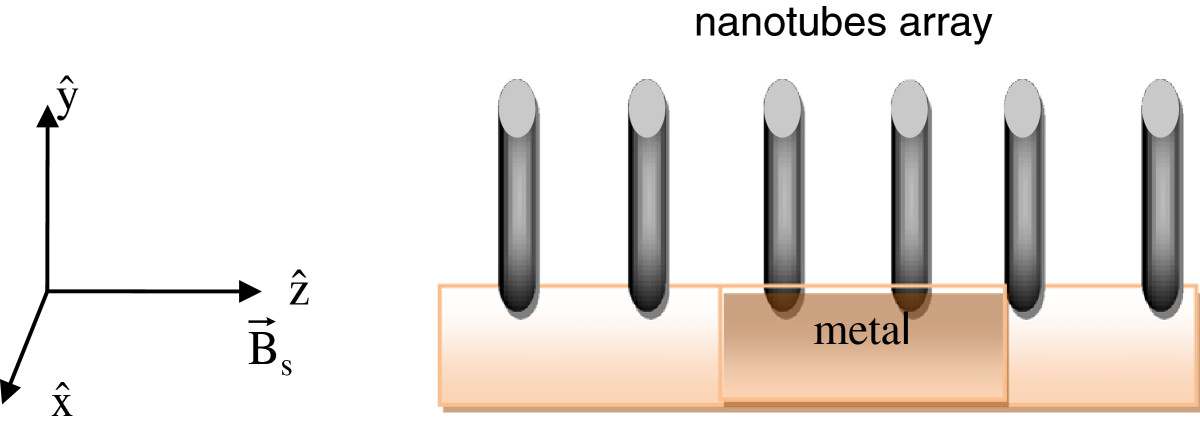
Consider a metal surface ( x = 0), embedded with normally mounted carbon nanotubes of radius r c , length c x^ , and surface density N c (per unit area), where c >> r c . The free electron density inside a nanotube is n 0 c.f. Figure 1 .

Figure 1

Schematic of process.

An amplitude-modulated laser is impinged on the nanotube array with electric and magnetic fields

EL=ALx^iy^1+μcosΩtz/ceiωtkz,
BL=ck×ELω,
AL2=A02exlc2/r02,

where k = ω / c , μ is the modulation index of laser, and Ω is in terahertz range.

There also exists a static magnetic field given by

Bs=B0z^.

Under the influence of electric field, the electrons of nanotubes are displaced by a distance Δ , and the displacement is governed by the equation of motion

md2Δdt2=eELmωp2Δ2εLy^eΔt×Bs.

Here, ω p  = ( n oe 2 / m ε 0  ) 1/2 is the plasma frequency of electrons in a nanotube, −e and m are the charge and effective mass of the electron, ε 0 is the free space permittivity, and ε L is the relative permittivity of the lattice.

The x and y components of the equation of motion can be written as

ω2Δx+iωωcΔy=e/mELx

and

ω2ω'pe2/2ΔyiωωcΔx=e/mELy,

where

ωp'=ωp/εL.

Here, it is to be mentioned that the restoring force due to the displacement of the electron cloud of nanotubes is finite for the field perpendicular to the nanotube axis and zero for the field along the axis.

On simplifying Equations 5 and 6 , we obtain the x and y components for the displacement of the electron cloud as

Δx=emELyω2iω/ωcELyωc/ωELxω2ωpe/2/2ωc2

and

Δy=emELy+iωc/ωELxω2ωpe/2/2ωc2,

respectively.

The electron velocity can be written as

v=iωΔxx^+Δyy^.

The laser exerts a ponderomotive force on electrons at the modulation frequency

Fp=e2cv×BL*z^e2AL2ki2mω2ωωcω2ωpe/2ωc2e2tz/c.

The oscillatory velocity of electrons due to the ponderomotive force following Equation 5 can be written as

v2Ω=iFp2Ωm4Ω2ωp'2/2.

The current density at Ω can be written as

J2Ω=n0ev2Ω=2n0eΩiFpm4Ω2ωp'2/2.

J2Ω
is finite over the cross section π  r c 2 of a nanotube and zero over the area a 2 = 1/ N (where a is the separation between the nanotubes). Thus, the average terahertz current density due to the array is
J2Ω=πrc2N2n0eΩim4Ω2ωp'2/2Fp=z^αexlc2/r02e2iΩtΩz/c,

where

α=πrc2Nn0eμ4Ω2ωp'2/2Ω2e2AL2m2ω2cωωcω2ωpe/2/2ωc2.

As the base of the carbon nanotube is metallic, there will be an image current density underneath the metal surface,

J2Ω'=z^αex+c2/r02e2iΩtΩz/c.

Let the y and z dimensions of the array be L × L .

The vector potential at a far point due to the current distributions is

Ar,t=μ04πJ2Ωr',tR/c/R)dV'+J2Ω'r',tR/c/R)dV',

where R=rr'r1r.r'/r2 = r – sin θ cos φ x − sin θ sin φ y ′ − cos θ z′; r , θ , and φ are the spherical polar coordinates of the point of observation, and we shall assume Ω c / c , Ω r c / c <<1 The above Equation 15 can be written as

A=z^αμ04πre2iΩtΩr/cI1I2,

where

I1=1/21/21/21/2ex'c2/r02edx'dy'dz'
I2=1/21/21/21/2ex'+c2/r02edx'dy'dz'
ψ'=2Ωcz'1cosθ+x'sinθcosϕ+y'sinθsinϕ.

On carrying out integration, I 1 and I 2 reduce to

I1=sinΩL/c1cosθiΩ/c1cosθsinθsinϕsinΩL/csinθsinϕπrce2iΩc/c

and

I2=sinΩL/c1cosθiΩ/c1cosθsinθsinϕsinΩL/csinθsinϕπrce2iΩc/c,

respectively.

From Equations 17 and 18 , we obtain

I1I2πrccosΩccsinΩL/c1cosθ.sinΩL/csinθsinϕΩ/c1cosθsinθsinϕ.

The magnetic field at far distance is

B=×Ai2Ω/cr^×A.

The time-average Poynting vector using Equation 20 can be written as

Sav=B22μ0cr^W/m2=r^rc4α2μ02μ2r24Ωcc2sin2ΩL/c1cosθsin2ΩL/c(sinθsinφ]1cosθ2sin2θsin2φW/m2.

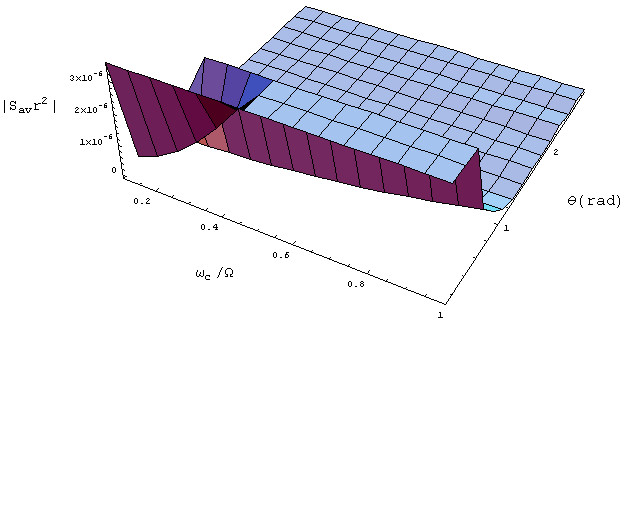
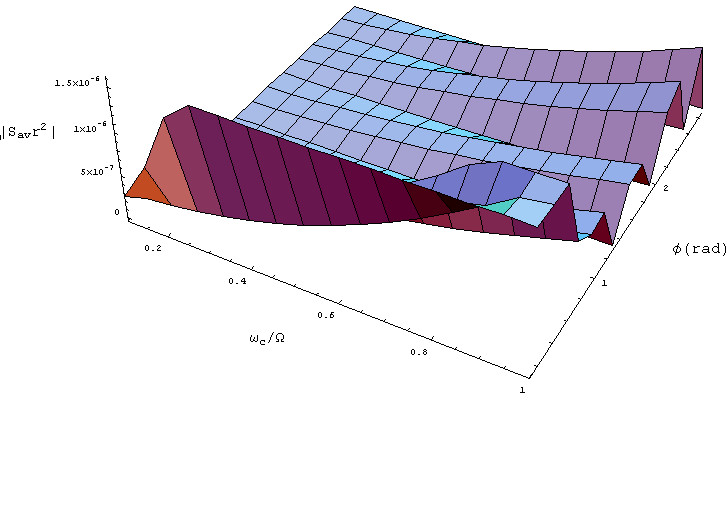
In Figure 2 , we have shown the variation of | r 2S av | with ω c /Ω at different values of θ for the following set of parameters: ω c /Ω = 20, nanotube radius r c = 25 nm, μ = 0.01, inter-nanotube separation a = 30 nm, length of nanotube c = 500 nm[ 20 ], n 0 = 10 21 cm −3 , φ =1 rad, ε L = 16, L × L = 2 × 2 cm, and eA L / mωc = 0.03. The efficiency of the generated THz power shows a maximum near θ = 1 rad. The efficiency increases with magnetic field strength, and for the above-mentioned parameters, ω c /Ω = 0.1 corresponds to a magnetic field strength of 100 kG. The above parameter of eA L / mωc = 0.03 can be realized using a Nd:YAG laser of 1.06 μm with an intensity of 10 15 W/cm 2 . In Figure 3 , we have shown the variation of | r 2S av | with ω c /Ω at different values of φ for θ = 1 rad. The other parameters are similar to those of Figure 2 . The power radiated shows oscillatory behavior with φ .

Figure 2

Variation of | r 2 S av | with ω c /Ω at different values of θ for different parameters. The parameters are as follows: ω c /Ω = 20, r c = 25 nm, μ = 0.01, inter-nanotube separation a = 30 nm, c = 500 nm, n 0 = 10 21 cm −3 , ϕ = 1 rad, ε L = 16, L × L = 2 × 2cm, eA L / mωc = 0.03.

Figure 3

Variation of | r 2 S av | with ω c /Ω at different values of φ for θ = 1 rad. Other parameters are similar to those of Figure 2 .

Conclusions

An array of carbon nanotubes mounted on a metallic base can be employed to generate THz radiations. The radiations' pattern is directional with a peak value of power radiated at around 5 μW, which is quite reasonable. Wang et al.[ 16 ] have predicted a maximum efficiency of 5 μW for THz radiations from the armchair carbon nanotube dipole antenna. On comparing with THz radiation generation from a GaP crystal via the difference frequency generation scheme[ 3 ], the efficiency is quite good. One can exploit the resonance condition Ωωp/8εL for enhancement of efficiency of THz radiation generation. The application of magnetic field reduces the requirement on the resonance condition. The efficiency of THz radiation increases with the strength of the applied magnetic field. The analysis is limited to a laser of moderate powers only.

Author's information

SJ did his masters degree in Physics from Barkatullah University, Bhopal (M.P.), India, and at present, he is working towards his Ph.D. degree in Physics. His research interests are in the area of interaction of electromagnetic and electrostatic waves with nanoparticles and nanotubes.

JP is presently the head of the Department of Applied Physics at Samrat Ashok Technological Institute. He did his masters in Physics in 1991 and Ph.D. in 1994 from Barkatullah University, Bhopal (M.P.), India. He worked at I.I.T. Delhi, University of Durban, S.A. and National Central University, Taiwan. His research interests include nonlinear effects in laser matter interaction, plasma physics, and free electron lasers.

RK is currently working as an associate professor at Maulana Azad National Institute of Technology, Bhopal (M.P.), India. He has obtained his masters degree in 1991 from Barkatullah University, Bhopal (M.P.), India and doctoral degree from the University of Leeds (UK) in 1998. In 2011, he has received the Royal Academy of Engineering, London, UK, Research Exchange Award for collaborative research with the University of Bath, UK and also received the UK-India Education Research Initiative (UKIERI phase-II) Award under the Thematic Partnership from British Council Delhi for collaborative research with the University of Bath, UK. His current research interests are ferrite nanoparticles and graphene nanoribbons.


Acknowledgement

This work was supported by the University Grants Commission, New Delhi, India under the research award scheme.


Competing interests

The authors declare that they have no competing interests.


Authors' contributions

SJ did the numerical analysis part of the work. JP did the analytical part of the work. RK conceived the idea and helped in designing and drafting the manuscript. All authors read and approved the final manuscript.


References

  1. Chan et al. (2007) Imaging with terahertz radiation (pp. 1325-1379) 10.1088/0034-4885/70/8/R02
  2. Bhasin and Tripathi (2010) Resonant terahertz generation by optical rectification of an amplitude modulated surface plasma wave (pp. 965-969) 10.1109/JQE.2010.2041898
  3. Ding (2007) High-power tunable terahertz sources based on parametric processes and applications (pp. 705-720) 10.1109/JSTQE.2007.895279
  4. Suizu et al. (2009) Extremely frequency-widened terahertz wave generation using Cherenkov-type radiation (pp. 6676-6681) 10.1364/OE.17.006676
  5. Bhasin and Tripathi (2009) Terahertz generation via optical rectification of x-mode laser in a rippled density magnetized plasma 10.1063/1.3248303
  6. Khoury et al. (2011) Electrically tunable surface plasmon source for terahertz applications (pp. 138-145) 10.1109/JSTQE.2010.2049255
  7. Wynw and Carey (2005) An integrated description of terahertz generation through optical rectification, charge transfer, and current surge (pp. 400-413) 10.1016/j.optcom.2005.06.065
  8. Son (2009) Terahertz electromagnetic interactions with biological matter and their applications 10.1063/1.3116140
  9. Hoffman and Fülöp (2011) Intense ultrashort terahertz pulses: generation and applications 10.1088/0022-3727/44/8/083001
  10. Welsh and Wyne (2009) Generation of ultrafast terahertz radiation pulses on metallic nanostructured surfaces (pp. 2470-2480) 10.1364/OE.17.002470
  11. Garwe et al. (2011) Bi-directional terahertz emission from gold-coated nanoratings by excitation via femtosecond laser pulses (pp. 551-554) 10.1007/s00340-011-4377-7
  12. Bahk et al. (2011) Anomalous band formation in arrays of terahertz nanoresonators 10.1103/PhysRevLett.106.013902
  13. Nemilentsau et al. (2007) Thermal radiation from carbon nanotubes in the terahertz range 10.1103/PhysRevLett.99.147403
  14. Batrakov et al. (2010) Terahertz process in carbon nanotubes 10.1117/1.3436585
  15. Portnoi (2008) Kibis, OV, deCosta (pp. 399-407) 10.1016/j/spmi.2007.07.026
  16. Wang et al. (2009) Terahertz radiation from armchair carbon nanotube dipole antenna (pp. 1801-1806) 10.1088/1674-1056/18/5/014
  17. Wang and Wu (2008) Properties of terahertz wave generated by the metallic carbon nanotube antenna (pp. 770-772) 10.3788/COL20080610.0770
  18. Ramakrishnan et al. (2009) Terahertz generation from graphite (pp. 16092-16098) 10.1364/OE.17.016092
  19. Dragoman and Dragoman (2004) Terahertz oscillations in semiconducting carbon nanotube resonant tunneling diodes (pp. 282-289) 10.1016/j.physe.2004.05.001
  20. Wang et al. (2004) Rybczynski, Herczynski A (pp. 2607-2609)
  21. Dagher et al. (2012) Theoretical investigation of traveling wave amplification in metallic carbon nanotubes biased by a dc field (pp. 463-471) 10.1109/TNANO.2011.2175005
  22. Parashar and Sharma (2012) Optical rectification in a carbon nanotube array and terahertz radiation generation (pp. 2069-2071) 10.1016/j.physe.2012.06.013