Findings
Background
One of the major challenging problems during multistep syntheses is to protect carbonyl functionality from nucleophilic attack until its electrophilic nature can be exploited [ 1 ]. For this reason, the protection of carbonyl groups remains a crucial challenge to organic chemists. Among the numerous protecting groups employed to protect aldehydes and ketones, 1,3-oxathioacetals attracted the attention of many organic chemists [ 1 ]. This attention can be attributed to their ease of preparation and their applicability as an acyl anion equivalent in C-C bond forming reactions [ 2 – 6 ]. Moreover, the use of oxathiolanes is much more convenient than the corresponding O O -acetals or S S -acetals because they are comparatively more stable than O O -acetals under acidic conditions and easier to remove than the corresponding S S -acetals. A variety of Lewis acids including ZrCl 4 [ 7 ], Sc(OTf) 3 [ 8 ], In(OTf) 3 [ 9 ], LiBF 4 [ 10 ], Fe(CF 3 CO 2 ) [ 11 ], Fe(CF 3 SO 3 ) [ 11 ], BF 3 .OEt 2 [ 12 ], ZnCl 2 [ 13 ], MoO 2 (acac) 2 [ 14 ], and LaCl 3 [ 15 ] are used for the preparation of 1,3-oxathiolanes. However, moisture sensitivity of the majority of this type of reagents renders them unsuitable for use in large-scale applications. Other methods using ionic liquids [ 16 , 17 ] and catalysts based on halonium ions [ 18 , 19 ] are also used for this purpose, but these methods generated strongly acidic wastes and/or they utilize highly expensive and non-recyclable reagents. To solve the above-mentioned problems, a number of heterogeneous alternatives such as carbon-based sulfonic acid [ 20 ], H 3 PW 12 O 40 /SiO 2 [ 21 ], montmorillonite clay [ 22 ], Amberlist® 15 [ 23 ] (The Dow Chemicals, Midland, MI, USA), PPA/SiO 2 [ 24 ], MTSA [ 25 ], and silica sulfuric acid [ 26 ] have been employed for this purpose. Although these methods are suitable for certain synthetic conditions, in many of the yields of products are not always satisfactory, and the catalytic activities are lower than homogeneous catalysts in most cases. Therefore, it seems that the major task of current research in chemistry is to replace both homogeneous and less efficient and traditional heterogeneous acid catalysis procedures by environmentally more acceptable protocols based on improved water-tolerant and recoverable catalysts.
In recent years, clays as nanostructured materials have been widely used in organic transformations as solid acid catalysts. The main reasons for the use of clays are accessibility, easy modification, cheapness, non-corrosively, and recyclability. Montmorillonite (MMT) is one of the most widely used clays that have very small micron-sized particles, and it is extremely fine grained and thin layered. The building blocks of montmorillonite layers contain silicon-oxygen tetrahedra (Si 2 O 5 2− ) and aluminum octahedra [Al(OH 6 ) 3− . The repeated unit contains two tetrahedral and one octahedral layer. The MMT layers have permanent negative charges because of the isomorphous substitution of, for instance, Mg 2+ for Al 3+ or, rarely, Al 3+ for Si 4+ . These net negative charges are balanced by exchangeable cations such as sodium and potassium between the clay layers in the gallery spaces [ 27 ]. The layers of MMT have thickness about 1 nm and length of 100 nm or a little more. Broken bonds on the edge are common phenomena for layered silicates and lead to the formation of hydroxyl groups, which can be utilized for chemical modifications.
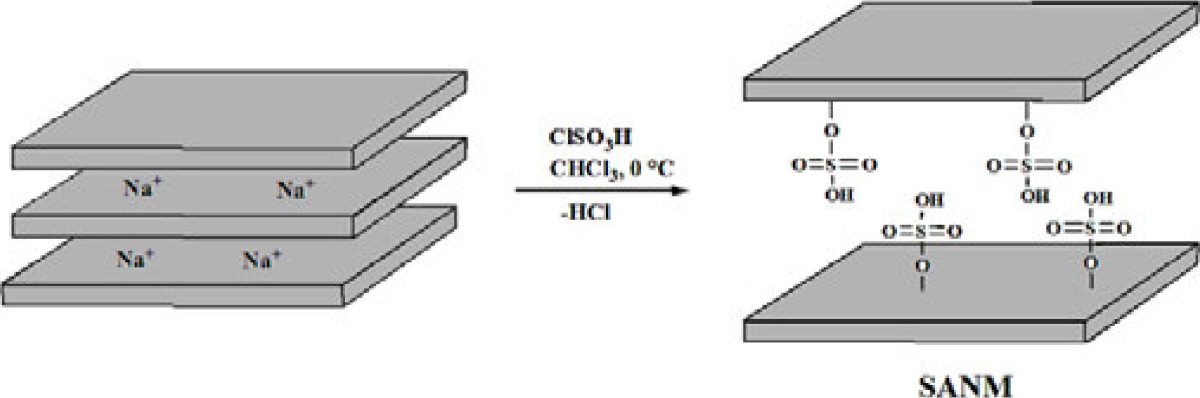
From this phenomenon, for the first time, we successfully prepared sulfonic acid-functionalized ordered nanoporous Na
+
-montmorillonite (SANM) by modification of Na
+
-montmorillonite faces (inside or outside) with sulfonic acid moieties. The preparation strategy for the nanoreactor (SANM) is shown in Figure
1
. In our first communication, we used this reagent as an efficient catalyst for
N
tert
-butoxycarbonylation of amines with di-
tert
-butyl dicarbonate [
28
]; our procedure provided better activity with high yields and turnover compared to the previously reported heterogeneous ones in the
N
tert
-butoxycarbonylation of amines and ability for use in the industry. Then we show the applicability of our synthesized nanocatalyst in the promotion of trimethylsilylation of alcohols and phenols with high chemoselectivity and yields [
29
]. Herein and in continuation of the above-mentioned studies, we are reporting the promoting effect of SANM as a new catalyst for the chemoselective protection of carbonyl compounds by 2-mercaptoethanol.
Preparation of SANM.Figure 1
Methods
Catalyst preparation
A 500-mL suction flask charged with 2.5 g Na + -montmorillonite (Southern Clay Products Inc., Gonzales, TX, USA) and 10 mL CHCl 3 was equipped with a constant pressure dropping funnel containing chlorosulfonic acid (0.50 g, 9 mmol) and a gas inlet tube for conducting HCl gas into water as adsorbing solution. Chlorosulfonic acid was added dropwise over a period of 30 min, while the reaction mixture was stirred slowly in an ice bath (0°C). After the addition was completed, the mixture was stirred for additional 30 min to remove all HCl. Then the mixture was filtered, and the solid residue washed with methanol (20 mL) and dried at room temperature to obtain SANM as white powder (2.58 g).
Catalyst characterization
The synthesized catalyst was characterized by Fourier transform infrared spectroscopy, nitrogen sorption technique (Brunauer-Emmet-Teller method), X-ray diffraction, thermogravimetric analysis and elemental analysis (CHNS) [
28
,
29
]. Our studies indicate that the sulfonic acid moieties have been intercalated into the sodium montmorillonite interlayer spaces and this can lead to the entrance of reactants in the galleries of Na
+
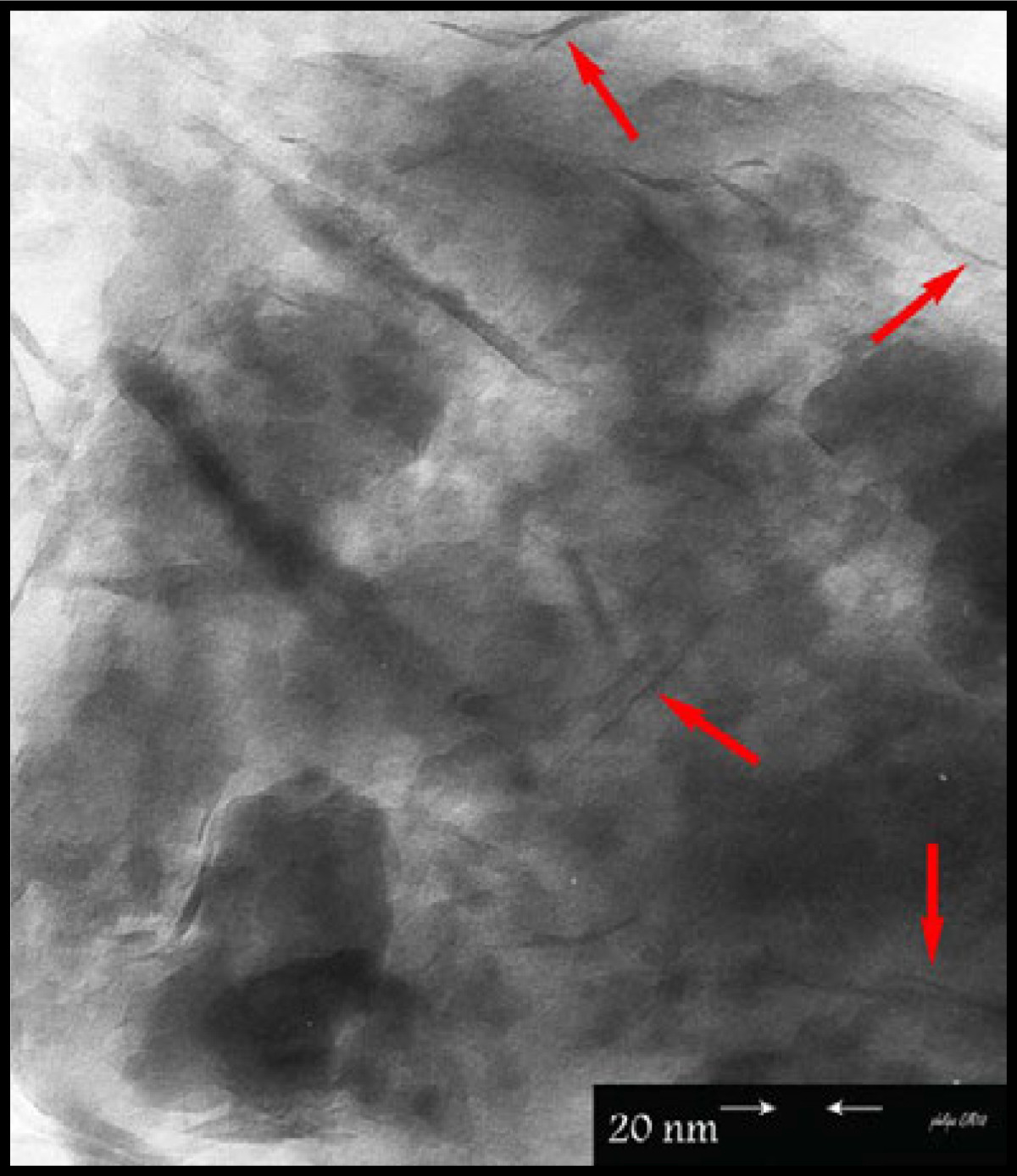
-montmorillonite and lead to their better interaction with catalyst. Also, further studies with transmission electron microscopy (TEM) demonstrated the crystalline periodic structure of our new nanoreactor (Figure
2
).
TEM photographs of SANM.
Red arrows demonstrated the crystalline periodic structure of our new nanoreactor.Figure 2
General procedure
A mixture of the substrate (1 mmol), 2-mercapto ethanol (2 mmol) and SANM (10 mg) in n -hexane was stirred at reflux temperature. The progress of the reaction was monitored by thin layer chromatography. On completion the solvent was evaporated, and CH 2 Cl 2 (5 mL) was added and filtered. The solid residue (SANM) was washed with 5 mL acetone, dried at 100°C and stored for reusing, and the organic layer was washed with saturated NaHCO 3 then with water and dried over MgSO 4 . Evaporation of the solvent followed by column chromatography on neutral silica gel gave the requested 1,3-oxathiolan in excellent yields. All the data (IR and 1 H NMR spectra) recorded are identical with the authentic samples and the reported methods [ 7 – 15 ].
Results and discussion
In order to optimize the reaction conditions, we conducted the reaction of 4-chlorobenzaldehyde (1 mmol), 2-mercaptoethanol (2 mmol) and SANM (50 mg) in various solvents (3 mL) at room temperature (Table
1
).
Synthesis of 2-(4-chlorophenyl)-1,3-oxathiolane in various solvents Entry Solvent Time (min) Yield (%) 1 CH2Cl2 60 NRa 2 CH3CN 120 25 3 CCl4 60 NRa 4 120 35 5 CHCl3 60 10Table 1
As shown in Table 1 , the above-mentioned reaction accomplished in various solvents at room temperature with very low yields, and the best result was obtained in n -hexane. Then we decided to run this reaction in higher temperature; for this reason, we carried out the reaction by refluxing n -hexane, and 2-(4-chlorophenyl)-1,3-oxathiolane was obtained with 95% yield in 10 min. After determination of the solvent, we changed the amount of 2-mercaptoethanol to 1.5 and 1.2 mmol and the product was obtained in 60% and 35% yields in 30 and 90 min, respectively. Also, we decreased the amount of the catalyst from 50 to 30 and 10 mg, and the yields and the time of the reaction did not change, but using 5 mg of catalyst, increased the time of the reaction to 30 min.
After optimization of the reaction conditions, the reaction of other aldehydes with 2-mercaptoethanol in the presence of SANM is accomplished (Scheme
1
) and the results are presented in Table
2
. Aromatic aldehydes having various substituents such as Cl, Br, F, Me, OMe, and NO
2
groups were converted to their 1,3-oxathiolane derivatives efficiently (Table
2
, entries 1 to 12). The reaction conditions were mild enough so that the acid sensitive moieties such as the methoxy group maintained intact under the reaction conditions (Table
2
, entry 9). Carbaldehyde group attached to naphthalene (entry 13) afforded the desired product in quantitative yield. In addition, the sterically hindered aldehydes (Table
2
, entries 8 and 12) gave good yields of the requested products. It is notable that, cinnamaldehyde, as an α,β-unsaturated aldehyde (Table
2
, entry 14), was protected smoothly without the isomerization of double bond. Moreover, the protocol could also equally work with aliphatic aldehydes (Table
2
, entry 15).
Reaction aldehydes with 2-mercaptoethanol in the presence of SANM.Scheme 1
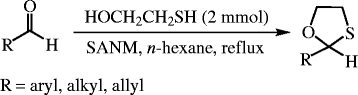
Table 2
SANM catalyzed preparation of 1,3-oxathiolanes
Entry | Substrates | Products | Time (min) | Yields (%)a |
|---|---|---|---|---|
1 | 10 | 87 | ||
2 | 10 | 95 | ||
3 | 20 | 90 | ||
4 | 35 | 92 | ||
5 | 10 | 91 | ||
6 | 5 | 93 | ||
7 | 15 | 90 | ||
8 | 20 | 94 | ||
9 | 10 | 88 | ||
10 | 5 | 90 | ||
11 | 10 | 89 | ||
12 | 25 | 85 | ||
13 | 20 | 94 | ||
14 | 20 | 91 | ||
15 | 20 | 91 | ||
16 | — | 60 | — | |
17 | — | 60 | — | |
18 | 20 | 90 |
Under selected conditions oxathioacetalization of ketones was not successful, and the starting material recovered was unchanged (Table
2
, entries 16 and 17). Therefore, the method can be useful for the selective protection of aldehydes in the presence of ketones (Table
2
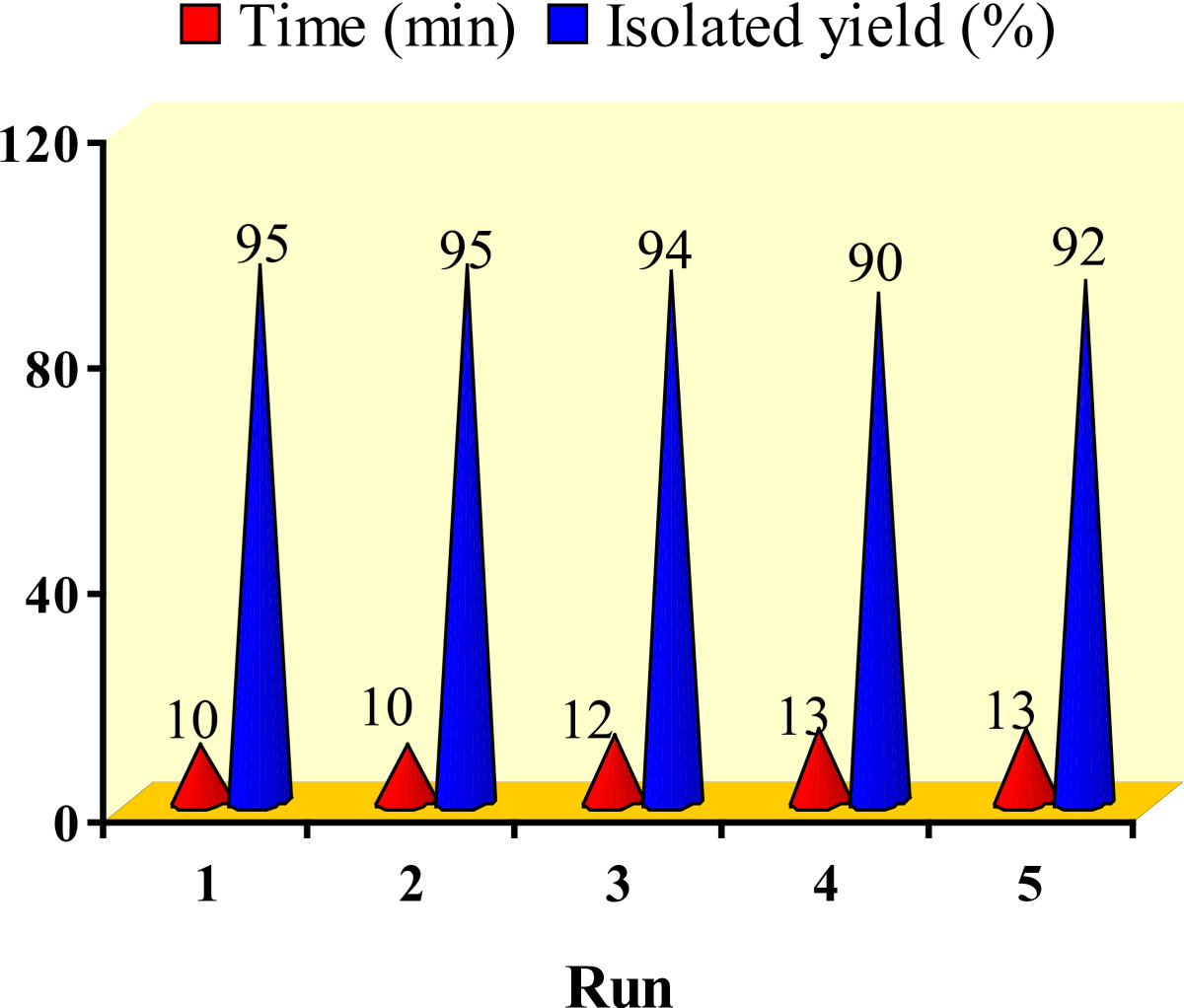
, entry 18). Investigation in the reusability of the catalyst showed that SANM is a reusable catalyst at least for five times (Figure
3
).
Reusability of SANM in the preparation of 2-(4-chlorophenyl)-1,3-oxathiolane (Table
2
, entry 2).Figure 3
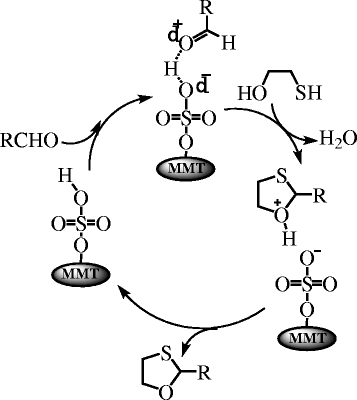
The possible mechanism for the oxathioacetalization of various aldehydes in the presence of SANM as a promoter is shown in Scheme
2
. On the basis of this mechanism, SANM catalyzes the reaction by the electrophilic activation of aldehyde to form a zwitterionic species, making the carbonyl group susceptible to nucleophilic attack by 2-mercaptoethanol. Successive elimination of H
2
O results in the formation of oxathioacetal derivatives and regenerates SANM in the reaction mixture.
Proposed mechanism.Scheme 2
A comparative study on the catalytic activity of the SANM with the reported catalysts was carried out using the oxathioacetalization of 4-chlorobenzaldehyde with 2-mercaptoethanol as a model reaction (Table
3
). In many cases the catalyst loading and the time of the reaction for SANM are lower than the previous catalysts (entries 2 to 7). It should be noted that although in the case of silica sulfuric acid (Table
3
, entry 8), the results are same as our results, this catalyst is recyclable only for three times, while SANM can be recycled at least for five times. From this comparison it can be concluded that the use of SANM is accompanied with the advantages such as shortest reaction time, lowest amount of the catalyst, and reusability of the catalyst.
Compared performance of various catalysts in the synthesis of 2-(4-chlorophenyl)-1,3-oxathiolane Entry Catalyst Catalyst loading (mg)a Time (min) Yield (%) References 1 SANM 10 10 95 This work 2 In(OTf)3 28 5 75 [ 3 MoO2(acac)2 22 4h 94 [ 4 H3PW12O40/SiO2 60 90 85 [ 5 Montmorillonite-K10 200 90 91 [ 6 Amberlist® 15 44 60 84 [ 7 MTSA 11 6 90 [ 8 Silica sulfuric acid 10 10 92 [Table 3
Conclusions
In conclusion, we have developed a simple and efficient protocol for the oxathioacetalization of various aldehydes using SANM as a novel heterogeneous catalyst. Good yields of the products, short reaction times, heterogeneous nature of the reaction conditions, and ease of the preparation, stability and recyclability of the reagent, and easy workup procedure are important features of the reported method. We are exploring further applications of SANM for the other types of functional group transformations in our laboratory.