Results and discussion
Characterization of MCM-41/CeO2 and MCM-48/CeO2
The characterization of MCM-41, MCM-48, MCM-41/CeO
2
, and MCM-48/CeO
2
prepared by grinding method are performed using X-ray diffraction (XRD), Fourier transform infrared (FT-IR) spectroscopy, and Brunauer, Emmett, and Teller (BET) N
2
adsorption-desorption isotherm. The XRD patterns of MCM-41 and MCM-41/CeO
2
samples and MCM-48 and MCM-48/CeO
2
samples are shown, respectively, in Figures
1
and
2
. The hexagonal and cubic ordered structured of MCM-41 and MCM-48, respectively, are confirmed by the XRD patterns [
9
].
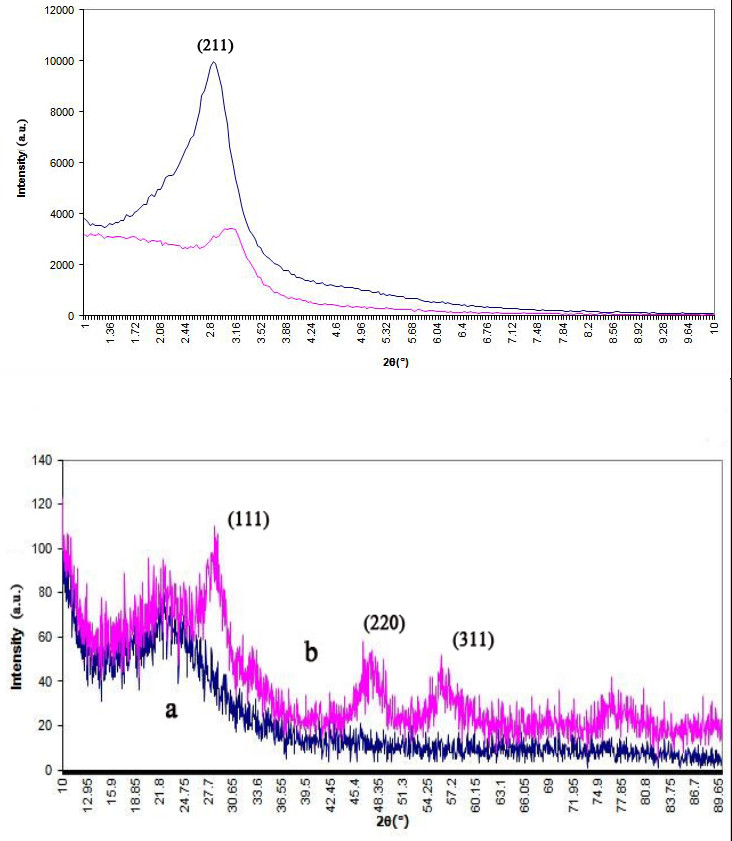
Small-angle (a) and wide-angle (b) XRD patterns of samples (1) MCM-41 and (2) MCM-41/CeO
2. Small-angle (a) and wide-angle (b) XRD patterns of samples (1) MCM-48 and (2) MCM-48/CeO
2.Figure 1
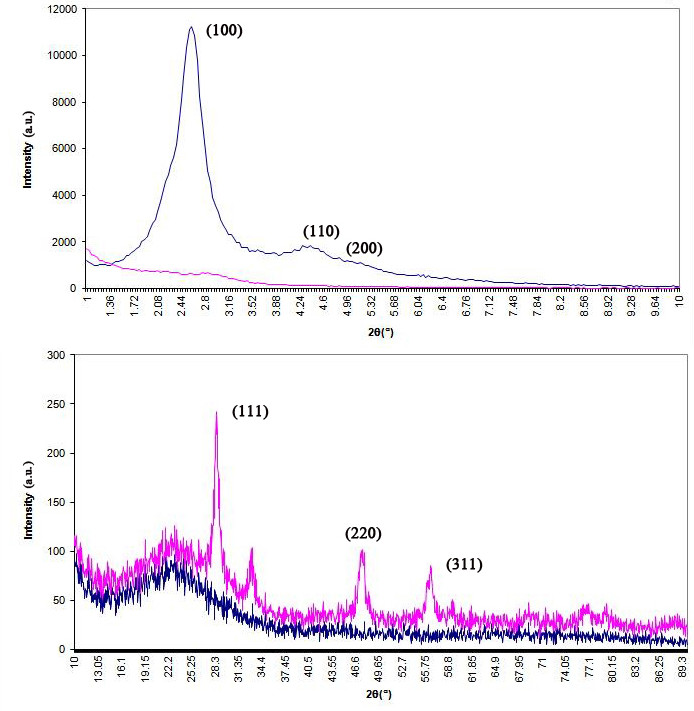
Figure 2
In Figure 1 a, in the small-angle XRD patterns of the prepared material MCM-41, an intense diffraction peak (100), together with an additional peak (110), and a very weak peak (200) were observed. It can be seen that peak (200) is not strong enough and also that the diffraction peaks move to the high angle, and the peaks become weaker when the CeO 2 particles are doped into MCM-41. The increase of CeO 2 particles in the framework of MCM-41 is due to reduction of the tunnel size of the substrate [ 9 – 11 ]. The XRD patterns of MCM-41 and MCM-41/CeO 2 (wide angle) are shown in Figure 1 b. The main substance of MCM-41 is amorphous silica as evident in one diffusion peak observed in the pattern of MCM-41. However, the peak of amorphous silica became weaker, and the peaks of CeO 2 appeared when the CeO 2 nanoparticles are introduced into MCM-41 [ 9 ]. The peaks with 2 θ values of 28.3, 33.2, 47.5 and 56.4 correspond to the (111), (200), (220), and (311) planes [ 13 ].
In the small-angle XRD patterns of MCM-48, the most intense diffraction peak (211) appears at 2 θ = 2.9° (Figure 2 a), while low intense diffraction peaks are seen at 2 θ = 3° to 6°. With cerium doping and a gradual loss of long-range ordering of MCM-48, the intensity of the diffraction peak of MCM-48/CeO 2 decreases at a small angle. The diffraction peaks of CeO 2 in the wide-angle XRD pattern have appeared obviously which show the content of CeO 2 in the channel (or in the extra framework) of the sample [ 14 ].
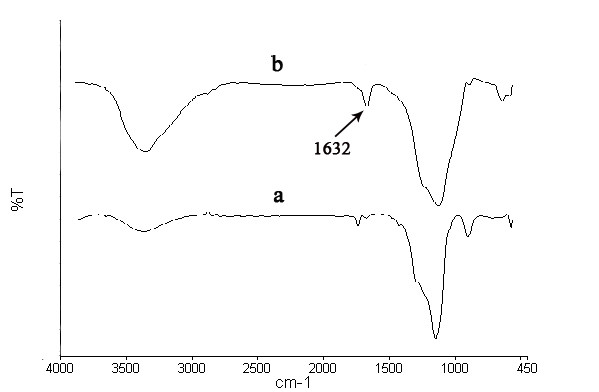
The FT-IR spectra of MCM-41 and MCM-41/CeO
2
are shown in Figure
3
. In the spectra of MCM-41, the stretching vibrating absorption peaks of the O-H band in the surfaced hydroxyl and in the planar water is seen at 3,440 cm
−1
. The symmetry and asymmetry flexural vibrating peaks of Si-O-Si at 1,080, 812, and 464 cm
−1
, respectively, are related to the framework of silicon [
9
]. As seen, there are some differences of the intensities of the peaks in the FT-IR spectra of MCM-41 and MCM-41/CeO
2
, which resulted from the doping of CeO
2
. A strong absorption peak at 1,632 cm
−1
is observed in the spectra of MCM-41/CeO
2
, and it indicates the formation of Ce-O-Ce [
9
].
FT-IR spectra of (a) MCM-41 and (b) MCM-41/CeO
2
.Figure 3
Figure
4
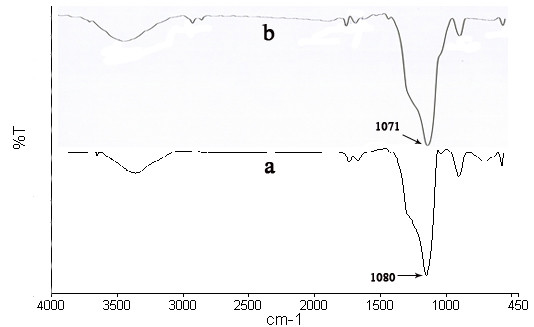
shows the FT-IR absorption spectra of the MCM-48 and MCM-48/CeO
2
samples. The absorption bands of asymmetric vibration of Si-O-Si of the silica framework appear at 1,200 and 1,080 cm
−1
. The stretching vibration peak of silica is at 815 cm
−1
. The vibration band at 1,080 cm
−1
are shifted 4 to 9 cm
−1
for the MCM-48/CeO
2
sample compared with the spectrum of MCM-48. This shift is due to the incorporation of Ce into the framework of MCM-48 [
14
].
FT-IR spectra of (a) MCM-48 and (b) MCM-48/CeO
2
.Figure 4
The N
2
adsorption and desorption isotherms of the MCM-48/CeO
2
sample is shown in Figure
5
, and the corresponding pore size distribution curve is shown in Figure
6
. It is shown that these isotherms have the typical characteristics of the mesoporous material isotherm and are of the type IV according to the IUPAC classification [
14
]. The BET surface areas, average pore size calculated by the BJH model, and the pore volume of MCM-48 [
14
] and MCM-48/CeO
2
samples are presented in Table
1
.
Nitrogen adsorption and desorption isotherms of MCM-48/CeO
2. Pore size distribution curves of MCM-48/CeO
2.Figure 5
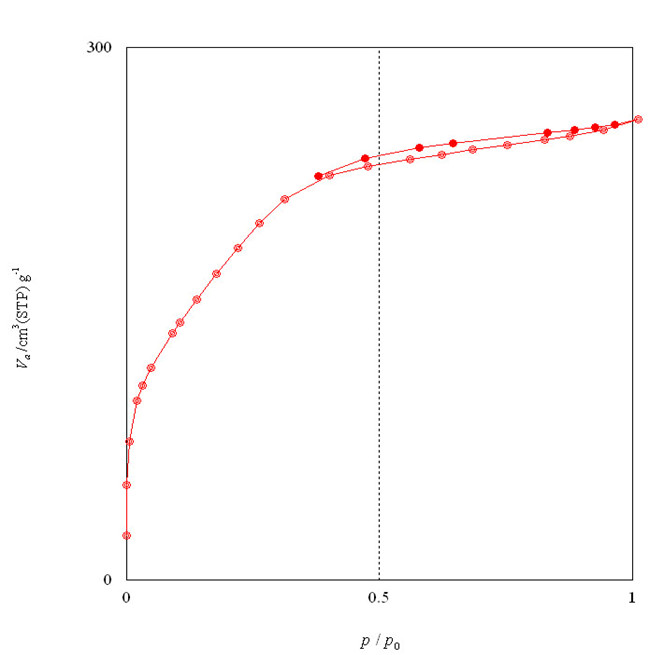
Figure 6
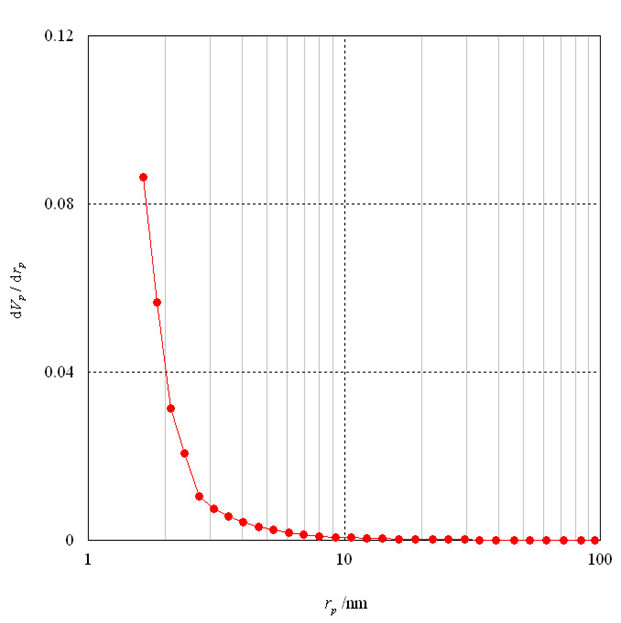
Table 1
Textural properties of MCM-48 and MCM-48/CeO 2 samples
Sample | Surface area (m2·g−1) | Pore volume (cm3·g−1) | Pore size (nm) |
|---|---|---|---|
MCM-48 | 895.0 | 0.850 | 2.23 |
MCM-48/CeO2 | 680.9 | 0.398 | 1.64 |
Photocatalytic degradation of Congo red
The control experiment indicates that CR was not degraded completely when irradiated with UV in the absence of a catalyst; only 24.7 % was degraded after 120 min. The primary factor of photocatalytic degradation is the adsorption of CR onto the catalyst surface via the interaction of surface hydroxyl groups, particularly onto high-surface area support, i.e., MCM-41 and MCM-48 [ 15 ]. In other words, the adsorption of anionic dye on oxide surface is favored, leading to an increase of the dye concentration on the surface and the facilitation of photocatalytic degradation of the dye being investigated [ 16 , 17 ]. The presence of transition metal cations such as cerium doped on the mesoporous materials, such as MCM-41 and MCM-48, may prevent the recombination between the photogenerated holes and electrons or elongate the time of charge separation because it acts as an electron acceptor center [ 18 , 19 ]. One can assumed that the hydroxyl groups on the surface of prepared catalysts act as an electron donor for photogenerated H + , forming active hydroxyl radicals (OH˙ + ) which attack the CR.
Table
2
shows the performances of MCM-41/CeO
2
and MCM-48/CeO
2
(prepared by different methods) and nanoparticles of CeO
2
as photocatalysts for the photocatalytic degradation of CR in 120 min. The
k
obs
values are also collected in Table
2
. Among the prepared catalysts, the mesoporous MCM-41/CeO
2
and MCM-48/CeO
2
that were synthesized by grinding method show the most photocatalytic activity with 97.6 % and 91.3 % photodegradation of CR, respectively. Apparently, the most cerium ions are doped in mesoporous materials by grinding method, and the weight percentage of CeO
2
in MCM/CeO
2
is near 40 % which is in accordance to what was mentioned in the ‘Methods’ section. However, a lot of cerium ions have been lost in the preparation of MCM/CeO
2
by direct and indirect methods in a solvent medium.
CR degradation in 120 min and
k
obs
of photocatalytic process over CeO
2
, MCM-41/CeO
2
,
and MCM-48/CeO
2 Catalysts %D Without photocatalyst 24.7 1.9 CeO2 51.9 6.0 MCM-41/CeO2, direct method 44.2 5.0 MCM-48/CeO2, direct method 37.6 3.7 MCM-41/CeO2, indirect method 52.7 6.0 MCM-48/CeO2, indirect method 46.7 5.4 MCM-41/CeO2, grinding method 97.6 36.0 MCM-48/CeO2, grinding method 91.3 22.7Table 2
The amount of CR degraded on the surface of the different catalysts showed the order of sequence: MCM-41/CeO 2 > MCM-48/CeO 2 > CeO 2 , which can be directly related to the surface area that is available for adsorption. As for CeO 2 nanoparticles, they show 51.9 % of degradation. However, good photodegradation is obtained over the MCMs/CeO 2 catalyst. The enhanced photocatalytic activity over the composite MCMs/CeO 2 is reflecting the beneficial adsorption properties of MCM-41 and MCM-48. Thus, it is clear that the presence of cerium in MCM-41/CeO 2 and MCM-48/CeO 2 plays a role in the catalytic reaction, that is to say, the Ce ions that dispersed highly in MCM/CeO 2 are the active sites. The enhancements of CR degradation may be due to the high dispersion of CeO 2 in the amorphous wall of MCM-41 and MCM-48 and the increase of the bandgap between the conduction band and valance band of CeO 2 in MCMs. In addition, due to the wide bandgap of MCM-41/CeO 2 and MCM-48/CeO 2 , the lifetime of photogenerated holes and electrons of the MCMs/CeO 2 is longer than that of CeO 2 nanoparticles [ 20 – 22 ].
The higher activity of MCM-41/CeO 2 may be due to the hexagonal ordered structured compared to MCM-48 with cubic ordered structured [ 21 , 22 ]. The hexagonal ordered structured of MCM-41 due to the higher dispersion of cerium on this sample.