Findings
Introduction
Mineralized tissues of living organisms reveal properties that material scientists can only aspire to achieve. Basalia spicules of glass sponges provide such an example. They have unique optical properties that are controlled through sophisticated structural organization of biosilica [ 1 – 3 ]. In particular, their optical nonlinearity is higher than that of quartz fibers [ 4 ]. We also showed in this work that the hybrid polysaccharide-silica nanocomposites prepared by biomimicking mineralization demonstrated similar high third-order nonlinear susceptibility. Here, we use hyperbranched polyglycidols (HBPs) instead of polysaccharides to synthesize novel photonic materials.
Results and discussion
HBPs (see structural formula in Figure
1
a) fall into dendritic macromolecules with random branch-on-branch topology [
5
]. They were synthesized and characterized as detailed in our article [
6
]. Macromolecules have a spherical or elliptical shape with rather densely packed chains. A scanning electron microscope (SEM) image can be seen in Figure
1
d.
Schematic presentation of main stages of preparation of hybrid HBP-silica nanocomposites with entrapped gold nanoparticles.
(
a
) Structural formula and (
d
) high-resolution SEM image of the HBP molecule; (
b
) schematic drawing of the HBP molecule with gold nanoparticles in its core, (
e
) TEM image of gold nanoparticles and diagram of their size distribution; (
c
) schematic presentation and (
f
) TEM image of the mineralized HBP molecule.Figure 1
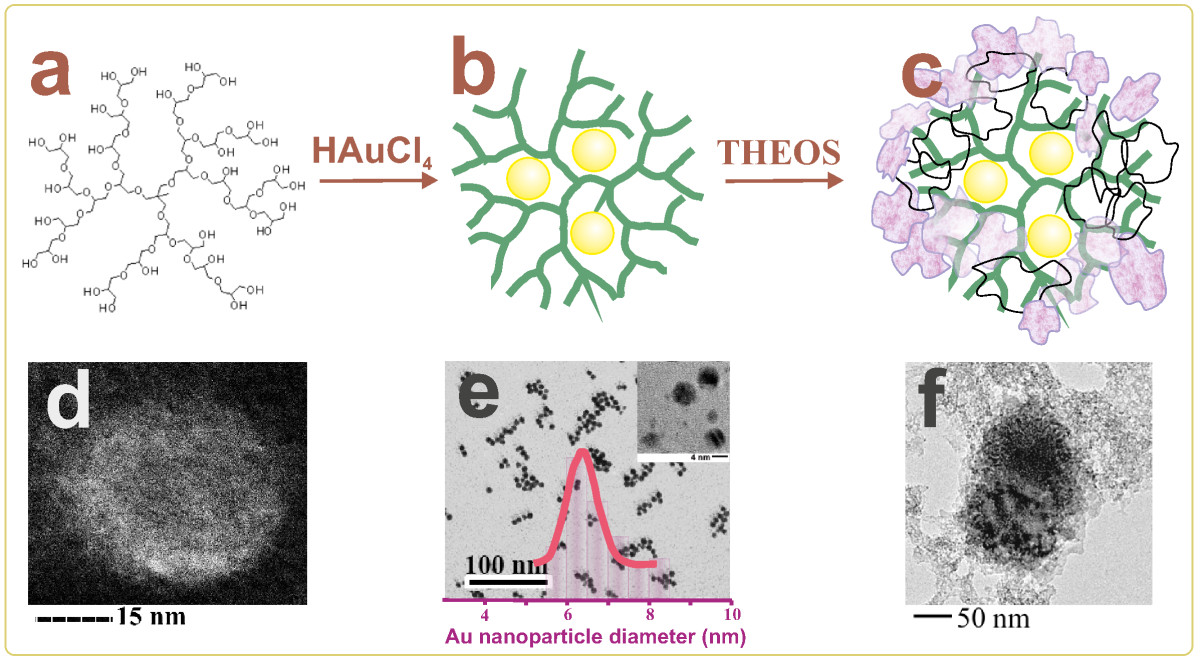
HBPs have aliphatic polyether backbones containing multiple terminal hydroxyl groups like polysaccharides. This enabled us to apply the same biomimicking mineralization procedure by treating them with a silica precursor, tetrakis(2-hydroxyethyl)orthosilicate (THEOS). Its advantage is its excellent compatibility with biopolymers and HBPs. Syntheses are performed in one stage at neutral pH, without the addition of acid/alkali and heating because of the catalysis of hydrolysis by hydroxyl-containing substances [ 7 , 8 ]. After a time of admixing an appropriate amount of THEOS into an aqueous solution of HBP, one can find silica formation that is manifested in the solution jellification. A representative transmission electron microscope (TEM) image of the synthesized nanocomposite is presented in Figure 1 f. There are HBP macromolecules encased in the silica matrix.
HBPs were used to synthesize gold nanoparticles as reported first in [ 6 , 9 ] by adding a chloroauric acid into a HBP solution. They serve as both reducing and stabilizing agents. Gold nanoparticles thus formed are mainly located within, rather than the outside of, the HPB core. As seen in Figure 1 e and the inserted size distribution diagram, their diameter is around 5 nm.
As-synthesized and dried nanocomposites were optically transparent. The transparency depended on the silica concentration. Samples synthesized using 10 wt.% THEOS have slight opalescence. With the increasing silica concentration, the transmittance is improving (curve 1, Figure
2
a). It is related to the morphology of mineralized HBPs. Representative SEM images are given in Figure
2
b,c. As obvious, nanocomposites prepared with 10 wt.% THEOS are rather heterogeneous, consisting of micron- and submicron-sized clusters (Figure
2
b). Their presence could be a reason of the mentioned opalescence. The sample containing 50 wt.% silica is much homogeneous, consisting of smaller clusters (Figure
2
c). This is the reason for improving the transparency with the increasing THEOS concentration.
Characterization of transmittance (a) and morphology (b, c) of hybrid nanocomposites.
(
a
) Transmittance of HBP-silica nanocomposites synthesized in an aqueous solution containing 50 wt.% THEOS and 1 wt.% HBP (1) with addition of 2.0 × 10
−5
(2) and 3.8 × 10
−5
M HAuCl
4
(3). (
b
,
c
) SEM images of HBP-silica nanocomposites. The THEOS concentration was 10 (b) and 50 wt.% (c); HBP, 1 (b) and 5 wt.% (c). Syntheses were performed at ambient conditions.Figure 2
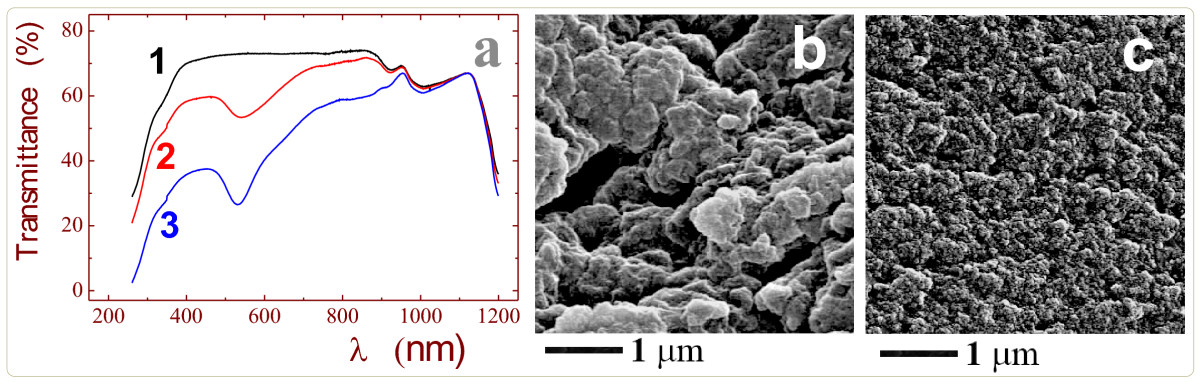
The transmittance is very sensitive to the presence of even trace amount of gold nanoparticles (curves 2 and 3, Figure 2 a). The effect is caused by the Au surface plasmon resonance that follows from a minimum located at a wavelength of 528 nm for the sample prepared at 3.8 × 10 −4 M chloroauric acid (curve 3, Figure 2 a).
The optical nonlinearity of the developed hybrid HBP-silica nanocomposites was examined by means of the standard Z-scan technique [ 4 , 10 ]. As found, the nonlinear refractive index n 2 is equal to 2.5 × 10 −13 cm 2 /W at λ = 532 nm and a pulse duration of 5 ns. For reference, the n 2 value of fused silica, which is widely used as nonlinear photonic fibers, is 2.6 × 10 −16 cm 2 /W (Appendix B in [ 11 ]). One may see from the comparison that the nonlinearity of hybrid HBP-silica nanocomposites is three orders of magnitude greater.
One of the impressive manifestations of the high nonlinearity of developed hybrid HBP-silica nanocomposites is the supercontinuum generation. Its appearance is obvious only under the action of ultrashort laser pulses. Their duration in our experiments was 40 fs with a frequency of 100 Hz and a central wavelength of 800 nm. A schematic drawing of the experimental setup is presented in Figure
3
a. More details are given in our article [
4
]. When an unfocused laser beam of 7 mm in diameter with maximum energy of a pulse of 1 mJ comes through a sample, an appearance of multiple distinct filaments is observed in its bulk (Figure
3
b). As obvious in Figure
3
c, an outgoing light beam constitutes a bright white core surrounded by spectral colors.
Characterization of supercontinuum generation in hybrid HBP-silica nanocomposites.
(
a
) Schematic drawing of the experimental setup including a Spitfire Pro 40 F laser complex (Spectra-Physics, Newport Corporation, Irvine, CA, USA), two IR mirrors of 700 to 930 nm with a reflection factor >99% (Newport Corporation), a SpectraPro 2500i spectrometer with polychromator (Acton Research Corporation, Acton, MA, USA), and a Picostar HR gated ICCD camera (LaVision, Göttingen, Germany). (
b
) Image of filaments and emitted white light in the hybrid nanocomposite of 14 nm in length. (
c
) Image of a conical beam outgoing from the sample. (
d
) The intensity vs. the wavelength for output laser beam (1) and emitted light from samples synthesized by taking 50 wt.% THEOS and 1 wt.% HBP (2) as well as 2.0 × 10
−5
(3) and 3.8 × 10
−5
M HAuCl
4
(4).Figure 3
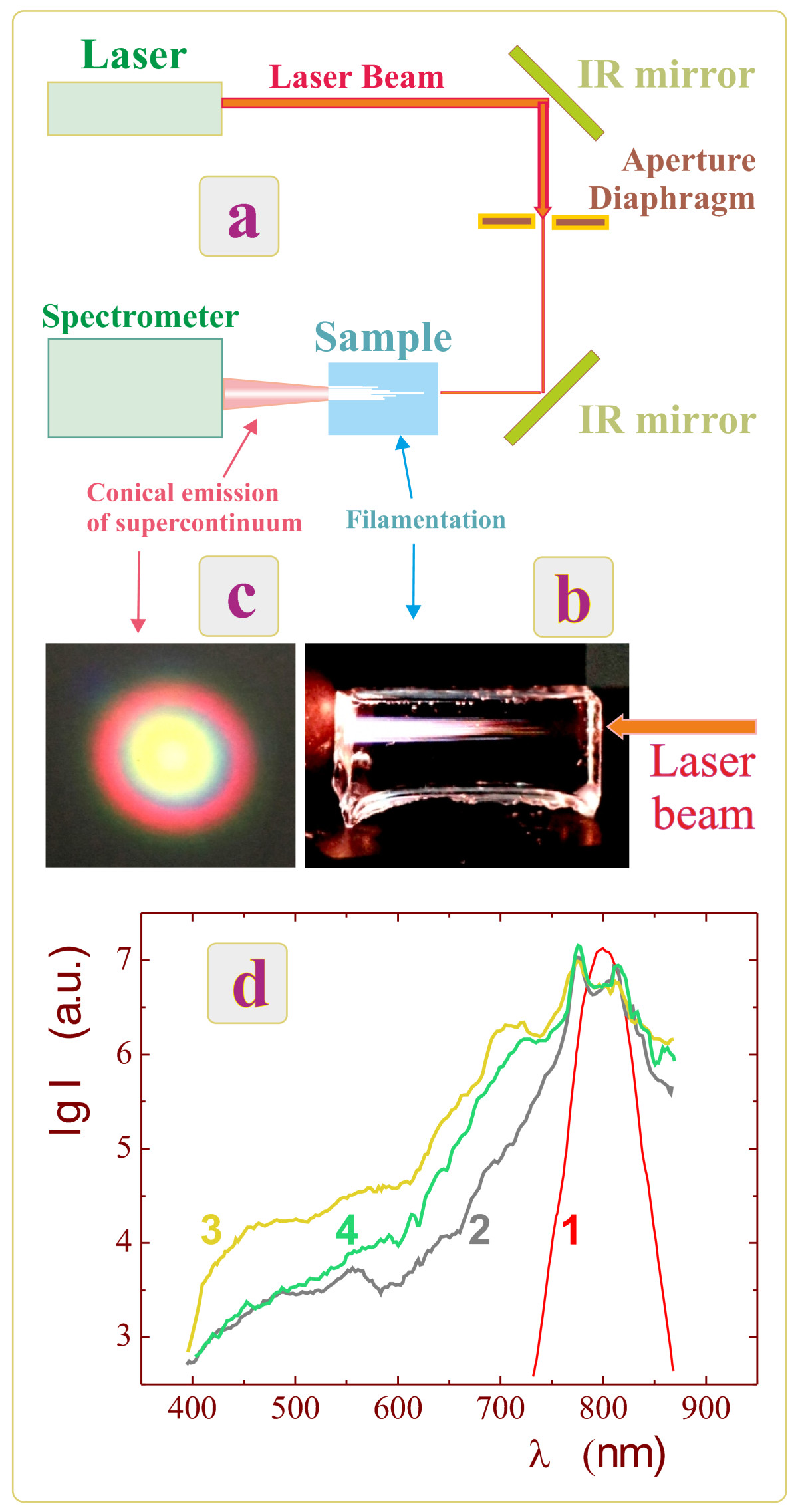
Spectral characteristics of the supercontinuum can be seen in Figure 3 d. Curve 1 presents the initial spectrum of the laser beam. Emitted spectrum for the sample containing HBP is shown by curve 2; for samples with Au nanoparticles of various concentrations, by curves 3 and 4. The nanosized gold serves as a dopant, having a profound effect on the supercontinuum generation. The light intensity measured in the sample with their trace amounts (curve 3) is around an order of magnitude higher than that in the HBP-silica nanocomposite (curve 2) almost over the whole visible spectral region (420 to 720 nm). As followed from a comparison of curves 3 and 4 in Figure 3 d, the effect depends on the Au nanoparticle content. When a critical concentration is reached, their successive addition causes a sharp decay of emission. The bleaching means that the plasmon resonance of gold nanoparticles has a profound effect on the processes in the bulk material.
The conversion of ultrafast laser pulses in the supercontinuum spectrum occurs at remarkably short lengths. We observe it in hybrid HBP-silica nanocomposites doped with Au nanoparticles with a thickness of 0.9 mm. It is essential that hybrids are stable under the action of intense laser pulses. Notable changes in the optical properties are not mentioned after prolonged (hours) testing. The value of nonlinear refractive index is indicative of possible ultrafast processes responsible for the supercontinuum generation. When its value is around 10 −16 or 10 −13 cm 2 /W, the phenomenon is brought about by electronic polarization or molecular orientation and electrostriction, respectively, which is characterized by ultrashort response time (10 −15 , 10 −12 , and 10 −9 , respectively; see, e.g., [ 12 ]). The measured value of 2.5 × 10 −13 cm 2 /W at a pulse duration of 5 ns and the supercontinuum emission at laser pulses of 40 fs mean that the phenomenon is generated jointly by a number of ultrafast processes.
Conclusions
This study extends a number of novel biomimetic organic–inorganic hybrids possessing high nonlinear susceptibility that was found previously for polysaccharide-silica nanocomposites in [ 4 ]. Here, we demonstrated additionally that the optical nonlinearity can be regulated by trace amounts of gold nanoparticles. As dopants, nanosized noble metal, metal oxides, and quantum dots are applied rather widely for regulating the photonic properties of glasses and sol–gel-derived silicates (see, e.g., [ 13 – 15 ]) but not, to our knowledge, for enhancing the supercontinuum processing. We have developed a novel type of photonic nanocomposite materials consisting of mineralized dendritic and polysaccharide macromolecules of which the structure is tailored via biomimetic mineralization with the help of a compatible precursor and the entrapment of gold nanoparticles. Their advantage is in the easy processability because of low viscosity of the initial solution of HBP, its low-cost synthesis, intrinsic transparency, and excellent nonlinear optical properties. They can be integrated with various materials. Owing to the high nonlinear refractive index, the supercontinuum is generated at short lengths. This is very promising for such potential applications as planar optical devices for optical computers, optical correlators, femtosecond Kerr shutter, and sensoring.