Retracted: Optimization of radiation modes in asymmetric planar slab optical waveguides

Retraction

This article was mistakenly published twice. For this reason this duplicate article has now been retracted. For citation purposes please cite the original: http://www.inljournal.com/?_action=articleInfo&article=17

Abstract

In this paper, we try to optimize the substrate-radiation/substrate-cladding (cover) radiation modes in terms of their performance parameters. It is well known that the guided modes can only be normalized. However, the radiation modes can also be normalized using the delta/Dirac function. We try to optimize the waveguide design parameters for the known cases to achieve performance as good as guided modes. The formal electromagnetic theory is applied to study the radiation modes. The normalization condition on radiation mode has been carefully used during analysis. The results are found to be satisfactory. It has been concluded that we can modify the performance of radiation modes according to our requirements. The performance is compared with the guided mode. The paper discusses guidelines to optimize the radiation modes for various constraints.


Background

Radiation modes are useful to study the power leakage loss and to design passive wavelength division multiplexing (WDM) fiber optic network components. Lots of power can flow through the substrate and cover regions. These radiation modes are useful not only to design fiber optic coupler and WDM optical network components, but also to predict the power loss in various passive WDM optical network components. It is inevitable to find out the optimum waveguide design parameters for the purpose to achieve a better device performance[ 1 , 2 ]. We need to optimize these modes to avoid the leakage of power in optical communication systems.

By choosing the appropriate waveguide design parameters, it is possible to perfectly match the radiation modes at the interfaces[ 39 ]. In fact, the radiation modes can be completely removed at the interfaces, which may not be possible even with guided modes.

Methods

Optimization of substrate/cover radiation modes

We implicitly assumed the rectangular coordinate system having refractive index variation in the x -direction. The wave is propagating in the z -direction, and the medium is infinite in the y -direction (no refractive index variation). We consider n c , n s , and n f as the refractive index of cover, substrate, and film regions, respectively. Since the phase constant β for the substrate radiation mode is in the range of (free space wave number k 0 )

k0nc<β<k0ns

The x -direction transverse wave-vector κ in the substrate satisfies[ 1 , 2 ],

0κk0ns2nc2

Here, subscripts s, c, f, and r are used to denote the substrate, cover, film, and radiation mode, respectively. After applying the continuity condition for the tangential electromagnetic field components at the interfaces, the lateral electromagnetic fields are obtained as follows:

Here, the lateral electromagnetic field distribution function Φr(x,ρs) would be[ 1 , 2 ]

φrx,ρs=1Dr{eαcx,0xcos(σfx)+Brfsin(σfx),tx0Arscosκx+t+Brssinκx+t,yt

where

σf=k02nf2ns2+κ2

αc=k02ns2nc2κ2
. If the normalization factor D r is
Dr=π2Ars2+Brs2

The distribution function satisfies the orthonormality condition,

+φr(x,ρs)φr(x,ρs')dx=δ(ρsρs')

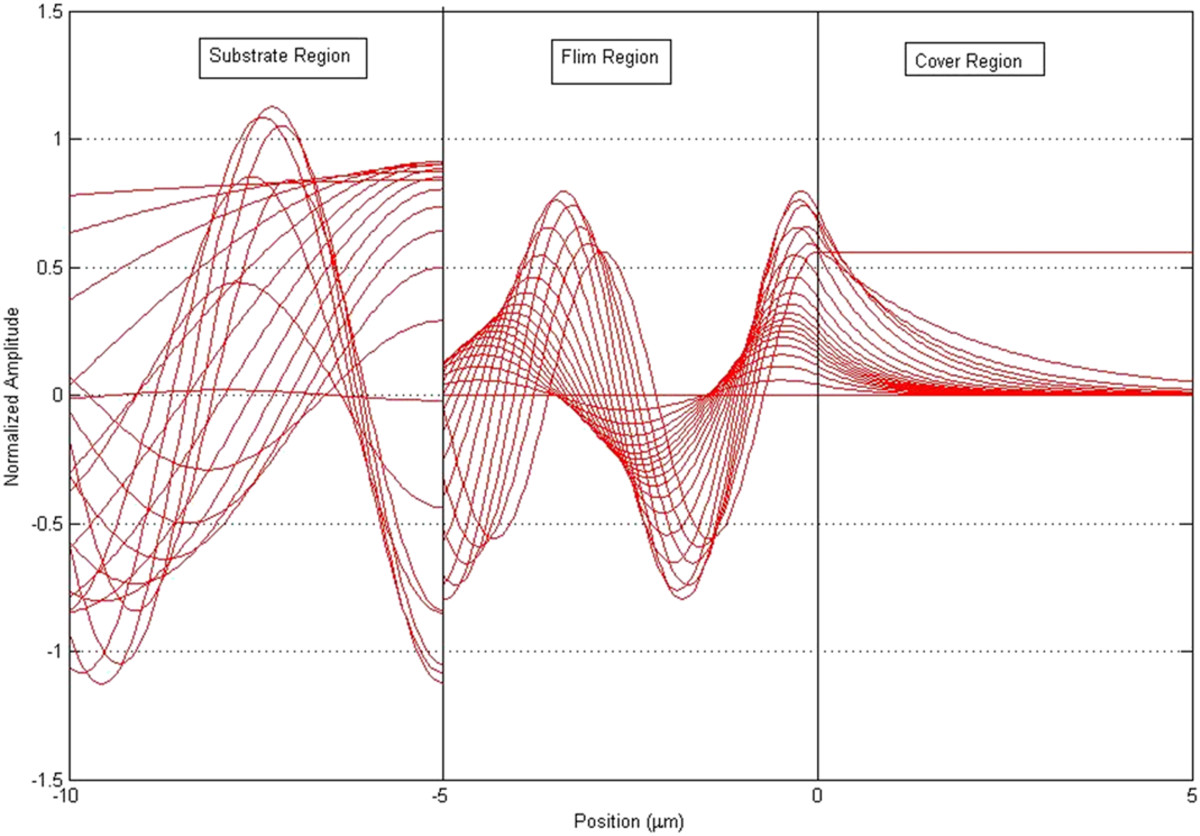
where δ(ρsρs') is the Dirac delta function. Figures  1 and 2 show the various calculations done on the substrate radiation modes. From Figure  1 , it is apparent that the film-cover region is perfectly matched, but not the film-substrate region. The film thickness h  = 5 μm is considered in all calculations. The refractive indexes are n f  = 1.50, n s  = 1.45, and n c  = 1.40, and the operating wavelength is λ  = 1.55 μm. The aim is to match or avoid the substrate-film radiation modes. The computation has been carried out for the various values of the transverse wave-vector for optimization purposes. The substrate radiation mode has been completely eliminated on κ=1.0712×104cm1 . This is shown in Figure  2 a.

Figure 1

Normalized substrate radiation modes for various values of the transverse wave-vector

Figure 2

Elimination and matching of the substrate radiation mode. ( a ) The substrate radiation mode has been completely eliminated. ( b ) The substrate radiation mode is almost matched with the film region

In this case, there is no leakage loss, and practically, it can be used for designing the lossless WDM optical network components. In fact, this particular mode will suffer a lesser amount of leakage loss compared to guided modes. The substrate radiation mode has been perfectly matched while on κ=1.2242×104cm1 , which is shown in Figure  2 b. Practically, this may be useful to design the WDM network components for phase-matching applications.

Figure  3 shows the mode amplitude difference between the substrate-film interfaces. Hence, computational accuracy has been tested.

Figure 3

Mode amplitude difference versus transverse wave-vector κ (cm −1 ) .

The radiation mode is almost perfectly matched at κ=1.2242×104cm1 , where the mode amplitude difference between the substrate-film regions approaches to zero. These waveguide design parameters are important to achieve the optimum performance.
Results and discussion

Since the phase constant β for the substrate-cladding radiation is in the range of[ 36 ]

0βk0nc

in this case, the x -direction transverse phase constant κ in the substrate satisfies

k0ns2nc2κk0ns

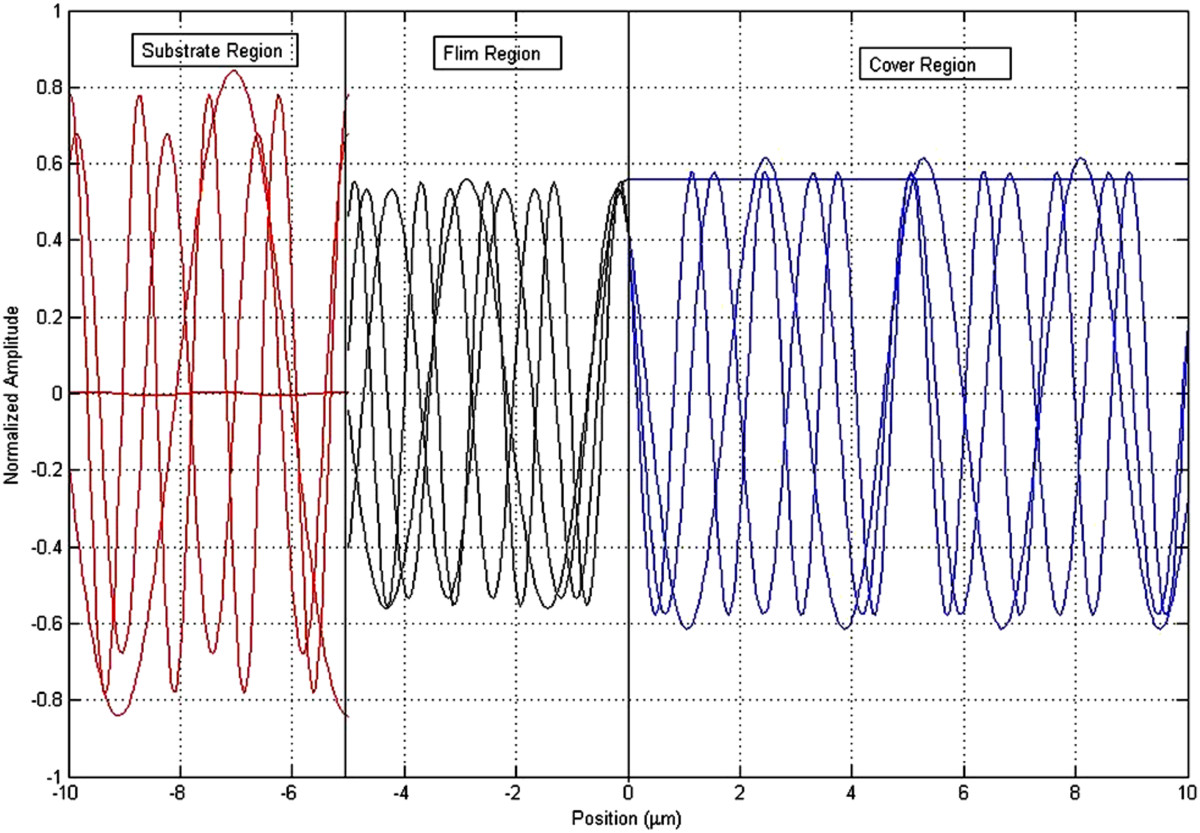
so that β is a pure imaginary number. In other words, the radiation mode may be propagated, in which case κ is given by Equation 2 , or may not be propagated, in which case κ is given by Equation 7 . The solution of wave equation for the substrate-cladding radiation mode is discussed in detail elsewhere[ 1 ]. The simulation results are the same, except that the range of β has been changed. Figure  4 shows that neither the film-substrate nor the film-cover regions are matched. These modes are not useful for any practical purpose. Several trials have been performed to match the interfaces and to search out the optimum waveguide design parameters. This case is even more crucial because there are two non-matching interfaces. From Figure  4 , it is apparent that the light is being guided in both the substrate and cover regions. Hence, more power will flow in the cover as well as substrate regions. For any practical application, these radiation modes need to be optimized.

Figure 4

Normalized substrate-cover radiation modes for various values of the transverse vector .

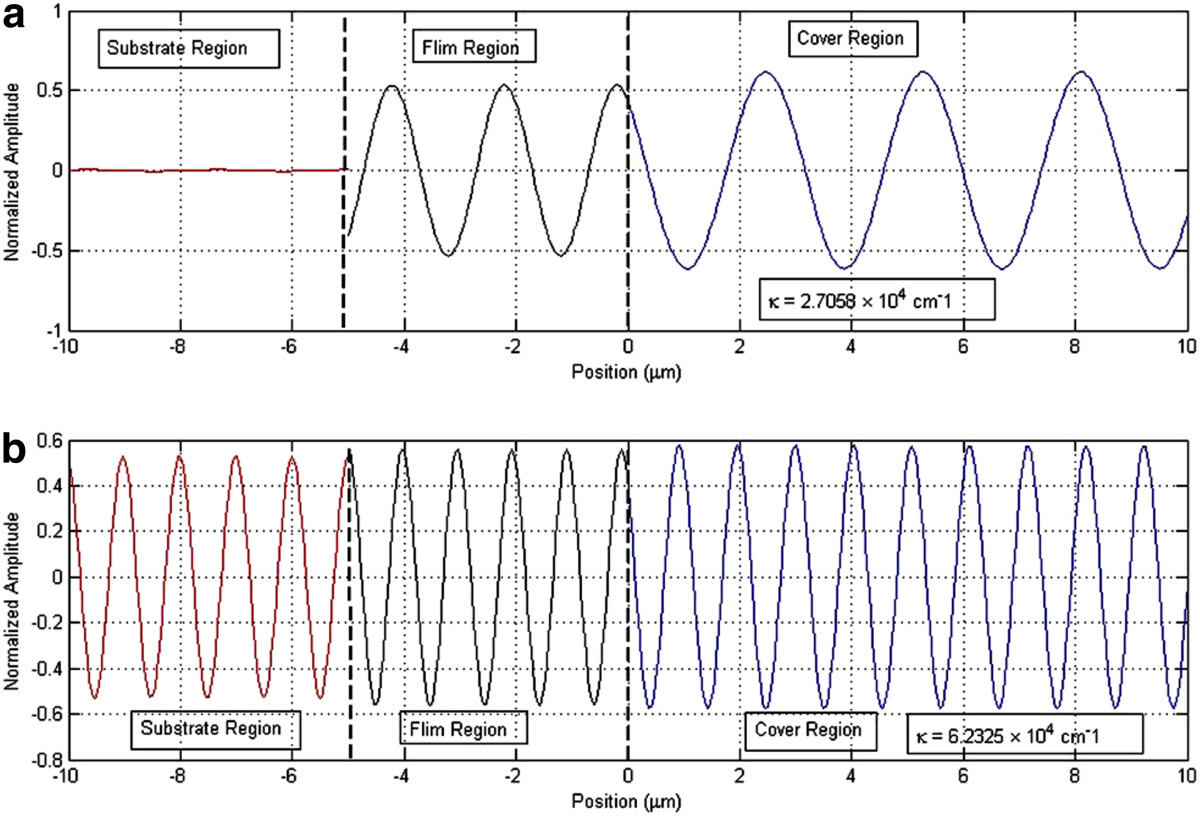
Figure  5 shows the various calculations done on the substrate-cover radiation mode. It has been found, as shown in Figure  5a , that at κ=2.7058×104cm1 , the substrate-film radiation mode is completely removed; however, the film-cover region is properly matched. In another observation, as shown in Figure  5 b, the substrate radiation mode is perfectly matched with both regions at κ=6.2325×104cm1 . These design guidelines are very useful to achieve the desirable performance.

Figure 5

Elimination of the substrate-film radiation mode and matching of the substrate radiation mode (a, b).

Conclusions

Formal electromagnetic theory has been applied on asymmetric waveguide structure to find out the eigen value equation for the given cases. The mode orthogonality condition has been proved unconditionally, while it has been carefully used in every aspect during the calculation. The asymmetric waveguide structure shows the non-uniform power variation in each region. The modes are not matched always for the given design parameter. In this paper, radiation modes are optimized without giving much mathematical treatment. The techniques of mode optimization were found to be satisfactory. It has been shown through analysis that we can either eliminate the substrate radiation mode or totally match the substrate radiation mode with the film region. These design guidelines on radiation modes are very important for the purpose of designing a low-loss waveguide coupler, mode isolator, mode phase-matching circulator, and other types of WDM components.

Authors’ information

SKR is working as an assistant professor in the Department of Electronics Engineering at Indian School of Mines, Dhanbad. He received his bachelor’s degree in Electronic and Instrumentation Engineering from S.G.S. I.T.S. Indore, Madhya Pradesh, India and his master’s degree in Solid State Technology from the Indian Institute of Technology, Kharagpur. Since July 2009, he has obtained his Ph.D. degree in the field of optics from the Department of Electrical Communication Engineering of the Indian Institute of Science, Bangalore, India. He is the author of one book entitled Analytical and Numerical Study of Propagation in Optical Waveguide and Devices in Linear and Non-linear Domain published by VDM Verlag, Germany in 2009. His current research interest includes homogeneous optical waveguide and nonlinear optics.

VK received his Ph.D. in 1980 and is presently working as a professor and head of the Department of Electronic Engineering, Indian School Mines, Dhanbad. He has published over 70 research papers in the reputed international and national journals and presented about 80 research papers in different national and international conferences. He has also authored two books entitled Electronic and Thermal Properties of Semiconductors: Plasmon Approach and Design of a Low Cost Wireless Sensor Network published by VDM Verlag, Germany in 2010. He gave number of seminar talks in UK, Italy, Portugal, Malaysia, Singapore, and USA. He has completed a number of R&D projects and organized a number seminars and short term courses.

RRP is working as an associate professor and head in the Department of Electronics and Communication Engineering at the Institute of Engineering and Industrial Technology, Malandighi, Durgapur, India. He received his (B.E.) degree in Electronic and Communication Engineering from MJP Rohilkhand University, Bareilly, Uttar Pradesh, India and his Master of Technology (M.Tech) degree in VLSI Design from Uttar Pradesh Technical University, Lucknow, India. He is pursuing his Ph.D. degree in the field of Modeling of WDM Optical Network Components from the Department of Electronics Engineering of the Indian School of Mines, Dhanbad, India. His current research of interest is modeling of WDM optics.


Competing interests

The authors declare that they have no competing interests.


Authors’ contributions

SKR carried the simulation work, sequence alignment, and drafted the manuscript. VK checked the validity of the simulations results and compiled the manuscript. RRP checked the grammatical and spelling mistakes. All authors read and approved the final manuscript.


References

  1. Marcuse (2003) McGraw Hill Inc.
  2. Koshiba (1992) McGraw Hill Inc.
  3. Yeh (1962) 10.1063/1.1931144
  4. Ghatak and Thyagarajan (2007) Cambridge University Press
  5. Mishra and Sharma (1986) Analysis of single mode inhomogeneous planar waveguides 10.1109/JLT.1986.1074699
  6. Raghuwanshi and Talabattula (2009) Analytical approximation solutions for 3-D optical waveguides: review 10.1007/s12648-009-0075-2
  7. Thyagarajan et al. (1987) Analytical investigations of leaky and absorbing planar structure 10.1007/BF02029881
  8. Scarmozzino et al. (2000) Numerical techniques for modeling guided-wave photonic devices 6(1) (pp. 150-162) 10.1109/2944.826883
  9. Raghuwanshi (2010) Comparative study of asymmetric versus symmetric planar slab dielectric optical waveguides 84(7) 10.1007/s12648-010-0059-2