Materials Research Laboratory, K.T.H.M. College, Nashik, 422 002, IN
Materials Research Laboratory, Arts, Commerce and Science College, Nandgaon, 423 106, IN
Abstract
This paper demonstrates the synthesis of SnO
2
nanoparticles using a simple hydrothermal route in the presence of the surfactant hydrazine at 100 °C for 12 h. X-ray diffraction (XRD), field emission scanning electron microscopy, and transmission electron microscopy (TEM) were employed to characterize the as-prepared product, and optical property was studied by UV-visible diffuse reflectance spectroscopy (DRS). The XRD pattern of the as-prepared sample is indexed to the tetragonal structure of SnO
2
, and the calculated particle size is 22.4 nm, which is further confirmed by TEM. The selected area electron diffraction patterns showed continuous ring patterns without any additional diffraction spots and rings of secondary phases, revealing their crystalline structure. Analysis of the DRS spectrum showed the bandgap of the synthesized SnO
2
to be 3.6 eV. The anionic surfactant hydrazine plays a key role in the formation of the SnO
2
nanostructures. A probable reaction for the formation of SnO
2
nanoparticles is proposed.
Background
Nanomaterials have attracted great interest due to their intriguing properties, which are different from those of their corresponding bulk state. In the past few years, SnO
2
is an important n-type wide-energy-gap semiconductor (Eg = 3.64 eV, 330 K) which has a wide range of applications such as in solid-state gas sensors [
1
], transparent conducting electrodes [
2
], rechargeable Li batteries [
3
], and optical electronic devices [
4
]. During the past decade, SnO
2
nanostructures have been one of the most important oxide nanostructures due to their properties and potential applications [
5
,
6
].
Many processes have been developed to the synthesis of SnO
2
nanostructures, e.g., spray pyrolysis [
5
], hydrothermal methods [
6
–
8
], evaporating tin grains in air [
9
], chemical vapor deposition [
10
], thermal evaporation of oxide powders [
11
], rapid oxidation of elemental tin [
12
], the sol–gel method [
13
], etc. Davar et al. [
14
] reported the synthesis of SnO
2
nanoparticles by thermal decomposition using [bis(2-hydroxyacetophenato)tin(II)], [Sn(HAP)
2
, as precursor. Salavati-Niasari et al. [
15
] synthesized zinc blend ZnS nanoparticles by a thioglycolic acid (HSCH
2
COOH)-assisted hydrothermal technique via the reaction between a new inorganic precursor [bis(2-hydroxyacetophenato)zinc(II)], [Zn(HAP)
2
, and thioacetamide (CH
3
CSNH
2
). Gnanam and Rajendran [
16
] synthesized nanocrystalline tin oxide powders of about 8 to 13 nm in size using different surfactants such as cetyltrimethyl ammonium bromide, sodium dodecyl sulphate, and polyethylene glycol via hydrothermal reaction at 160°C for 12 h and studied their structural and photoluminescence properties.
A simple hydrazine-assisted hydrothermal route was employed to synthesize nanocrystalline SnO
2
powders in this study, and structural, morphological, microstructural, and optical properties were discussed.
Methods
All reagents used were of analytical grade without further purification. First, 3.505 g of SnCl
4
·5H
2
O (0.1 M) was dissolved in 100 ml of distilled water, and then 1.2800 g of hydrazine hydrate (0.01 M) was added with stirring. N
2
H
4
·H
2
O immediately reacted with SnCl
4
in the solution to form a slurry-like white precipitate of the hybrid complex between N
2
H
4
and SnCl
4
. After 10 min of stirring, the solution was transferred into a Teflon-lined stainless steel autoclave with a capacity of 200 ml and then sealed. The autoclave was maintained at 100°C for 12 h and cooled naturally to room temperature. The product was centrifuged, filtered out, and rinsed with methanol and distilled water several times, and then dried at 120°C for 1 h in air.
The possible reaction of SnCl
4
·5H
2
O with hydrazine produced SnO
2
nanoparticles via Sn
4+
reaction with NH
4
OH. The process can be expressed as follows:
mSnCl4+nN2H4→(SnCl4)m(N2H4)n(SnCl4)m(N2H4)n→mSn4++nN2H4+4mCl−3N2H4+4H2O→4NH4OH+N2Sn4++4NH4OH→SnO2↓+4NH4++2H2O.
Prior to the hydrothermal process, the (SnCl
4
)
m
(N
2
H
4
)
n
complex clusters were formed via reaction (1), and at the same time, the clusters were agglomerated into the slurry-like white precipitate mentioned above. As represented in reaction (2), the (SnCl
4
)
m
(N
2
H
4
)
n
clusters underwent dissociation when the solution was heated to 100°C during the hydrothermal stage. In reaction (3), OH
−
ions were formed via the dissociation of N
2
H
4
into NH
4
OH and N
2
[
17
]. Reaction (4) represents the formation of the SnO
2
nanoparticles via the reaction between Sn
4+
and OH
−
ions formed in reaction (3).
The synthesized sample was characterized by X-ray powder diffraction (XRD) using the XRD Make-Bruker D-8 model (Bruker AXS, Inc., Madison, WI, USA) with CuKα radiation with a wavelength
λ
=1.5418 Å at 2
θ
values between 20° and 80°. Transmission electron microscopy (TEM) images were recorded from a transmission electron microscope (CM-200, Make-PHILIPS, Amsterdam, The Netherlands). The UV-visible (UV–vis) diffuse reflectance spectrum (DRS) was obtained from a JASCO UV–vis/NIR spectrophotometer V-670 model (Easton, MD, USA).
Results and discussion
Structural properties by XRD
The XRD pattern of the product is shown in Figure
1
. The peaks at 2
θ
values of 26.6°, 33.8°, 37.9°, 51.8°, 54.7°, 61.9°, and 65.9° can be associated with (1 1 0), (1 0 1), (2 0 0), (2 1 1), (2 2 0), (3 1 0), and (3 0 1), respectively. A matching of the observed and standard (
hkl
) planes confirmed that the product is of SnO
2
having a tetragonal structure, which are in good agreement with the literature values (JCPDS card no. 41–1445). The average particle size (
D
) was estimated using the Scherrer equation [
18
]:
D=0.9λβcosθ,
where
D
is the crystallite size,
λ
is the X-ray wavelength,
β
is the full width at half maximum of the diffraction peak, and
θ
is the Bragg diffraction angle of the diffraction peaks. The average particle size was found to be 22.4 nm.
Figure 1
XRD pattern of the SnO2sample.
Morphological properties by FESEM
Figure
2
shows the field emission scanning electron microscopy (FESEM) micrograph of the synthesized SnO
2
sample. Clustering of particles seems to have occurred on the surface. In this image, cubic structures can be easily seen.
Figure 2
FESEM image of the SnO2sample.
Microstructural properties by TEM and SAED pattern
Figure
3
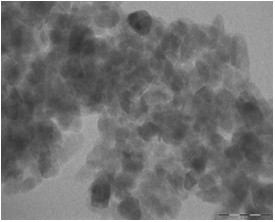
shows the electron diffraction patterns of the sample. It is clear from the figure that the SnO
2
particles are crystalline in nature. The electron diffraction patterns show continuous ring patterns without any additional diffraction spots and rings of secondary phases, revealing their crystalline structure. Seven fringe patterns corresponding to planes (1 1 0), (1 0 1), (2 0 0), (2 1 1), (2 2 0), (3 1 0), and (3 0 1) are consistent with the peaks observed in the XRD patterns. XRD and TEM studies confirmed pure tetragonal structure of SnO
2
as evidenced from Figures
1
and
4
, respectively. The ring-to-the-center distance of each ring is measured as 3.01, 4.23, 4.41, 5.61, 6.52, 7.10, and 7.71 and expressed in terms of nm
−1
. The reciprocal of these values gives the interplanar distance
d
. Details are given in Table
1
.
Figure 3
SAED pattern of the SnO2sample.
Figure 4
TEM image of the SnO2sample.
Table 1
dvalues obtained from XRD and TEM
Reportedd values (Å)
XRDd values (Å)
Electron diffraction (TEM)
Planes (hkl)
Reciprocal ofd valuesδhkl(nm−1)
d valuesdhkl(Å)
3.35
3.342
3.01
3.320
(1 1 0)
2.64
2.604
4.23
2.364
(1 0 1)
2.37
2.372
4.41
2.267
(2 0 0)
1.76
1.770
5.61
1.782
(2 1 1)
1.67
1.653
6.52
1.533
(2 2 0)
1.50
1.501
7.10
1.408
(3 1 0)
1.41
1.418
7.71
1.297
(3 0 1)
Optical properties by UV–vis DRS
To determine the optical bandgap of synthesized SnO
2
, the reflectance spectra of the SnO
2
thick film prepared by screen printing technique [
19
] on a glass substrate was measured. The reflectance (
R
) spectra of the SnO
2
thin film were shown in Figure
5
.
Figure 5
Reflectance spectra of the SnO2thin film.
As seen in Figure
5
, the reflectance spectra show a strong decrease after 360 nm. This decrease is related to optical transitions occurring in the optical bandgap. In order to determine the precise value of the optical bandgap of the SnO
2
, the reflectance values were converted to absorbance by application of the Kubelka-Munk function [
20
,
21
].
The Kubelka-Munk theory is generally used for the analysis of diffuse reflectance spectra obtained from weakly absorbing samples. The Kubelka-Munk formula is expressed by the following relation:
F(R)=(1−R)22R=KS,
where
F
(
R
) is the Kubelka-Munk function which corresponds to the absorbance,
R
is the reflectance,
K
is the absorption coefficient, and
S
is the scattering coefficient. It is well known that the optical transitions in semiconductor materials are taken place by direct and indirect transitions. The absorption coefficient
α
for direct transitions is expressed by the following relation [
22
]:
αhν=A(hν−Eg)n,
where
α
is the linear absorption coefficient of the material,
A
is an energy-independent constant, Eg is the optical bandgap, and
n
is a constant which determines the type of optical transitions: for indirect allowed transition,
n
= 2; for indirect forbidden transition,
m
= 3; for direct allowed transition,
n
= 1/2; and for direct forbidden transition,
m
= 3/2. The
F
(
R
) values of the SnO
2
film were obtained using the
(1−R)22R
relation in Equation 6 [
23
,
24
] and the Kubelka-Munk function
F
(
R
) is directly proportional to the absorbance. Therefore,
F
(
R
) values were converted to the linear absorption coefficient by means of the
α=F(R)t=Absorbancet
relation [
25
], where
t
is the thickness of the SnO
2
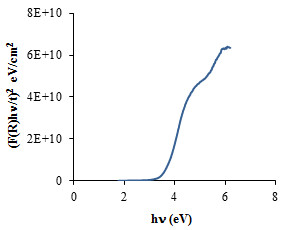
film. The curve of
F(R)hνt2
vs. hν for the SnO
2
film was plotted, as shown in Figure
6
. The optical bandgap (Eg) of the SnO
2
film was determined from the curve of
F(R)hνt2
vs. hν and was found to be 3.6 eV. The optical bandgap of the SnO
2
studied is similar to that of undoped SnO
2
materials obtained by various methods [
26
,
27
]. This suggests that the optical bandgap of SnO
2
semiconductors changes with respect to the synthesis method used.
Figure 6
Plot of (αhν)2vs. hν for the SnO2thin film.
Conclusions
SnO
2
nanoparticles have been successfully synthesized by a simple hydrothermal method at low temperature using hydrazine hydrate as a mediator. The structural, morphological, microstructural, and optical properties of a SnO
2
sample were investigated. XRD spectra indicated that the as-prepared product is polycrystalline in nature. It was also shown from these spectra that the crystallite structure was observed to be tetragonal. The surface morphology was investigated by FESEM. The crystallite size (22.4 nm) of the SnO
2
nanoparticles, estimated by XRD, is confirmed by TEM. The optical bandgap of the SnO
2
film was found to be 3.6 eV.
Authors’ information
GEP is an INSPIRE fellow at Materials Research Laboratory, KTHM College, Nashik, India. He received his B.Sc. and M.Sc. (Physics) degrees from North Maharashtra University, Jalgaon, in 2005 and 2007, respectively. He is currently pursuing a Ph.D. degree under the supervision of Dr. GHJ at the University of Pune, Pune. He is a life member of the Indian Science Congress Association. His research interests are in the areas of preparation of binary oxide thin film by spray pyrolysis and its gas sensing applications. DDK is an assistant professor at MVP’s Arts, Commerce and Science College, Nandgaon, India. He received his B.Sc. and M.Sc. (Chemistry) degrees from the University of Pune. He has 25 peer-reviewed research publications to his credit. He is a life member of the Indian Science Congress Association. His research interest is in the areas of perovskite materials for gas sensors, thin films, and nanosized material preparation. Dr. VBG received his M.Sc., M.Phil., and Ph.D. degrees from the University of Pune, Pune, in 1981, 1990, and 2001, respectively. He is currently a professor and the Head of the KTHM College, Nashik, and a member of the Management Council, University of Pune. His research interest is in the areas of environmental science, material science, and nanomaterials. He is a member of the Indian Association of Nuclear Chemists and Allied Scientists, BARC, Mumbai. Dr. GHJ is an associate professor and the Head of the Department of Physics at MVP’s KTHM College, Nashik, India. He received his M.Sc. (Physics) degree from the University of Pune, Pune, in 1989 and Ph.D. (Materials Science) degree from Pratap College, Amalner, North Maharashtra University, Jalgaon, in 2007. He has published 44 research articles in the Journal of International Repute. His areas of interest are perovskite for gas sensors, nanomaterials, and thick and thin films. He has delivered invited talks at MS&T 2008, USA; EUROMAT 2009, UK; ICST 2010, Italy; ICST 2011, New Zealand; and ICPAC-2012, Mauritius. He is a BOS member in Physics at the University of Pune, Pune.
Acknowledgements
The financial support for this work through the INSPIRE Fellowship for doctoral degree from DST, New Delhi, is gratefully acknowledged. The authors thank the Sophisticated Analytical Instrument Facility, Indian Institute of Technology (IIT), Bombay, for carrying out TEM characterization and C-MET, Pune, for providing the FESEM facility.
Competing interests
The authors declare that they have no competing interests.
Authors’ contributions
GEP synthesized the nanocrystalline SnO
2
materials, carried out the characterization, and drafted the manuscript. DDK participated in the discussions and interpretation of all characterization results. VBG and GHJ gave the final approval of the version to be published. All the authors read and approved the final manuscript.
Peng et al. (2000) Mesoporous Sn–TiO2 composite electrodes for lithium batteries
Aoki and Sasakura (1970) Tin oxide thin film transistors10.1143/JJAP.9.582
Paraguay-Delgado et al. (2005) Structural analysis and growing mechanisms for long SnO2 nanorods synthesized by spray pyrolysis10.1088/0957-4484/16/6/011
Cheng et al. (2004) Large-scale, solution-phase growth of single-crystalline SnO2 nanorods10.1021/ja0493244
Fujihara et al. (2004) Hydrothermal routes to prepare nanocrystalline mesoporous SnO2 having high thermal stability10.1021/la0493060
Duan et al. (2005) Single crystal SnO2 zigzag nanobelts10.1021/ja042748d
Liu et al. (2005) A highly sensitive and fast-responding SnO2 sensor fabricated by combustion chemical vapor deposition10.1021/cm050451o
Dai et al. (2002) Tin oxide nanowires, nanoribbons, and nanotubes10.1021/jp013214r
Hu et al. (2002) Large scale rapid oxidation synthesis of SnO2 nanoribbons10.1021/jp0125552
Pourfayaz et al. (2005) SnO2 sensor selective to ethanol in presence of CO, LPG and CH410.1016/j.snb.2004.12.107
Davar et al. (2010) Synthesis and characterization of SnO2 nanoparticles by thermal decomposition of new inorganic precursor 496(1–2) (pp. 638-643) 10.1016/j.jallcom.2010.02.152
Salavati-Niasari et al. (2011) Synthesis and characterization of SnO2 nanoparticles by thermal decomposition of new inorganic precursor10.1039/c0ce00343c
Gnanam and Rajendran (2010) Anionic, cationic and nonionic surfactants-assisted hydrothermal synthesis of tin oxide nanoparticles and their photoluminescence properties 5(2)
Zhu et al. (2006) Hydrothermal synthesis of Zn2SnO4 nanorods in the diameter regime of sub-5 nm and their properties10.1088/0957-4484/17/9/052
Cullity (1956) Boston
Jain et al. (2006) Surface modified BaTiO3 thick film resistors as H2S gas sensors10.1016/j.snb.2005.11.031
Escobedo Morales et al. (2007) Use of diffuse reflectance spectroscopy for optical characterization of un-supported nanostructures
Senthilkumar et al. (2010) Synthesis fluorine doped tin oxide nanoparticles by sol–gel technique and characterization 53(2) 10.1007/s10971-009-2094-z
Caglar et al. (2010) The effects of Al doping on the optical constants of ZnO thin films prepared by spray pyrolysis method
Caglar et al. (2009) Electrical conductivity and optical properties of ZnO nanostructured thin film10.1016/j.apsusc.2008.11.055